ESA Court Victory in Arizona

October 1, 2013

(Guest Post by Matthew Ladner)

The Arizona Court of Appeals rendered a unanimous ruling in favor of the Empowerment Scholarship Accounts program, which you can read here. In so doing, they completely rejected all of the arguments made by those seeking to destroy the program.

Congratulations to our crack legal-eagles at the Institute for Justice, Goldwater Institute and Arizona Attorney General’s Office. If you are not in the mood to read a long legal decision, here are some highlights drawn out by Jonathan Butcher. The Cain decision is the Arizona Supreme Court decision which found vouchers unconstitutional on the basis of our Blaine amendment. The Appeals Court however finds very big distinction between ESAs and vouchers:

The parents of a qualified student under the ESA must provide an education in reading, grammar, mathematics, social studies, and science. Whether that is done at a private secular or sectarian school is a matter of parental choice. The ESA students are pursuing a basic secondary education consistent with state standards; they are not pursuing a course of religious study.

The ESA does not result in an appropriation of public money to encourage the preference of one religion over another, or religion per se over no religion. Any aid to religious schools would be a result of the genuine and independent private choices of the parents. The parents are given numerous ways in which they can educate their children suited to the needs of each child with no preference given to religious or nonreligious schools or programs. Parents are required only to educate their children in the areas of reading, grammar, mathematics, social studies, and science.

Where ESA funds are spent depends solely upon how parents choose to educate their children. Eligible school children may choose to remain in public school, attend a religious school, or a nonreligious private school. They may also use the funds for educational therapies, tutoring services, online learning programs and other curricula, or even at a postsecondary institution.

The specified object of the ESA is the beneficiary families, not private or sectarian schools. Parents can use the funds deposited in the empowerment account to customize an education that meets their children’s unique educational needs.

Thus, beneficiaries have discretion as to how to spend the ESA funds without having to spend any of the aid at private or sectarian schools.

Thus, unlike in Cain II, in which every dollar of the voucher programs was earmarked for private schools, none of the ESA funds are preordained for a particular destination.

The supreme court has never interpreted the Aid Clause to mean that no public money can be spent at private or religious schools.

This program enhances the ability of parents of disabled children to choose how best to provide for their educations, whether in or out of private schools. No funds in the ESA are earmarked for private schools.

First, the ESA does not require a permanent or irrevocable forfeiture of the right to a free public education.

All the ESA requires is that students not simultaneously enroll in a public school while receiving ESA funds. This same restriction applies to any children who attend private school or are homeschooled.

Second, parents are not coerced in deciding whether or not to participate in the ESA…Parents are free to enroll their children in the public school or to participate in the ESA; the fact that they cannot do both at the same time does not amount to a waiver of their constitutional rights or coercion by the state.

Finally, the ESA does not limit the choices extended to families but expands the options to meet the individual needs of children.

BOOOOOOOOOM!!!!!

One of the three judges had previously found vouchers unconstitutional. Next stop- Arizona Supreme Court for what will be the only binding legal decision. So far, so good.


What I learned in P.E. class

July 26, 2013

(Guest post by Jonathan Butcher)

A few months ago, I grabbed my tennis shoes and went to my son’s last P.E. class of the year, which happened to be a “parent participation” day. This P.E. class is a program for homeschool students, so children of all ages and backgrounds were there to have relay races and play dodge ball.

I had the chance to run around that day with Jordan Visser, a young man I met about a year ago when his mom, Kathy, signed him up for one of Arizona’s education savings accounts. Regular readers of this blog will recognize his name and story from this post.

Jordan is a quiet kid, but he’s got a big smile and plays as hard as any of the other boys. From the video available on the link above, you will learn that Jordan has mild cerebral palsy and has a hard time with is balance—or at least, he did at one time. Since he’s been using the savings account, he’s seen specialists and used therapeutic horseback riding lessons to help his motor coordination, paid for with the education savings account. The account has also helped Jordan’s parents find individual tutors to help with subjects like math and reading.

Now, having run alongside him in a relay where we grabbed a sponge out of a bucket, squeezed it into a cup, then handed it off to the next person, let me be the first to say Jordan’s quality of life has dramatically improved. If you didn’t know Jordan’s story and were watching the PE class from the sidelines, you wouldn’t be able to tell the difference between Jordan and the other kids who were soaking wet and laughing.

Vouchers and tax credits have helped children like Jordan, along with students in failing schools and from low-income households, all over the country for more than 20 years. Education savings accounts use a student’s funds from the state formula to give families the same great educational choices as vouchers and scholarships—and more. The flexibility that parents have to meet their child’s unique needs with an account is unprecedented. Parents can buy online classes, pay private school tuition, buy textbooks, and save for college, to name just a few possible uses.

Lindsey Burke and I wrote a special report that was released today explaining the benefits of the accounts’ flexibility. We also propose ways in which vouchers and scholarships can be enhanced by education savings accounts:

  • Creating public school education savings accounts. Parents could use a public school education savings account for traditional school classes, public charter school offerings, public virtual schools such as the Florida Virtual School, community colleges, or state universities.
  • Shifting existing school voucher or scholarship tax credit funds to an education savings account. States with existing voucher programs or scholarship tax credit programs should allow parents to deposit voucher or scholarship funds into an education savings account in order to gain more flexibility with their child’s funds.
  • Expanding the approved expenses covered by a voucher or private school scholarship. This would include expanding the uses of a school voucher or scholarship, transitioning the program into an education savings account.

Jordan’s education savings account changed his life, and it didn’t take an increase in funding, school turnaround plan, or district consolidation. Let’s keep school choice out front and give all parents the flexibility to help their children, whatever their needs are.


North Carolina Lawmakers Chose Wisely to Pass School Choice

July 25, 2013

(Guest Post by Matthew Ladner)

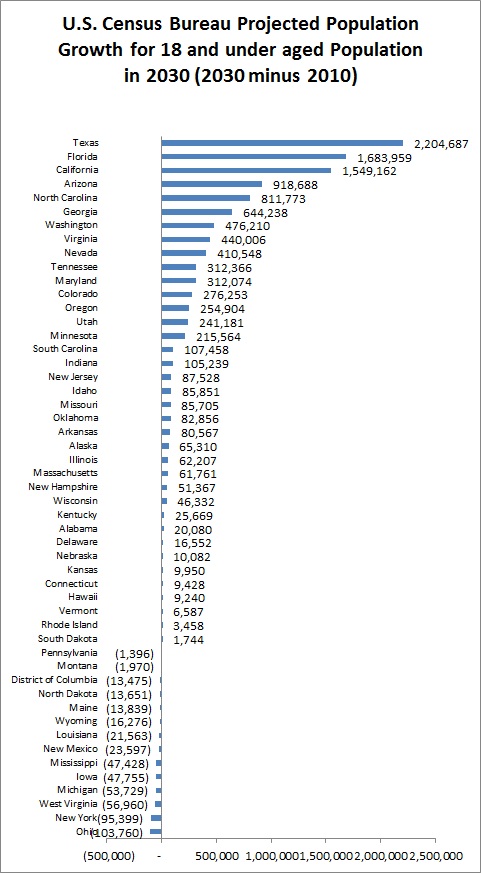
North Carolina legislators have passed measures to provide school choice options to low and some middle-income students and another measure for all special needs children. Data from the Census Bureau indicates that these were wise decisions and should in fact be followed by more improvements.

CensusThe Census Bureau projections show that the school age population of North Carolina is set to expand substantially over the next couple of decades, with an increase of over 800,000 people aged 18 or less by 2030. For a little perspective, this is a school aged population greater than the total K-12 enrollment of Alabama and a bit below that of Colorado. How and where will they be educated?

Mind you that the largest private school choice program in the nation, the Step Up for Students Tax Credit in Florida, will educate around 60,000 students this fall. Along with the McKay program for children with disabilities, private K-12 choice in Florida is poised to pass the 100,000 student threshold in a few years after a decade and a half of admirable and concerted effort.

North Carolina however has 800,000 new students on the way.  If these laws are going to help to make a dent in that figure, a concerted effort to refine and improve the laws will be needed. Formula funding would allow the programs to grow naturally along with the demand of parents and the supply of private schooling. Funding per pupil amounts must be generous enough to spur the supply of new private space.  Quite frankly few choice bills have been designed well enough to pull this off, North Carolina lawmakers should make certain that their laws will spur new private school supply.

If North Carolina choice advocates can achieve all of these things, they will set up an incremental process of expanding private school supply which is similar to the increase in charter school space in states with well designed laws. A state in North Carolina’s growth situation could easily accommodate a robust increase in charter and private schools and would still need to invest hundreds of millions of dollars annually in new district schools to accommodate student population growth.

North Carolina could also accommodate a greater number of students through their choice programs by broadening the use of their programs through an Education Savings Account model. This would allow parents to choose between a variety of education service providers including private schools, online programs, MOOCS, certified private tutors, community college and university courses to build a customized learning experience. By allowing parents to save some funds for future higher education expenses, it might be the only way to preserve a public funding mechanism for North Carolina colleges and universities in the face of nationwide pressures to decrease state funding.

State lawmakers can’t charge tuition to prisoners to keep the jails open, but undergraduates on the other hand…

North Carolina budgets, like all states, will continue to face severe strains from health care spending as we continue to fumble our policies and our population ages. A crush of new K-12 students will simply add to the burden, and the way we are approaching K-12 is serving far too many students very poorly at levels of spending which will prove unsustainable. We need to figure out ways to educate students better and more efficiently. A decentralized process allowing parents and students to figure out how to make best use of scarce funds represents the best way forward.

North Carolina lawmakers chose wisely in passing among the broadest school choice measures in the country.  Sincere congratulations are in order-North Carolina is now ahead of the pack. The hardest work however lies ahead.


Governor Brewer signs ESA expansion

June 21, 2013

(Guest Post by Matthew Ladner)

Arizona Governor Jan Brewer signed SB 1363 yesterday, incorporating significant improvements into Arizona’s Empowerment Scholarship Account program into law. The ESA program will increase the minimum funding amount for participating students and will make eligible kindergarten students able to participate without prior public school attendance. Program eligibility remains otherwise unchanged (special needs and beginning this fall students attending D/F rated schools or districts, foster care children and the children of active duty military parents.)

Arizona had an incredibly difficult legislative session in 2013 so we are incredibly grateful to Governor Brewer and our stalwart legislative champions who got this bill over goal line.  Governor Brewer continues to build an impressive K-12 legacy and I remain hopeful that we will be able to pinpoint her administration as a turning point for public school performance in future NAEP data. Democratic Senator Barbara McGuire deserves special praise for doing right by the kids by offering a motion to reconsider on the bill after it had failed by a single vote on the Senate floor on the last day of session.  This action required real moral courage and it is clear that Senator McGuire has the quality in spades.

The lobby team led by Sydney Hay of the American Federation for Children and Deb Gullett of A+ Arizona have earned spots in the School Choice Hall of Fame, and the program continues to benefit from the outstanding work of the Goldwater Institute locally and the Friedman Foundation and HCREO nationally. In addition, Goldwater and IJ have been doing a great job in defending the program in court. This victory was a team effort and there are many more people both inside and outside of government who have helped to bring the program along. I am proud and thankful for all of you.

An Arizona Department of Education official recently told me that participating parents literally weep in meeting in expressing the depth of their gratitude for this program. This is a far greater reward than any thanks that I can offer. The ESA team has created a growing experiment in freedom-thank you all and keep up the good work!

EDITED FOR TYPOS


Arizona Lawmakers Pass Bills to Expand ESA and Tax Credit Programs

June 14, 2013

(Guest Post by Matthew Ladner)

Arizona lawmakers ended an incredibly difficult legislative session last night by expanding school choice.  The Empowerment Scholarship Accounts program made kindergarten students otherwise eligible to participate (children with a disability, living in a D or F rated school or district boundary, foster care or the child of an active duty military) eligible to participate without prior public school attendance. The new law also shifts the funding for the program to the charter school formula, which will increase the minimum funding received and should make participation more feasible for students attending D and F schools and children with disabilities funded at the lower levels under the Arizona formula more feasible.  A separate tax credit bill expands the types of corporations allowed to participate in the corporate scholarship tax credit program. Both measures are on their way to Governor Jan Brewer’s desk.


The ESA took my College Debt Away

May 19, 2013

(Guest Post by Matthew Ladner)

Interesting read in Governing about universal college savings accounts for kindergarten students.

Now if they would simply send the K-12 budget into these accounts with a meaningfully higher amount going to poor and otherwise disadvantaged children I could leave this whole edu-nerd business and open my own Alamo Drafthouse in Jackson Hole Wyoming while producing compilation cds for Rhino Records on the side. Do you think the world is ready for Rancid to cover the greatest hits of Dean Martin yet?

I’m thinking martinis in the mosh pit.


ESAs in the NYT

March 28, 2013

(Guest Post by Matthew Ladner)

The New York Times has a story on the progress of the school choice movement. Money quote on Arizona’s Empowerment Scholarship Account program:

The Arizona Legislature last May expanded the eligibility criteria for education savings accounts, which are private bank accounts into which the state deposits public money for certain students to use for private school tuition, books, tutoring and other educational services.       

Open only to special-needs students at first, the program has been expanded to include children in failing schools, those whose parents are in active military duty and those who are being adopted. One in five public school students — roughly 220,000 children — will be eligible in the coming school year.       

Some parents of modest means are surprised to discover that the education savings accounts put private school within reach. When Nydia Salazar first dreamed of attending St. Mary’s Catholic High School in Phoenix, for example, her mother, Maria Salazar, a medical receptionist, figured there was no way she could afford it. The family had always struggled financially, and Nydia, 14, had always attended public school.       

But then Ms. Salazar, 37, a single mother who holds two side jobs to make ends meet, heard of a scholarship fund that would allow her to use public dollars to pay the tuition.       

She is now trying to coax other parents into signing up for similar scholarships. “When I tell them about private school, they say I’m crazy,” she said. “They think that’s only for rich people.”

BOOOOOOOOOOOOOOOOOOOOOOOOOOOM


Amid Talk of Gun Control, Don’t Forget School Reform

January 22, 2013

(Guest Post by William Mattox)

Amid all the talk about gun control and mental health reform, one important question begged by last month’s tragedy in Connecticut has gone unasked:  Is there anything we can do about the structure of education that might help lower the risk of another school massacre?  I believe there is – and a poignant story (and some very interesting research data) will help explain why.

Two of my children once attended a small private school in a town where we had just moved.  Early in the fall semester, another new kid at that school – a boy with Asperger’s Syndrome who would now be 19 or 20 years old – had several emotional “meltdowns” as he sought to adjust to his new routine.  This unsettling behavior caused some school officials, and a number of concerned parents, to wonder if our school was equipped to handle the challenges presented by this student (whom I’ll call “Bradley”).

Bradley’s teachers rallied to his cause.  They appreciated his keen intellect.  And they were reluctant to give up on him – partly because Bradley had had a rough childhood.  (His condition had been misdiagnosed for years, causing household stress that contributed to his parents’ divorce).  But there was an even greater reason for the teachers’ reluctance: Since this was a Christian school, the teachers felt they had a special responsibility to “go the extra mile” with social outcasts like Bradley.  Even if this was, at times, difficult.

So, Bradley remained a part of our school.  And the teachers who’d had experience working with Asperger’s students helped those who’d had none.  And they all sought to teach their students some important “life lessons” about dealing with people who are different from you.

Apparently, some of these lessons got through.  One day, I chaperoned a dance at the school.  When it came time for the first number, I saw one of the most popular teen girls in the school maneuver into a position where she could be the first girl Bradley asked to dance.  This girl didn’t have a romantic interest in Bradley.  But she did have a heart of compassion – and a maturity beyond her years.  And she recognized that no girl would be apt to dance with Bradley unless someone like her saw past his social awkwardness and validated his worth.  As a human being.  As a child made in the image of God.

After the dance, Bradley got into his mother’s van and made a peculiar announcement.  “Today, I placed my hand on the hip of four different girls,” he said.  These odd words brought tears to his mother’s eyes, for she understood them to mean that her socially-awkward son’s yearning for human connection, for some measure of normal acceptance, had been met in a most meaningful way that day.

Now, I don’t want to insinuate that an episode like this could have only occurred at a Christian school – or that it would have happened at every faith-based private school.  But when I consider how their Christian faith affected the way these teachers and students treated Bradley, I can’t help but affirm the Florida policymakers who created the McKay scholarship program that made it possible for Bradley to attend a private school of his family’s choosing.  Especially since a recent research study suggests that Bradley’s experience at that school was not that unusual.

According to a Manhattan Institute study, 47 percent of McKay scholarship recipients had been picked on often at their local public school – and 25 percent had been victimized physically. At their new schools, chosen for them by their parents, only 5 percent of these special needs students experienced frequent harassment and only 6 percent were physically mistreated.

In view of all this, I think every state ought to adopt programs like Florida’s McKay scholarships (or Arizona’s Educational Savings Accounts) which give families of special needs students the freedom to choose learning options for their children beyond those available at their local public school.  For many Asperger’s children (and other students with special needs) yearn for human connection and social acceptance – and delight when others affirm their worth in the eyes of God.

William Mattox is a resident fellow at the James Madison Institute and a Florida Voices columnist.  His four children have all attended public high schools.


Forbes on Education Savings Accounts

October 12, 2012

(Guest Post by Matthew Ladner)

Forbes magazine on the ESA update to the voucher concept. I like the iPhone analogy as the first generation of phones were only designed to do one thing, whereas a modern smart phone expands capabilities and options considerably. Likewise, our first generation of choice programs were essentially designed to allow children to transfer into a pre-existing stock of non-profit schools, whereas Education Savings Accounts open many more options.

Meet the new and improved brick!

Take a look- but before any of you conspiracy theorists get started, please note that the financial services fees from similar accounts such as college savings accounts and HSAs went below 1% years ago and have continued to fall. If only the “management fee” for public education were heading in the same direction…


Hot Off the Press — New Report on ESAs

September 27, 2012

Our very own Matt Ladner has a new report out with the Friedman Foundation on Education Savings Accounts (ESAs).  Here’s the summary:

Education savings accounts are the way of the future. Under such accounts—managed by parents with state supervision to ensure accountability—parents can use their children’s education funding to choose among public and private schools, online education programs, certified private tutors, community colleges, and even universities. Education savings accounts bring Milton Friedman’s original school voucher idea into the 21st century.

Arizona lawmakers were the first to create such a program, called Empowerment Scholarship Accounts (ESAs). Through that program, the state of Arizona deposits 90 percent of the funds for a participating child into an account, which can cover multiple educational services through use-restricted debit cards. Parents can choose to use all of their funds on a single method—like private school tuition—or they can employ a customized strategy using multiple methods (e.g., online programs and community college classes). Critically, parents can save some of the money for future higher education expenses through a 529 college savings program. That feature creates an incentive for parents to judge all K-12 service providers not only on quality but also on cost.

A fully realized system of ESAs would create powerful incentives for innovation in schooling practices seeking better outcomes for lower costs. Also, the broader use of funds may help to immunize choice programs against court challenges in some states. Policymakers must fashion their system of accounts to provide reasonable state oversight, fraud prevention, academic transparency, and equity.

If Milton Friedman were alive today, he likely would agree that education savings accounts represent a critical refinement of his school voucher concept. Existing voucher programs create healthy competition between public and private schools, but ESAs can create a much deeper level of systemic improvement. ESAs would allow parents to build a customized education to match the individual needs of every child, thus transforming education for the better.