More Administration Talk/Walk Disconnect

July 22, 2009


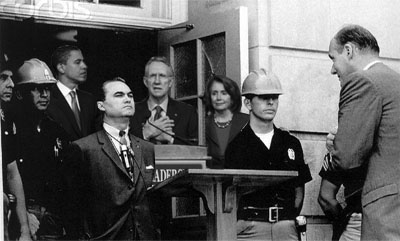
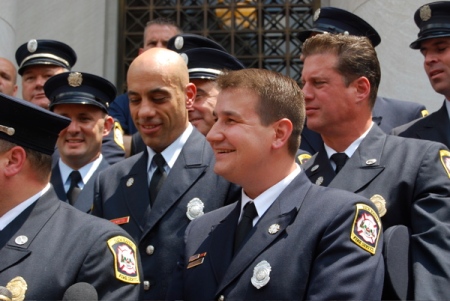
Ricci firefighters

They won their case, but it changes nothing – the administration is now imposing racial quotas that will keep their kids out of AP.

(Guest post by Greg Forster)

In today’s post, the disparity between talking the reform talk and walking the reform walk once again “rises to the top.”

Mike Petrilli has again put on his Pollyanna dress and bought into Hope And Change, praising Obama’s NAACP speech in shockingly hyperbolic terms – “It was transcendent. It was inspirational. It was honest, direct, bold, and, I hope, important, maybe a turning point.”

Look, as has always been the case, Obama says a lot of the right things, and that does matter. But come on, Mike, let’s maintain a grip on reality. Of the descriptors you offer, only “direct” seems plausible. Ask the DC voucher kids how “honest” Obama is being when he poses as a reformer. I’m not sure how you can call him “bold” while simultaneously joining the choruses that endlessly sing his praises everywhere I turn – what would he say if he were a coward? (FWIW, McCain has the exact same issue – he’s a “straight talker” who never tells the public anything it doesn’t love to hear. But that doesn’t excuse Obama.) And while Obama’s choice to talk like a reformer is important, if nothing new emerged in this speech – and it didn’t, unless I’m missing something – then this speech adds nothing “important” to the previously established fact that Obama talks like a reformer. (HT Adam Schaeffer, who got to this party before me.)

As for “maybe a turning point” – only in terms of the channel on my radio.

You know whom you should listen to, Mike? There’s this really great blogger on Flypaper who just did an eye-opening post on the Obama administration’s little-noticed threat to bring race discrimination lawsuits against school districts if they don’t have enough “students of color” in advanced courses. Once the threat has been made, of course, the lawsuit never need be brought – school districts across the country have now recieved the message and will quietly adopt racial quotas to avoid attracting the attention of the people playing with matches near the gas tanks at the DOE’s civil rights office. The threat is the quota.

How does that square with the president’s telling the NAACP that black students shouldn’t use social disadvantages as excuses for slacking in school? What will that do to a couple decades’ worth of work you and Checker and so many others have put into promoting rigorous academic standards against all the charlatanry of the radical left?

If I were you, Mike, I’d start following that blogger’s work on a regular basis. A guy who digs up that kind of shocking story when nobody else found it, and has the guts to broadcast it even if it might get him in trouble with the administration – well, in my book, that’s a guy who’s going places.


What Is Competition?

June 5, 2009

Monopoly - Pennybags

He’s done such a good job with your schools,
now he’s going to run your health care!

(Guest post by Greg Forster)

Mike Petrilli notes that Barack Obama and Paul Krugman are using the language of “competition” to mask Obama’s ambitions for a government takeover of the health care sector.

Krugman writes:

The “public option,” if it materializes, will be just that – an option Americans can choose. And the reason for providing this option was clearly laid out in Mr. Obama’s letter: It will give Americans “a better range of choices, make the health care market more competitive, and keep the insurance companies honest.

Mike responds:

You mean just like creating charter schools will give Americans “a better range of choices, make the education system more competitive, and keep the teachers unions honest”?

So in education, where the government is the major player, we’re trying to create competition via the private sector. But in health care, where the private sector is still a major player, we’re trying to create competition via the public sector?

Weird.

Mike, “weird” is not the word you’re looking for. Try “wrong.”

In health insurance, as in education, there’s no “market” deserving the name. But the way the government eliminates the market is slightly different. In education, government destroys the market by providing the service for “free” (of course you pay for it in your taxes, but it’s free at the point of service), making it impossible for anyone to compete; other providers are stuck serving niche markets. Whereas in health care government uses the tax code to force almost everyone to get insurance through their employers, which also eliminates the market, but more sneakily.

It’s as though government told you that from now on, your employer gets to pick one restaurant for you, and from now on you’re only allowed to eat out at that restaurant. They’d say that it’s a free market – because, hey, the restaurants are privately owned and there are multiple options available!

So it’s not surprising if the health sector and the education sector seem similar. Both are government-controlled command economies. The difference is, in the health sector you have these huge privately owned companies acting as rent-seekers, siphoning off tons of money and getting away with it because government has abolished the market forces that ordinarily weed out leeches – as Matt once explained to our Sith apprentice Leo. Whereas in the education sector, the rent-seeker siphoning off tons of money is the government itself.

The Obama/Krugman proposal isn’t about creating competition for private health insurers. That’s a smokescreen. It’s simply the first step toward making the command economy in the health sector more like the command economy in the education sector.


The Daily Show on Arizona State University

May 18, 2009

(Guest Post by Matthew Ladner)

So Arizona State asked Barack Obama to deliver the commencement speech, but decided not to offer him an honorary doctorate, opining that his body of work was yet to come, and thus apparently did not merit such an honor.

The Daily Show picked up on this, and well, judge the clip for yourself. I’ve been critical of ASU for a lousy graduation rate and offering staggeringly unseemly bribes overly generous National Merit Scholarships in an effort to create the appearance of academic quality. Get the Daily Show mad at you, however, and they will drop the “Harvard of Date Rape” cluster-bomb on your village without a second thought.

It’s almost enough to make me feel sorry for ASU (once I got my breath back and dried my eyes) but when you lead with your chin, you can’t credibly complain when someone breaks your jaw. When you accept 92% of applicants and have a 28% 4-year graduation rate, it just might indicate that you are using a large number of ill-prepared students as financial cannon-fodder.

Yes, yes-it’s their choice, everyone gets an opportunity, yadda yadda yadda.  That’s all fine until you finance these six-year-beer-soaked-odysseys-of-self-discovery-resulting-in-a-graduation-about-half-the-time-vacations-from-reality with money forcibly extracted from other people. Many of the third party payers never went to college and are struggling to make ends meet.   What choice did they get?

(edited for typos)


Clive Crook on American Education and the Democrats

May 11, 2009

6837-004-ED31B9D4

 (Guest Post by Matthew Ladner)

Clive Crook doesn’t think that the alliance between education reactionaries and Democrats is going to last. I don’t either. Crook writes in the Financial Times of London:

The keys – and here comes the political challenge – are accountability and competition. However you do it, through school vouchers if you want to be radical, or the faster expansion of self-governing charter schools if you do not, the crucial thing is to give parents alternatives to failing schools. This means firing the worst teachers and shutting the worst schools. Teachers’ unions have a death grip on the system and are having none of it. In many parts of the country, sacking a teacher, however incompetent, is next to impossible. Will Mr Obama dare to face down this powerful Democratic party constituency?

There are two reasons to hope he might. One is that he understands the issue and cares about it. Plainly he feels passionately about inequality. Improving the working poor’s economic opportunities is essential, and if schools cannot be fixed, that is not going to happen.

Another reason for guarded optimism is that the politics of education is more complicated and less predictable than you might think. The Democratic party, despite the clout of the teachers’ unions, is split. Many urban activists and community organisers – the milieu from which Mr Obama sprang – are strongly in favour of greater school choice, which one might have supposed to be a Republican rallying-cry. The pressure for reform is coming from the left as well as the right.

At a meeting in Washington to launch the McKinsey report, Al Sharpton, a black community leader and all-round stirrer of controversy, was on the platform alongside more orthodox education reformers and administration officials. He called school reform the civil-rights challenge of our time. The enemy of opportunity for blacks in the US was once Jim Crow, he said; today, in a slap at the educational establishment, it was “Professor James Crow”. He is right, and the country must hope the president agrees.


Does President Obama care more about black criminals than black schoolchildren?

May 7, 2009

Jason Riley asks the question in the Wall Street Journal

His answer: 

“Unfortunately, the Obama administration seems more interested in the sentencing gap than the learning gap. The president pays lip-service to the need to open pathways to educational achievement, but he and Education Secretary Arne Duncan have been actively working to shut down Washington, D.C.’s Opportunity Scholarship Program, which provides low-income children with $7,500 per year to use toward tuition at a private school. Mr. Obama can’t claim that the program isn’t working. The latest evaluation by his own Education Department showed scholarship recipients — 99% of whom are black or Hispanic — outperforming their public-school peers in reading. That finding takes on even more significance when you consider that black 12th-graders in this country average lower reading scores than white 8th-graders.

Yesterday, the administration announced that it will support allowing current students to remain in the program but will oppose letting any new kids join them. The illogic is exquisite. If the president believes that school vouchers are effective enough to grandfather existing participants, the scholarship program deserves to be expanded, not shuttered.”


The Wall Street Journal Strikes Again

May 5, 2009

The Wall Street Journal has another strong editorial today condemning Barack Obama and Arne Duncan’s hypocrisy in seeking to end the D.C. voucher program.  Here’s a highlight:

“See if you can follow this political syllogism. President Obama and his Education Secretary have repeatedly promised to support “what works,” regardless of ideology. The teachers unions adamantly oppose school vouchers, whether or not they work. Ergo, Messrs. Obama and Duncan decide to end a D.C. school voucher program that works and force poor kids back into schools where Messrs. Obama and Duncan would never send their own children. What a disgrace.”

There’s a rally of voucher families planned for this week and there will be congressional hearings on reauthorizing the program next week.  Stay tuned.


Democratic Control of Schools

April 26, 2009

Yesterday the New York Times profiled a school district in which the democratically elected school board is dominated by a group that places its financial interests ahead of the educational interests of children in the district.  And that group easily wins school board elections because they are well-organized, have cohesive interests, and turn-out to vote in much higher numbers than parents of children in the schools.

No, the NYT hasn’t suddenly decided to publicize the money-grabbing, electoral bullying of teacher unions in large numbers of school districts all around the country.  Instead the NYT is concerned about the money-grabbing, electoral bullying of a community of Orthodox Jews in Rockland County, NY.

Well, the NYT didn’t exactly describe the Orthodox Jews as money-grabbing: “Many of the Orthodox here and elsewhere feel crushed by the weight of high school taxes and private school tuition.”

The problem, as the NYT piece suggests, is the sense that schools ought be controlled by the families that send their children to those schools: “But increasingly, others are chafing at the idea that people who don’t send their children to the public schools are making the decisions for those from very different cultures who do.”

I have to say that I am sympathetic to this concern.  There are problems with control over schools being located outside of the families whose children attend those schools.  But, unlike the NYT, I don’t restrict my concern to instances involving Orthodox Jews. 

It concerns me that President Obama, who has never sent his children to public schools, and Arne Duncan, who intentionally avoided placing his children in DC public schools, are making decisions to compel children to return to D.C. public schools. 

It concerns me that teacher unions dominate school board elections all over the country, placing their financial interests ahead of the educational interests of children.  In many urban school districts disproportionate numbers of teacher union members also don’t send their own children to the public schools.

The obvious solution is to increase control over schools by the families that attend them by giving those families vouchers.  Empowered with vouchers, schools will be responsive to the interests of current and prospective students rather than the interests of people whose children do not attend those schools is order to attract and retain the revenue those vouchers bring.

Of course, the general regulatory framework governing schools could still be under democratic control, including non-parents.  But let’s restrict the general public’s involvement in controlling schools  to the broad regulatory issues that affect the public’s interests as opposed to the operational details of individual schools.


USDoE Yanks Opportunity From DC Children

April 11, 2009

democrats-block-school-choice

(Guest Post by Matthew Ladner

Rotherham’s cynical take looks a little more on target this morning, while my own optimism looks a bit more naive. This morning the Washington Post ran an editorial blasting the United States Department of education for their latest attack on the DC Opportunity Scholarship program.

EDUCATION SECRETARY Arne Duncan has decided not to admit any new students to the D.C. voucher program, which allows low-income children to attend private schools. The abrupt decision — made a week after 200 families had been told that their children were being awarded scholarships for the coming fall — comes despite a new study showing some initial good results for students in the program and before the Senate has had a chance to hold promised hearings. For all the talk about putting children first, it’s clear that the special interests that have long opposed vouchers are getting their way.

Secretary Duncan seems to be taking this action simply to create, as the WaPo describes, a presumption of death about the program in advance of next year’s reauthorization effort. The decision, as the WaPo describes, is extremely disruptive to lives of many families:

It’s a choice President Obama made when he enrolled his two children in the elite Sidwell Friends School. It’s a choice Mr. Duncan had when, after looking at the D.C. schools, he ended up buying a house in Arlington, where good schools are assumed. And it’s a choice taken away this week from LaTasha Bennett, a single mother who had planned to start her daughter in the same private school that her son attends and where he is excelling. Her desperation is heartbreaking as she talks about her daughter not getting the same opportunities her son has and of the hardship of having to shuttle between two schools.

Sadly for LaTasha Bennett and her children the above photo is increasingly becoming less of a pointed joke and more of a reality.  How can anyone feel anything other than dismay to watch the nation’s first African American President, himself a product of private education, enroll his own daughters in an elite private institution and then rip that same opportunity away from people like LaTasha Bennett?

This action is in stark contrast with everything for which the left allegedly stands. As George Orwell once wrote: Four legs good, two legs better! The Washington Post makes it clear why the administration is behaving so disgracefully:

It’s clear, though, from how the destruction of the program is being orchestrated, that issues such as parents’ needs, student performance and program effectiveness don’t matter next to the political demands of teachers’ unions. Congressional Democrats who receive ample campaign contributions from the National Education Association and the American Federation of Teachers laid the trap with budget language that placed the program on the block. And now comes Mr. Duncan with the sword.

Duncan and Obama should both be ashamed of themselves.


Obama’s Courage, and “Courage,” on GM

April 1, 2009

obama

(Guest post by Greg Forster)

On Monday, Jay praised the president’s “courage” because the media were reporting that the administration was talking about bankruptcy for GM. I posted a comment to the effect that the media reports cited unnamed sources, and nobody should be praised for “courage” until somebody stood up and said “bankruptcy” in front of TV cameras.

Right after that, what does the president do but get up and say “bankruptcy” in front of TV cameras?

So, credit where it’s due. It was a bold move.

But there are two kinds of courage: the courage of the man who is resolved to do a hard thing because it’s right, and the courage of the man who is resolved to do a hard thing because it’s necessary to save his own skin.

We’ve yet to see which kind of courage this is. In today’s Journal, the indispensable Holman Jenkins makes the case that the president is bluffing because he needs to create the impression that he’s serious about bankruptcy.

Whatever else we may say about the president, he knows one thing the Clintons don’t: even if the only thing you care about is your own survival, you still have to take risks periodically. If you always do the “safe” thing, you’ll end up less safe.


Symbols Matter

March 11, 2009

wingdings

(Guest post by Greg Forster)

Jay points out that the president’s speech on education yesterday doesn’t resemble his legislative agenda. But it’s worse than that. There are things Obama could do to promose these good reform ideas even without legislation or budget changes, but won’t.

He calls on states to lift their charter caps. But what does he plan to do about charter caps? Even without extending federal authority over the states on charter policy, there’s plenty he could do, as Jay Matthews points out:

Will the Obama Education Department prepare and publicize a list of all the charter school cap laws in the country? Will Duncan call the governors, and legislators and school boards responsible for them and ask them to remove those restrictions on new charters, and find a way to get rid of bad charters?

Is the pope Muslim?

So on pretty much all fronts, the president’s “plan” for education is just symbolism.

But you know what? Symbols matter! The president is using his position in the spotlight to endorse choice and competition (as he did during the campaign) and rewards for performance, the two indispensable principles of sound educational reform. Even if he’s only doing it because Democratic constituencies other than the education unions expect it, it matters that the president has chosen to align himself with those constituencies rather than the unions. He could easily have taken the old line and kowtowed to the unions. But he didn’t, and that counts for something. So let’s give the president his due.

Now if only he had stopped his pals in Congress (who look an awful lot like his bosses these days) from kowtowing to the unions on vouchers.