Image: Tim Keller of the Institute for Justice, right, wields his legal fiddle to defend school choice.
(Guest Post by Jason Bedrick)
Great news from the Peach State, where a superior court judge dismissed a constitutional challenge to Georgia’s scholarship tax credit (STC) law. The Institute for Justice intervened to defend the law on behalf of five tax-credit scholarship recipients. Currently, more than 13,000 Georgia students receive tax-credit scholarships to attend the schools of their choice.
School choice opponents alleged that the STC violated the state constitution’s historically anti-Catholic Blaine Amendment, which prohibits the state from publicly funding religious schools, among other provisions. However, citing precedent from the U.S. Supreme Court and several state supreme courts, Judge Kimberly M. Esmond Adams held that tax-credit eligible donations constitute private funds, not public expenditures:
Courts that have already considered whether a tax credit is an expenditure of public revenue have answered this question in the negative. Of particular importance is Arizona Christian Sch. Tuition Org. v. Winn, 131 S. Ct. 1436 (2011), where the United States Supreme Court found that taxpayers lacked standing to challenge a scholarship tax credit program under the Establishment Clause of the United States Constitution that was almost identical to the Program at issue here. Like Georgia’s Program, the Arizona program provided that taxpayers could receive a credit for donations made to independent scholarship organizations which then provided scholarships for students to attend private schools. […] Plaintiffs have not presented any arguments for why this Court should not follow this persuasive authority.
The fact that tax-credit eligible donations are private funds is the primary reason that STC laws have a perfect track record in the state courts thus far. It’s also why tax credits are the most liberty-friendly means of financing educational choice, as the late, greatAndrew J. Coulson never tired of reminding us (much to Greg’s chagrin). In response to the U.S. Supreme Court’s similar ruling five years ago, Andrew wrote:
The rationale underlying the Court’s ruling highlights a unique advantage that tax credits have over other ways of funding education: they expand both freedom of choice for parents and freedom of conscience for taxpayers.
Plaintiffs had argued that cutting a person’s taxes is equivalent to spending government money, and so taxpayers were being compelled to support religion when credits were used for donations to religious [scholarship organizations]. The Court said, “that is incorrect.”
Unlike the funding of public schools, which is compulsory for all taxpayers, participation in [a] tax credit program is voluntary. If an individual chooses not to donate to [a scholarship organization], his taxes are collected just as they have always been, and those dollars cannot be used for any sectarian purpose. Furthermore, if a taxpayer does choose to make a donation, he is free to select the STO most consistent with his own values. […]
There are other ways of funding universal choice in education, but only tax credits (either for parent’s own education expenses or for donations to [scholarship organizations]) respect the freedom of conscience of taxpayers as well as the freedom of choice of parents. If we truly wish our schools to help build strong, harmonious communities, there is no better way than to adopt such programs at the state level on a grand scale.
The opponents of educational choice are likely to appeal the judge’s decision. Let us hope their appeal meets the same fate as all of its predecessors.
I first remember meeting Andrew and his wife, Kay, at a conference in Toronto in 2000. I have to admit that he felt out of place. Here was this guy without any university, think tank, or other affiliation and without any formal training presenting on the history of markets in education. And people did not typically attend these meetings with spouses. Who was this guy?
As it turns out, this guy was a brilliant autodidact who “retired” after being an early programmer with Microsoft to devote his time to studying and advocating education reform. And he was really good at it.
The thing that struck me most about Andrew was his incredible optimism and quirky sense of humor. Liberty-oriented education activists tend to be on the losing side of policy battles. It can be downright discouraging. But Andrew never seemed discouraged or became bitter. It was a long game and he maintained a sunny optimism that freedom worked better and people would eventually gravitate towards what worked.
He didn’t mind standing apart from the crowd. Just because donors, policymakers, and other scholars were drawn to test-based accountability didn’t make Andrew feel like he had to join them. He even expressed serious reservations about certain methods of expanding school choice, including charters and vouchers, that he thought would invite excessive government regulation. I confess that I paid little attention to Andrew’s warnings back then but I wish I had. The experience and wisdom he obtained from studying history made him more sensitive to these dangers than my narrow practice of social science. The autodidact had quite a lot to teach highly trained people like me. As it turned out, choice reforms less prone to excessive regulation, like tax credit funded scholarships and ESAs, are now spreading rapidly — just as Andrew had expected and advised.
His humor often seemed to involve plays on words. For example I once posted to Facebook a photo of what I (incorrectly) captioned as a “Golden Lion Tamarind.” He made some sort of joke about how the dish was prepared. Some people of faith find small typos and errors in language interesting because they think they can be unintentionally prophetic. I don’t know if that was Andrew’s motivation but the thought of me secretly wishing to eat a small monkey is pretty funny.
I will miss that quirky humor, but more importantly I will miss his wise counsel and good cheer. It’s a long game that must go on but something will be missing without Andrew as part of it.
Choice Remarks carries my article on the government school monopoly and religious hatred:
For decades, we’ve heard opponents of school choice claim that the government school monopoly is our only protection against “jihad schools” that will teach children to hate and kill. In all that time, you know what we haven’t seen? Jihad schools, operating in any of the nation’s 59 private school choice programs across 28 states. In fact, the government school monopoly doesn’t protect us from religious division, and it can’t do so.
Partly we’re talking about good old fashioned bigotry that doesn’t want to believe highly religious minorities can support democracy and pluralism. But there’s more to the story.
We demand that highly secularized institutions should have a monopoly on education because we think such institutions are “neutral” with regard to religion. This fails for two reasons.
First, it incentivizes schools to marginalize and alienate religious minorities in order to legitimize the secular monopoly on education. Religious minorities must be seen as dangerous, or the interests of the monopoly will be threatened.
Second, highly secularized institutions are inherently less effective at inculcating the values and practices essential to democracy and pluralism:
This is because a secular institution can tell you to be good (be tolerant, respect diversity, etc.) but it can’t tell you why. It can’t connect the rules of right behavior to deep sources of meaning, purpose, and identity. It ends up just spewing a lot of sentimental gas, and then wagging its finger at you if that doesn’t work, and then punishing you. Or it offers utilitarian, mercenary reasons to be good. None of that helps students form either a deep attachment to moral rules or the self-discipline to carry them out.
Citing low enrollment and bogus “research” that excludes the mountain of random-assignment studies, one anti-choice group says Mississippi’s education savings account program for students with special needs is a “failure.”
Of the more than 50,000 children with special needs in Mississippi public schools, 251 were qualified and approved to receive vouchers. Of those, only 107 appear to have used them, .0018 of one percent of Mississippi’s children with special needs.
The research claim clearly doesn’t hold water (unsurprisingly, the only gold standard study they cite is the recent one from Louisiana) but what about the low enrollment? Is this a program that parents don’t really want? Or perhaps there just aren’t enough private school seats for parents?
First, it’s pretty rich that a group that opposes educational choice cites low enrollment as a reason it is “failing.” If enrollment was high, do you think they would see that as a sign of success?
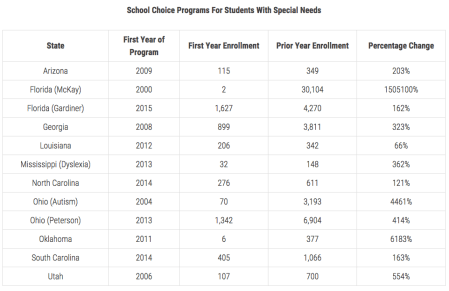
Second, the ESA program is still in its first year. As Empower Mississippi demonstrates in this helpful chart, programs that start small can grow significantly over time:
As Empower Mississippi notes, detractors were probably quick to declare Florida’s McKay scholarships a “failure” when only two students used them in the first year, but after experiencing 1,505,100% growth in the next decade and a half, I doubt anyone is making that case anymore.
That said, detractors might be right that there aren’t enough private school seats right now. However, one of the purposes of educational choice is to expand the market. Greater demand should spark greater supply, if the price is right. Unfortunately, that’s a big “if.” The Magnolia State’s ESAs are currently funded at only $6,500 per year. Funding is tied to the state’s base student cost rather than the cost for students with special needs, as Arizona does.
If Mississippi lawmakers want to see greater supply in private school seats for students with special needs — and empower parents to use the ESAs to tailor their child’s education using tutors, online courses, educational therapy, etc. — then they should make sure that the ESAs are adequately funded.
[UPDATE: Grant Callen of Empower Mississippi wrote to let me know that I got one very important detail wrong: the image I used originally was of a Japanese Magnolia, not the North American Magnolia that is Mississippi’s state flower. I stand corrected!]
And it is also important to identify states that have weakened public education—by seeking to privatize their schools or turn them into profit-making ventures, as well as states that have aggressively instituted a regime of high stakes testing that unfairly sorts, ranks and demoralizes students, educators and schools.
Unlike other organizations such as The American Legislative Exchange Council (ALEC) and Michelle Rhee’s StudentsFirst, whose report cards rank states in relation to their willingness to privatize public education and weaken the status of the teaching profession, we take another path. We give low marks to states that devalue public education, attack teachers and place high stakes outcomes on standardized tests.
But…..there seems to be no consideration of outcomes going on in Little Ramona‘s report card. She pulled together some University of Arizona College of Education folks and they gave states a grade on various policies like “No High Stakes Testing” and “Resistance to Privatization” and others. “Chance for Success” is my personal favorite: why gather someone’s opinions about the chance for success rather than measure er actual success? In the Report Card on American Education that I have coauthored/authored for the American Education Exchange Council, we rank states according to the overall NAEP scores and NAEP gains for low-income general education students. We think this is a reasonable approach given the large differences between average family incomes etc. between states. Some disagree (and we claim only that the comparison is reasonable rather than perfect) but at least we are looking at student outcomes, which don’t even constitute an afterthought in Ravitch’s Report Card.
Anyway, my home state of Arizona received an overall grade of “F.” Quelle horreur!
Strangely enough though, if we conjure up the NAEP data and examine academic progress by state for the period in which all 50 states participated (2003 to 2015) this is what you learn about Arizona: in 4th grade math Arizona had the 9th largest state gains, in 8th grade math the 3rd largest. In 4th grade reading Arizona students had the 17th largest gain and in 8th grade reading the 2nd largest state gain.
Ah well Arizona’s demographics became more favorable during this period. Nope-economy got drop kicked and the student population moved to majority minority status. Yeah but spending went way up. Er, no, it actually wentdown after the Great Recession. But maybe the scores would have gone up even more without all of these terrible policies! Mmm hmmm….and maybe there is a breeding population of aquatic dinosaurs in Loch Ness as well. What do you mean no credible evidence? Maybe they eat their dead so dino bodies don’t wash up on shore. I mean it could be something stranger still going on.
Seems legit…
A few years ago I successfully campaigned to receive the first (and as far as I know still only!) Lifetime Bunkum Award from Reactionaries-R-Us. In that same spirit, I can’t wait to see what happens with Arizona’s gains once we earn our way to the first Ravitch F-minus!
UPDATE: I recalled the the University of Arizona College of Education played a large role in the creation of a charter school in Tucson called the Wildcat School. The Arizona Daily Star reported “When it opened, it was lauded as the first charter school to have an affiliation with a state university. Its goal was to provide an academically rigorous math- and science-focused education for low-income students.”
The school closed in 2013 after receiving two “D” grades in a row and facing the prospect of a third, which would have qualified the school for state intervention. The Board President, a professor at the U of A College of Education Professor explained “We just know we weren’t making the achievement test scores that we needed to make. I’m not sure I have an explanation for that,” he said. “We just faced the reality that we needed to act in a way that was best for the families and students in our school.”
Kudos to the board for pulling the plug on something that wasn’t working for kids. If I were a cynic I might note that they made a rational decision after getting themselves in over their heads, facing the prospect of an increasingly embarrassing situation. Thus under this uncharitable view they made the right call to pull the band-aid off rather than have things get progressively worse. You might very well think that, but I of course could never be so cynical. Ever. Ravitch hires University of Arizona ed school profs to grade state K-12 policies, they give Arizona and F. Meanwhile Arizona comes near first in overall NAEP gains. Professors from the same department essentially create their own charter school and it folds. Meanwhile Arizona’s charter schools rock the 2015 NAEP like a New England state.
I’m pretty sure I do have an explanation for that and it’s fairly straightforward- no aquatic dinos eating dead aquatic dino explanations necessary.
All students learn differently and should have the opportunity to attend a school that has the best environment for each student to be successful. This can be accomplished through
Education Savings Accounts, while still protecting school finances.
Senator Clark Jolley and Representative Jason Nelson have legislation on this issue. Send it to me and let’s give students and parents a better chance for educational success than they have today.
I do recognize these are some of the hardest things I’ve ever asked for your help to accomplish as governor. But they’re also some of the most important. We were sent here to lead, and we need to lead now more than ever. We have smart, capable people in this room and throughout state government. We can do this.
Now for people like me who support Arizona developing a set of standards unique to Arizona and replacing the current CC standards and possibly test so long as they are as good or better, the presence of Oklahoma on that last chart is a problem. For anti-CC crusaders, it’s an even a larger problem, unless of course you are just shameless is your support for tests that a chimp could sometimes pass blindfolded. Yes Tex I am looking at you. A constructive vote of no-confidence remains a respectable path to leaving CC in the rear view mirror, so I hope Oklahoma will pull it off in plenty of time for the 2017 NAEP.
Our pal Mike P. may be feeling a bit squeamish about ESAs, but rapper/actor LUDACRIS is ALL IN BABY! From the Atlanta Journal Constitution:
“Regardless to social status, all children should be able to access a great school,” said Ludacris. “Education savings accounts empower all children to be able to access a great education.”
First, as Matt noted, this is not Mike’s first foray into Hemisphere Fallacy territory. (Or the second. Or even the third.) Like the guy who thinks anyone who is more religious is crazy and anyone who is less religious is a heretic, Mike thinks he has found the Perfect Goldilocksian Mean and everyone else is wrong. In Mike’s view, those who support more regulation than he does are paternalist Nannies, and those who support less regulation are utopian Purists, but the temperature of his regulatory porridge is just right.
Second, as I noted on Twitter, it’s adorable that Mike thinks he’s not a Nanny. He decries their “micromanagement” but he supports forcing private schools to administer the state test (de factodetermining what is taught when and even how), as well as price controls that economists will tell you leads to shortages and obliterates the essential price signal (without which we may have competition, but we most certainly do not have a functioning market). He may fancy himself a “Realist” but, if these categories really mean anything, he just has minor disagreements with his fellow Nannies.
I think X is a problem. I believe Solution Y solves X. Group A opposes Solution Y, therefore Group A must not think X is really a problem.
Of course, this is a fallacy because it is entirely possible (as is the case here) that Group A agrees that X is a problem but doesn’t think Solution Y actually solves it. Mike thinks his preferred regulations solve the problem of bad schools, but we think those regulations are more likely to have adverse effects. More on that in a moment.
Mike accuses the “Purists” (those who, like Milton Friedman, conclude based on the evidence from nearly every other industry that markets spur innovation and lead to greater quality and efficiency) of being utopian. He writes:
Start with the Purists. I’m skeptical of all utopian visions, including theirs—one imagining that a full-fledged system of choice (perhaps through universal Education Savings Accounts) will yield greater innovation, productivity, and customer satisfaction—and produce better-educated young people to boot.
But there’s nothing utopian about that. We see that ESAs have already begun to produce greater innovation, productivity, and customer satisfaction. We don’t yet have any data on test scores or graduation rates, but we have no reason to believe that ESAs will underperform the many voucher programs that have produced positive results. No one in the free-market crowd is expecting miracles. We’re expecting the sort of incremental improvement that the market regularly brings about through the process of experimentation, evaluation, and evolution.
(For that matter, the most utopian schemes in education come from the Nannies. Can you imagine a more fantastically utopian scheme than “No Child Left Behind”? Is there a more utopian slogan than that anywhere in education policy? And did anyone in the administration really believe we’d ever achieve 100% proficiency in any state, let alone every state? Either they set up the nation to fail or they were delusional. Or perhaps they just set up the DOE for a naked power grab. But I digress.)
Mike’s central challenge to the Friedmanite crowd is the Payday Lender Problem. What do we do about bad private schools?
First of all, Mike doesn’t have a whole lot of evidence that the government does a better job ensuring quality than the market. Indeed, the Louisiana debacle should give him great pause about that article of faith.
Second, eliminating the least-bad option doesn’t guarantee a better option. Payday lending serves an important function in the market (in the Third World, we call it “microlending,” a concept for which Muhammad Yunus won a Nobel Peace Prize). Poor people who need funds to cover rent or buy food while waiting for payday often turn to payday lenders. If they repay the loan on time, the fees are generally marginal. If they repay late, the interest rates can be exorbitant, especially if (misleadingly) expressed in annual terms. (The interest is so high both because the loans are so small and because the rate of default is so high, which is why banks generally just refuse to lend to the poor.) But eliminating the payday lenders can have serious unintended consequences that make the poor even worse off. The payday lender may charge a steep fee for late payment, but at least Rocky Balboa doesn’t come break your legs.
Kicking a school with poor test scores out of a voucher program doesn’t guarantee those poor kids a seat at a better school. Rather, the state just eliminates that kid’s least-bad alternative. Even in Louisiana, where the voucher schools appear to be doing much worse on the state test than the district school alternatives, the families who chose those schools may well have had good reasons for doing so. Perhaps they were safer. Perhaps they had higher graduation rates. We don’t know. But those families chose them for a reason and they may well be worse off overall if deprived of that choice.
Third, as Michael McShane explained previously, the market process has proven time and again to significantly improve absolute quality (and efficiency) over time:
Cars today are uniformly better than cars in 1950. They are safer. They are faster. They are more comfortable. They are more fuel efficient. But it wasn’t a clear upward-sloping line to get here. People bought Edsel’s in the 50’s, Corvairs in the 60’s, Chevettes in the 70’s, Yugo’s in the 80’s, Suzuki Sidekicks in the 90’s, and Pontiac Aztecs in the 00’s. These were bad cars.
But “bad” has two meanings in this case, an objective one and a relative one. There are relatively bad cars out there today. That is, my hail-damaged ’05 Kia Spectra with no cruise control and a blown-out right front speaker is worse than Jay-Z’s Maybach on almost every calculable measure, relatively speaking. But my Spectra, which is still purring like a kitten after over 100,000 miles with darn near nothing more than oil changes, tires, and brake pads is a helluva lot better than the burn-out-after-five-years cars that automakers made for decades. That’s absolute quality.
Markets work when the spectrum of relative quality drives improvements in absolute quality. Someone sees my little tin can driving down the road and says “I want to buy a car that doesn’t look like it’s going to blow away in a stiff breeze” and cars get less tin-canny. Someone buys a Ford Excursion and then gas prices go up and says, “I’m never doing that again” and cars get more fuel efficient. It’s a slow winnowing process, but over time it is superior to centralized systems, that, for example, made the Trabant in an essentially unchanged manner for over three decades.
Rather than thinking we can regulate bad schools out of existence, a better goal is to develop a system that continuously improves what we think a “bad” school is.
Mike Petrilli is right to be worried about kids who are in bad schools today, but the regulations he proposes to ensure that those students are attending relatively good schools interfere with the market process that could otherwise be driving up absolute quality for everyone (and, as Louisiana has shown, those kids may end up in low-performing schools anyway).
Imagine if government officials, following Mike’s logic, had decided decades ago that every low-income family should have access to a phone. Now, these Realist officials aren’t Nannies — they’re not going to have the government make the phones or micromanage the specs. They’re just going to ensure that everyone has access to a good phone, so they create a phone voucher but prohibit companies selling phones from charging more than the value of the voucher. What would have happened?
Well, there’s the seen and the unseen. We would have seen, perhaps, that everyone would have had access to a phone and many would have applauded that (although given the price controls, it’s likely that supply would not have met demand). But what we wouldn’t have seen was that the iPhone had not been invented. With no way to charge more than the meager voucher, there’d be no market for expensive smartphones. And that wouldn’t just have harmed the wealthy, it would also have harmed the poor. After all, Walmart now sells a $10 smartphone that has better specs that the original iPhone. Innovations that at first benefit the wealthier early adopters tend to benefit even the poor after a while.
In short, Mike’s admirable passion to help the poor immediately through state action may well harm them in the medium-to-long run without any guarantee of actually helping them in the short run. That doesn’t sound very Realist to me.
No drink, drank or drunk…no pointing….and you have to take a shot with each triangulation hemisphere fallacy!
(Guest Post by Matthew Ladner)
Mike Petrilli created a taxonomy of school choice factions which is kind of fun. I agree with a good deal of it, especially the part about the interesting conversations now being between choice supporters rather than between choice supporters and opponents. Some of Mike’s take however strongly evokes Greg’s classic series of Hemisphere Fallacy posts: Faction one claims that the earth is a sphere, faction two insists that the earth is flat, so the real answer is obviously that the world is actually a hemisphere! Somewhere along the way these posts turned into a drinking game.
So in the taxonomy, Mike identifies JPGB as an oasis for “Purists,” identifies a more nebulous group of “Nannies” and then others as “Realists.” Mike identifies himself in the “Realist” camp.
Triangulation nudges one to exaggeration in order to create middle space to inhabit. Mike describes Purists as holding charter schools with suspicion, but a quick search through the JPGB archives will reveal dozens of reviews of charter school research, celeNAEPtion posts etc. for every “get off my lawn kid and take that Recovery School District with you!” post. Mike also describes ESA supporters as “utopian.” Someone put a link in the comments if you have seen otherwise, but I think the consistent theme in the ESA discussion has been their virtues vis a vis older models. I’ve made a consistent effort to describe our unfolding ESA experiment as a learning experience. I see an entirely reasonable path for real benefits, but I have never promised anyone a Workers Paradise or the New Jerusalem.
Or **ahem** “No Child Left Behind.”
I see questions over regulation within a system of parental choice to be an entirely appropriate topic for discussion and debate. It’s worth noting that from the very outset of the parental choice movement Milton Friedman called both for standardized testing and a certain degree of regulation. So in my mind thinking about this as a spectrum would make sense, but if I made a taxonomy it would look like:
Separation of School and State Extremists
Jeffersonian Freedom Fighting Sons of the Great Milton Friedman
Nanny State Busy Bodies
After careful consideration I place myself in the Jeffersonian Freedom Fighting Sons of the Great Milton Friedman…what?!? I did WHAT?!? Oh fine…



 Posted by Jason Bedrick







 Jay P. Greene's Blog