Who’s Responsible for the Technocratic Takeover of Ed Reform?

May 26, 2016

Robert Pondiscio has written a very important piece about the current state of the education reform movement.  He correctly notes that the previously diverse coalition leading ed reform is breaking down and he accuses the Left of taking over.  I’d modify his argument only slightly to note that the real divide in ed reform is not between Right and Left, but between Technocrats and those favoring more decentralized reforms. The danger is not just that Social Justice Warriors have seized control of ed reform, but that they are perfectly content to advocate no end of faux-scientific management and top-down regulation to impose their preferences.

Robert is not completely original in noting this hostile takeover.  I’ve been decrying the rise of the Petty Little Dictator Disorder for quite some time.  And Rick Hess warned last year about the wheels coming off of the old ed reform coalition.  However, the fact that the ever-conciliatory Fordham Foundation is declaring the Ed Reform Civil War seems to make it official.

In this post I’d like to talk a little about how we got to this point.  I blame the big ed reform foundations for facilitating this Technocratic/Social Justice Warrior takeover. An entire industry of ed reform activists has been created by foundation dollars.  They populate a host of organizations with a variety of banal names; few of which would exist if foundations didn’t pay their salaries.

So, we now have a giant industry of foundation-paid reformers staffed mostly by young, enthusiastic, and bright-but-lacking-in-wisdom, idealists.  It should come as no surprise that the profile of those who staff the ed reform industry tilts heavily toward the profile of Social Justice Warriors.  Their high education levels, lack of wisdom, and boundless self-confidence inclines them strongly toward Technocracy.

In addition, once you’ve assembled a large ed reform industry, what are all of these people supposed to do?  They aren’t likely to have a meeting at which they decide that parents and local communities are probably better situated than they are to devise solutions appropriate to the circumstances.  If they turned power over to families and communities, most of them would have to quit their jobs and close up shop.

Instead, they have meeting after meeting at which they sit around and dream about how other people should live their lives.  They develop plans, systems, and metrics, to guide, nudge, or force others to do the “right things,” typically from DC or other distant locations  And they have no doubts about what those right things are nor do they lack confidence in their ability to measure those good outcomes or to devise plans and systems for ensuring them.

I really wished that it would not come to this.  But I watched the New School Venture Fund Conference as Robert did and came to a similar conclusion.  Their hostility to the common values that held the diverse ed reform coalition together was manifest.  Their contempt for all non-believers was insufferable.  The way in which they swarm and bully dissenters on social media demonstrates anti-intellectualism and intolerance.

The good news is that this Technocratic Cult mostly doesn’t matter.  Education policy is mostly made by state and local governments paying virtually no attention to what foundation-funded organizations say or do.  It’s quite striking how national advocacy organizations promoting a Technocratic approach to school choice typically have no ability to anticipate where new choice proposals are going to make headway and usually play little or no role in shaping them.  Statewide school choice programs have been passed in Nevada and Arizona with only the Friedman Foundation and the Foundation for Education Excellence playing significant roles among national organizations. Students First actually tried to block Nevada’s universal choice ESA with the same lack of effectiveness that is typical of the national Technocrats.

The only thing lost by the Technocratic takeover of national ed reform efforts is the enormous amount of money being wasted.  But if the donors want to set giant piles of money on fire, they are free to do so.  I just hope they enjoy the warm glow because they aren’t getting much else good out of it.

(Correction — I incorrectly wrote Step Up for Students when I meant Students First.  My apologies.  Also, I changed Rob to Robert.  I keep forgetting which he prefers.)


Education Is Political

May 25, 2016

AM1ONHSI

(Guest post by Greg Forster)

This post on education philanthropy by Megan Tompkins-Stange could give us a lot to discuss, but the most alarming point for me is the total failure of the technocratic people to accept the legitimacy of the political. Of anything political. Of course education is deeply political, since it is (among other things) training for life in the polis. There really is no separating the question “what is a good education?” from “what is a good social order?”; they are distinct but interdependent questions.

But not for some:

For example, when asked about the foundation’s work on the Common Core, Bill Gates told a Washington Post reporter, “These are not political things,” he said. “These are where people are trying to apply expertise to say, ‘Is this a way of making education better?'”

Note he’s not saying that his education philanthropy is not political, which might be taken to mean that it doesn’t arise from a partisan preference – which is probably true. What he’s saying is that education itself is not political.

And of course, as we have known since Plato, the failure to recognize the political nature of political questions is only a way of concealing the tyrannical exercise of power over politics. The tyrannical nature of the action is disguised by defining it as “not political.”

Think I’m exaggerating? Tompkins-Stange draws our attention to this:

In a much-circulated piece in the Wall Street Journal last fall, founding Facebook president Sean Parker described “hacker philanthropy” as “a desire to ‘hack’ complex problems using elegant technological and social solutions, and an almost religious belief in the power of data to aid in solving those problems.” As an example, Parker proposed funding private militias to conduct peacekeeping operations rather than government armies.

She notes that “in response, Princeton historian Stanley Katz wrote: ‘I teach public policy, and I’d be very concerned about a graduate student who told me that he felt confident that private militias should replace government military forces in troubled parts of the world. Wouldn’t you?'”


Case Dismissed: Victory for School Choice in Florida

May 24, 2016

case-dismissed

(Guest Post by Jason Bedrick)

The legal attacks on school choice programs are dropping like characters in a George R.R. Martin novel. Last week, a Nevada judge dismissed a case against the state’s education savings account program. Today, a Florida judge dismissed a case against several of the state’s school choice programs.

The Florida lawsuit originally concerned whether the state was adequately funding public education, but in 2014 the plaintiffs amended their suit to challenge a wide range of policies, including state accountability statutes, charter schools, tax-credit scholarships, and the McKay Scholarship Program for Students with Disabilities. Last year, a judge ruled that the plaintiffs did not have standing to challenge the private school choice programs, but this ruling also rejects their substantive claims that the choice programs somehow harm the traditional district school system:

[T]he Court finds no negative effect on the uniformity or efficiency of the State system of public schools due to these choice programs, and indeed, evidence was presented that these school-choice programs are reasonably likely to improve the quality and efficiency of the entire system. […]

Plaintiffs’ specific allegations regarding the constitutional implications of three of Florida’s choice programs- charter schools, the FTC Program, and the McKay Program- are similarly unsupported by the weight of the evidence. […]

The Court has already held that Plaintiffs lack standing to challenge the FTC Program, and the Court further concludes that the weight of the evidence does not support their speculative allegations that the FTC Program diverts state funding or has any material, detrimental effect on Florida’s system of public schools.

The weight of the evidence similarly does not support Plaintiffs’ allegations about the McKay Program, which is limited to “Students with Disabilities” and requires eligible students to have an individual educational or accommodation plan under federal law. […] As indicated by the Florida Supreme Court, parental decisions to send individual children with special needs to private school do not implicate the uniformity of the broader public school system- regardless of whether some of those parents accept scholarship funds from the State.

BOOOOOOOOOOOOOOOOOOM!!!!!!!

tumblr_m6uv60m4ur1rqpx0x

This decision constitutes one more legal stake in the heart of the canard that educational choice programs harm students attending traditional district schools. As Jon East pointed out at RedefinED yesterday, judges presiding over a separate anti-choice lawsuit in Florida cast a gimlet eye on similar claims during oral arguments last week:

[Florida Education Association] attorney Lynn Hearn: “The loss of $300 million at a minimum to the Florida public school system … is absolutely a fact.”

Presiding Judge Lori S. Rowe: “In your complaint, you haven’t actually alleged that there is a $300 million loss to the Florida education budget, have you?… In fact, the $300 million you’re referring to are the funds that flow into the scholarship program, correct?”

Attorney Hearn: “Well, that’s where the number arrives from, your honor. But we absolutely do allege that that amount has left the public schools in favor of the scholarship program. That’s because of the way the Florida schools are funded. They are funded on a per-student basis. So, during that year, 2013-14, there were 60,000 students who left the Florida public school system.”

Judge Ross L. Bilbrey: “But doesn’t that mean there are 60,000 fewer students that the state has to pay to educate?”

Attorney Hearn: “It does your honor. But the funding of students in our public schools is, uh, we’re not funding widgets, the funding formula for students is not a perfect correlation to the variable cost of funding that student.”

Judge Rowe: “But exactly what is the special injury you are articulating here? You haven’t alleged that any individual student is suffering. You haven’t alleged that per-student funding has been reduced. You haven’t even alleged that the education budget has been reduced.”

Essentially, the union wants to argue the district school system has some special claim on students–and therefore the public funds attached to those students–without openly making that claim. After all, the district school system can’t suffer a “loss” unless they somehow owned those funds to begin with, but parents have no such obligation to enroll their children at their zoned district school, or any district school for that matter. They feel entitled to those children and the corresponding funding, but they know they can’t make that claim explicitly because, well, it’s ludicrous. That’s why the union is having such a hard time articulating any special injury–and why they’re likely to lose that lawsuit as well.

For more information on today’s decision, see Travis Pillow’s write up at RedefinED.

*****

UPDATE: Supplementing his opinion, the judge issued a 179-page Appendix for Findings of Fact which, among many other things, explains that Florida’s tax-credit scholarship program relies on private (not public) funding and explains that the plaintiffs failed to demonstrate any injury resulting from the program:

The Florida Tax Credit Scholarship Program (the ―FTC Program‖) allows Florida taxpayers to apply for tax credits ―to make private, voluntary contributions‖ to fund scholarships for children attending eligible K–12 private schools.767 Plaintiffs allege that the FTC Program violates the uniformity and efficiency requirements of Article IX, Section 1(a) by diverting public funds to private schools that are not subject to the same requirements as schools within the State‘s system of free public schools.

The Court has previously found that the FTC Program, which allows third parties to obtain tax credits for making private donations, does not involve public funds, legislative appropriations, or the State‘s ―provision‖ for a ―system of free public schools‖ under Article IX. Because the private donations that fund the FTC Program are not legislative appropriations, the Court has previously determined that Plaintiffs lack taxpayer standing to assert a challenge to this program under Florida law.

Plaintiffs have also failed to prove any special injury that would allow them to challenge the FTC Program. […]

[A]ny connection between the FTC Program and appropriations to support Florida‘s system of free public schools—not to mention the overall quality of that system—is purely speculative. There was no persuasive evidence presented that the FTC Program has any direct or indirect impact on public-school funding or on the uniformity, efficiency, safety, security, or quality of Florida‘s public schools. […]

Even if tax credits resulted in a decrease in the number of students attending the public schools, local school districts are not responsible for educating students who attend private schools.

The appendix is also is chock-full of citations of some dude named Jay Greene. Here’s a taste:

3rd Grade Retention Policy

Florida‘s third-grade retention policy also is supported by academic research. Dr. Jay Greene, a professor of education and head of the Department of Education Reform at the University of Arkansas, has extensively studied the effect of Florida‘s policy. Dr. Greene‘s studies, which are published in a peer-reviewed journal, concluded that Florida‘s test-based retention policy significantly improves the academic achievement of students who are retained.239 Plaintiffs did not present any evidence countering Dr. Greene‘s findings.

Resources & Results

Plaintiffs allege that the overall level of funding in Florida is not sufficient to provide a uniform, efficient, safe, secure and high quality system of public education.784 Plaintiffs assert that the performance outcomes for certain groups of students indicate that school funding is insufficient.

Plaintiffs, however, have not met their burden of proving a causal relationship between the level of resources available to schools in Florida and student outcomes. Indeed, as described below, the weight of the evidence presented on that issue establishes a lack of any causal relationship between additional financial resources and improved student outcomes. […]

In addition to Dr. Hanushek, Defendants presented findings of Dr. Jay Greene, a professor of education and head of the Department of Education Reform at the University of Arkansas. Dr. Greene statistically analyzed school district-level variables throughout the state of Florida, including per-pupil spending, teacher characteristics, and discipline rates, and found no relationship between these variables and student outcomes.

Specifically, Dr. Greene examined school district per-pupil expenditures and percentages of students proficient on the Florida Comprehensive Assessment Test (―FCAT‖)797 for grades 3 through 10 in reading and math; grades 5, 8, and 11 in science; as well as highschool graduation rates, for school years 2007–08 to 2012–13. The analysis revealed no connection between higher amounts of funding available in school districts and better student performance.

Dr. Greene also conducted regression analyses of spending and performance data, controlling for student demographic differences and prior levels of achievement across school districts. The demographic characteristics that were controlled included the proportion of minority students, proportion of students receiving free or reduced price lunch, the proportion of students classified as English language learners (―ELL‖), and the proportion of students with a disability who had an individual educational plan (―IEP‖), as well as academic outcomes in the prior year. The purpose of these analyses was to examine whether school districts would have better student outcomes if they had more resources, assuming school districts had the same demographic composition and prior year‘s academic outcomes. Dr. Greene‘s regression analyses revealed that there is no pattern between the level of spending in Florida school districts and student performance on the FCAT or high school graduation rates.

Teacher Experience

In addition, Dr. Greene evaluated the assertion by Plaintiffs that teacher qualifications and experience characteristics impact student performance, and that districts with high-minority and low-income student populations have a lower percentage of qualified, experienced teachers. Consistent with his other findings, Dr. Greene found no statistical relationship between the proportion of novice (first-year teachers) or ―highly qualified teachers, as defined by the Florida Department of Education, and student performance on the FCAT or high school graduation rates. Likewise, Dr. Greene found no statistical relationship between the percentage of minority and low-income students in a district and the proportion of novice or highly qualified teachers.

Suspension Rates

Dr. Greene also addressed Plaintiffs‘ assertion that high suspension rates are attributable to a lack of school district resources and lead to lower student performance outcomes. As above, Dr. Greene conducted regression analyses that controlled for student demographic characteristics and prior student outcomes. Dr. Greene found no relationship between the rate at which students are given out-of-school suspensions in Florida school districts and FCAT reading, math, or science proficiency, or graduation rates.

Court’s Conclusion re: the Evidence

The Court accepts Dr. Greene‘s conclusions and finds that they corroborate other evidence in the case showing the lack of causal relationship between the level of resources available in Florida schools and student outcomes, as well as evidence showing that the level of resources available is sufficient for a high quality system.

Although Plaintiffs bear the burden of proof in this case, neither Plaintiffs‘ expert witnesses nor their school-district witnesses presented analyses or studies rebutting the work of Drs. Hanushek and Greene. In fact, the weight of the evidence shows that despite budget cutbacks associated with the Great Recession, student performance continued to improve in the period 2007–08 to 2014–15.


Florida Mom Smacks Down Choice Deniers

May 24, 2016

momma-brown-bear-protecting-her-cubs

(Guest Post by Jason Bedrick)

Last week, the president and education chair of the Florida State League of Women Voters (LWV) — which is a party to the Florida teacher union’s lawsuit against the state’s tax-credit scholarship programargued that some parents are just not well-informed enough to choose a school for their own kids:

Choosing small, private, mostly religious schools is most likely a poor choice, but how can [parents] know?

What assurance do parents have that their children’s needs are being met? Not much. Teachers in private schools do not have the same certification requirements. Schools do not have to use the state curriculum or administer state tests. Private schools are not graded as public schools are.

Parents are told they can vote with their feet if they are dissatisfied. Some do, but many may have little idea that their children do not receive the same educational opportunities. Small private schools have cachet but may well lack quality.

The LWV apparatchiks provide zero evidence that private schools are “likely a poor choice.” Indeed, the best evidence shows that, on average, parental choice in education improves students outcomes.

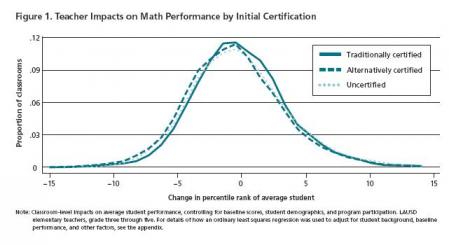
Sure, private school teachers don’t need to be certified, but as this handy chart from the Brookings Institution demonstrates (see page 8), such certification is a guarantee of absolutely nothing:

gordon-1-7398851

Traditionally certified teachers are no more or less effective, on average, than alternatively certified or even uncertified teachers.

Likewise, they present no evidence that the state curriculum is superior to other curricula. And private schools may not administer the state test, but they do administer other nationally norm-referenced tests that give parents information about how their children are performing compared to students nationwide. Funny that the LWV apparatchiks would omit that fact.

Lacking any evidence that parents aren’t choosing wisely, the LWV argument amounts to “trust us, we know what’s good for your kids better than you do,” and at least one mother is sick of it:

I’m tired of people who think they know better than I do, especially when it comes to my children’s education. Like the League of Women Voters.

The League joined the teacher’s union to file a lawsuit to end the Florida Tax Credit scholarship, which allows low-income and working-class parents like myself to send their children to private schools. Three of my daughters are among the 78,000 who use them.

The mother, Cheryl Joseph, is one of 15 parents of scholarship students who intervened in the McCall v. Scott lawsuit to defend the scholarship program, and she’s not taking any guff from the people who claim to speak for women voters but want to deny them access to more educational choices for their children:

Two leaders of the League said in the Tallahassee Democrat that the scholarship cannot support high quality education, and choosing private, mostly religious, schools is most likely a poor choice. They actually wrote that scholarship parents “have little idea that their children do not receive the same educational opportunities.”

Believe me, we know.

We know many people have school choice. Some have enough money to move into neighborhoods where the public schools are excellent. Others choose to send their kids to private schools. Many of us can’t afford to move, but thanks to the scholarships, we have choices.

The mother describes how her children’s zoned district school wasn’t rigorous enough for them, but she couldn’t send them to another school through the district’s choice program because it was full. Fortunately, they got scholarships to attend a private school that they “absolutely love,” where students regularly graduate and enroll in college, including Ivy League schools. She also appreciates that the school has separate-gender classes (for which there is actual evidence that it improves performance), the teachers communicate regularly with the parents, and the principal “shakes every student’s hand every morning and knows each by name.”

The school works for her kids, so why does the LWV want to take that option away? She concludes:

I’m tired of people with many choices trying to block the rest of us from having any. It reminds me of the civil rights battles over 50 years ago. Who is blocking the schoolhouse doors now?

Maybe if the League talked to more “struggling” parents, they’d learn from them. My job is helping public housing residents become self-sufficient, so I talk to working-class parents all day.

Many want their children in different schools for various reasons, but too often, they’re stuck with limited choices.

The scholarship gives them options, gives them the opportunity to have more choices for their children – just like parents with more money.

Anybody who believes otherwise really needs to think twice.

bear11


The Unknown History of the Mother of All K-12 Competitive Effects

May 24, 2016

(Guest Post by Matthew Ladner)

How did this happen?

NAEP Math Cohort gain 2015

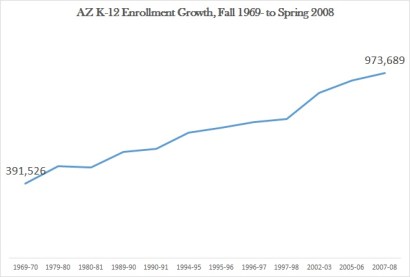
As per usual, there is no one single simple answer, but the elephant sitting in Arizona’s K-12 room over the last decade has been abrupt and bracing change in a decades long trend of district enrollment growth and funding increases.  Arizona has experienced more than a century of population growth as the rest of you figured out that it was possible not to dig your car out from the snow, and even to play golf in February in Arizona. Arizona K-12 enrollment boomed for decades, with almost all of it going to the districts. In 1995 the first charter schools opened, but at first they were like little mammals scurrying around fearfully in the Age of Dinosaurs.


AZ enrollment growth

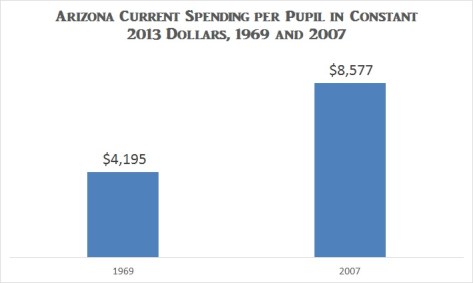
During the booming age of plenty, the districts were not only getting ever more students, but the spending per pupil steadily increased. Arizona has never been a wealthy state and has long had a relatively small working age population due to the presence of beaucoup retirees and children (relatively large LDS families, immigrants etc.) so this increase was even faster in most states, but was still very large in Arizona:

AZ spending


So in this sort of lost, antebellum Arizona of pre-2007, the school district folks would complain about more of these charter schools popping up, but really they were just whining- spending per pupil had been going up, and they had more pupils than they knew what to do with. Mind you the NAEP of 1992 showed that only 28% of Arizona Anglo students could read proficiently in “English” so a reasonable person could conclude that the districts and their swelling enrollment and growing funding could use a little competition.

As fate would have it, they got competition with both barrels after 2007. In fact, I will have to nominate Arizona as having gone through the mother of all competitive effects.

The Great Recession hit Arizona early and hard. Arizona’s general fund dropped 20% in a single year. When your main industry is building houses on golf courses and all of the sudden everyone nationwide has a difficult time selling their house, your economy takes a beating something like:

Great Recession SMASH AZ economy! Great Recession is the STRONGEST ONE THERE IS!!!!!

I…..wish…..I……could…………spend..more……on……..schools!

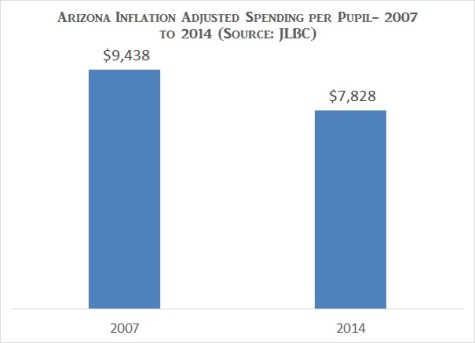
So the federal stimulus and a temporary sales tax increase engineered by former Governor Jan Brewer temporarily staved off cuts, but they were eventually necessary and they were not insignificant:

AZ spending

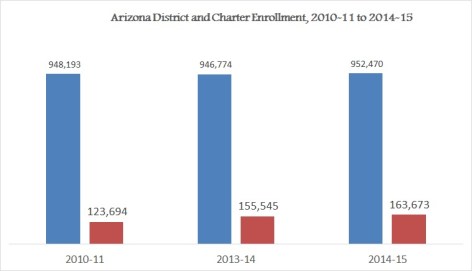
At the same time per pupil spending declined, enrollment growth came to a screeching halt in the districts, in part because of the continued growth of charter schools:

AZ enrollment

Now mind you that the absolute size of district enrollment was quite modest, but the normal experience for Arizona schools had been non-stop growth for decades.  That growth not only stops and reverses a bit, but state assistance per pupil declines as well. Thus at exactly the same time you might want to make up per pupil funding losses with more pupils, you suddenly stop getting as many pupils.

Now as I have written about before, the Newtonian model of K-12 mechanics would have concluded that Arizona’s NAEP scores would have declined under the weight of this pressure. (In fact, Mike Petrilli still owes LGK and I beers on that front….hmmmm….interest accruing daily btw.)

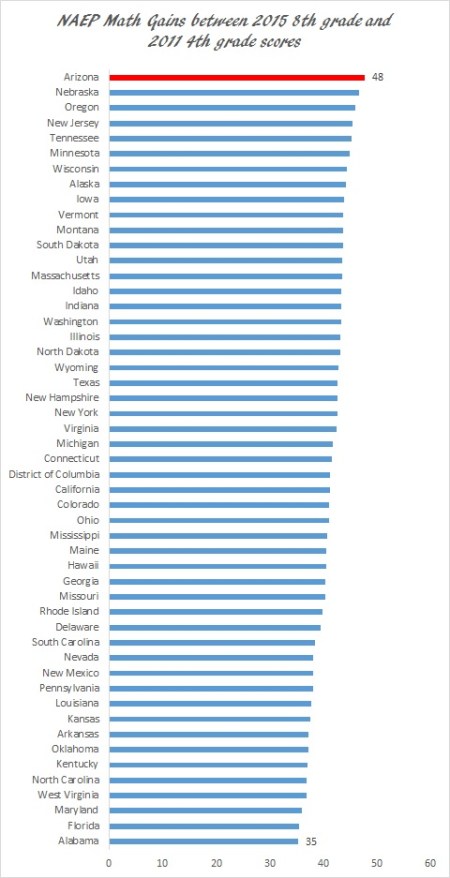
What actually happened during the Great Recession however is that while the economy was smashed, outcomes in schools continued to improve, even defying the national trend in the 2015 NAEP. As the first chart in this post shows, Arizona’s students made more math progress between their 4th grade scores in 2011 and the same age cohorts scores as 8th graders in 2015 than any other state. What gives?

While funding decreased, competition for students increased. An ever higher percentage of students continued to apply to attend charter schools and their waiting lists continued to swell.  Fancy Scottsdale Arizona somehow has a couple of empty schools. The state wisely moved to outlaw LIFO in school district layoffs, because layoffs were necessary. A skillful school leader would have taken the opportunity to preserve as many highly effective teachers as possible in this process.

In short, this was a productivity increase that you see in private industry on an ongoing basis. Arizona schools became less expensive and more effective. It is however at complete and utter variance with the state’s history of ever growing budgets and students along with relatively stagnant scores.  The Mother of All Competitive Effects (so far) was great for kids and taxpayers, tough on providers and it came about as a combination of deliberate policy and accidental economic catastrophe.

Where do we go from here? Proposition 123 will provide an extra $3.5 billion over the next 10 years, the baby boomer teacher cohort will continue to retire and need replacing, new charter schools will continue to open. Enrollment growth has already returned but the working age population will continue to shrink as a percentage of the total population.  The need for further academic gains remains acute. In short, the need for a less expensive and more effective education system is not going away, nor will the political battles surrounding the K-12 debate.

If however Arizona policymakers play their cards skillfully, the state can continue its ongoing move out of the NAEP cellar and towards a world class system of education. Some Arizona schools have already arrived at this enviable spot.

The challenges are very real, but the sky is the limit on our opportunity to improve.


Arizona Post-Prop 123

May 20, 2016

(Guest Post by Matthew Ladner)

Arizona Education Association President Andrew Morrill and I hit NPR to discuss the Arizona school finance landscape post Prop. 123.


Sweet Reason Prevails in Arizona

May 19, 2016

(Guest Post by Matthew Ladner)

Arizona voters have passed Proposition 123, wisely (if narrowly) settling a lawsuit over education funding in the process.

This will be a week long-remembered! It has seen the end of the Texas Supreme Court being used as a sock puppet and the end of a Nevada lawsuit that attempted to use KKK inspired constitutional provisions to keep kids trapped in an overcrowded and under-performing school system. It has now seen the end to a distracting lawsuit that if left to fester would have threatened Arizona’s nation-leading pace of academic improvement. We have put an end to this destructive conflict and brought order to the cactus patch!


Ok all kidding aside this was the best possible outcome- it has been a rough decade for Arizona schools since the Great Recession drop kicked our economy and I for one am happy to see our schools get some additional resources without raising taxes in what is still a less than robust recovery. Congrats to the lawmakers, school advocacy groups, business community and especially to Governor Ducey for providing the leadership to make it happen.


School Choice is Win-Win

May 19, 2016

Last week M. Danish Shakeel, Kaitlin Anderson, and Patrick Wolf released their meta-analysis of experimental studies of private school choice, finding significant test score benefits from the 19 studies they reviewed.  This week Greg joins the party with an updated edition of his “Win-Win” report reviewing the evidence on school choice.

Greg goes beyond the scope of the Shakeel, et al meta-analysis by also considering evidence on how expanding school choice affects traditional public schools, public finances, segregation, and civic values.  That’s covering a lot of different types of effects.  And what does he find?

The evidence points clearly in one direction. Opponents frequently claim school choice does not benefit participants, hurts public schools, costs taxpayers, facilitates segregation, and even undermines democracy. However, the empirical evidence shows that choice improves academic outcomes for participants and public schools, saves taxpayer money, moves students into more integrated classrooms, and strengthens the shared civic values and practices essential to American democracy. A few outlier cases that do not fit this pattern may get a disproportionate amount of attention, but the research consensus in favor of school choice as a general policy is clear and consistent.

This is a very handy resource.  Check it out!


Winning the Blaine Game in Nevada

May 19, 2016

case-dismissed

(Guest Post by Jason Bedrick)

As Matt noted earlier, a Nevada judge upheld the state’s ESA program yesterday. Here’s what the Institute for Justice had to say:

“Today’s decision is a powerful rebuke to the idea that school choice programs undermine education,” said Tim Keller, managing attorney for the Institute for Justice’s Arizona office, “The Nevada ESA program contains both hallmarks of a constitutional school choice program: parents, not the government, decide where their children go to learn, and the government stays entirely neutral with respect to religion.” The Institute for Justice (IJ) represents six Nevada parents who have been approved for ESAs.

ESAs are a cutting edge reform in finding ways to educate a booming population amidst strained state budgets. The ESA program deposits money into accounts controlled by participating parents, who then use it to design a customized education for their children. ESA funds may be used to enroll in private schools, hire tutors, buy textbooks and curricula, and even pick and choose among individual courses at public schools and universities.

“ESAs hand the reins over to parents,” explained Keith Diggs, also an IJ attorney in Arizona. “Kids don’t deserve to be stuck in a school that doesn’t suit them. ESAs will open up a huge array of options and create a market where parents can seek out the education their kids need.”

Over at the Cato-at-Liberty blog, I take a deep dive into the judge’s ruling:

Following the U.S. Supreme Court’s First Amendment jurisprudence, the judge held that the Nevada Constitution prohibits aiding one religion, preferring one religion over others, or aiding all religions in a manner that prefers religion over non-religion, citing in particular the state constitution’s declaration that the “free exercise and enjoyment of religious profession and worship without discrimination or preference shall forever be allowed in this State.” The Blaine Amendment had prohibited “sectarian” instruction in the public schools, but did not preclude the legislature from enacting religiously neutral programs that would provide funding to families to educate their children in the manner they preferred, whether at a religious or secular institution.

…the Nevada judge held [that] any benefit to religious schools from the ESA was ancillary and indirect. The Blaine Amendment “was not intended to preclude any expenditure that has an incidental benefit to religion, where such is made for a primary secular purpose,” and the ESA “was enacted for the valid secular purpose of providing financial assistance to parents to take advantage of educational options available to Nevada children.”

Case dismissed.

Let’s hope the Nevada Supreme Court agrees.


Sorry ACLU-Court Rejects Blaine Challenge to ESA

May 19, 2016

(Guest Post by Matthew Ladner)

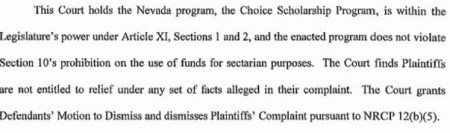
A Nevada judge dismissed one of the two lawsuits challenging NV ESA. From the ruling:

NV ruling


BOOOOMILICOUS victory, but the program injunction remains in place from the other case, and this all ends up in the Nevada Supreme Court.  It is always sickening to me to see anyone attempt to use provisions created by a past wave of anti-Catholic bigots, so it is always good to see such attempts fail.

From the Las Vegas Sun:

Education insiders around the country are keeping a close eye on the Nevada program, and its success or failure could determine whether similar sweeping programs are pushed in other states.

When it comes to the ACLU’s lawsuit, the judge dismissed the group’s argument that Nevada’s constitution only tasks the Legislature with ensuring a public school system.

“The framers indicated they intended to create two duties, a broad one to encourage education by ‘all suitable means,’ and a specific, but separate, one to create a uniform public school system,” judge Eric Johnson wrote in his opinion. “The Legislature can provide for a uniform system of common schools, free from religious instruction and open to general attendance by all Nevada children, and still adopt other suitable means of encouraging education.”

Johnson also dismissed the ACLU’s contention that allowing public money to be used to pay tuition at private religious schools violates the state constitution, which has been a central argument in lawsuits against ESA and voucher programs elsewhere.

Ruling can be read here.