
People Don’t Like to be Meddled With

June 23, 2016

(Guest Post by Matthew Ladner)

So it’s official- Brexit passed. It looks to me that there were villains and heroes on both sides of this debate, and it will cause a huge amount of disruption. In the end it seems to me that you would much rather be ruled by people you can turn out of office in “elections” rather than distant meddlers who never face the voters- no amount of fear should dissuade anyone from this position. Difficult days lie ahead but perhaps Britons never will be slaves after all.


Daily Facepalm: Choice “Clogs Our Roads”

June 21, 2016

us-roads-are-more-clogged-than-ever

The problem: too many choices?

(Guest Post by Jason Bedrick)

The abundance of choices among competing grocery stores is “clogging” our roads, according to an Australian academic who advocates assigning people to government-run grocery stores based on the location of their home:

Almost 60 per cent of Melbourne shoppers are bypassing their local grocery store, according to world-renowned academic John Hattie.

Professor Hattie said ‘food choice’ had led to a “clogging of the motorways” as shoppers avoided their neighbourhood grocery store in pursuit of alternatives.

Food choice has also fuelled unhealthy competition between grocery stores, he told a packed lecture theatre at the University of Melbourne on Tuesday evening.

“Nearly all this choice is based on hearsay, the flavor of the food, and rarely on whether the food is or isn’t adding nutritional value to the shoppers’ health,” he said.

All right, all right. If you’re a regular reader of the JPG blog, you’ve probably already deduced that I changed the words “school” and “students” to “grocery stores,” “food,” and “shoppers.” Here’s what Professor Hattie actually argued:

Almost 60 per cent of Melbourne students are bypassing their local school, according to world-renowned academic John Hattie.

Professor Hattie said school choice had led to a “clogging of the motorways” as students avoided their neighbourhood school in pursuit of alternatives.

School choice has also fuelled unhealthy competition between schools, he told a packed lecture theatre at the University of Melbourne on Tuesday evening.

“Nearly all this choice is based on hearsay, the nature of the students, and rarely on whether the school is or isn’t adding value to the students’ learning,” he said.

Frankly, it’s no less absurd than the modified version.

So-called “experts” demonstrate their own hubris and contempt when they proclaim from their ivory towers that they know better than the little folks below, despite lacking any local knowledge about a particular student’s aptitude, interests, or learning needs. Aside from the fact that the best international evidence suggests that school choice boosts student outcomes (i.e., on average, the parents outperform the central planners), educational choice is an end in and of itself.

Moreover, although I don’t think education policy should be used as a lever to promote environmental goals, research from Professor Bart Danielson suggests that school choice policies are more environmentally friendly than district-based systems. Countless parents have fled urban areas to rescue their children from failing district schools–the “white flight” that Hattie decries–which contributes greatly to suburban sprawl. According to Danielson’s research, parents are more likely to remain in urban areas when they have more educational options, thereby reducing their carbon footprint.

In short: the “clogged roads” argument against choice is as spurious as it is silly.


Remarks to the Arizona Chamber of Commerce: More Than This

June 20, 2016

Friedman award

(Guest Post by Matthew Ladner)

The Arizona Chamber of Commerce and Industry held an awards breakfast last Friday, where they recognized a number of worthy recipients including friends serving in the legislature like Senator Debbie Lesko and Senator Steve Pierce and Representative Paul Boyer.  They also however chose to recognize a rather dubious character with whom you will be all too familiar by bestowing upon him the Milton Friedman Award, Obviously I was deeply touched to receive an award named after one of my heroes.

At the request of the Chamber, I prepared the following remarks:

I am deeply touched to receive this honor, but I must say that I feel a bit like Jack Ryan. You may recall the scene in the Hunt for Red October when Ryan exclaims “Me?!? I’m just an analyst!”

Arizona is sailing into history!

While I am deeply appreciative of the award, it is I should honor you. The groundwork for what I am about to describe was already in place when I arrived in Arizona in 2003. You as long-time business and civic leaders in Arizona should take great pride in what I will relate.

It was recently reported that Arizona ranks number two in job growth. I am happy to relate to you that Arizona ranks number one in K-12 academic gains.  The National Assessment of Educational Progress gives academic exams to 4th and 8th graders in all 50 states every two years. When you follow the academic progress of 4th graders in 2011 to when they became 8th graders in 2015, you find that Arizona students made more progress than any other state. Given everything this state endured during the Great Recession, this is a remarkable tribute to the resiliency of our students, educators and policymakers.
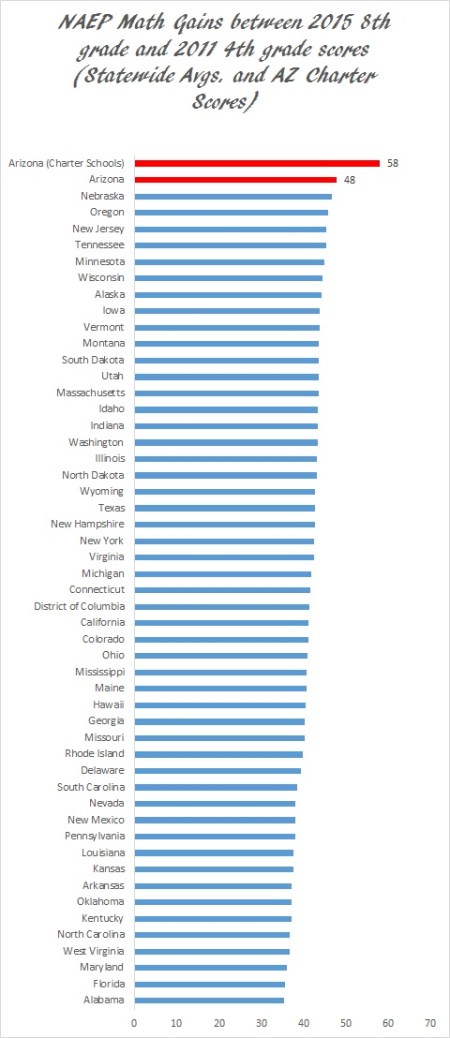
NAEP Math cohort gains with AZ charters

This progress is across the board and includes both district and charter schools. In addition our charter school students did something truly extraordinary. On the same 2015 National Assessment of Educational Progress, Arizona’s charter school students scored comparably to the highest performing states like Massachusetts and New Hampshire. This is all the more impressive when you consider that Arizona charter schools are funded far more modestly, and have student bodies far more diverse, than the schools in New England.
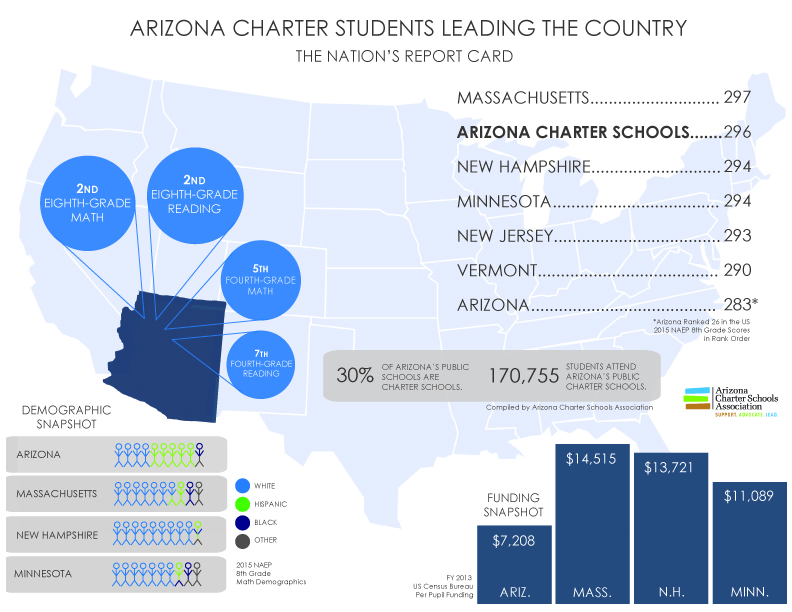
These results are remarkable. How did this happen? What is the secret sauce? There is no single explanation and there are many ingredients in the Arizona K-12 reform gumbo. You made the mistake however of giving me an award named after the great Milton Friedman and then the even larger mistake of giving me the microphone, so I am going to talk about parental choice. It seems clear to me that parental choice has been a major contributor to Arizona’s improvement.

Parental choice is controversial. Some people believe that parental choice is about some schools being “good” while others are “bad.” Those who believe this however are mistaken. Parental choice is about the fact that every single child deserves to have access to a school that is a good fit for them. Good fits between students and schools are very powerful, and we cannot replace it with any other source of improvement.  Without giving parents the ability to match the needs and interests of their child with the particular strengths of a school, the public education system will never reach full potential.

During the campaign, Governor Ducey quite rightly placed an emphasis on Arizona students sitting on wait lists at our high demand district and charter schools of choice. These students only have one shot at their K-12 education, but they find themselves stranded by the inadequacies of our policies, waiting for the opportunity to attend their good fit school. Meanwhile the sand continues to run through their hourglass. 

Our challenge includes this, but it is also more than this.

Tens of thousands of Arizona students sit on wait lists, but hundreds of thousands of Arizona parents never even considered some of our highest performing district and/or private schools. These schools may have been great fits for the needs of their children, but they didn’t even cross the radar screens of these parents for consideration. Why not? Because they have effectively been priced out of consideration. Parents either cannot afford the high price of real estate for the district schools, or else cannot afford to pay tuition in addition to their taxes. Many sadly see these schools as being for someone else, but not for them. It doesn’t however have to remain this way. We have it in our power to make our educational opportunities more inclusive. The blessings of liberty should not remain the privilege of the few, but rather the birthright of all.

I fell in love with Arizona because of our innovative spirit and I believe that we have been richly rewarded for it. If Dr. Friedman were still with us, I believe he would be proud of what we have done, and would encourage us to do more. Arizona is a state with big horizons, where the sky is the limit. May we always remain so.

I genuinely am deeply appreciative of both the award, and the opportunity to work with great people on these issues in Arizona.


Jaws on the Water Brought to You by the Alamo Drafthouse

June 16, 2016

(Guest Post by Matthew Ladner)

Yes please!


Rick Hess Crushes the Ball

June 15, 2016

(Guest Post by Matthew Ladner)

Go read this Rick Hess post. Like right now! “Ed Reform, I’d like to introduce you to 1990s Ed School. Oh- so….you two are already acquainted?”

Another Rick once noted “He who fights with monsters might take care lest he thereby become a monster. And if you gaze for long into an abyss, the abyss gazes also into you.”


Will the Ed Reform Band Continue to March into the Alley?

June 14, 2016

(Guest Post by Matthew Ladner)

Robert Pondiscio’s now famous piece on ed reform’s leftward drift brought to mind the above scene from the masterpiece of American juvenile cinema Animal House. It’s hardly impossible to imagine ed reform going off course as, well, it happened before and in the recent past. Tom Loveless for instance argues that the entire Common Core effort has been worth less than a single NAEP point (on a 500 point scale) and that this gain is already reflected in the 2015 exams. I would not bet my left foot that Tom is absolutely correct about that, in fact I hope he’s wrong and the entire effort has some sort of delayed reaction since it is a sunk cost. I have yet to see anyone attempt to muster a credible refutation, and Tom’s analysis finds support from Hanushek’s work as well.  The could be mistaken, but calling the question as of now makes it look like:

Well yes maybe that has not worked out as well as hoped, but the teacher evaluation systems pushed by Race to the Top are going to close the achievement gap by…oh wait watch out….gahhhgh my trombone!!!!!!

Not all such diversions are of recent vintage. Some are more of a persistent folly sort of phenomenon. For instance, it is fairly clear that the school voucher movement never would have launched in Milwaukee without a strange bedfellows coalition of liberals and conservatives. This was terribly exciting at first, but with the benefit of hindsight…

It now seems painfully obvious that the means testing of private choice programs has served to politically marginalize private choice vis-a-vis charter schools, district schools, magnet schools, digital learning and/or **fill in the blank here** because almost nothing else in K-12 education funding has adopted the view that actively discriminating against the children of the people who pay the highest rates of tax constitutes an inspired political strategy.

This is not at all to say that equity issues are anything less than vitally important or that we should not engage in an ongoing and thoughtful discussion about how best to reflect them in a system of private choice. The means testing fetish however has persisted so long that some very prominent charter school supporters for instance failed to recognize the rich irony of their criticism of the Nevada ESA program for being universal in nature when in fact every charter school law also involves universal eligibility by income.  Come to think of it, I don’t know of many charter school laws that give additional state dollars to low-income kids, but the NVESA does provide additional state funds to low-income students….

Anyhoo, means testing for thee, but not for me won’t do- wake me up when our friends on the left means test district or charter schools. Otherwise the worthy conversation lies in settling upon the level of additional resources should be provided to disadvantaged children. All of which leads to Paul Peterson’s great valedictory piece as Editor in Chief of Education Next making the case that the regulatory approach to school reform led us down a blind alley reached its ceiling. Peterson calls on reformers to double down on parental choice as an improvement strategy. This approach, while promising, requires a level of modesty notably lacking from today’s would be technocrats. I’m happy to pass the ed reform baton to those who can snatch this particular pebble, as my next career creating Rhino Record compilation cds of Dean Martin and punk rock classics awaits (Martinis in the Mosh Pit, Volume 7!!!) and would be even more fun than anything in ed reform, other than jayblogging.

Ooops, day dreaming again, so getting back on track the above sort of issues deserve deliberation and debate in my view. I could be in the grips of an enormous folly that is invisible to me, just as my friends in the charter school movement seem oblivious to their means testing double standard. I’ve been wrong before, and I will be wrong again so have at it if you disagree. I’d rather debate these sort of issues than endure any further virtue signalling in the form of therapy sessions where Ivy League ed reformers work out their guilt from lacking an urban Horatio Alger story in public.  Such burdens are best born in private with a determined stoicism, terrible though they may be, as they seem lacking in utility.


The Disconnect Between Changing Test Scores and Changing Later Life Outcomes Strikes Again

June 14, 2016


I’ve written several times recently about how short term gains in test scores are not associated with improved later life outcomes for students.  Schools and programs that increase test score quite often do not yield higher high school graduation or college attendance rates.  Conversely, schools and programs that fail to produce greater gains in test scores sometimes produce impressive improvements in high school graduation and college attendance rates, college completion rates, and even higher employment and earnings.  I’ve described at least 8 studies that show a disconnect between raising test scores and stronger later life outcomes.

Well, now we have a 9th.  Earlier this month MDRC quietly released a long-term randomized experiment of the effects of the SEED boarding charter school in Washington, DC.  Because SEED is a boarding school, there was a lot of hope among reformers that it might be able to make a more profound difference for very disadvantaged students by having significantly more time to influence students and structure their lives.  Of course, boarding schools also cost significantly more — in this case roughly twice as much as traditional non-residential schools.

While the initial test score results are very encouraging, the later life outcomes are disappointing.  After two years students admitted to SEED by lottery outperformed those denied admission by lottery by 33% of a standard deviation in math and 23% in reading.  If we judged the quality of schools entirely based on short term changes in test scores, as many reformers would like to do, we’d say this school was doing a great job.

In fact, SEED may be doing a great job in a variety of ways, but when we look at longer term outcomes for students on a variety of measures the evidence demonstrating SEED’s success disappears or even turns negative.  Of the students accepted by lottery to SEED 69.3% graduate from high school after four years compared to 74.1% for the control group, a difference that is not statistically significant.  And when asked about their likelihood of attending college, there was no significant difference between the two groups.  SEED students also score significantly higher on a measure of engaging in risky behavior and lower on the grit scale.

We’ve seen this pattern before.  Research by Marty West and colleagues of no excuses charter schools in Boston found large gains in test scores but also significantly lowered student performance on noncognitive measures.  And Josh Angrist and colleagues found that those schools actually decrease four year high school graduation rates despite large gains in test scores.  In their words:

Perhaps surprisingly given the gains in test score graduation requirements reported in column 2 of table 4, the estimates in column 4 of this table suggest not. In fact, charter attendance reduces the likelihood a student graduates on time by 14.5 percentage points, a statistically significant effect.

It’s time that people start paying a lot more attention to this pattern of a disconnect between short term test score gains and long term life outcomes.  We can’t just dismiss this pattern as fluke.  And the reduction in noncognitive skills may be important for explaining this pattern.  Reduced grit scores may not just be the product of reference group bias.  It appears that certain types of charter schools that are able to produce large test score gains also lower character skills and fail to yield long term improvements in life outcomes.  Conversely other types of charter and private schools in choice programs fail to improve test scores but yield large gains in later life outcomes.

If we think we can know which schools of choice are good and ought to be expanded and which are bad and ought to be closed based primarily on annual test score gains, we are sadly mistaken.  Various portfolio management and “accountability” regimes depend almost entirely on this false belief that test scores reveal which are the good and bad schools.  The evidence is growing quite strong that these strategies cannot properly distinguish good from bad schools and may be inflicting great harm on students.  Given the disconnect between test scores and later life outcomes we need significantly greater humility about knowing which schools are succeeding.


Russ Whitehurst Throws Cold Water on the Grit Craze, But Is the Water Too Cold?

June 11, 2016

Russ Whitehurst, one of the most cool-headed education researchers, throws cold water on the grit craze seizing some quarters of the ed reform world.  As I warned in my recent review of the Angela Duckworth and Paul Tough books, “This new attention to character skills has many of the markings of previous failed fads…. In short, school and educator practice with respect to character skills is running far ahead of knowledge.” I wanted to cool grit fever, but in his recent piece Russ throws icy cold water on it.  He raises excellent points but I wonder if Russ is too cold on the importance of character skills.

Russ makes three arguments: 1) A recent study that compared grit scores among fraternal and identical twins suggests that grit may be heritable to a large degree, which would make it unrealistic to expect schools or others to be able to alter it; 2) The twin study as well as a meta-analysis of grit research found that grit only explains about 2-3% of the variance in achievement scores, which Russ thinks makes it a poor predictor of other outcomes; and 3) The meta-analysis suggests that grit may be highly correlated with conscientiousness, one of the Big 5 personality traits that psychologists have been studying for a long time.

I think Russ is most persuasive on the last point.  Grit may be more of an effective marketing brand than a new contribution to the field.  But whether it is really distinct from conscientiousness or not, this does not establish whether grit and other character skills are important for education reform.

Russ is much less persuasive with his second argument.  The fact that grit or other character skills may not be strongly predictive of achievement test results is not surprising if these non-cog measures capture something that is important independently of cognitive ability.  That is, the true test of the predictive power of “noncog” measures is not whether they are correlated with cognitive measures (like achievement scores), but whether they are correlated with later life outcomes.  As it turns out out, they are.  As this recent piece in Economics of Education Review by Collin Hitt, Julie Trivitt, and Albert Cheng shows, their character skill measure collected in middle or early high school is predictive of later educational attainment, employment, and earnings in 5 different longitudinal panel data sets, even after cognitive ability and other factors are controlled.

Russ’ first argument is the most important for educational reform.  If grit or other character skills are not malleable, then why bother devoting a lot of energy to trying to address them in schools?  Russ is correct to point out that about 37% of the perseverance component of grit is heritable, but that does not establish that educational policy and practice are unable to alter the non-heritable factors that form grit and other character skills.

There is a growing body of evidence that suggests character skills are malleable and that education plays an important role in shaping and altering character.  Albert Cheng and Gema Zamarro have a new study that shows students randomly assigned to teachers who possess stronger character skills experience an increase in their own character skills.  And Albert Cheng has another study using a student fixed-effect research design that has the same finding.  This would not be possible if character skills were not malleable.

In addition we have an entire literature on pre-school and school choice suggesting that educational interventions can produce long-term success without improving short term achievement test scores (and vice versa).  It’s not well-understood exactly how these benefits are being produced, but a reasonable explanation is that early childhood and effective school choice programs may improve character skills without also increasing test scores.  And in the long-run the improvement in character skills may be more important for success.

Russ Whitehurst is right to warn us about the irrational exuberance some have about grit, but he shouldn’t throw out the baby with ice cold bath water.  There seems to be something very important about character skills in education even if we do not fully understand how to define, measure, or alter them.

(edited for typos)


Fordham’s Economics Malfunction

June 9, 2016

68773636

(Guest Post by Jason Bedrick)

Yesterday, Checker Finn and Brandon Wright of the Fordham Institute published an essay highlighting three “market malfunctions” in the charter school sector. What they highlighted instead were primarily government malfunctions.

The first “market” malfunction they identify is the apparent lack of congruence between supply and demand:

As rapidly as it’s grown (6,800+ schools at last count), the supply of charters has not keep up with demand in most places. (Estimates of the total waiting list go as high as a million kids.) All sorts of political, budgetary, and statutory obstacles have limited the number, size, and locations of charter schools.

Political, budgetary, and statutory obstacles… these are market malfunctions?

Skipping number two for a moment, their third supposed “market” malfunction is the problem of what they call “distracted suppliers”:

Many charters are strapped for funds. They feel overregulated by their states, heckled by their authorizers, and politically stressed, so the people running them often struggle to keep their heads above water (which includes keeping enrollments up). They have little energy or resources to expend on becoming more rigorous or investing in stronger curricula and more experienced instructors.

Strapped for funds when the law prevents them from charging their customers anything. Overregulated by their states. Politically stressed.

Again, my Fordham friends, these are market malfunctions?

Their second concern is the closest they come to identifying a market malfunction: weak consumer information.

Even where parents are mindful of school quality and try their best to be discerning, consumer information in this marketplace remains incomplete, hard to access, and difficult to understand. State report cards are ubiquitous yet lacking. Even when they adequately display academic achievement in tested subjects, they cannot begin to convey all the other information that goes into a sound school choice. What, for example, does the school truly value? Are its classrooms quiet and orderly or lively and engaged? How does it handle character development? Discipline? Disabilities? Do students and teachers like it there or flee as soon as possible? The list goes on.

Yes, the market (as well as the government) has failed thus far to provide bountiful, accessible, and high-quality information about most schools. I’ve explained how the market could accomplish this (e.g., a combination of private certification, expert reviews, and consumer reviews) and there are some organizations already trying to fill this gap (e.g., GreatSchools), but there’s still much more to do.

Of course, one reason that there are so few third-party organizations providing such information is that the government crowds them out, both by providing their own scorecards (which Finn and Wright find wanting) and by operating a massive system of “free” district schools that crowd out private alternatives.

So again: you call these market malfunctions?


Send in the Nimitz!

June 6, 2016

Most interesting man

(Guest Post by Matthew Ladner)

Every so often you just have to ask yourself “What would TMIMITW do?” Given that TMIMITW is actually from New York, maybe he can be persuaded to run! His substantive political accomplishments already approximately equal and perhaps greatly exceed those of the two nominees combined and let’s face it- who do you want to be stuck with on your television set for the next four years?  In addition, his position of the two party system has been long-established, so he cannot be accused of opportunism:

Christopher Buckley eerily predicted this election back in 2008 and disguised his prophecy as satire. Send in the Nimitz!