First Prize a Cadillac El Dorado, Second Prize a set of steak knives

September 27, 2017

(Guest Post by Matthew Ladner)

Please join me at the Fordham Institute on Oct. 3 for a debate between three very distinguished panelists but also one sketchy panelist and yours truly to debate which state has the best prospects for achievement gains in the four years ahead: Arizona, California, Louisiana and Tennessee.  Wonkery with light refreshments to follow so come out and cheer for the Cactus Patch!


How About More “Very Nimble” District Schools?

September 21, 2017

(Guest Post by Matthew Ladner)

The Arizona Republic ran a quote from my state Senator, Kate Brophy McGee, that scores high on the unintentionally hilarious meter. A left of center organization issued a report complaining about procurement rules governing Arizona charters. Senator Brophy McGee stated:

State Sen. Kate Brophy McGee, a Republican from Phoenix, said charter schools should be held to the same standards as public schools because both deal with public money.

“We’ve given district schools more and more regulation, while not requiring the same of these very nimble charters, and we wonder why the public schools aren’t as successful,” McGee said.

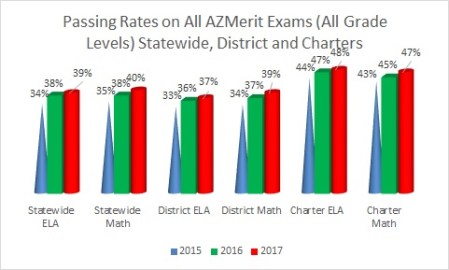
I have what I think is a better idea- one of these two sectors should become more like the other, but based on what we see in the academic data it is the districts who should become more like the charters, rather than the other way around. Last session for instance Governor Ducey called for districts to have similar freedom in hiring to charters. It, ah, seems to be working out really well for charters. This makes all the sense in the world, but reactionary elements of the district establishment acted like it was some sort of ghastly mistake. As the Prime Minister of the UK might say “I refer the honourable gentlemen to the red columns in the above chart.”

If the Grand Canyon Institute or anyone else has evidence of lawbreaking, they should refer these to the appropriate authorities. The State Board for Charter Schools is for instance empowered to investigate complaints. More importantly, Arizona parents are absolutely brutal in punishing schools that fail to deliver- they have other options and can vote with their feet. This is real accountability as opposed to the faux bureaucratic variety.


There Will Always be a Scottsdale Unified

September 18, 2017

(Guest Post by Matthew Ladner)

Here on the JPGB I’ve been keeping an eye on Scottsdale Unified, as the district makes for an interesting microcosm of several issues in parental choice. In Arizona’s relatively liberal charter laws, Scottsdale parents have taken a shine to some of our home-grown charter schools.

To the extent that parents care about test scores, those charters do very well on everything from PISA (eat our dust South Korea) to AZMerit, to the Arizona Board of Regents tracking of post-graduate results. A 2012 report of the Arizona Auditor general found Scottsdale Unified at only 65% capacity, and this despite taking in thousands of open enrollment students from out of district. Judging from the wait lists of these schools, some (well deserved) philanthropic support could force Scottsdale Unified to close additional campuses. As it is, there is a multi-building 127,000 sq ft. campus that sits vacant, and the Auditor General concluded that Scottsdale Unified could move $3.8m per year into the classroom if it would make more rational use of facility space. “Everything is grim, we need to dial back this parental choice business before we destroy public education!” goes the battle-cry of many.

That’s a scary story, but fortunately it is demonstrably wrong.

We should judge school districts by outcomes above all else. On this front we have three years of comparable academic data for Scottsdale Unified from AZMerit, and just like the statewide trend results in 2016 were better than 2015, and the results from 2017 were better than 2016. A survey conducted by a demographer on behalf of Scottsdale Unified identified “academic rigor” as a major issues for transfers out of Scottsdale Unified. Scottsdale Unified might have indeed faced big problems without academic improvement, but lo and behold that improvement is underway.

Things look to be trending in the right direction academically. They might do so at a faster pace if those $3.8m were directed into the classroom, but that is a decision for the school board to make. Scottsdale Unified gets more total public funding per pupil than their charter school competitors, nothing is stopping them from moving into a more choice-based system similar to what we see in districts such as Phoenix Union and Vail through specialized magnet programs. The era of big-box schools appearing at the top of performance lists, even in highly demographically advantaged areas, has drawn to a close. Perhaps some of those 1/3 empty Scottsdale Unified big boxes could become full campuses hosting multiple schools.

The Great Recession took a toll on Arizona’s finances. Eventually real cuts to K-12 funding hit. Enrollment growth stalled for the first time since WWII, and high-quality charters seized the opportunity to obtain properties. It was a rough time to be running a school district. What doesn’t kill you makes you stronger, and all indicators show that Arizona has a better performing public school system now than ever. Enrollment growth, funding per pupil and most important of all academic performance are all up.

It would be mathematically impossible for Arizona to have been leading in statewide NAEP gains without the improvement of district scores. We need to keep it going, but AZMerit indicates that it kept rolling after the 2015 NAEP. #WeneedtoWinMOARRRRR


Diversity and Community on Campus

September 15, 2017

IMG_1869

(Guest post by Greg Forster)

Just in time for the Ben Shapiro non-Ragnarok in Berkeley, OCPA’s Perspective carries my article on diversity and community on campus:

The dominant group, on the political Left, learns from these episodes that getting offended brings power. Stigmatizing people and destroying their lives pays off. By crushing their victims, they establish themselves as the people who must be kept happy if peace is to be maintained.

The oppressed minority group, on the political Right, is also incentivized to escalate the conflict. Increasingly, conservative students conclude that they are desperately besieged, and fighting back with equally divisive tactics is the only realistic response to their oppressed state. Worse, conservative websites and activists make big bucks circulating stories of on-campus outrage for clicks and donations.

I dissent from criticism of Harvard’s “black graduation” on the Right:

It was a student-run, unofficial event that took place two days before the official ceremony, and thus did not affect it. Anyone was permitted to attend the event.

In other words, a private student group held its own event on campus, celebrating something it wanted to celebrate—its positive sense of its own identity and achievements. That’s a perfect example of what happens in real communities. It’s no more a threat to the solidarity of the broader, multiethnic university than a “Kiss me, I’m Irish” button.

Thankfully Harvard hasn’t done anything monumentally stupid in the meantime that might make me regret defending them.

I also offer thoughts on how colleges can strengthen both community and free speech. Your free speech in response is welcome!


No Arizona Charters We’ve Got to Win MOARRRRR!!!!

September 14, 2017

(Guest Post by Matthew Ladner)

After the release of the 2017 AzMerit, the Arizona Charter School Association reported that 97% of the top 100 Local Education Agencies (LEAs) in terms of percentage passing the English Language Arts AzMerit exams were charters. I decided to check out the data for myself.


This however may actually be “too much winning” given that most of the charter LEAs are individual schools, whereas a school district like Catalina Foothills is a multi-school district. I’ll let you ponder that holy mystery for yourself, but I ran the same numbers for individual campuses. The top 100 individual campuses were almost evenly split between districts and charters-51 district schools and 49 charters.

In 2012-13 (the last time NAPCS had data) charters only made up 24.5% of Arizona public schools, so it is plenty of winning to make up almost half of the top schools by ELA passing rate. I’m thrilled that scores continue to improve for both district and charter schools.


I’ve been CHAITED, been MISTREATED, when will wildly successful low reg charter sectors be loved?

September 7, 2017

(Guest Post by Matthew Ladner)

HT to Asness on the title

I stopped reading Jonathan Chait’s piece on charter schools when I came across this:

The most successful charter systems tend to be highly regulated, with controls to require high-quality operators and close down low-performing schools.

This statement is the precise opposite of the truth. High regulation charter sectors seem extremely adept at preventing charter schools from opening, but not much else. Meanwhile we have multiple examples of states with low NACSA scores for their charter laws but very promising student outcomes (Arizona, Colorado, Florida, Idaho, New Mexico, Utah).

Let me help you out JC:

The most successful charter systems tend to be highly lightly regulated, with controls competition to require high-quality operators and close down low-performing schools.

Happy to be of service. Carry on.


Arizona Low-Income Scores in Both Districts and Charters are Moving On Up

September 7, 2017

(Guest Post by Matthew Ladner)

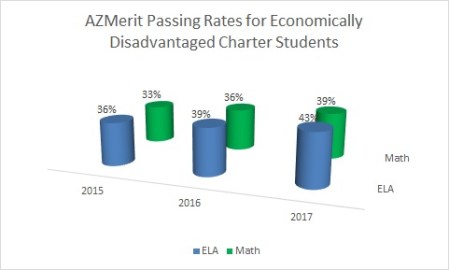
The improvement in AZMerit scores looks broad and inclusive across subgroups. Economically disadvantaged students for instance show academic gains across school sectors in Arizona. Here is a look at the trends for 4th grade district students:

Here are the 4th grade trends for low-income students attending Arizona charter schools:

Arizona students made larger academic gains on NAEP between 2009 and 2015 than any other state under very trying circumstances. The AZMerit data indicates that they kept making progress in 2016 and 2017. This is a great accomplishment for our students, our teachers and our policymakers, and hopefully…


2017 AZMerit Scores Improve, AZ Charters Continue to Rock

September 6, 2017

(Guest Post by Matthew Ladner)

Longtime Jayblog readers may vaguely recall something about Arizona charter schools rocking the 2015 NAEP, might have seen a post or two about Arizona’s statewide results leading the nation in NAEP gains from 2009 to 2015. I mean, you know, maybe you saw a thing or two here along these lines.

Ring a bell?

Okay good. So today the Arizona Department of Education released the 2017 AZMerit exams, and by the look of things results have continued to improve statewide. The below chart shows all tests for all students at all grade levels for both districts and charters:

Based upon how AZMerit lined up with the NAEP in 2015, Arizona charter schools may have improved from merely world class to somewhere in the realm of supercalafragilisticexpealadocious. In the chart below, the blue columns are from 2015, and the AZ Merit passing rates that year landed Arizona’s majority-minority modestly funded charter sector in the same NAEP neighborhood as New England states on scores. Judging by AZMerit, the improvement did not stop in 2015. Here for instance is 4th grade Math and ELA for AZ charters:

Here are the 4th grade numbers for Hispanic charter students. Again bear in mind that the 2015 numbers hit the very high end on NAEP compared to statewide averages:

There is no guarantee that the AZMerit improvement will translate on NAEP. It is possible that some of the improvement we see is a testing familiarity effect. Having said that, based on the statewide and charter school improvement seen in the AZMerit data, I’m looking forward to the release of the 2017 NAEP in January. For now:


I Only Know One Truth-It is Time for Bossy McBossypants Testing to End

September 5, 2017

(Guest Post by Matthew Ladner)

Last spring I was on my bike and came across this in front of a local middle school. I found it striking enough to take a picture with my phone:

In case you are squinting at your iPhone, the sign says “AZ Merit Testing 4/17-5/3.” Now mind you that the test that these students take to determine whether or not they go to college, and if so what sort of college, takes 4 hours. Comprehensive exams for a Ph.D. took me three days. Somehow in the awesome logic of 2017 it came to pass that it would make some sort of “sense” to disrupt schools for two weeks to give…AZMerit.

I think we all know what tends to happen to the school year starting (in this case) 5/4.

Weeks later I had the opportunity to observe a number of focus groups held on parental choice policy. The groups were from different parts of the country, and included parents, teachers and opinion leaders. Despite the fact that the topic of the convening was never testing, everyone made their feelings on the subject clear during conversations. All groups everywhere deeply dislike the current practice of standardized testing.

I can’t emphasize the next point strongly enough: I never once heard anyone use the phrase “Common Core” or burst into a fit of conspiracy mongering. Rather what I saw repeatedly was that people feel that schooling has become overly fixated on test preparation. People have a rather strongly held belief that schooling is supposed to be more than test prep. Something has gone terribly wrong with education in their view, and they want it to stop. Across the groups I saw, the consensus seemed to be that we should drive a stake through the heart of the current system, fill the mouth with holy wafers, and then burn the sarcophagus to fine ash.

I have seen remarkably little evidence that today’s heavy-handed, standards based testing system is of much utility. There is some suggestive evidence that states that had been doing nothing on the testing front before NCLB got a modest bump in results when they started testing. They may however have received a similar bump from a system with a much lighter footprint. Moreover no less than Hanuskek and Loveless have concluded that the heavy-handed Common Core project resulted in approximately nothing in the way of improved student learning. Given that we live in a democracy, a lighter footprint system seems like a fine idea.

So here is mine:

Preserving campus level academic transparency should be the central goal of testing. The Demos would apparently be happy to sacrifice it in return for slaying the testing vampire, but it would be a terrible loss in my view. States can adopt whatever standards they want (I suggest the old Massachusetts standards) but give their students a three-hour national norm reference exam on the second to last day of school. The last day rather than last month of school can now be the write-off. Do a good job teaching the MA standards, your students will do well/show progress on the nnr test.

Some will want to have their state officials grade or otherwise label schools based on the results. Have at it-but it is worth noting that the defacto accountability system in this country has become the Greatschools rating system given that is where the eyeball traffic resides. State ratings have become little more than an obsession internal to the system. Some will want to continue on the troubled path of trying to move the number of teachers fired for low performance from 1% to 1.5%. My view is that this is an unworkable path to hold schools accountable, but if some state or locality wants to keep it up feel free.

I know some of you continue to feel motivated by the idea that standards are going to lead us to profound improvement and narrower achievement gaps.  Decades into the project it is time to ask- where’s the beef? If you are willing to impose a deeply unpopular system of testing upon American families I must ask why? The burden of proof lies with you. If you (like me) would like to preserve campus level transparency I ask what is your plan? My plan is to adopt a system that is less intrusive and prescriptive and hold for dear life to campus level data-now tell me your plan. If your plan is to hold onto dear life to a system that the public abhors, I want to suggest that you need a new plan.

In my view, voting with your feet represents the most robust form of accountability by a very wide margin. I would like to have those voting decisions informed by test scores, and a great many other things including parent reviews (score another touchdown for Greatschools). Watching the focus group discussions made me realize that the United States House’s decision to enact a deeply misguided federal opt-out was not a fluke, but rather fit with the democratic sentiments of their constituents.

Opt-outs lead to nudge outs which leads to completely unreliable and thus worthless data. They will be passing at the state level soon unless transparency supporters pull their heads out of the sand. As Corwallis wrote to Clinton before the Battle of Yorktown “What is our plan? If we don’t have one, what are we doing here?”

Perhaps I’ve got this all wrong. If so, the comment section awaits.


The Play’s the Thing

September 4, 2017

What do students learn from field trips to see live theater?  As it turns out, quite a lot.  That’s the finding of my new working paper co-authored with Heidi Holmes Erickson, Angela Watson, and Molly Beck that was posted on SSRN this week.

We randomly assigned groups of students to receive free tickets to see a play or to remain in their school to serve as the control. We repeated this experiment for five different plays over a period of two years.  For two of the plays we added a second treatment condition in which students left school to see a movie comparable to the play, while some were randomly assigned to see the play and the rest remained in school as the control.

Across all five plays we found that students randomly assigned to see live theater scored significantly higher than the control students on measures of tolerance and social perspective taking as well as a test of their knowledge of the play’s plot and vocabulary.  For the two plays in which there was also a movie treatment, we found no difference between students who saw the movie and those who remained in school as the control.  Seeing live theater produces important social and cognitive benefits for students that are not realized by showing them a movie instead.

This experiment cannot tell us the exact mechanisms by which these benefits are produced.  Our best guess is that leaving school to see a play exposes students to a broader world, which helps them gain greater understanding and acceptance of that broader world.  For many students, theater is a window to different people, places, and ideas.  Movies may not have the same effect because they lack the personal interaction of live theater.  Perhaps students are more intellectually and emotionally engaged when there are people acting out a story in front of them than when they see that story on a screen.  The relative novelty of theater may also be a factor.

Dan Bowen, Brian Kisida, and I saw similar tolerance and knowledge benefits in a previous experiment in which students were randomly assigned to go on field trips to see an art museum.  There appears to be something about the in-person exposure to cultural activities that affects student values and knowledge of that material.

The new working paper builds on and improves upon an earlier article that presented the results from the first two of the five play experiments we conducted.  With significant help from Cari Bogulski, Hunter Gehlbach, and Thalia Goldstein we revised the original study design to collect pre-treament measures of outcomes, add the movie treatment condition, and to include social perspective taking as an outcome.  The new study presents the results of all five plays combined although the estimated effects are remarkably consistent for each play separately.

Our research of both art museums and theater shows that out of school arts experiences produce significant benefits for students.  Much may be lost if we continue abandoning these activities as schools narrow their focus on math and reading test results.