(Guest Post by Matthew Ladner)

(Guest Post by Matthew Ladner)
 Leave a Comment » |
  economics | Tagged: Bailout, Bailout Application |
  Permalink
 Posted by matthewladner
I can’t take it anymore. Someone must have abducted the folks at Fordham and replaced them with inside the beltway obsessed navel gazers. Who cares (this much) who the next education secretary will be? Four of the last five posts have been about the ed sec naming and about half of all posts in the last few weeks.
If, as John Nance Garner is said to have remarked, the vice-presidency isn’t worth a warm bucket of spit, being education secretary isn’t worth having to drink the bucket. Education secretaries barely have control over a professionalized staff that barely have control over a budget that contributes barely 8% of all education spending. I guess they can use their bully pulpit to influence the agenda for education policy, but almost all of the important education decisions are made by state and local actors.
Someone needs to free Mike, Checker, Sleepy, Grumpy, and Doc (I guess there are 5 because the alliteration works). Free the Fordham Five and bring back an interesting blog!
Update — The rescue team appears to have been successful! Flypaper has just posted 6 items in a row not about the ed sec nomination. Let’s all give thanks for the return of the Fordham Five and an interesting blog over at Flypaper.
4 Comments | politics | Permalink
Posted by Jay P. Greene
(Guest Post by Matthew Ladner)
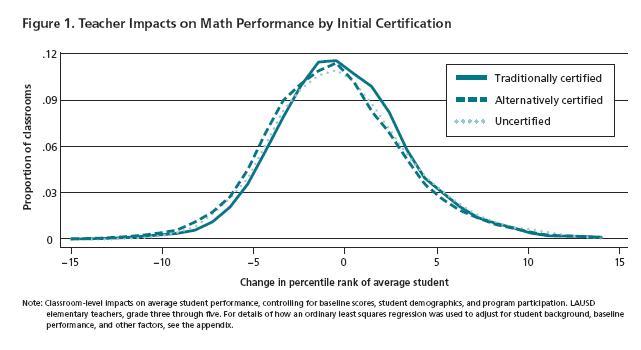
This chart from Brookings is one of the most important education charts I’ve seen in several years. Rather than me going on about why I think that is, super edu-nerd bonus points for you if you do so in the comments section. We are all about community here a JPGB!
Hint: there is more than one reason.
22 Comments | teacher quality | Tagged: Alternative teacher certifaction, value added analysis | Permalink
Posted by matthewladner
(Guest post by Greg Forster)
You may have heard about the Texas prof who was fired for publicly disclosing the names of students he caught cheating. Pajamas Media carries a somewhat confessional column today in which I discuss the role of the Internet (which, contrary to popular opinion, makes cheating harder rather than easier) and the rise of educational lawsuits (which colleges have responded to by abdicating their traditional disciplinary role), but also reflect, without satisfaction, upon my own experience dealing with a cheater:
The fear of lawsuits only compounds the difficulty of what is already a difficult decision. Even with the strongest possible intellectual conviction that it’s the right thing to do, actually imposing a punishment on a fellow human being takes a certain amount of moral courage. It takes some guts.
The isolation of the teacher as the lone defender of honesty in the classroom only makes it much more difficult to do the difficult but necessary thing when the time comes. And this, again, is something I can testify about from personal experience.
I regret to say that when I confronted my cheater, I chickened out.
What I ended up doing in the end, instead of what I had resolved to do and then didn’t have the courage to do, actually might be a good model for how to deal with a cheater. Of course, I’d rather have discovered it through intelligence rather than cowardice. As C.S. Lewis says, only fools learn by experience, but at least they do learn.
2 Comments | civic values, scandal | Tagged: cheating, Greg Forster, Loye Young, Pajamas Media | Permalink
Posted by Greg Forster

Sean Corcoran, who is guest blogging for the blogger formerly known as Eduwonkette, may have to go to education research jail because he violated the Denominator Law today. For those of you unfamiliar with the Denominator Law from my previous post on the topic (and ignorance of the law is no excuse) it is: “No one should be allowed to highlight numerators without also presenting denominators. That is, it is often misleading to describe a big number without putting that number in perspective.”
So, Sean is all worried about private donations to public schools creating or exacerbating inequities in funding. He references a report about California (and it had better be peer-reviewed or the blogger formerly known as Eduwonkette will throw a fit) that finds: “contributions to California school foundations rose from $123 million in 1992 to $238 million in 2001.” He does helpfully add that $238 million only amounts to $40 per pupil. But he doesn’t fully comply with the Denominator Law because he fails to point out that $238 million only represents .4% of the $52.2 billion in total public school revenue in California in 2001.
It’s not the average amount of private giving in California that really worries him. What concerns him is that these donations are concentrated in wealthy areas: “Of course—as Brunner and Imazeki point out—these contributions are far from evenly distributed. Donations are strongly related to family income, and in some cases they are quite high, at more than $250 to $500 per student. (You can read about the $3.3 million education foundation in Santa Monica-Malibu Unified School District here).”
Here, your honor, is where he flagrantly breaks the Denominator Law. He suggests that $250 to $300 per pupil, as illustrated by $3.3 million in private giving to public schools in Santa Monica, is “quite high.” Without a denominator, it’s hard to judge how high $3.3 million in Santa Monica really is.
Let me help. According to the School Matters web site operated by Standard and Poor’s, Santa Monica has 12,191 students. The private contributions Corcoran mentions amount to $271 per pupil — within his $250 to $300 range. But total revenue for Santa Monica public schools amounted to $11,062 per pupil as of 2006. Private contributions of $271 amount to only 2.4% of total revenue — not exactly “quite high.”
And this private giving hardly accounts for resource differences between Santa Monica and the average district in California. According to School Matters the average district in CA had total revenue of $9,553 as of 2006, $1,509 less than in Santa Monica. If Santa Monica received $271 in private donations compared to $40 for the average California district, the extra $231 could only account for about 15% of the extra resources Santa Monica possesses.
If this is the worst case that folks can muster, it hardly seems like private giving is a significant contributor to resource inequities. We only gain this appropriate perspective when we comply with the Denominator Law — so be sure to follow the law out there.
4 Comments | money myth | Tagged: Eduwonkette, Jay Greene, Jay P. Greene, Santa Monica, Sean Corcoran | Permalink
Posted by Jay P. Greene

“This bailout will get out of control. It will get out of control and we’ll be lucky to live through it.”
(Guest post by Greg Forster)
Fred Thompson on nonstop bailouts: “If you work in New York in a tall building making millions of dollars every year, it’s called ‘leverage.’ If you’re livin’ anywhere else, it’s called ‘living above your means.'”
Jim Geraghty quips: “When you’re in the red, listen to Fred.”
1 Comment | economics | Tagged: Credit Crunch, Fred Thompson, Greg Forster, Jim Geraghty | Permalink
Posted by Greg Forster
When people can’t argue the facts, they argue peer review. That’s been my experience when I’ve released non-peer reviewed reports. Without peer review, folks wonder, how can we know whether to trust these results?
The reality is that even with peer review people still need to wonder whether to trust results. Peer-review is by definition irresponsible — by which I mean that the reviewers have no responsibility. By being anonymous, reviewers offer their opinions on the merit of research without any meaningful consequence to themselves. Many reviewers do a laudable job, but there is nothing to stop them from using their reviews to advance findings they prefer and block findings they dislike regardless of the true merit of the work. Peer-review is often little more than the anonymous committee vote of a panel composed of some mix of competitors and allies. It is about as reliable as the Miss Congeniality vote at a beauty contest. Do we really think she’s the nicest contestant or did the other contestants voting anonymously have ulterior motives for burying her with faint praise?
The true test of research quality is replication. Science doesn’t determine the truth by having an anonymous committee vote on what is true. Science identifies the truth by replicating past experiments, applying them to new situations, to see if the results continue to hold up.
I’m pleased to say that several pieces of my work have been successfully replicated. By successful replication I mean that the basic findings are upheld. Replicators almost always make new and different choices about how to handle data or run an analysis. The question is whether the same basic conclusion is found even when those different choices are made.
The evaluation I did with Paul Peterson and Jiangtao Du of the Milwaukee voucher experiment was successfully replicated by Cecilia Rouse. The evaluation I did of the Charlotte voucher program was successfully replciated by Josh Cowen. My study of of Florida’s A+ voucher and accountability program was successfully replicated three times — by Raj Chakrabarti; Rouse, et al; and West and Peterson. And my graduation rate work has been successfully replicated by Rob Warren and Chris Swanson.
The interesting thing is that every one of my studies above was initially released without peer review. And every one of them was attacked for being unreliable because they were not peer reviewed. When they were all later published in peer reviewed journals (except the grad rate work) and successfully replicated I don’t remember ever hearing anyone retract their accusations of unreliability.
(edited for typos)
4 Comments | research reports, school accountability, vouchers | Tagged: Jay Greene, Jay P. Greene | Permalink
Posted by Jay P. Greene

Barack Obama has his finger on the pulse of American public opinion. So when the president-elect came out in support of an 8 team college football playoff to replace the current BCS-selected match-up of the top two teams, he was endorsing a view held by 97.4% of all football fans. This stat comes from the same source that found that 73.8% of all statistics are made up on the spot.
I, however, am among the 2.6% that prefers the current BCS method. Why? — because an 8 team playoff solves virtually none of the supposed injustices of a BCS-selected championship game and because playoffs create significant, new problems.
The main injustice that a playoff is supposed to prevent is the exclusion of worthy teams from competing in the post-season for the national championship. The current system uses a formula combining coach and journalist rankings of teams with computer models of team performance given the difficulty of their schedules to identify the top two teams in the country. Those two teams then play for the national championship.
“But what about the third ranked team?” opponents of this system ask. Shouldn’t they have a chance to compete for the championship also? This concern for injustice is compounded by disputes over whether the top two teams identified by the BCS really are the two best teams. People become particularly passionate about this if their team is the one ranked 3rd (or even 4th, 5th, etc…). And the fact that computer models have a hand in selecting the top two teams only fuels the technophobe football fan rage. The intensity of opposition to BCS ratings is almost always inversely related to a person’s ability to do algebra (or even compute simple sums).
Moving to an 8 team playoff doesn’t really solve this perceived injustice. Instead of arguing over whether the 3rd ranked team was unjustly excluded from competing in the post-season for the national championship, we’ll just argue about whether the 9th ranked team was unjustly excluded. You have to draw the line somewhere.
In addition, there has to be some method for selecting the 8 teams. If you don’t like relying on computer models and polls, try to describe a system that would more accurately identify the best teams. Some have suggested providing guaranteed spots to the winners of 6 of the most competitive conferences with two additional teams selected at-large. But it’s not hard to imagine the injustices that would flow from such a system. Who gets to pick the 6 conferences? Why shouldn’t the 7th conference have a guaranteed spot? What if there are two top-notch teams in a conference? How will we select the two at-large teams? The bar arguments will never end no matter how we select teams.
The virtue of the BCS method of ranking is that it combines multiple reasonable methods into a single rating. It incorporates the subjective judgment of experts as well as the dispassionate computer assessment of team schedules. Sure, the BCS, like any rating system, will be imperfect. But its methodology is reasonable and the rules are clearly stated in advance.
The only question remaining is why only have 2 teams in the post-season instead of 4 or 8 (or 16 for that matter). I’ve already argued that drawing the line anywhere is somewhat arbitrary and would produce disputes and claims of injustice. But others might respond that it is better to have more teams included in the post-season than fewer.
The problem with expanding the post-season to include more teams in the national championship race is that it would require more games to be played. You cannot add games to college football without a price. Other than among advocates of the ginormous financial bailout, everyone understands that there is no such thing as a free lunch. Extra college games come at a cost.
If we simply add two more games to the post-season to have an 8 team playoff, we are requiring players to have longer seasons with greater opportunities for injuries. Remember that college football players are uncompensated young students (and free tuition hardly qualifies as fair compensation given how much revenue they generate). If we make them play longer seasons, they run a significantly higher risk of suffering debilitating injuries that could ruin any hopes for a professional football career and/or turn them into life-long cripples. Barack Obama and 97.4% of all football fans may not care about exploiting unpaid college kids for our entertainment, but I think there have to be limits.
I suppose we could instead shorten the regular season by two games to avoid making players extend their season. But if we do that we will reduce the information from the regular season for determining who deserves to be in the playoffs. We’ll also deprive the vast majority of college football programs and their fans of two games and the revenue those games produce. Again, there is no free lunch.
People wonder why college football is the only major sport without a playoff. But college football is different from other sports. Football is so brutal that it can only be played once a week and even then the probability of serious injury increases dramatically with each additional game. We can expect the pros to play longer and run those risks because, well, their pros. They are paid (although not nearly enough — but that is a story for another day), while college athletes are virtually unpaid (and that is an injustice that should also be corrected — but that is also a story for another day). I’d rather have a bunch of bar arguments over whether the 3rd ranked team was unjustly excluded from the championship game than significantly increase the exploitation of college football players.
12 Comments | college sports | Tagged: BCS, Jay Greene, Jay P. Greene | Permalink
Posted by Jay P. Greene
 (Guest Post by Matthew Ladner)
Ed Sector’s Kevin Carey’s article on the technological transformation of American higher education is a must read. Carey’s article leaves much to discuss, but a bottom line conclusion is that computer based learning at traditional universities is improving instruction, lowering costs and moving us in the direction of outcome based assessment- all very positive developments.
The other story however is that many universities are pocketing the efficiency savings and jacking up tuition, making undergraduates even bigger cash cows than they used to be. Higher education is on an unsustainable path, and yet Carey writes:
Long-prosperous colleges risk finding themselves in the perilous state of the newspaper, with competitors using the Internet to drive down prices in businesses that were once profit leaders. That would be a mixed blessing, at best. The Web is a boon for those who need to access higher education at a distance. For colleges that have grown complacent and inefficient—and there are many—a dose of fiscal reality would do them good. But the financial cross-subsidization at the heart of the modern university also sustains much of what makes it a uniquely valuable institution, more than a mere conveyer of credits and degrees. Much as newspapers use classified advertising to support money-losing foreign bureaus, subsidized scholarship makes huge contributions to the scientific, cultural, and civic lives of the nation. The University of Phoenix does not.
Carey is of course correct about the huge contributions of university academic departments which cannot financially sustain themselves. I suspect however that the costs of many such departments are far greater than their benefits. It’s not a stretch, for example, to view, say, a Sociology department with a large number of faculty and few students as a group of self-indulgent rent seekers whose dead-weight cost helps drive up tuition and wastes taxpayer money. Mind you, there has been some great work done by sociologists, but there seems to be much more taxing of plumbers to subsidize coffee house revolutionaries going on.
Not just to pick on the Sociologists, when I was a Political Science graduate student in Texas, my fellow graduate students and I once counted up the number of Ph.D. programs in political science in the state. We wondered “do we really need so many?” The answer was obvious: no, hell no.
I think Carey’s use of the newspaper analogy is an apt one- it just hasn’t happened yet. A little Schumpeterian creative destruction in higher education seems long overdue.
5 Comments | higher education | Tagged: Computer based learning, higher education, Kevin Carey, Online learning, Online universities, Tuition inflation | Permalink
Posted by matthewladner
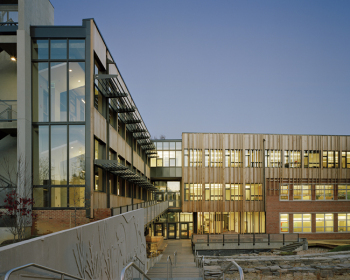
Sidwell Friends Middle School Building
“Brand new, but built to look obsolete and run down!”
(Guest post by Greg Forster)
Two weeks ago, Jay ruffled a few feathers by arguing that we shouldn’t care where President Obama’s children go to school. His point was that it isn’t necessarily hypocrisy for school choice opponents to send their kids to private schools, if they believe that private education is valuable (and thus something they’re willing to pay to acquire) but not the kind of thing government should subsidize to ensure equal access.
At the time, my response was that I totally believe Obama opposes school choice because he thinks government shouldn’t be in the business of ensuring that rich and poor alike have equal access to valuable goods and services, and I eagerly look forward to seeing this prinicple applied to his positions on welfare, health care, housing, labor policy, the environment, economic bailouts, entitlements, farm subsidies, taxes . . .
This morning, Jonah Goldberg argues that yes, Obama’s choice of Sidwell Friends while he opposes school choice makes him a hypocrite – but hypocrisy is overrated as a sin (this is a longtime hobbyhorse of Goldberg’s) and the real scandal is simply Obama’s (and other politicians’) opposition to choice. I couldn’t agree more.
But maybe school choice isn’t the only reason we should be interested in where the Obamas send their kids to school. This week, America’s Last Education Labor Reporter points out that Sidwell Friends is in abominable shape, and in desperate need of improvement:
It would be a shame if the Obama kids were to miss out on all these benefits, so we humbly submit these additions and subtractions to make Sidwell Friends the type of school the experts want all schools to become:
* Add a unionized workforce and a collective bargaining agreement. NEA asserts “that the attainment and exercise of collective bargaining rights are essential to the promotion of education employee and student needs in society.” How can the Obama kids have their education needs filled without agency fee, release time, grievances, binding arbitration and strikes?
* Add geographic enrollment boundaries. The Obamas will reside 3.5 miles from one Sidwell campus and 8 miles from the other, located in the state of Maryland. What’s next, flying in the next generation of Kennedy kids via helicopter from Massachusetts? Limit enrollment to those in the immediate neighborhood.
* Subtract weak teacher benefits. According to the Sidwell web site, teachers pay 10-40% of their health insurance premiums, pay into a defined contribution retirement plan, and receive only two personal days a year.
* Add diversity. The Obama kids will become part of the 39% of Sidwell students who are racial/ethnic minorities. But the DC Public Schools are 95% racial/ethnic minorities. How can the Obama children be denied so much of the rich cultural mix our nation’s capital provides?
* Subtract religion. The Quaker tradition is part of daily life at Sidwell Friends, including weekly worship meetings for all students, Quaker or not. This isn’t very inclusive of the Catholics, Muslims, Hindus, Wiccans and animists among the student body. Religious beliefs should only be studied from an academic standpoint and never practiced within a school’s walls.
* Add to the curriculum. Grades PreK-4 emphasize things like phonics, handwriting, vocabulary, comprehension, grammar, fractions, algorithms, geometry, and American history. Upper grades are heavy with English literature, advanced math, history, science, foreign languages and the arts. There isn’t much “getting information from television, film, Internet, or videos” or “Represent multiplication as repeated addition” for lower grades, or “Identify the countries, such as Italy, Poland, China, Korea, and Japan, where large numbers of people left to move to the United States at the end of the 19th and early 20th centuries” for upper grades. We don’t want to saddle a 21st century President with an 18th century curriculum.
As patriotic Americans, how can we stand by while our president’s family gets such substandard services?
Or maybe we shouldn’t be worried. After all, family and environmental influences are the only real determinants of educational outcomes. And clearly the Obama children are well blessed in that respect.
Or maybe we should be worried. After all, the Obamas did pick this shockingly substandard school, even though they had the opportunity to go with the nation’s most lavishly funded and heavily unionized schools in the D.C. public system, so how smart can they be?
13 Comments | politics | Tagged: Barack Obama, Greg Forster, Sidwell Friends | Permalink
Posted by Greg Forster

 Jay P. Greene's Blog