Liberating Learning

June 1, 2009

Liberating Learning by Terry M. Moe: Book Cover

Two decades after writing Politics, Markets, and America’s Schools, Terry Moe and John Chubb have done it again.  With Liberating Learning they’ve written a a compelling account of what is blocking significant improvement in public education and provided strategies for overcoming those obstacles. 

The main obstacle has remained the same across the two books: teachers unions.  Organized special interests in education as in other sectors of public policy shape the policies that are made.  In the case of education the special interests are so large, well-organized, and well-funded that their influence has distorted policy significantly to the benefit of the adults working in schools and against the interests of students and their families.

In their earlier book the solution to union dominance was choice and competition.  Interest groups can control policy but they can’t easily control markets.  But in the new book Moe and Chubb (they flipped the order of the names) acknowledge that unions have been generally successful at using politics to block the creation of effective markets.  Something has to loosen the union stranglehold to allow the markets to develop and prosper.

In Liberating Learning they’ve found what they think will break that logjam: technology.  The increasing use of technology in education will transform the operation of schools and the role of teachers in education.  In general, it will reduce the need for teachers by replacing (at least to some extent) labor with capital.  It will generate tons of data, improving the transparency of schools to the public and policymakers.  And it will decentralize the education workplace, making it harder for unions to organize and control the workforce.

There are clear echoes of Clayton Christensen’s work on disruptive technologies in this new book.  But unlike Christensen, Moe and Chubb focus on the politics of public organizations rather than technology per se.  In fact, if you are looking for detailed descriptions of how technology should be used in education or hard proof of its effectiveness, you won’t find it in Moe and Chubb’s new book.  They are not trying to prove that these technologies are educationally effective or describe best practices, although it is clear that they have some ideas on these topics.  They are trying to describe the political logic of the current stagnation in education and how it might be altered.

The clear writing and tight argument will make Liberating Learning a pleasure to read for education reformers.  We might still wonder whether unions will be able to use politics to block the transformative effect of technology, but the book is sure to provoke a lot of productive discussion and thinking.

(edited for typos)


School Choice is the New Civil Rights Struggle

May 31, 2009

So says the WSJ on Saturday.  Didn’t they get the memo that serious people don’t talk about school choice?  Or was the message of that memo that we want the embarrassment this issue causes Democrats to go away already.


Pass the Popcorn: Things Are Looking Up – Or Are They?

May 29, 2009

UP 1

(Guest post by Greg Forster)

Well, I’m going to owe a lot of people their money back on this post. Bowled over by the new Star Trek film (which you should really go see if you haven’t already) I overconfidently predicted that it would be the best movie of the year, and offered a refund on the price of the blog post to anyone who felt differently at year’s end. My reasoning at the time – as I explained in the comment thread – was as follows: “Take a look at what else is on the docket for this year. See anything that’s likely to be better?”

Guess what I had completely and totally forgotten about?

When I realized that a Pixar movie was coming out this summer, here’s what I felt like:

UP 2

But who knows? Pixar has been less than stellar in the past – remember A Bug’s Life and Monsters Inc.? Both are better than the average family movie, but to say that is damning with faint praise.

And UP comes to us from a relatively untested creative team. It was written by Bob Peterson and co-directed by Peterson and Pete Docter. Both have accumulated some secondary credits at Pixar – Peterson got secondary writing credits on Finding Nemo and Ratatouille; Docter got “story” credits on both Toy Story movies, Monsters Inc. and Wall-E; both have worked on Pixar shorts, direct-to-video projects, videogames, etc. (Peterson was also the voice of Ray the science teacher in Nemo and Roz the bureaucrat-cum-deus-ex-machina in Monsters.) Neither seems to have done much outside Pixar.

Between the two of them, there’s only one topline credit before UP. Guess what it is?

Docter directed Monsters Inc.

Let’s see how far back we have to go before we find a Pixar movie with a similarly untested creative team:

Wall-E: Written and directed by Andrew Stanton of Finding Nemo

Ratatouille: Written and directed by Brad Bird of The Incredibles and The Iron Giant (a masterpiece you really must see if you haven’t yet)

Cars: Written and directed by John Lasseter of Toy Story & Toy Story 2

The Incredibles: Written and directed by Brad Bird of The Iron Giant

Finding Nemo: Written and directed by Andrew Stanton of . . .

. . . well, OK, I guess the last time we had an untested creator at the helm, we did pretty well, didn’t we?

But guess when the last time before that was? Monsters Inc. Directed by Pete Docter.

I suppose I’m being overly pessimistic. It’s partly because I don’t want to have to shell out all that money on my ill-advised guarantee.

But I have another reason to suspect UP will be no good – I loved the teaser trailer.

No, seriously. Up until now, I have hated every teaser trailer I’ve seen from Pixar. I hated the teaser for Finding Nemo. I hated the teaser for The Incredibles. I really hated the teaser for Cars. I don’t remember seeing the teaser for Ratatouille but I didn’t go in with high expectations so I can’t have liked it if I did see it. And I was, I guess, nonplussed by the teaser for Wall-E – by that time I had learned that hating the teaser was actually a good sign, so that changed my whole outlook on them.

So up until now the teasers have been awful and the movies have been great. What does it say that the teaser for UP made the movie look really good?

This is the second of what I guess will be an annual series of Pass the Popcorn entries on Pixar. I don’t think I can top what I said in the first edition, so I’ll stop here.

Except I will note that the plot synopsis for Toy Story 3 has changed pretty radically since I first expressed such trepidation about it. Before, there was a whole paragraph, which I don’t remember in detail but it was about Woody and Buzz getting thrown away after Andy grows up. Now it’s just one sentence, and Woody and Buzz are ending up in a day care. That sounds much more promising.


Oooooooops!

May 27, 2009

(Guest Post by Matthew Ladner)

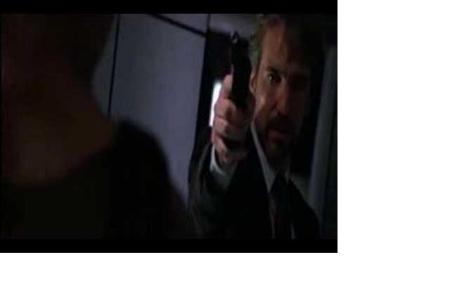
One of my favorite scenes from Die Hard is when the evil villain Hans gets found by our hero, John McLain. Hans, dastardly fellow that he is, passes himself off as an American. John gives him a gun to have him help fight the bad guys. John turns his back, and the villain confidently pulls the trigger, only to hear a loud

 **CLICK**

hans

McLain looked at Hans, shocked to be holding what he now knew to be an unloaded gun, and said, if memory serves: “OOOOOOOPS!!!! Do you think I’m f****** stupid Hans?!?”

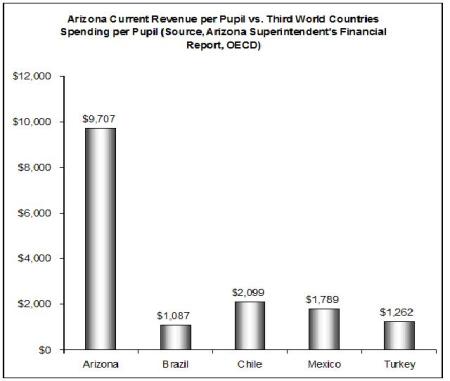
Apparently, an outfit calling itself the “Arizona Economic Council” thinks that Arizonans are stupid. They shot an advertisement in Africa claiming that the looming budget cuts in K-12 threaten to move Arizona to Third World Status.

There is just one little problem with this: objective reality.

The Organization for Economic Cooperation and Development has this pesky habit of actually collecting spending per pupil data. Here is Arizona compared to the Third World Countries:

Third world 1

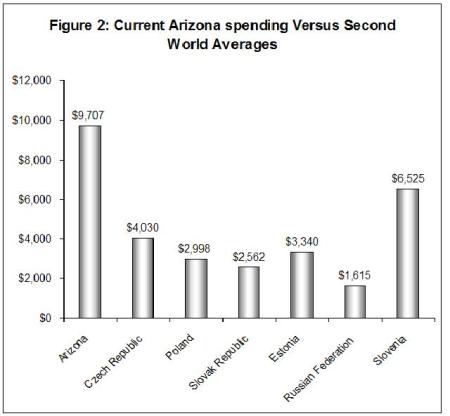
Oooops! Arizona spends five to nine times more than any of them. How does Arizona compare to Second World (former Communist) countries?

Third world 2

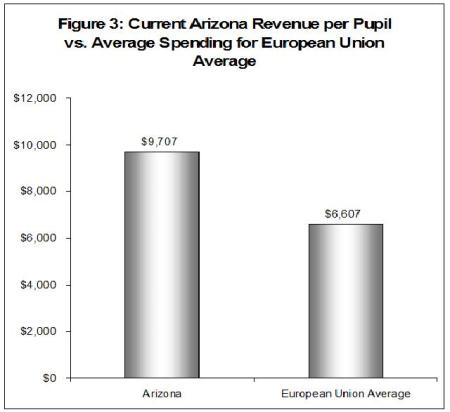
Ooops! All the former communist countries would kill to switch places with Arizona. How does Arizona compare to First World European Countries?

Third world 3

Ooops! Arizona’s figure is 48% higher.

I could dig up comparisons on academic outcomes but that would just be running up the score. Like Hans, the so-called Arizona Economic Council is shooting blanks. And given that they could have looked up these numbers before flying to Africa, I have to say they look pretty stupid.


Briefing on School Choice Research Misscheduled

May 27, 2009

nixon

(Guest post by Greg Forster)

BAEO, the Urban League and ASC are holding a briefing on What the Research Says about School Choice tomorrow afternoon, 2:00, at the National Press Club. It’s open to the public “by RSVP only,” so contact Ashley Ehrenreich at aehrenreich@allianceforschoolchoice.org or 202-280-1986 if you want to attend.

The good news is, you can hear Jay P. Greene’s Blog’s own Jay P. Greene along with an all-star lineup of school choice researchers discussing what the research says about school choice.

The bad news is, due to a horrible scheduling mixup, the sponsors failed to obey the new city ordinance that says all public release of information regarding vouchers within the boundaries of the District must take place late on Friday afternoon. If even the Obama administration couldn’t get itself exempted, why did these guys think they could?


The Last Word on Unions and Reform

May 26, 2009

building_unions

(Guest post by Greg Forster)

In the great Flypaper debate over whether unions are an obstacle to reform, Robert Costrell has what can only be considered the last word on the subject. Little Ramona started the argument by asserting that Massachusetts has strong unions and yet it accomplished some reforms, therefore unions are not an obstacle to reform, QED. (I paraphrase, but not by much.)

Costrell offers a very striking post on his real-world experience in Massachusetts. Excerpt:

It is indisputable that the Massachusetts Teachers Association (MTA) was the largest obstacle to implementing key elements of the reforms, most notably the MCAS exit exams, which were the main driver of Massachusetts’ success. Diane seems to minimize “the current effort to show that teachers’ unions were no help to education reform in Massachusetts,” as if this were some sort of recent revisionist history. But the “current” effort simply reiterates the well-documented history that was established at the time.  The fight against MCAS featured lawsuits, boycotts, demonstrations, and, most famously, the MTA’s $600,000 fear-mongering ad campaign (the ads showed a ticking clock with nervous students, despite the fact that the exams were untimed).

Here’s the game changer:

My own contribution to this history was solicited by Diane for her last annual Brookings conference….At the time, Diane thought my piece was “great.” So I was surprised to read that the lesson Diane now draws from Massachusetts is that “unions do not block academic improvement.” Well, it was certainly not for lack of trying.

Back in the early 1990s, we videogamers used to call that a “finishing move.”

In other news, sock puppet and Sith apprentice Leo Casey continues to offer his insights. Question for Leo: How deep do you intend to let the hole get before you stop digging?


Rick Hess on Recruiting the Teachers of the Future

May 22, 2009

(Guest Post by Matthew Ladner)

The new edition of Education Next is online, and Rick Hess has a very interesting article on modernizing the teaching profession. Rick notes that we need to update bedrock assumptions-such as assuming that the dominant model of teaching recruitment should rest on recruiting 20 year olds into colleges of education and then expecting them to teach for the next 30 or 40 years. Lots of interesting suggestions on technology, compensation and alternative certification.

Great article, well worth reading.


Indiana Teacher Union Implodes like a Freddie

May 21, 2009

(Guest Post by Matthew Ladner)

AIG, Bear Stearns, Freddie, Fannie, and now….the Indiana State Teachers Association!

The National Education Association has taken over the operations of the ISTA, its’ Indiana affiliate, due to “financial distress.”  ISTA’s medical and long-term disability insurance fund is projecting a $67 million deficit and is on the brink of bankruptcy due to very questionable investment management.  For instance, in a nine month timeframe, over 4,000 investment trades were made, many of which were in high-risk equities.

Question for Leo: when do we start that LLC? The fire-sale has begun! A mere $67m to buy a controlling interest in the political overlords of Indiana K-12 policy is cheeeeeeap!!


This is the Song That Never Ends

May 20, 2009

The AFT’s Leo Casey of union cue-card check and sock-puppet fame has written a blog post for his “steakholders” once again accusing me of cherry-picking.  The last time Leo accused me of cherry-picking voucher studies I produced what I believe are comprehensive lists of random-assignment voucher participant and high-quality voucher competitive effect studies.  Given his inability to substantiate that cherry-picking charge, I’m a bit surprised to see that he is a glutton for punishment and wants to make the charge again.  I guess Leo has joined with Shari Lewis, Lambchop, and all his sock-puppet friends to make this cherry-picking charge another song that never ends.

This time the issue is whether teacher unions tend to raise costs and lower student achievenement.  Leo noticed my guest posts over at Flypaper on this and asserts: “if you think that the scholarly literature on the subject is a guide, it clearly comes down in a place quite different from that suggested by Greene.”

Leo’s claim hinges entirely on what “scholarly literature” means and whether all “studies” should be treated equally.  For example, I could claim that the scholarly literature shows that candy improves student achievement, citing as scholarly literature papers written by my 5th grade son and friends whose research design involved describing how smart they felt after eating candy.

Leo doesn’t go quite that far but he does cite a study by the AFT’s very own Howard Nelson that makes a cross-sectional comparison of test scores controlling for a handful of observed demographics.  He also cites literature reviews that consist mostly of these cross-sectional analyses controlling for observed demographics. 

The problem is that there is a serious design flaw with these studies — unobserved factors that are associated with unionization may also be associated with student achievement.  For example, wealthier communities may be more likely to produce unionization because those communities have the wealth to bear the higher costs associated with unionized teachers.  Wealth may be associated with higher student achievement, but our controls for wealth (free lunch status) may not fully or accurately capture the differences in wealth.  So, unobserved and uncontrolled factors would bias the results from these cross-sectional studies.

Caroline Hoxby’s study, upon which I base my claims, employs a vastly superior research design that addresses this problem.  I’ll let her describe the problem and how she solves it:

“The … most serious obstacle is the identification problem caused by the difficulty of differentiating between the effects of a union on a school and the characteristics of a school  that make a union more likely to exist.  Even after controlling for observable characteristics of a school district such as demographics, there are presumably unobservable school characteristics associated with unionization.  The unobservable school characteristics that promote unionization may themselves affect the education production function….  My third, and probably best, attempt to solve the identification problem combines differences-in-differences and instrumental variables estimation.”

Her instrumental variable strategy involves using changes in state laws regarding unionization to derive unbiased estimates of when schools would unionize.  The change in the state law would help predict whether a school unionizes without being associated with the academic achievement in that school.  This is a far better way to estimate the effect of unionization than simply looking at whether unionized schools have higher or lower scores, since the scores and other factors associated with school quality could themselves be causing the unionization.

I’d put much more confidence in this rigorously designed study than a dozen weakly designed cross-sectional analyses.

But even if Leo insisted upon relying on the literature reviews he cites rather than the higher quality research, he would have to accept some results that aren’t very flattering to teacher unions.  Those lit reviews find that unionization raises the cost of education by about 8% to 15%.  In addition, they find that unionization tends to hurt the academic achievement of high-achieving and low-achieving students while benefiting more typical students found in the middle of the ability distribution. 

As Leo’s authority, Eberts, Hollenbeck and Stone, put it: “While on average students fare at least as well, if not better, in unionized schools, atypical students – students well below or above average ability – do appear to fare less well because instructional settings are more standardized, less individualized in unionized schools.”

So, if Leo wants to say that unions exacerbate the achievement gap for disadvantaged minority students while driving up costs, I guess he can rely on that literature review.  I prefer to rely on Caroline Hoxby’s rigorously designed study in a top economics journal.


Free to Teach: What America’s Teachers Say about Teaching in Public and Private Schools

May 20, 2009

Free to Teach cover

(Guest post by Greg Forster)

Today the Friedman Foundation releases Free to Teach: What America’s Teachers Say about Teaching in Public and Private Schools, a study I co-authored with my Friedman colleague Christian D’Andrea.

It’s a simple study with a powerful finding. We used the teacher data from the Schools and Staffing Survey, a very large, nationally representative, confidential survey of school employees conducted by the U.S. Department of Education. We just separated public school teachers from private school teachers and compared their answers on questions covering their working conditions.

We found that the government school system is not providing the best environment for teaching. Public school teachers fare worse than private school teachers on virtually every measurement – sometimes by large margins. They have less autonomy in the classroom, less influence over school policy, less ability to keep order, less support from administrators and peers, and less safety. So it’s not surprising that they also have less job satisfaction on a variety of measures. About the only thing they have more of is burnout. (The measures of teacher burnout were some of the more eye-popping numbers we found in the federal data set.)

Free to Teach box scores

The Schools and Staffing Survey is observational, so we can’t run causal statistical analyses. But it’s really not hard to figure out why private schools provide a better teaching environment. The government school system responds mainly to political imperatives, because anything owned and run by government is inherently political and always will be. Meanwhile, the biggest pressure on private schools is from parents, because if the schools don’t please the parents, the parents can take their children elsewhere.

Which of the two sources of influence – politics or parents – do you think is more focused on demanding that schools provide better teaching?

That’s why private schools deliver a better education even when they serve the same students and families as public schools, and public schools improve when parents can choose their schools.

Parents and teachers are traditionally thought of as antagonists. And no wonder – under the current system, parents have no effective control over their children’s education other than what they can extract from their teachers by pestering and nagging them. The status quo is designed to force parents and teachers into an antagonistic relationship.

But in the big picture, parents are the best friends teachers have. Ultimately, it’s parents who provide the pressure for better teaching, and – if what we’re seeing in the Schools and Staffing Survey is any indication – that pressure for better teaching provides better working conditions for teachers.

Here’s the executive summary:

Many people claim to speak on behalf of America’s teachers, but we rarely get the opportunity to find out what teachers actually have to say about their work – especially when people are debating government control of schooling.

This study presents data from a major national survey of teachers conducted by the U.S. Department of Education; the Schools & Staffing Survey. We break down these observational data for public and private school teachers, in order to compare what teachers have to say about their work in each of the two school sectors.

These are eye-opening data for the teaching profession. They show that public school teachers are currently working in a school system that doesn’t provide the best environment for teaching. Teachers are victims of the dysfunctional government school system right alongside their students. Much of the reason government schools produce mediocre results for their students is because the teachers in those schools are hindered from doing their jobs as well as they could and as well as they want to. By listening to teachers in public and private schools, we discover numerous ways in which their working conditions differ—differences that certainly help explain the gap in educational outcomes between public and private schools. Exposing schools to competition, as is the case in the private school sector, is good for learning partly because it’s good for teaching.

Key findings include:

• Private school teachers are much more likely to say they will continue teaching as long as they are able (62 percent v. 44 percent), while public school teachers are much more likely to say they’ll leave teaching as soon as they are eligible for retirement (33 percent v. 12 percent) and that they would immediately leave teaching if a higher paying job were available (20 percent v. 12 percent).

• Private school teachers are much more likely to have a great deal of control over selection of textbooks and instructional materials (53 percent v. 32 percent) and content, topics, and skills to be taught (60 percent v. 36 percent).

• Private school teachers are much more likely to have a great deal of influence on performance standards for students (40 percent v. 18 percent), curriculum (47 percent v. 22 percent), and discipline policy (25 percent v. 13 percent).

• Public school teachers are much more likely to report that student misbehavior (37 percent v. 21 percent) or tardiness and class cutting (33 percent v. 17 percent) disrupt their classes, and are four times more likely to say student violence is a problem on at least a monthly basis (48 percent v. 12 percent).

• Private school teachers are much more likely to strongly agree that they have all the textbooks and supplies they need (67 percent v. 41 percent).

• Private school teachers are more likely to agree that they get all the support they need to teach special needs students (72 percent v. 64 percent).

• Seven out of ten private school teachers report that student racial tension never happens at their schools, compared to fewer than half of public school teachers (72 percent v. 43 percent).

• Although salaries are higher in public schools, private school teachers are more likely to be satisfied with their salaries (51 percent v. 46 percent).

• Measurements of teacher workload (class sizes, hours worked, and hours teaching) are similar in public and private schools.

• Private school teachers are more likely to teach in urban environments (39 percent v. 29 percent) while public school teachers are more likely to teach in rural environments (22 percent versus 11 percent).

• Public school teachers are twice as likely as private school teachers to agree that the stress and disappointments they experience at their schools are so great that teaching there isn’t really worth it (13 percent v. 6 percent).

• Public school teachers are almost twice as likely to agree that they sometimes feel it is a waste of time to try to do their best as a teacher (17 percent v. 9 percent).

• Nearly one in five public school teachers has been physically threatened by a student, compared to only one in twenty private school teachers (18 percent v. 5 percent). Nearly one in ten public school teachers has been physically attacked by a student, three times the rate in private schools (9 percent v. 3 percent).

• One in eight public school teachers reports that physical conflicts among students occur everyday; only one in 50 private school teachers says the same (12 percent v. 2 percent).