Private Schools and the Public Interest

September 9, 2009

I may not agree with what you say, but I will defend to the death your right to say it. Just not in my neighborhood. While you are at it, drop by and beg for permission to run for office.

(Guest Post by Matthew Ladner)

Regular JPGB readers will recall the survey that the Goldwater Institute sponsored showing an appalling lack of civic knowledge among Arizona high school students, both public and private. Sneak preview: a special Oklahoma remix is on the way.

Well, guess what, we also asked a series of questions about political tolerance, volunteerism and satisfaction in the same survey.

Yesterday the Goldwater Institute released two studies: Tough Crowd: Arizona High School Students Evaluate Their Schools and Better Citizens, Lower Cost: Comparing Scholarship Tax Credit Students to Public School Students.

Let’s start with the latter study, which focuses on political tolerance and volunteerism. I could fish up absurd quotes from people about how only public schools can teach proper civic values, and how scary private schools under a choice system are certain to indoctrinate children into all sorts of dangerous anti-democratic ideologies. You being a discriminating consumer of education blogs, however, makes the task unnecessary.


So what happens when you ask a standard set of political tolerance questions to samples of public and private school students in Arizona? Try this:

Tolerance 1


Mmkay, maybe public schools aren’t doing much better at teaching tolerance than they are in teaching reading. Next we asked:

Tolerance 2


So a high percentage of kids, especially in public schools, like the idea of a personalized language police. Disturbing. Next:

Tolerance 3


Hello ideological segregation! Next:

Tolerance 4


Mmm-hmm, we’ll just have all the candidates drop by your house and ask for permission to run. Be sure to wear your ring so that the candidates can kiss it.

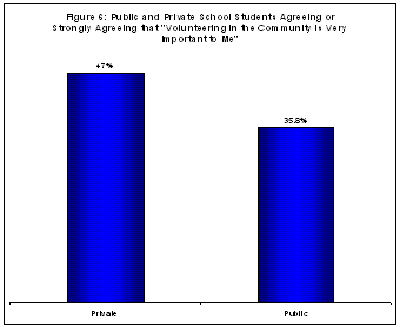
Ah well, tolerance isn’t the only civic virtue- volunteerism counts as well. Next we asked:

Tolerance 5


and while we were at it:


Tolerance 6


There were no meaningful differences between private school students attending with the assistance of a tax credit scholarship, and those who did not receive a scholarship. A minimum of 41% of tax credit scholarships are given out by groups that employ a means-test, so it is not the case that the private school kids are all wealthy and attending Dead Poet Society Schools, which are few and far between here in Arizona in any case.

Of course not all, and perhaps even none of the observed differences can be attributed to the actions of the schools. This however seems very unlikely. This was a survey of high-school students. I know I didn’t have a clue about my family income when I was in high-school, and thus wouldn’t believe the numbers we might get from asking about it, so we didn’t ask.

These results however strongly debunk the notion that private schools function as intolerance boot camps. In fact, it is much easier to build that sort of a case against public schools with the available data, though more research ought to be done.

Arizona’s $2,000 tax credit scholarships are looking like quite the bargain compared to $9,700 Arizona public schools. If you care about tolerance and volunteerism, that is.

More soon on how Arizona high school students view their schools.


Bud Light Makes an Ad about Ladner

September 9, 2009


(Guest Post by Matthew Ladner)


Still More Lefties for School Choice

September 9, 2009

Monopoly - Pennybags

Can you sell school choice to monopolists?

(Guest post by Greg Forster)

We’ve been tracking the increasing movement on the political left toward school choice.

Now, Arianna Huffington repackages school choice for the lefty crowd, connecting it to the health care debate by calling choice “single payer for education,” i.e. you choose the provider and government pays.

The association is distasteful, given that the pending government takeover of healthcare is a knife at the throat of our freedom. But if this is how some people need to think about it in order to see the point about school choice, that’s fine as far as it goes – in education, moving to a “single payer” system would be a step in the right direction, as opposed to a step in the wrong direction as with health care.

HT Eduwonk


New Blog — Mid-Riffs

September 8, 2009

Check out the new blog, Mid-Riffs.  It’s got a catchy name for a blog offering “a view from mid-America.”  In it’s inaugural post it declared:

“While those of us that contribute here won’t always agree, we are bound by a shared appreciation for good arguments, logical consistency, geeky sarcasm, and all things good.  We are against things that are bad (e.g., Texas).”

And in its first substantive post, Mid-Riffs takes on the new high school millage in Fayetteville, Arkansas.

(edited to correct typo)


Mostly Harmless

September 8, 2009

Many electrons have already been spilled on Obama’s speech today to the nation’s school children.  When news first broke of the planned speech, alarms were raised by Michelle Malkin, Glenn Beck, and Neal McCluskey (among many others). 

This was followed by a counter-backlash from the left as well as folks on the right, including the Wall Street Journal and Tunku Varadarajan at Forbes, who said that the initial reaction was “overwrought” and “demented” (respectively if not respectfully).

The counter-backlash is correct that the speech is basically harmless.  Telling kids to stay in school, say no to drugs, and the like is the sort of thing that Nancy Reagan used to say (and people used to mock not because it was indoctrinating but because it was likely ineffective.)

It’s worth stepping back from this kerfuffle to wonder why the president making a speech to the nation’s school children while they are in school is such a big deal.  The counter-backlash wants to suggest that the original backlash against the speech was motivated by crazy, conspiratorial thinking.  Presidents talk to the country all the time, they note.  And if the problem is supposed to be in the lesson plan proposed by the U.S. Department of Education, teachers can use or ignore these suggestions as they wish, just like they can regularly choose lesson plans.

But that is at the heart of the backlash and is not entirely crazy.  Parents sense a lack of control over what their children are taught in school.  This is as true of every day’s social studies lesson as it is of Obama’s speech.  Most of those lessons, just like the president’s speech, are likely to be unobjectionable to most parents. 

But on a fairly regular basis schools teach (or fail to teach) some things that are contrary to the values that parents would like conveyed to their children.  To those of us who see education as an extension of child-rearing, compulsory education privileging government-operated schools is an intrusion of the government on this parental responsibility.  To others, the intervention of the government is a positive good, protecting children from potentially dangerous values of the their parents and assuring allegiance to a common set of ideals necessary for our society to function.  As an empirical matter, government-operated schools are actually less effective at conveying that common set of ideas than are schools selected by parents.  

Amy Gutmann, in the widely read book, Democratic Education, argues that this is not really an empirical question.  The principle is that there should be some democratic input into what is taught to children, not just parental control.   But in a chapter in the book, Learning from School Choice, I dissect Gutmann’s book to show that her scheme isn’t democratic at all.  She believes that local democracies should control schools as long as they avoid discriminating and repressing.  The problem is that almost everything of importance that they do could be portrayed as discriminating or repressing.  So who, under her scheme, resolves these disputes about what is permissible for local democracies to control in schools?  Unelected judges and unelected teaching professionals.  Gutmann’s proposal is really to substitute the dictatorship of an elite for the dictatorship of parents.  As I’ve argued before, I prefer to trust even poorly educated parents to make decisions in the best interests of their own children than well-trained but differently motivated bureaucrats.

So, beneath the over-reactions and counter-over-reactions on Obama’s speech today is a real issue — Who should have primary responsibility for raising (educating) children?


Pass the Popcorn: Basterds = Glorious Fun

September 4, 2009

(Guest Post by Matthew Ladner)

It has been a long time since I walked out of a movie almost speechless other than an occassional “WOW…I mean………WOW!!!!”

Inglorious Basterds, a Quentin Tarrantino film a decade in the making, did the trick.

This flick will not be everyone’s cup of tea. Par for the course for QT, there is grisly violence. Described as a Spagetti Western set in Nazi occupied France, the film struck me as being longer than it ought to have been. Having said that, Inglorious Basterds is a great example of post modern film and a roller coaster of fun.

The film has dual subplots. In the first, Brad Pitt plays a charismatic Tennessee redneck army officer who recruits a team of Jewish soldiers to infiltrate occupied France to terrorize the Nazis. Pitt is out to terrorize the Nazis, and emulating the Apaches, demands 100 Nazi scalps from each of his troops. Pitt was magnificent in this role, and I found myself wanting to get back to his psycho-cartoon while the other plot developed.

The second plot features a young covertly Jewish woman in Paris who owns a movie theatre, and develops a plot to kill the Nazi high command, including Hitler himself, at a film screening. Here’s the trailer:

The name of this movie could just have easily been Nazis Need Killin’!!!! or I want my scalps!!!!!!

Christopher Waltz’s chillingly evil but elegant portrayal of an SS officer earned him a well deserved best actor nomination at Cannes.

As alternative universe World War II spagetti-western psycho Nazi killing revenge fantasies go, this  one is aces. It builds to an amazing cresendo, and left me wanting to turn around and see it again.


Ignorance May Be Bliss, But It Makes Bad Policy

September 4, 2009

ignorance-is-bliss

(Guest post by Greg Forster)

ALELR draws attention to some problematic details in the Gallup/PDK poll finding on Americans’ support for charter schools.

 I hate to draw attention to the PDK poll, since its voucher support question has been shown to be misleading in a way that drives down the appearance of voucher support by an astonishing 23 percentage points. But I feel pretty safe because the PDK voucher question has lost so much credibility that it’s not really very dangerous any more.

So back to the charter school question. PDK finds 64% of Americans support charter schools. That’s the topline. But guess what else you find if you look below that?

A majority of Americans don’t think charter schools are public schools.

57% believe charter schools charge tuition.

71% believe charter schools can select their own students.

Perhaps vouchers and charters were separated at birth.

Bear that in mind the next time you hear charters are more popular than vouchers. First of all, I doubt that it’s true – I’ve seen plenty of polls with around 64% support for vouchers. But on top of that, how sure are we that when people say they support charters they don’t think they’re supporting sending children to private schools of their choice using public funds, which is the very definition of a voucher?

Image HT I Think I Believe


Universal Voucher Benefits

September 3, 2009

Economist Maria Marta Ferreyra of Carnegie Mellon University has a new article coming out in the American Economic Review that models what would happen in a multi-district urban area if there were universal vouchers.  She finds that universal vouchers would generally improve income and racial integration and improve educational outcomes.

She explains it all in this excellent video:

UPDATED to correct typo


Tampa Tribune Op-Ed

September 3, 2009

Marcus Winters and I have an op-ed in this morning’s Tampa Tribune on how Florida’s McKay voucher program for special education students has restrained the spiraling growth in special education enrollments in public schools.  We write:

In Florida, as in most other states, schools receive additional funding for each student identified as disabled. Often, these additional resources are greater than the actual cost of providing special-education services, giving schools a financial incentive to increase their diagnoses.

The financial incentive to misdiagnose is particularly apparent when classifying students as having a specific learning disability (SLD). That’s because SLD is the most common, the most ambiguous, and the least costly category of special education. In many cases, school officials might simply be trying to get extra resources to help struggling students. But the net effect is the misclassification of a huge number of students as having an SLD.

The McKay program reduces the financial incentive for Florida’s schools to misdiagnose learning disabilities by placing revenue at risk whenever a student is placed into special education…

In our new study, we found as the number of nearby, McKay-accepting private schools increases, the probability that a public school will identify a student as having an SLD decreases significantly. The program reduced the probability that a fourth-, fifth-, or sixth-grader in a school facing the average number of nearby private options was diagnosed as SLD by about 15 percent.


School Board Democracy

September 2, 2009

Over at the Education Next Blog, my second blogging home, Peter Meyer has an excellent post about what school board democracy really looks like.

He describes how a gadfly like him could only manage to slip onto the board through a “stealth” campaign.  Normally boards are dominated by those backed by current school district employees or other status quo forces.  Those with the greatest vested interest in the status quo are the most motivated to turn-out during the intentionally inaccessible school board elections scheduled on off-election days.  But the low turn-out also allows a stealth candidate like Peter to get elected every now and then.  Don’t worry, now that he’s no longer stealth it’s very likely that a well-funded and organized challenger will unseat him next time around.

Peter then describes how the school board repeatedly blocked his efforts to open up school district decisions to greater scrutiny and public discussion:

And, after being sworn in, they went out of their way to keep me in the dark.  If the superintendent recommended hiring a new teacher and I asked to see the candidate’s resume, a motion was quickly made that school board did not want to see said resume.  It passed, 6 to 1.  When a special board meeting was called to approve $25 million in construction contracts, I asked to see the contracts.  “I make a motion that the board does not look at the contracts,” said one of my colleagues. “I second that, said another.”  Another defeat, 6 to 1…. My orientation consisted of the board president and superintendent sitting me down and saying, “You’re not getting anything.”

Ahh, democracy in action.

Oddly, Peter’s faith in school board democracy remains unshaken: “There is much debate in policy chambers and think tanks across the country about the value of school boards.  I am here to say we need them. And we need more of them.  They remain a kind of last hope for democracy, where a rogue can actually be elevated to position of authority, bringing a flashlight –- and, sometimes, a pulpit — to the process.”

I emphasize “faith” because it is hard to understand Peter’s commitment to the value of school boards given his experiences without attributing to him a religious-like devotion to it.  In the comments section of his post I objected that his examples support the position that school boards are a dead-end for reformers.  Rather than rely on the phony democracy of low turnout and insider controlled school boards, reformers should rely on markets.  Yes, we need democracy to set the rules for the markets, but that can be done by state legislatures.  We don’t need democratically elected boards to run schools.  Charter schools, for example, do just fine operating in markets without democratically elected boards to run them.

I fear that Peter’s committment to school board democracy despite all evidence that should dissuade him of his view is part of our national secular religion of public school.  It’s actually more like a cult.  We falsely believe that the public school is the foundation of our democracy when in fact our democracy preceded it by more than a century.  We wrongly believe that the public school is the main engine of civic progress when we know that public schools were segregated by law for most of their existence.  We wrongly believe that public schools are best at teaching political tolerance and other civic values, when the evidence shows that private schools actually serve these public goals better

Until we shake this cult-like devotion to public schools, expect more education pundits dancing through the airport singing their hare krishna song about the democratic virtues of public schools.

CLARIFICATION — I din’t mean to suggest that Peter is one of those cult members who worship at the true church of the public school.  I was just suggesting that these ideas pervade our thinking so that even very sharp reformers like Peter are dragged into praising school board democracy.