New Column on Florida’s Anti-Testing Nihlists

July 16, 2012

(Guest Post by Matthew Ladner)

I authored a column in response to anti-testing extremists in Florida. Here is a sample:

A recent problem with the FCAT writing test drew a great deal of attention from FCAT opponents. We should take care not to miss the forest for the trees. NAEP gave a writing exam in 1998 (just before Florida’s reforms) and again in 2007. Florida students achieved the largest gain of any state and more than three times larger than the national average during this period.

Sadly, leading the nation in writing gains on the highly respected NAEP exam seems to mean little to Florida’s testing opponents. One of the anti-testing groups seized upon the FCAT writing dispute to proclaim: “These abysmal FCAT Writes scores are proof that Tallahassee’s ‘education reforms’ are an unmitigated disaster.”

Against the highly credible NAEP score gains, testing opponents offer up a grab-bag of complaints and recently even a publicity stunt. A college-educated testing opponent recently claimed to have taken and failed a test similar to the 10th-grade FCAT. Whether this person actually took anything like the FCAT, or actually made any effort, is unknown but of little consequence. The vast majority of Florida 10th-graders did pass the FCAT on their first try last year.

Daniel Patrick Moynihan once stated that while everyone is entitled to their own opinion, no one is entitled to their own facts. Here are some facts: Since the advent of testing and reform, the nation’s most highly respected measure of academic achievement shows strong gains in Florida. Standardized test scores and graduation rates have both improved substantially since the late 1990s, which means Florida’s residents and students are getting more of what they want, need and deserve from the public education system today.


Random Pop Nationalization

July 13, 2012

“Don’t support national standards? Here is a pair of clown shoes to wear!”

(Guest post by Greg Forster)

NRO is on fire this morning. An awesome appreciation of the classic G.I. Joe series from Loren Smith (“When I get my hands on those Red October whackos, I’ll make ’em wish Karl Marx was Groucho’s brother!”) and a call to arms from Sally Lovejoy on how the Obama administration has made a lot of progress toward nationalizing education (“With the approval of two more state waivers of the NCLB Act, over half the states (26) have exchanged one set of federal mandates for another, moving us closer to a nationalized educational system.”).

Coincidence? Son, when COBRA is involved, there are no coincidences.

NOW YOU KNOW! And…

HT


Jordan Increased Income Inequality on the Bulls while Making All the Players Wealthier

July 11, 2012

(Guest Post by Matthew Ladner)

Fun piece by Matthew Schonfield in the Journal today. Strangely the guys riding the pine on the Bulls in 1998 making four times as much as their equivalents in 1984 did not feel the need to bang on drums to protest income inequality. Also read Iowahawk’s particle physics/health care mashup.


New Mexico Governor Susana Martinez on School Grades, Social Promotion and Teacher Policy

July 10, 2012

(Guest Post by Matthew Ladner)

New Mexico has released their first official A-F school report cards. They have more Fs than As, more Ds than Bs. Given New Mexico’s current standing near the bottom of the rankings on NAEP, that sounds about right. In the clip above, New Mexico Governor Susana Martinez explains why they adopted letter grades, and the next steps she would like to see for reform.

Congratulations to Governor Martinez and New Mexico’s education reformers. Far more remains to be done than has been done to date, but school grading represents a critical first step which reformers can build upon in order to create a more effective system of public education.


Some Great Pieces by Friends

July 9, 2012

In case you’ve missed them, there were some great pieces by Andrew Coulson and Bob Maranto in newspapers today.  And the book on Obama’s education policies edited by Bob Maranto along with Mike McShane, one of our graduate students who is now a research fellow at AEI, was reviewed by Nathan Glazer in Education Next.

Andrew’s piece appeared in the Wall Street Journal and made the unconventional but persuasive argument that we probably have too many teachers rather than too few.  Here’s a taste:

Since 1970, the public school workforce has roughly doubled—to 6.4 million from 3.3 million—and two-thirds of those new hires are teachers or teachers’ aides. Over the same period, enrollment rose by a tepid 8.5%. Employment has thus grown 11 times faster than enrollment. If we returned to the student-to-staff ratio of 1970, American taxpayers would save about $210 billion annually in personnel costs….

[NAEP] tests, first administered four decades ago, show stagnation in reading and math and a decline in science. Scores for black and Hispanic students have improved somewhat, but the scores of white students (still the majority) are flat overall, and large demographic gaps persist. Graduation rates have also stagnated or fallen. So a doubling in staff size and more than a doubling in cost have done little to improve academic outcomes.

Nor can the explosive growth in public-school hiring be attributed to federal spending on special education. According to the latest Census Bureau data, special ed teachers make up barely 5% of the K-12 work force.

The implication of these facts is clear: America’s public schools have warehoused three million people in jobs that do little to improve student achievement—people who would be working productively in the private sector if that extra $210 billion were not taxed out of the economy each year.

Bob’s piece appeared in the Northwest Arkansas Times.  The local Bentonville school district recently failed to  pass a millage to build a second high school to alleviate overcrowding in the current one.  Bob proposes that they might consider expanding the range of charter school options to alleviate overcrowding, save taxpayers money, and improve the choices for students for whom the large traditional public high school does not work well.  Here’s a taste:

There is a better and less expensive way to partially relieve overcrowding and serve student needs.

Why not keep a great big high school which works well for most kids, but also permit smaller schools of choice for parents who want something diff erent? Why not allow charter schools?

Charter schools are public schools managed like private schools. Like traditional public schools, charters are authorized by public authorities, must do well on state academic tests, have to serve special-needs students, and cannot impose religion or discriminate in admission.Yet like private schools, charters are self-governing rather than reporting to a district and school board.

Charters earn funding based on the number of parents choosing the school. If nobody chooses a charter, it closes, so charters work hard to please parents. Andif a charter fails financially or academically, the state closes it, making charter schools doubly accountable.

Charters typically serve niche markets with a singular focus such as the arts, vo-tech education, classical learning, or science and math, rather than trying to be all things for all families.

In Arkansas, charter schools must survive on the basic state per-pupil allocation and do not access any of the funding provided by local millage taxes. In Arkansas, and in most states, charters spend about a fifth less per pupil than traditional public schools, offering parents a choice and taxpayers a bargain.

Research shows that charters excel on teacher and parent satisfaction, and generally do somewhat better than average on student level value added (how much a student learns each year).

Approving a charter school in Bentonville could help alleviate overcrowding and enable Bentonville High to stay great rather than split in two. Since charter schools cost the local community nothing and charters are usually quick to open, they would off er more system-level flexibility in meeting demand. Charters could also offer a refuge to students who need a smaller environment, or just want something different.

And here is a taste from Nathan Glazer’s review of Maranto and McShane’s book on Obama’s education policies:

… the program that education reformers have tried to promote now for decades—introduce more choices of schools for students, enable competition among schools, open up paths for preparing teachers and administrators outside schools of education, improve measures of student achievement and teacher competence, enable administrators to act on the basis of such measures, and limit the power of teachers unions—has been advanced under the Obama administration, in the judgment of authors Maranto and McShane….

Maranto and McShane conclude by noting four large forces that will shape the future of education and its funding: the increasing number and percentage of the aged, putting pressure on all other public functions, primarily because of the cost of medical care; the rise of the ”creative class,” as described by urban theorist Richard Florida, as those who work with ideas and demand more from teachers and schools; the new technology for education, rivaling and undermining traditional approaches and structures; and advances in measurement of achievement and competence, making the failings of current schools and educational approaches more apparent. This makes for a sobering future for traditional education: it will not be able to count on more public resources, and ideas will become more important than ever. Clearly, despite NCLB and Race to the Top, we are only at the beginning of an age of reform in education, whoever comes out ahead in the election.

Of course, if Andrew, Bob, and Mike were really hot policy analysts they should have just communicated their arguments in 140 characters.  Don’t they know that all the really cool kids have PLDD?


Petty Little Dictator Disorder (PLDD)

July 9, 2012

I would like to tell you about a serious condition afflicting thousands of policy analysts.  It’s called Petty Little Dictator Disorder, or PLDD, and you or someone you love could be suffering from this epidemic sweeping through our think tanks, advocacy groups, and government offices.  According to the description pending for inclusion in the DSM V, here are the warning signs of PLDD:

  • Do you spend a fair amount of your time imagining how the government could be used to shape people’s behavior for their own good?
  • Do you tell yourself and others that you believe in liberty and stuff but there are negative externalities, information costs, and children who need protecting from their parents, so we need to step in?
  • Do you use the word “we” a lot to refer to government action by which you really mean you and your friends?
  • Do you consider yourself an expert despite having never really done anything or rigorously studied anything in your life?
  • Do you feel the need to communicate your expert opinions in no more than 140 characters more than 1,000 times a year because you need constant reinforcement in the belief that you are changing the world?
  • Do you sit in cafes or bars with your colleagues and have conversations that resemble dorm room pot-smoking bull sessions about how it would be best for families to live in apartments above bodegas with the sound of light rail roaring just outside their window because, after all, the life you currently have and enjoy is the same thing that families with three children and a dog should want?
  • Do you think science or a panel of experts can identify the right way to do almost anything?

If you answered yes to any of these questions, you may be suffering from PLDD.  But don’t worry, help is available.  Here are some steps that may address your PLDD:

  • Think about how others have plans for their own lives just as you have a plan for yours.  Just because you don’t understand their plan doesn’t mean that theirs is not legitimate or that you should impose your vision on them.
  • Recognize that just as others are subject to limited information and systematic deviations from rationality, so are you.  You shouldn’t imagine that you are the rational, well-informed one whose plan can fix the defects from which others suffer.
  • Remember that you and your friends are not the government.  Once the government takes responsibility for an issue, no one can completely control what the government will do and those with the strongest vested interests (and often not the best intentions) are likely to have more influence than you.
  • Be humble about the limits of your knowledge and expertise.  You may have gone to an elite school and have always been told how smart you are, but that doesn’t mean that you understand everything.  Understanding comes from real experience and/or rigorous examination of an issue.  Reading a bunch of articles or having spent a few years as the deputy assistant director of whatever does not count as experience or rigorous examination.
  • Don’t confuse the constant sound of your own voice (or Tweets) and the praise of your friends with actually influencing things.  Roosters may be noisy but they don’t actually make the sun come up.  Pick your topics, develop real expertise in those topics by having meaningful experience and/or engaging in rigorous scholarship, and then communicate when you really think you have something to add.
  • If you choose meaningful experience as your path to expertise, remember that it takes many years of experience to develop expertise.  Rigorous scholarship allows one to generalize from a systematic review of evidence relatively quickly, but it is virtually impossible to generalize from experience until you have accumulated many years of it.
  • Dorm room, pot-smoking bull sessions are fine if you are in college, but you really need to grow out of them if you want to be a serious policy expert.  Sitting around after you’ve graduated college and agreeing with your friends about how much different occupations should be paid, what kinds of cars people should drive, what people should eat or drink, etc.. just makes you the Peter Pan of dorm room, pot-smoking bull sessions.
  • Understand that “ideology” is just the negative spin that people suffering from PLDD use to describe the principles or values of people with whom they disagree.  There is nothing wrong with having an ideology (or principles and values) since it helps guide you about the ends for which you are striving.  Just be sure not to confuse your ideology with an empirical claim.
  • Be humble about the ability of science or experts to resolve questions, just as you should be humble about your own expertise.  Science provides a method for understanding the world, but it does not answer questions about principles and values.  And even when it comes to empirical questions, science always leaves some uncertainty.  That doesn’t mean you should reject science and embrace the nihilistic view that science just consists of lies and manipulation to disguise interests and power.  But it does mean you have to be wary of interest and power corrupting science just as they can corrupt everything else.

PLDD has often gone unnoticed and untreated.  Attention has instead focused on BSDD — Big Scary Dictator Disorder.  And while it’s true that people with BSDD, like Hitler, Stalin, Saddam Hussein and Kim Jong Il, have posed grave threats to the world, the dangers of PLDD are more insidious.  People with BSDD are relatively easy to recognize, there is strong motivation to mobilize an opposition to their disorder, and the condition is quite rare.  When it comes to PLDD, however, people hardly notice how their liberty is chipped away bit by bit by those suffering from PLDD.  PLDD is also very common, by some estimates afflicting a majority of policy analysts.  And the righteousness and good intentions of those with PLDD undermine the effective mobilization of a response to the disorder.

I hope you will help me fight the scourge that is PLDD.  Try to check this disorder within yourself and watch for the signs of it in others.  Together, we can win the war against PLDD.


Reform School, The Final Clip

July 5, 2012

In this one, being the meanie that I am, I support federal programs, like Title I, to help educate students who cost more:

If you’ve missed the previous 6 clips, you can find all of them here.


Ohio Superintendent to Lawmakers-Please Ignore the Illiterates Behind the Curtain

July 5, 2012

(Guest Post by Matthew Ladner)

Ohio recently passed a law to curtail social promotion from the 3rd grade for students requiring extra help in reading. Not everyone is thrilled as a Ohio Newspaper recently reported “Pike-Delta-York Superintendent Ken Jones thinks the state is overstepping its boundaries with the mandate.   ‘School administrators and parents are smart enough to figure all that out. We don’t need the state coming in and telling us how to operate or telling us how to move kids through our system,’ he said.”

Hmmmm

I’m sure Ohio school administrators are plenty smart, but they might want to go look at some data before making their mind up about the need for this policy. The figure below draws data from the NAEP data explorer, showing the percentage of Ohio students scoring “Below Basic” and “Proficient or Better” on the 2011 4th grade reading NAEP by ethnicity.

Superintendent Jones does seem to have one thing right- he and his fellow Ohio Superintendents apparently know all about “moving kids through the system”- even the students who desperately need more help in mastering basic literacy skills. Note that among Ohio’s Black students that four times as many scored Below Basic as Proficient. The fact that fifty-four percent of Ohio’s Black 4th graders couldn’t read in 2011 hardly constitutes a firm basis for a “steady as she goes!” declaration.

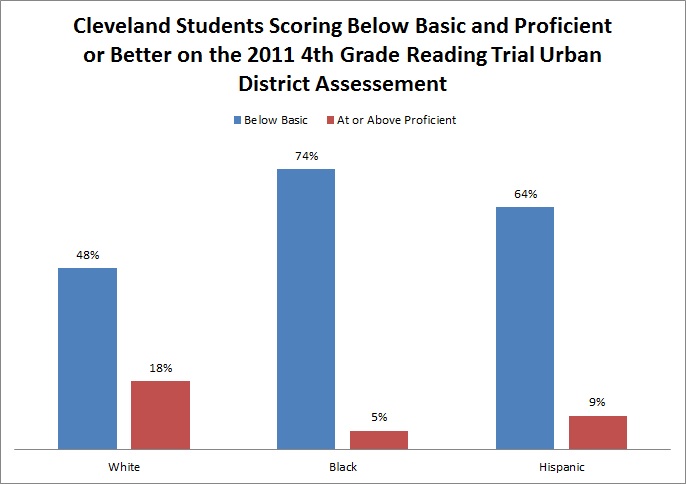
Superintendent Jones may feel confident that he and his compatriots have this whole reading thing figured out, but it is little wonder why Ohio legislators and Governor Kasich saw things a bit differently. If I really wanted to be cruel I would go look up the numbers for Cleveland in the TUDA…err…wait….too late!

More than twice as many White students scoring Below Basic as Proficient,  almost 13 times as many Black students scoring in the illiterate area as Proficient, seven times as many among Hispanics. Little wonder that Ohio lawmakers also decided to depart from the status-quo again and turn the district over to the Mayor.

What makes anyone think that this policy will make things better? Well there are no guarantees that Ohio will implement it as well as Florida, but here is what happened in Florida:

I’m sure that life would be easier for Ohio Superintendents if lawmakers would just keep sending the money to the districts without asking any questions. I’m also however certain that it would not make life for students any easier if Ohio continued to ignore what is plainly a literacy crisis.


Bipartisan Group of NC Legislators Override Veto, Enact K-12 Reform

July 3, 2012

(Guest Post by Matthew Ladner)

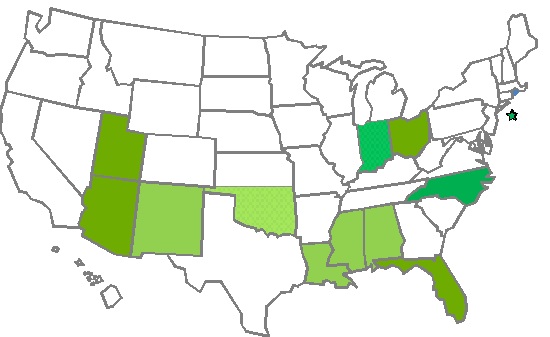
The North Carolina legislature voted to override the budget veto of Governor Purdue, enacting significant K-12 reform in the process. Reforms included in the budget include A-F school grading, curtailment of social promotion and merit pay for teachers.

I think that the map of states having adopting A-F school grades now looks like this, although I may have missed a state. The star represents New York City:


National Standards Post for GWBI Blog

July 3, 2012

I wrote a post for the George W. Bush Institute’s blog to build on the debate I had last week with Checker Finn in the Wall Street Journal about national standards.  Here is a taste of the blog post:

Last week Checker Finn and I debated the merits of national standards in the pages of the Wall Street Journal.  Checker argued for requiring that all students meet the same, national standards, while I argued against.  I oppose national standards because I don’t think all students should learn the same things in the same way, because I don’t trust a national authority to correctly identify what students should learn, and because I am convinced that progress in education, like in our economy, comes from choice and competition rather than from central planning.

But many good and smart people are nevertheless attracted to national standards.  Why?  I think the problem is a mixture of hubris, impatience, and naiveté….

As tempting as it is for people of good will who see the problems of our education system and think they know better ways of doing things, it is important to resist the impulse to impose a national solution.  You may not know the better way for everyone; you need to work with parents and localities to gradually experiment with reforms; and you shouldn’t imagine that you will be the one in charge of the national solution.  Avoid the dangers of hubris, impatience, and naiveté while pressing forward with the gradual experimentation of choice and competition.