(Guest Post by Matthew Ladner)
Good timing Greg- saw your post on a long flight. How is this?

(Guest Post by Matthew Ladner)
Good timing Greg- saw your post on a long flight. How is this?
 2 Comments |
  Digital Learning | Tagged: Massive Open Online Courses, Pulp_O-Mizer |
  Permalink
 Posted by matthewladner

The path-breaking sociologist, James Coleman, was not a fan of high school sports. He thought the culture of athletic prowess swamped the culture of academic success. Schools should get rid of sports and channel that competitive spirit into inter-scholastic academic contests, like Quiz Bowl.
But James Coleman also believed that the enhanced social capital produced by church attendance was key to the success of Catholic schools. The adults would get together at church, share information about their kids and school, and thus be better positioned to work together to improve their school academically. The adult culture of academic success could prevail more easily if the adults were better connected with each other by seeing each other on a regular basis at church.
But maybe high school sports are the secular equivalent of church. Perhaps Friday night football is an event, like church, that gathers parents, allows them to share information about their kids and school, and more effectively work together to improve their school.
So which James Coleman is right? Is it the one who fears athletic success subordinating academic success or the one who thinks social capital is the key to school improvement?
Dan Bowen and I decided to examine this issue with an analysis of Ohio high schools. We look at whether high schools that give greater priority to athletic success do so at the expense of academic success. The results of our analysis are in the current issue of the Journal of Research in Education.
We found that high schools that devote more energy to athletic success also tend to produce more academic success. In particular, we looked at whether high schools with a higher winning percentage in sports also had higher test scores as well as higher rates of educational attainment. We also looked at whether high schools that offered more sports and had a larger share of their student body participating in sports also tended to have higher test scores and higher attainment.
Using several different specifications, we find that higher rates of athletic success and participation were associated with schools having higher overall test scores and higher educational attainment, controlling for observed school inputs. For example, we found:
With regard to attainment, a 10 percentage point increase in a school’s overall winning percentage is
associated with a 1.3 percentage point improvement in its CPI, which is an estimate of its high
school graduation rate.
We also looked at whether schools that offered more opportunities to participate in sports had different rates of attainment:
When we only examine winter sports, an increase of one sport improves CPI by 0.01, which would be a 1
percentage point increase in the high school graduation rate. For the winter, the addition of 10
students directly participating in sports is associated with a 0.015 improvement in CPI, or a 1.5%
increase in high school graduation rate.
In addition to attainment, we also looked at achievement on state tests:
We observe similar positive and statistically significant relationships between the success
and participation in high school sports and student achievement as measured by the Ohio
standardized test results. A 10 percentage point increase in overall winning percentage is
associated with a 0.25 percentage point increase in the number of students at or above academic
proficiency. (See Table 4) When we examine the effect of winning percentage in each sport
separately, once again winning in football has the largest effect. Girls’ basketball also remains
positive and statistically significant (at p < 0.10), but boys’ basketball is not statistically
distinguishable from a null effect.
Lastly, we looked at the effect of participation rates in Ohio high schools on overall student achievement:
As for participation and achievement, the addition of one sport increases the number of
students at or above academic proficiency by 0.2 of a percentage point. The addition of 10
students directly participating in a sports team improves the proportion of students at or above
proficient by 0.4 of a percentage point. Both of these results are statistically significant at p < 0.01. (See Table 5) When examining just the winter season, adding one winter sport increases the
percentage of students performing proficiently by 0.4 of a percentage point, while an additional
10 student able to directly participate in sports during the winter season relates to a 0.6
percentage point increase in students at or above proficiency (see Table 5)
It is a common refrain among advocates for education reform that athletics “have assumed an unhealthy priority in our high schools.” But these advocates rarely offer data to support their view. Instead, they rely on stereotypes about dumb jocks, anecdotes, and painful personal memories as their proof.
Our data suggest that this claim that high school athletic success comes at the expense of academic success is mistaken. Of course, we cannot make causal claims based on our analyses about the relationship between sports and achievement. It’s possible that schools that are more effective at winning in sports and expanding participation are also the kinds of schools that can produce academic success. But the evidence we have gathered at least suggests that any trade-offs between sports and achievement would have to be subtle and small, if they exist at all. Descriptively, it is clear that high schools that devote more energy to sports also produce higher test scores and higher graduation rates.
I guess James Coleman was right — er, I mean, the James Coleman who focused on social capital, not the other one who feared the culture of athletic competition.
[Updated for clarity and to correct typos]

7 Comments | research reports | Permalink
Posted by Jay P. Greene

(Guest post by Greg Forster)
If you value your productivity, do not click here.
Also, to keep this rolling, I made this:

Your move, Matt.
Leave a Comment » | random pop culture | Tagged: Greg Forster, John Rawls, Robert Enlow | Permalink
Posted by Greg Forster
(Guest Post by Collin Hitt)
On Aug. 11 inside a school gymnasium in West Englewood, more than 200 parents scribbled their child’s name on a pink raffle ticket.
They crossed their fingers, prayed and waited.
Representatives of Freedom to Learn Illinois fished the names of 15 youngsters out of a bin. The kids whose names were called won scholarships to attend private schools of their choice. They wouldn’t be stuck at their designated neighborhood school. Fifteen children from at-risk families went home that day with a new backpack and a chance.
That’s from the Chicago Tribune’s excellent Monday editorial. Freedom to Learn is trying to succeed where public policy has failed, by giving kids a choice. The group – where I’m a board member – is a grassroots group dedicated to school reform. It currently commits most of its resources to opportunity scholarships. The obvious goal is to better kids’ lives, immediately. A larger objective of the group is to have its scholarship program become the model for a publicly funded program, like those in nearby Indiana and Wisconsin.
The Trib goes on to highlight a new school choice proposal in the Illinois legislature.
A bill introduced in Springfield takes a new approach to school choice that its sponsor, state Rep. La Shawn Ford, D-Chicago, hopes will temper opposition.
Ford’s bill would use money from lottery ticket sales to pay for 1,000 scholarships each year of up to $6,000. Students who live in the top-grossing ZIP codes for lottery sales would be eligible. Most of those ZIP codes are located in Chicago’s poorest neighborhoods. One Chicago ZIP code alone, 60619 on the South Side, generates nearly $30 million in annual ticket sales.
When it was launched in 1974, the Illinois Lottery was supposed to be the panacea for education funding. It never happened. Lottery money merely replaced, not supplemented, what the state was paying toward K-12 education…
Ford’s bill draws a straighter line between the lottery and education. It would cost the lottery about $6 million out of about $708 million in lottery proceeds that go toward special causes each year…
The bill gets around one important argument against traditional vouchers: The scholarship money wouldn’t come from tax dollars.
You have to give Ford an A for creativity. And I love the use of the lottery. In some states, like Georgia and Arkansas, the lottery is used to fund higher education scholarships; why not K-12 scholarships, which would actually do more to increase higher education attainment by decreasing dropout rates and increasing college attendance? Ford has a difficult fight on his hands (and some personal legal difficulties to manage as well). Illinois’ leading Democratic champions for school choice – Rev. James Meeks, Kevin Joyce and Karen Yarbrough – have all quit the General Assembly. The fight for school choice in Illinois likely remains a multi-year battle.
But in the meantime, Freedom to Learn and other Illinois charities will be putting kids through school, giving them the choice that our public education system currently denies them.
2 Comments | vouchers | Permalink
Posted by Jay P. Greene

(Guest Post by Matthew Ladner)
A few years ago, a rookie quarterback named Michael Bishop was brought into a game to perform a last second desperation bomb before the end of the half. It was his first pass as an NFL player, and against the odds it resulted in a long touchdown. Commenting on the pass for ESPN, Chris Berman said something to the effect of “Completion rate-100%. Pass to touchdown ration also 100%. QB Rating = INFINITY!!!!!”
This came to mind when reading this great piece by Wolf and McShane in that had Congress redirected money from the bloated and ineffectual DCPS for the Opportunity Scholarship Program, then the cost of the program would have been nothing and the benefits substantial, meaning ROI = INFINITY!!!”
[Note: This is based on their peer reviewed article that is in the current issue of Education Finance and Policy.]
1 Comment | vouchers | Tagged: DC Opportunity Scholarship Program, Mike McShane, Patrick Wolf | Permalink
Posted by matthewladner
 (Guest Post by Matthew Ladner)
So Michelle Malkin recently wrote columns of an alarmed tone warning of the dangers of the Common Core. Here is a taste:
Under President Obama, these top-down mal-formers — empowered by Washington education bureaucrats and backed by misguided liberal philanthropists led by billionaire Bill Gates — are now presiding over a radical makeover of your children’s school curriculum. It’s being done in the name of federal “Common Core” standards that do anything but set the achievement bar high.
Substitute the word “conservative” for “liberal” and the paragraph reads like Diane Ravitch. Ms. Malkin proceeds to repeat various anti-Common Core assertions as facts-but are they facts? Having read that last bit about “standards that do anything but set the achievement bar high” I decided to put it to a straightforward empirical test.
Kentucky was the earliest adopter of Common Core in 2012, and folks from the Department of Education sent some before and after statistics regarding 4th grade reading and math proficiency. I decided to compare them to NAEP, first 2011 KY state test and 2011 NAEP for 4th Grade Reading and Math. NAEP has four achievement levels: Below Basic, Basic, Proficient and Advanced. Kentucky also has four achievement levels: Novice, Apprentice, Proficient and Distinguished. The first figure compares “Proficient or Better” on both NAEP and the state test in 2011:
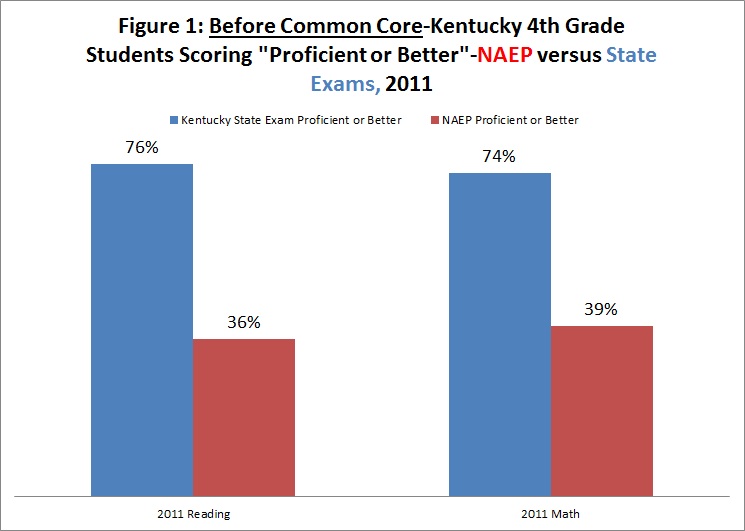 As you can see, Kentucky’s definition of “Proficient” was far more lax than that of NAEP. In the Spring of 2012 however they became the first state to give a Common Core exam. How did the 2012 state results compare to the 2011 NAEP?
 Kentucky’s figures are strongly suggestive that the new test is a good deal more rigorous than the old one- it tracks much closer to NAEP than the previous test. While it is possible that Kentucky had item exposure that explains some of the difference, but let’s just say there is an awful lot of difference to explain. We would expect somewhat lower scores with a new test, but if the new test were some dummied down terror…
There will also still be honest differences of opinion over standards independent of the rigor of the tests. Moreover, just because it is an obnoxious pet-peeve of mine, it is worth noting that starting out more rigorous doesn’t guarantee that they will stay that way…
A formal study could definitively establish the rigor of the new Kentucky test definitely vis-a-vis NAEP, but it is well worth considering where KY’s old test ranked in such a study by NCES. Short answer: Kentucky’s old standards were high-middle when compared to those of other states. Ergo we can infer that the proficiency standard on the KYCC test is far closer to those of NAEP than a large majority of current state exams.
There is room for honest debate regarding Common Core as a sustainable reform strategy, but we should have that debate rather than the present one.
UPDATE: Reader Richard Innes detected an error in the NAEP proficiency rates in the first version of this post. I made the mistake of looking at the cumulative rather than the discrete achievement levels and then treating the cumulative as discrete-thus double counting the NAEP advanced. If you have any idea of what I am talking about give yourself a NAEP Nerd Gold Star. Getting instant expert feedback is one of the best things about blogging, and I have updated the charts to correct the error.
In terms of substance, both sets of KY tests were further apart from NAEP proficiency standards, but the new ones are still far closer than the old ones.

28 Comments | school accountability | Tagged: common core, Kentucky Common Core, Michelle Malkin | Permalink
Posted by matthewladner

(Guest post by Greg Forster)
My colleagues at the Friedman Foundation have released this year’s ABCs of School Choice, which you can find here – but only if you want the very latest and best data on school choice.
Just inside the cover is this striking photograph of Milton and Rose, which I had never seen before. Coming up on seven years after his passing, I’m tremendously heartened by the progress school choice has made. Right up until his death Milton was boldly predicting that he would live to see one state enact a universal voucher. As I’ve said on numerous occasions, it was a gutsy thing to say for a man who had seen the far side of 90 and was cracking jokes about having outlived the actuarial tables.
Next to the photo appears this statement, which first ran in The School Choice Advocate in 2004:
Government is committed to assuring that all children receive a minimum education. It currently does so by setting up and running schools, assigning students within a designated catchment area to each school. Students are thereby deprived of choice. They go to the designated school or else they do not benefit from the government commitment and their parents must pay twice for their education—once in the form of taxes, again in tuition.
Equally important, government is deprived of the benefits of competition. It is as if the government decided that the automobiles it uses must be built in government factories. What do you think the quality and cost of government cars would be? Or, to take another example, it is as if recipients of food stamps were required to spend them in a specified government-run grocery store.
It is only the tyranny of the status quo that leads us to take it for granted that in schooling, government monopoly is the best way for the government to achieve its objective.
A far more effective and equitable way for government to finance education is to finance students, not schools. Assign a specified sum of money to each child and let him or her and his or her parents choose the school that they believe best, perhaps a government school, perhaps a private school, perhaps homeschooling. Let the schools in turn, whether government or private, set their own tuition rates, and control their own operating procedures. That would provide real competition for all schools, competition powered by the ultimate beneficiaries of the program, the nation’s children.
Check it out.
5 Comments | tax-credit scholarships, vouchers | Tagged: Greg Forster | Permalink
Posted by Greg Forster

(Guest Post by Matthew Ladner)
Jeb Bush and Clint Bolick are teaming up for a book on immigration that will come out in March, and previewed their thinking today in the Wall Street Journal. Read the article here. Basic thesis:
In some conservative circles, the word “comprehensive” in the context of immigration reform is an epithet—a code word for amnesty. People who oppose such reform declare that securing the United States border must come before moving toward broader reform.
Such an approach is shortsighted and self-defeating. Border security is inextricably intertwined with other aspects of immigration policy. The best way to prevent illegal immigration is to make sure that we have a fair and workable system of legal immigration. The current immigration system is neither.
3 Comments | politics | Tagged: Clint Bolick, Immigration Reform, Jeb Bush | Permalink
Posted by matthewladner
Any movie that begins with the message, “based on a true story,” is in danger of engaging in bad story telling and insufficient character development. Claiming that something is true appears to be license for lazy film-making. My objection is not that many “based on a true story” films are barely connected to real events. No, my concern is that because they claim to be real, film-makers think they can get away without doing the things necessary to make a great film.
Not all “based on a true story” movies are lousy; Argo, for example, tells a compelling story with well-developed characters. But Argo’s effectiveness is almost entirely derived from the ways the movie deviated from the “true story.” [SPOILER ALERT] The tension-filled ending was great movie making even though — actually, because — it bore no resemblance to actual events. And the most engaging character played by Alan Arkin was the one almost completely invented for the movie. In addition, we found the main character played by Ben Affleck so engaging in part because of the entirely fictitious back-story about his separation from his wife and son. The greatness of Argo comes from its effective story telling, not from its “reality.”
Zero Dark Thirty, on the other hand, was a really disappointing film because it relied on its “reality” as a substitute for great film-making. [SPOILER ALERT] There was virtually no character development. I didn’t know anything about what motivated the main character to join the CIA and hunt UBL. Yes, I saw that she had a friend killed, but her obsession with UBL pre-dates that. At one point in the movie, a supervisor specifically asks her why she was recruited by the CIA and she declines to answer. So, I know almost nothing about her life other than that she is hunting UBL. About 2/3 through the movie I realized I couldn’t even remember her character’s name because… well, because who cares about her? The movie was also poorly paced, painfully slow at times, and lacking in comic relief or any other variation in tension.
The movie is gripping, but so is playing Call of Duty with my son. Similarly, Call of Duty has no character development and maintains a numbing lack of variation in tension. But it sure is fun while you are playing it! It just isn’t a lasting story. We won’t re-tell that Call of Duty match we had several years ago nor will anyone, in all likelihood, watch Zero Dark Thirty in ten years. The appeal of it is entirely contained in the fact that it is topical. The meaning and excitement of Zero Dark Thirty comes not from the story the movie tells but from the story that I know from the world that I impart to the movie. When my knowledge of or interest in these current events fade, so will my (and everyone else’s) interest in the movie. The movie requires my knowledge of current events to mask its inadequate story-telling and character development. That’s not Best-Picture film-making.
Homeland is a much better version of Zero Dark Thirty. It is better because it has well-developed characters about whom I care and because it is intentionally crafted to be properly paced. It doesn’t have to worry about being true. It can just be good.
It’s true that Zero Dark Thirty is popular, but then again so are reality TV shows and they suffer from many of the same defects. If the Real Housewives of New Jersey were a scripted show, no one on Earth would watch it. But the show is quite popular because it claims on some level to be “real.” Everyone understands that it isn’t fully real. But it is a little bit “based on a true story.” And because of that, we accept its lousy story-telling and ridiculous characters. We do that because we are actually imparting to it knowledge of other real people that we know who we think may resemble the characters in some ways. We provide the context to make the stories work in reality TV.
Lastly, let me mention another recent film that claims to be “based on a true story,” The Way Back. Despite claiming to be real, the movie works well with an engaging story and set of characters. But as it turns out, the events on which the movie is loosely based are actually fiction. According to IMDB:
The film is based on a memoir by Slavomir Rawicz depicting his escape from a Siberian gulag and subsequent 4000-mile walk to freedom in India. Incredibly popular, it sold over 500,000 copies and is credited with inspiring many explorers. However, in 2006 the BBC unearthed records (including some written by Rawicz himself) that showed he had been released by the USSR in 1942. In 2009 another former Polish soldier, Witold Glinski, claimed that the book was really an account of his own escape. However this claim too has been seriously challenged.
I don’t see this as an indictment against the film at all. It was a compelling story that sold over 500,000 copies and led to a good movie because it was intentionally crafted to be a good story. Life rarely gives us that in its reality. That’s why we have imaginations to shape, combine, and alter our real experiences. In some sense, every story is “based on a true story.” The important thing is whether those stories are good, not whether they are true.
[Edited to add paragraph on Homeland]
1 Comment | random pop culture | Tagged: Argo, The Way Back, Zero Dark Thirty | Permalink
Posted by Jay P. Greene
(Guest Post by William Mattox)
Amid all the talk about gun control and mental health reform, one important question begged by last month’s tragedy in Connecticut has gone unasked: Is there anything we can do about the structure of education that might help lower the risk of another school massacre? I believe there is – and a poignant story (and some very interesting research data) will help explain why.
Two of my children once attended a small private school in a town where we had just moved. Early in the fall semester, another new kid at that school – a boy with Asperger’s Syndrome who would now be 19 or 20 years old – had several emotional “meltdowns” as he sought to adjust to his new routine. This unsettling behavior caused some school officials, and a number of concerned parents, to wonder if our school was equipped to handle the challenges presented by this student (whom I’ll call “Bradley”).
Bradley’s teachers rallied to his cause. They appreciated his keen intellect. And they were reluctant to give up on him – partly because Bradley had had a rough childhood. (His condition had been misdiagnosed for years, causing household stress that contributed to his parents’ divorce). But there was an even greater reason for the teachers’ reluctance: Since this was a Christian school, the teachers felt they had a special responsibility to “go the extra mile” with social outcasts like Bradley. Even if this was, at times, difficult.
So, Bradley remained a part of our school. And the teachers who’d had experience working with Asperger’s students helped those who’d had none. And they all sought to teach their students some important “life lessons” about dealing with people who are different from you.
Apparently, some of these lessons got through. One day, I chaperoned a dance at the school. When it came time for the first number, I saw one of the most popular teen girls in the school maneuver into a position where she could be the first girl Bradley asked to dance. This girl didn’t have a romantic interest in Bradley. But she did have a heart of compassion – and a maturity beyond her years. And she recognized that no girl would be apt to dance with Bradley unless someone like her saw past his social awkwardness and validated his worth. As a human being. As a child made in the image of God.
After the dance, Bradley got into his mother’s van and made a peculiar announcement. “Today, I placed my hand on the hip of four different girls,” he said. These odd words brought tears to his mother’s eyes, for she understood them to mean that her socially-awkward son’s yearning for human connection, for some measure of normal acceptance, had been met in a most meaningful way that day.
Now, I don’t want to insinuate that an episode like this could have only occurred at a Christian school – or that it would have happened at every faith-based private school. But when I consider how their Christian faith affected the way these teachers and students treated Bradley, I can’t help but affirm the Florida policymakers who created the McKay scholarship program that made it possible for Bradley to attend a private school of his family’s choosing. Especially since a recent research study suggests that Bradley’s experience at that school was not that unusual.
In view of all this, I think every state ought to adopt programs like Florida’s McKay scholarships (or Arizona’s Educational Savings Accounts) which give families of special needs students the freedom to choose learning options for their children beyond those available at their local public school. For many Asperger’s children (and other students with special needs) yearn for human connection and social acceptance – and delight when others affirm their worth in the eyes of God.
William Mattox is a resident fellow at the James Madison Institute and a Florida Voices columnist. His four children have all attended public high schools.
10 Comments | Education Savings Accounts, vouchers | Tagged: Education Savings Accounts, McKay Scholarships, William Mattox | Permalink
Posted by matthewladner


 Jay P. Greene's Blog