Constructive Criticism for Common Core Constructivism Deniers

March 21, 2013

(Guest Post by James Shuls)

Let me start by saying that I share most of Jay Greene’s reservations about the Common Core State Standards. Over the past couple of years, I have had the opportunity to discuss these concerns with many Common Core supporters. Although I typically disagree with their conclusions or their logic, I believe Common Core supporters are for the most part sincere in their belief that these standards are rigorous and will improve outcomes for students. However, I find claims that the Common Core State Standards will not influence instructional practices downright disingenuous and obviously false.

In a recent Twitter exchange, the Missouri Department of Elementary and Secondary Education informed me that the CCSS don’t “tell teachers how to teach.” This is a phrase that has been echoing across the country as the Common Core has come under attack from the left and the right.

The fact is that curriculum standards don’t tell teachers how to teach in the same way that a high jump bar doesn’t tell a jumper how to jump. You could theoretically jump over a high jump bar in whatever way you would like; but because of how the jump is structured there is a clear advantage to doing the old Fosbury Flop.

It is clear from documents on the Common Core website and from the discourse throughout the country that these new standards encourage constructivist teaching practices. Take for example these two quotes from a Key Points in Common Core Math document.

  • The standards stress not only procedural skill but also conceptual understanding, to make sure students are learning and absorbing the critical information they need to succeed at higher levels ‐ rather than the current practices by which many students learn enough to get by on the next test, but forget it shortly thereafter, only to review again the following year.
  • Having built a strong foundation K‐5, students can do hands on learning in geometry, algebra and probability and statistics. Students who have completed 7th grade and mastered the content and skills through the 7th grade will be well‐ prepared for algebra in grade 8.

Common Core developers themselves are saying that traditional methods of math instruction aren’t working and students should be learning through “hands on learning.” It is reasonable to assume the tests will likely favor constructivist teaching practices.

I have written extensively about what constructivist teaching looked like in my child’s classroom, where students were supposed to discover how to solve math problems rather than learn to use standard algorithms. My kid’s school is not the exception, it seems to be the rule. Across the country schools are beginning to understand that the Common Core standards will require a more constructivist based form of instruction.

In California, teachers will be “encouraging critical thinking over memorization, focusing on collaboration and integrating technological advances in the classroom.”  We are told that teachers “are attending workshops and training sessions to rethink the way they relay information to students.”

A Virginia newspaper reports, “Discovery, guided math, problem-based learning, project-based learning – call it what you like, it’s here.”

Even in Massachusetts, a state that had arguably better standards than the Common Core, teachers are moving more towards constructivist teaching practices. In the Wrentham School District, “the first and second grade math programs are already implementing new methods for teaching basic math skills that are designed to create deeper understanding of math among the students.” One teacher commented, “Our job as teachers is to guide through questioning.” If that doesn’t sound constructivist, then I don’t know what does.

I am aware that some non-constructivist based curricula, like Saxon Math, are aligning to the Common Core. They are doing so because they have to or they will be at a competitive disadvantage in the marketplace. It remains to be seen if these more traditional models will resist constructivist influences. Much of that depends on how the Common Core assessments are structured.

I am also aware that the standards do not dictate which pedagogical approach a teacher must take. Although, to me it feels a bit like when my mom used to say, “You can do what you want.” Which never really meant that I could do what I wanted.

The bottom line is that the Common Core State Standards are built on constructivist principles and are being implemented, by and large, by constructivist means. If supporters like constructivism, which I suspect most do, then they should just come out and say so. That is not such a difficult position to defend. But don’t attempt to tell me these standards won’t tell teachers how to teach.

———————————-

James Shuls is the education policy analyst at the Show-Me Institute


What’s in a Name? Memphis Edition

March 20, 2013

Memphis City Council member, Lee Harris, stands in front of the statue of Nathan Bedford Forrest

The names we give to public schools, parks, and buildings matter.  Names provide an opportunity for communities to identify what they hold dear and to remind themselves and teach their children about those values.  As Brian Kisida, Jonathan Butcher, and I argued in an analysis we did of trends in school names, school districts nationwide are more and more frequently missing the opportunity to use school names as a means for praising individuals who embody our cherished values.  Instead, we are now more likely to give schools vague nature names that sound more like herbal teas or day spas (Whispering Hills, Hawk’s Bluff, etc…), than people who we think could serve as models for our children.

Because names are important and because they should reflect community values, if communities change their values they also need to consider changing public names.  There is no doubt that Memphis has changed since it originally named three public parks: Confederate Park, Nathan Bedford Forrest Park, and Jefferson Davis Park.  State legislators in Tennessee, however, were considering a law that would prevent certain name changes.  According to the USA Today:

The “Tennessee Heritage Protection Act of 2013” bill, already introduced in the state legislature, would prohibit name changes to any “statue, monument, memorial, nameplate, plaque, historic flag display,school, street, bridge,building, park preserve, or reserve which has been erected for, or named or dedicated in honor of, any historical military figure,historical military event, military organization, or military unit” on public property…

To pre-empt that legislation the Memphis City Council voted 9-0 to temporarily rename these three parks as Memphis Park, Health Sciences Park, and Mississippi River Park.  They’ve also formed a commission to explore what the new names for these three parks should be.  Let’s hope they break the trend and actually identify individuals who embody values that Memphis holds dear after whom they will name the parks.  There are certainly a large number of great people associated with Memphis or who come from elsewhere who could fit the bill.


New Score: Tom Vander Ark 3, New Gates PLDD Strategy 0

March 19, 2013

The research score continues to run-up in favor of the old Gates education reform strategy of creating small schools of choice rather than the new Gates PLDD strategy of centrally determining what students should be taught (Common Core) and how teachers should be evaluated (Measuring Effective Teachers).  When Tom Vander Ark led the Gates education effort, they had a winning strategy.

The new evidence comes from another paper that was presented at the Association for Education Finance and Policy conference.  Two of my excellent students, Anna Jacob Egalite and Brian Kisida, received a data award from the Kingsbury Center to analyze the effect of school size on student achievement using NWEA test results.  They used a student-fixed-effects research design to see if students improved or worsened their academic achievement when they switched to a school of a different size.  And the results:

We found consistent negative effects of large school size on student math and reading achievement, especially in secondary schools that enroll more than 540 students. In grades 6-10, for example, math achievement declined by -.043 SD (standard deviation) and reading achievement declined by -.024 SD.

If a student moved from a largest quintile school in grades 6-10 to a school in the smallest quintile for those grades, we would expect a 6.4% of a standard deviation improvement in math performance.  Of course, a student fixed effects study is not quite as strong methodologically as the random-assignment evaluation of small high schools in New York City, but it is pretty darn good.  And this study has the advantage of using a large data base of more than 2 million students from across the country.  It’s pretty clear that students would benefit significantly from a reduction on school size — especially junior high and high school students.

Bring back Tom Vander Ark.


Bring Back Tom Vander Ark

March 18, 2013

Under Tom Vander Ark‘s leadership the Gates Foundation pursued an education reform strategy focused on creating smaller high schools.  The theory was that smaller high schools would create tighter social bonds between schools and students, preventing students from slipping through the cracks and increasing the likelihood that they would graduate and go on to college.  Smaller high schools could also be more varied in their approaches and offerings, allowing students to choose schools that best fit their needs.

But around the same time Vander Ark left the Gates Foundation at the end of 2006, the reform strategy shifted.  Rather than fostering small, diverse schools of choice, the Gates Foundation now wanted to build centralized systems of what everyone should be taught (Common Core) and centralized systems of evaluating, training, and promoting teachers (Measuring Effective Teachers).  As I’ve written before, the shift in Gates strategy was not prompted by research.  In fact, the high quality random-assignment study that Gates had commissioned to evaluate the small high school strategy showed strong, positive results.  But the post-Vander Ark leadership at Gates couldn’t wait for the evidence.  The knew the truth without any pesky research and had abandoned the small high schools strategy in favor of their new centralization approach years before those results were released.

Well, the evidence continues to pile up that the Gates strategy under Tom Vander Ark was effective and the new strategy is a failure.  A new National Bureau of Economic Research study by Lisa Barrow, Amy Claessens, and Diane Whitmore Schanzenbach examines the effects of small schools in Chicago.  Just like the earlier random-assignment study of small high schools in New York City had found and like the Vander Ark theory of reform had suggested, small schools promote high school graduation:

We find that small schools students are substantially more likely to persist in school and eventually graduate. Nonetheless, there is no positive impact on student achievement as measured by test scores. The finding of no test score improvement but a strong improvement in school attainment is consistent with a growing literature suggesting that interventions aimed at older children are more effective at improving their non-cognitive skills than their cognitive skills.

As Vander Ark had expected, smaller schools have non-achievement effects, like creating stronger social bonds, that help students go further in their schooling.  And as numerous studies have shown, higher educational attainment is strongly predictive of a host of good outcomes for students later in their lives. Score: Tom Vander Ark 2, New Gates PLDD Strategy 0.

Meanwhile I witnessed further confirmation of the failure of the new Gates approach during a panel at the Association for Education Finance and Policy conference last weekend.  The Gates folks spent more than an hour presenting their Measuring Effective Teachers work.  That stuff may win over gullible policymakers and journalists, but the researchers at AEFP were not impressed.

Tim Sass had the first question and essentially repeated my concerns about how MET fails to provide evidence for the use of multiple measures.  Value-added test scores are predictive of later life earnings, as Chetty, et al have shown, he said, but why should we believe that classroom observations measure anything we care about?  The Gates folks didn’t really have an answer.  Jane Hannaway then articulated my concern that effective teaching may be too context-dependent to lend itself to a single formula for effective practices.  The Gates folks responded that there are probably some basic skills for effective teaching that are useful in all contexts.  They may have a point but that does not address whether MET is getting at those basic skills or not.  The weak correlations of everything in the study suggest they are not finding approaches that are commonly effective.

A third questioner wondered about the cost of adopting the MET approach, especially given the need for multiple observations by multiple, trained raters.  The response was that schools are already spending money on classroom observations but of course that does not address the extra costs of the multiple rater/observations approach.

And lastly William Mathis asked about the generally weak correlations between classroom observations and value-added test scores.  Doesn’t this suggest that these are distinct dimensions of effective teaching that shouldn’t be combined in a single measure, he wondered.  The Gates response surprised me.  They said that the weak correlations were good news.  It is precisely because classroom observations and value-added measures capture different dimensions of effective teaching that we need to combine them in an overall measure.

Of course, this ignores the Sass question about whether we know that the classroom observations are measuring any important aspect of effective teaching.  But more problematic was the “heads I win, tails you lose” nature of their response.  If earlier arguments defending MET were based on how classroom observations and VAM were correlated, then how could the lack of correlation also be presented as proof of MET’s success?  I went up to the Gates presenters after the panel (and chatted with some of them later) and asked them what MET could have found that would have led them to conclude that combining the measures was a bad idea.  They were stumped.  Maybe negative correlations would have dissuaded them from advocating a combined measure, but they weren’t confident about that either.

Essentially, they admitted that the MET policy recommendation is a non-falsifiable claim.  No research finding would have dissuaded them from it.  The ability to falsify a claim is at the heart of science.  MET is not science; it is just politics.  You should have seen the discomfort of the Gates researchers as they pondered why they were presenting non-falsifiable claims as research findings at an academic conference.  This sort of thing corrupts science and has reputational consequences for the researchers who lend their credibility to the new evidence-free Gates reform strategy.

There is a solution to the rot at Gates — Bring back Tom Vander Ark.  At least his ideas were supported by rigorous research.


Where Have You Gone Mr. Moynihan? Our Nation Turns its lonely eyes to you

March 12, 2013

(Guest Post by Matthew Ladner)

The lovely Mrs. Ladner gave me Daniel Patrick Moynihan: A Portrait in Letters of an American Visionary for Christmas. Once I started reading it, a found it quite difficult to put down the 702 page tome. DPM’s career as advisor to Presidents Kennedy, Johnson, Nixon, Ambassador to India and the United Nations and United States Senator is interesting in itself. The real value of the book however lies in the letters of the scholarly Senator providing a first hand account of how Washington elites wrestled with the issues that still consume us today.

Despite the fact that Johnson viewed DPM somewhat suspiciously as an Irish Catholic “Kennedy man” Moynihan’s memoranda to President Johnson especially jump off the page. Moynihan laid out in detail why the path to the Civil Rights Act was comparatively easy compared to what faced the nation going forward. Americans broadly support equality of opportunity he explained but the reform coalition would inevitably fragment over attempts to provide equality of condition.

Citing data from the United States Armed Services exam, he attempted to steel the resolve of the Johnson administration that American Blacks had been so profoundly damaged by the legacy of slavery and Jim Crow that they were poorly situated to thrive in an atmosphere of free competition. DPM estimated that the nation faced a 50 year project to right this wrong, and that it would be enormously controversial, but that the administration may as well get on with it.  You can judge for yourself whether this was a wise course to follow, but Moynihan’s clear-eyed prescience regarding everything leading up to the Civil Rights Act having been the easy part of the struggle is breathtaking in its stark clarity.

During this same period however Moynihan began to sound the alarm concerning the dissolution of the Black family, predicting that the trend would ultimately undermine anti-poverty efforts. DPM gained lifelong enemies on the left for having dared to speak such a truth, only some of whom ever apologized to him years and even decades after it had become abundantly clear that he had been quite correct.

DPM’s cross-species jump to become a prominent policy advisor in the Nixon White House is amusing to watch. Many of DPM’s memos contain dark warnings concerning the New Left campus radicals. While DPM clearly viewed such people as illiberal thugs, as someone born in 1967 I can’t quite decide whether he genuinely viewed such people as a threat to democracy or whether he was simply manipulating a group of gullible Republicans.  Perhaps both and someone who lived through this era should let me know what they think. Regardless, Moynihan paints a vivid picture of a deeply chaotic and misguided America which I am quite happy to have left to others to endure.

DPM’s writings of the time reveals the Nixon administration as deeply concerned with issues of poverty and race along with Moynihan’s growing disenchantment with the Vietnam War. Repeatedly he warns Nixon that what had been Johnson’s War in the public’s perception steadily transforming into Nixon’s burden. DPM pushed Milton Friedman’s proposal for a negative income tax hard, hoping to defuse what he saw as a catastrophic cycle of resentment over welfare programs.

Welfare reform remained Moynihan’s white whale throughout his career in the Senate. He championed meaningful reform legislation in 1989, and led a desperate effort to get the Clinton administration to address the subject in the early 1990s. Moynihan seemed to carry the Hillarycare bill primarily to leverage stronger action on welfare reform, and eventually he turned on the administration. At one point he even set up a meeting between Hillary Clinton and economist William Baumol in an effort to explain the doom of the approach. Later to her credit Senator Clinton graciously admitted that she ought to have listened.

In the end, DPM passionately opposed the Personal Responsibility Act of 1996, coming across as misguided in the process to this reader. Unfortunately it does not come across clearly in the book exactly what sort of welfare reform DPM would have pushed in 1993 if given the chance. In any case, the country will once again be facing these sort of issues as we face the painful task of putting the nation’s fiscal house in order.

It is impossible to read this book without yearning for Moynihan’s trained mind, keen intellect and above all moral courage to return to our national politics.  Moynihan’s lifelong passionate support of parental choice served as simply one example of these towering qualities. Just in case no one else is going to suggest it, a Daniel Patrick Moynihan Institute dedicated to pursuing the still unfinished business of the Senator’s career could greatly enrich our public debate.

Whether you agreed or disagreed with him, Moynihan was one of the great figures of the United States Senate. When will we see another?


I. Must. See. It.

March 7, 2013

Joss Whedon has a movie of Much Ado About Nothing coming out in general release.  I. Must. See. It.


Heads You Win, Tails You Still Win

March 5, 2013

(Guest Post by Matthew Ladner)

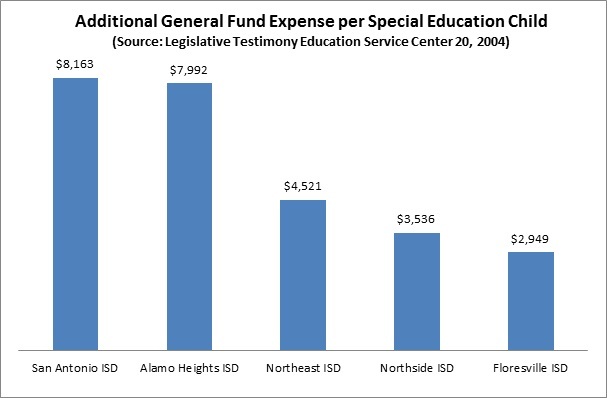
I had the opportunity to testify to the Senate Education committee in Texas today on the experience with parental choice programs for special needs children. One of the items of discussion was the following chart:

McKay Texas 1This phenomenon is often discussed regarding special education, but seldom quantified. In 2004 however officials from Education Service Center 20 (a regional body roughly covering school districts in the San Antonio area) provided the following chart to quantify the additional cost per special education student in a number of school districts. There were costs above and beyond those covered by state funding, and thus represented in effect a transfer from district general funds into special education funds on a per special education student basis.


Stanford economist Caroline Hoxby also testified to this interim committee in 2004, and she made the point that since school districts have been complaining that states don’t cover the full costs of special education for decades, that they have no cause to complain about students leaving with their (inadequate) funding. Districts can either keep these funds in the general education effort, or spend more on their remaining special education students (approximately 5% of Florida special education students directly utilize McKay but far more benefit from it) but either way they benefit.


Jason Bedrick Defeats Darth Strauss Over Tax Credit Scholarships

March 1, 2013

Jason Bedrick has an excellent post on Education Next rebutting Valerie Strauss’s ridiculous column on Tax Credit Scholarships.

People should keep their eye on Jason.  The force is strong with that one.


Alabama Lawmakers Pass Tax Credits for Children Attending Failing Public Schools

March 1, 2013

(Guest Post by Matthew Ladner)

Wow– Alabama lawmakers are officially the Cinderella kids, coming out of nowhere to shock the school choice world with an unexpected victory with the creation of two new tax credit programs for children attending failing public schools.

Here is a link to the bill, with the tax credit programs starting on page 14.


US Teacher Unions Need to Close the Global Union Corruption Gap

February 27, 2013

The head of Mexico’s teacher union, Elba Esther Gordillo, has been arrested by authorities “on charges of embezzling $200 million.”  She only officially earned $90,000, but still managed to run up about $3 million in charges at Nieman Marcus, another million for property in San Diego, several hundred thousand to an art gallery, endless rounds of plastic surgery (yikes!), etc

It now appears that there is another global comparison on which the US is lagging way behind other countries.  Yes, our teacher unions have folks like Paul Egan, the New York union honcho and testing cheater whose alcohol-fueled tizzy over portion sizes at a swank Albany restaurant caused him to be arrested and led us to advise him that “Fat, Drunk, and Stupid is No Way to Go Through Life, Son.”  And we have “longtime Broward (Fla.) Teachers Union president Tony Gentile admitt[ing]… that he arranged for a sexual tryst with an Internet pal he thought was a 14-year-old girl.”  And also in South Florida, “The longtime leader of the Miami-Dade County teacher’s union pleaded guilty… in a deal after a public corruption task force found he fraudulently charged the organization for up to $650,000 in personal expenses for cruises, vacations and other luxuries.

Is that the best our corrupt teacher union leaders can do?  Just $650,000?  Mexican teacher union leaders can skim off a cool $200 million.  Even all of the abuses cataloged by the vanishing breed of education investigative reports,  Scott Reeder or Mike Antonucci, pale in comparison to Ms. Gordillo… or, as she was known in Mexico, The Teacher.  I suppose that overly-generous and ill-funded teacher pensions begin to approach the scale of malfeasance achieved in Mexico, but that union-directed financial extraction spreads its largess over millions of teachers.  In Mexico a single teacher union boss managed to grab $200 million for herself.  I highly doubt that Randi Weingarten is up to that challenge.

What we have here is a Global Union Corruption Gap.  Maybe we need to draft some cue cards for politicians so they can begin to address this problem with their steakholders.

[Correction — Paul Egan wasn’t actually arrested.  The restaurant called the police because Egan was unruly and refused to pay the bill.  The police ordered Egan to pay.  Jeesh!  Our union bosses even lag behind their colleagues in Mexico on getting arrested!]