The Brown Shirt Left

September 29, 2014


(Guest Post by Matthew Ladner)

I attended a debate last night between gubernatorial candidates Doug Ducey (R) and Fred Duval (D) on K-12 policy. Unfortunately what would have otherwise been a civil exchange of ideas between two candidates who pass the “would like to have a beer with” test was marred by protesters in the audience who attempted to hijack the event by screaming invective on entirely unrelated matters from the audience.

It seems almost unnecessary to say that the protesters were uniformly on the far left. I’m 47 years old, have seen this happen several times, and have yet to see a right of center group behave in such an anti-democratic fashion. I’m not saying it has never happened, just that I have never once seen it happen.

The person who should be most upset by this is Fred Duval. Duval is obviously a decent guy and I would put the odds that he had anything to do with this squarely at zero. Nevertheless, when a group of people shouting random hostility at his opponent act like a group of brown-shirt fascists, it’s nothing but bad. This was Duval’s best chance to make his points with the public on the subject that he has emphasized more than any other, and that chance was essentially lost. Ducey handled the situation well, receiving a thunderous round of applause in elegantly rebuking the protestors. Game, set match Ducey.

Attempting to shout down opponents is contemptible and against the most basic tenets of democracy. I would say exactly the same thing if a group of conservatives disrupted a debate by attempting to shout down the Mr. Duval.  Notice the muted reaction of the Arizona Republic. If a group of Russell Pearce supporters had shown up in force to scream at Fred Duval I hate to say that I strongly suspect that it would have been a top of the fold front page story rather than a buried note in page three. Seeing this unfold made me wonder if the era of public debates might not be drawing to a close. It is much easier to keep things under control in a studio. The only other alternative is to hire a ton of security, which raises the cost of public events considerably. Either way, we will have fewer civil and public exchanges so long as a vocal minority of Americans lack a basic commitment to civility.

If so, illiberal forces will have stolen something from us. I took my sons aged 14 and almost 13 to the debate last night, and I wonder how many more such events they will have the opportunity to attend. The soft bigotry of low expectations seems very much at work here. We’ve grown to expect some left-wing groups to behave like fascists. We should have much higher expectations.

The misguided people engaging in brown-shirt tactics should remember an old slogan of the left- the whole world is watching. You may have deluded yourself with some complex rationalization justifying attempting to shout down opponents, but don’t expect decent people of either the left or right to believe it.


On the move with our man McShane

September 25, 2014

(Guest Post by Matthew Ladner)

See Mike go…see Mike dodge infographics!


Stop Nick Cage Before He Kills Again!

September 25, 2014

Spurious Correlations

(Guest post by Greg Forster)

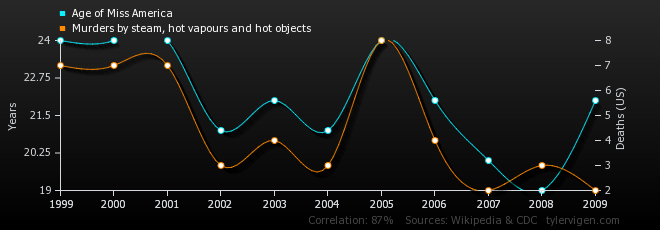
This graph of the correlation between the number of Nicholas Cage films and the number of swimming pool drownings in each year (correlation = 0.666004) and many more await you at Spurious Correlations.

Here’s the graph of the age of Miss America and the number of murders by steam, hot vapors and hot objects (correlation = 0.870127):

Spurious Correlations 2

Perhaps you scoff at such weak correlations. It may interest you to know that the marriage rate in Kentucky and the number of people who drown after falling out of a fishing boat correlate at 0.952407! What on earth are newlyweds doing in Kentucky, and how do we put a stop to it?

HT Michael Strain


One Two Minerva is Coming for You, Three Four Better Lock the Door, Five Six grab a crucifix, Seven Eight Gonna Stay Up Late

September 24, 2014

(Guest Post by Matthew Ladner)

Check out this interesting profile of the Minerva Project by Graeme Wood in the Atlantic: The Future of College? Minerva is the first elite university founded in the United States since Rice over a century ago, costs half as much as Rice, and talks of serving as the asteroid to end the Cretaceous period of American academia.

How am I supposed to hire dozens of new non-teaching staffers this week with all these dreadful explosions going on?

I find myself vaguely skeptical. The graduate student association at Rice after all has this great bar they run in the basement of the Chemistry building called Valhalla. Minerva won’t have that, and college might not be the same without it. Maybe living in Europe, Asia and South America would be even better than Valhalla, especially when it is half the price of Rice. If the Minervas of the world disrupt Rice in Christensen inspired inferno of creative destruction, I hope Rice can hang on long enough for me to savor one final pint with Odin and the boys before academic Ragnarok reaches its inevitable conclusion.

Speaking of Odin, there is a lot of bold talk in this article from from a one-eyed fat man someone with 33 students, but on the other hand fortune sometimes favors the bold. The decision to avoid federal money alone makes me want to root for them. Let’s see how they do.


Sentences that Aren’t Worth Finishing

September 24, 2014

solomon01Aristotle_Plato  JLocke

(Guest post by Greg Forster)

Robert Pondiscio: “Our earliest thinkers about education—men like Benjamin Rush, Noah Webster, and Horace Mann…”


Standards are Important… NOT!

September 23, 2014

My students, Charlie Belin and Brian Kisida, have a new article in the journal, Educational Policy, that examines the relationship between state science standards and science achievement according to NAEP.  As an indicator of the quality of state science standards they use Fordham’s ranking of those standards.  They find no relationship between Fordham’s ranking of standards and achievement.

Possible explanations for this result include:

1) Fordham is lousy at judging the quality of standards.

2) The quality of standards doesn’t matter.

I’m inclined toward the latter explanation, but either way, would it seem like a good idea to blow hundreds of millions, engage in endless and destructive in-fighting, and consume nearly all of the energy of the reform movement on something that makes virtually no difference?

I know, I know… the standards crowd readily admits that standards, by themselves, are not the issue.  It’s the way we link standards to teacher training, professional development, and assessments with consequences for teachers and students that really matters.  OK, so standards only matter if we also achieve a level of benevolent, top-down control over key aspects of the education system that has never been accomplished before.

Where have I heard this kind of argument before?  Oh yeah! That’s what the crazy guy in Harvard Square was yelling about when he said that the past failures of communism didn’t matter because it would finally work if we just did it correctly and completely.  And how much coercion and forced conformity would be required in the futile effort to achieve this level of top-down control?

Of course, it is also possible that Charlie and Brian’s analysis failed to capture the true causal relationship between standards and achievement given that is is only an observational study.  But if that is the case, the burden would still be on the advocates for national standards to demonstrate the causal connection between the reform they advocate and improved outcomes.  We shouldn’t remake all of American education on a hunch and a rationalization borrowed from the failure of communism.


Long Term Trends in the Fight for Choice

September 22, 2014

Disco Stu trends

(Guest post by Greg Forster)

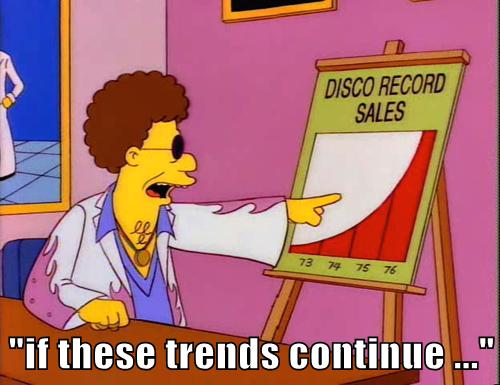
Funny Matt should choose this morning to post thoughts about the future of charters and private school choice. My article on long-term trends in the fight for private school choice was just published by OCPA’s Perspectives. [Update: Oops, link added.]

The most important omen for the long term, though, is the war of ideas and moral legitimacy. Nobody takes the school unions and other guardians of the status quo seriously any more. The mask is off; everyone knows they’re all about the gravy train. Moreover, in milder forms like charter schools, the principle of choice has been almost universally accepted on both sides of the political aisle. How long can people go on supporting charters but opposing private choices, especially as it becomes clear charter schools don’t have enough freedom to reinvent education?

As Matt Ladner likes to say, these days the “cool kids” in education are the entrepreneurs who invent radically new kinds of schools. A few years ago, everyone was atwitter about the revolutionary potential of these “greenfield” experiments. Recently, though, the bloom is off the rose. People are beginning to realize that the world of tomorrow isn’t going to be so easy to build. Where will they turn for the tools they need to truly reinvent education? Universal choice is looking better and better.

Pop culture aficionados are invited to submit their judgment on the quality of my references to Doctor Who.

A shorter version of the article was published as an op-ed in the Edmond Sun.


The Future of Private Schooling, if any

September 22, 2014

(Guest Post by Matthew Ladner)

Neerav Kingsland has a fun post over at relinquishment noting that at below current rates of student growth that charter schools take over public education before 2050 through the magic of compound interest. Kingsland notes:

Clearly, I could give many reasons why the charter school sector won’t maintain this growth.

I could also give many reasons why the charter school sector could grow much faster.

Charter schools face natural limits to growth, primarily in the need for facility funding. The only way for me to imagine a much faster rate of growth would be to have a general recognition of the fact that school buildings represent a massive investment of public resources that are often misused to the detriment of children and taxpayers. Then we would need policymakers to develop a mechanism for increasing the educational ROI for those investments on behalf of children and taxpayers within a new context of public education that gets away from the 19th century heavily politicized geographically defined factory model.

Who could imagine such a thing?

We are a long, long way from charters displacing districts as the dominant form of public education. A couple of decades trending in that direction however might be enough, all else being equal, to greatly diminish private education.  Charter schools hit private schools much harder than the districts, so the question arises: is the current pace of private choice program growth sufficient to keep private school education viable?

Charter vs. Private Choice enrollment

I cobbled together the above chart from a number of different data sources, including NCES, AFC, NAPCS etc.  Let’s just say that the current trends do not look promising for traditional private schools on a national level.  Part of the story here is that charter schools are making progress in the big population states (CA, TX, NY) that the private choice world has yet to crack. The real question then becomes how many states, if any, have funded private education on an equitable basis with charters? When you factor in the rise of not only charter schools, but also home-schooling (which also draws from a universe of parents looking for an alternative to district schools) how viable does private schooling appear in the long run state by state?

I don’t know the answer to this question, but I suspect careful consideration of the available data would deliver a fairly grim answer from the perspective of private education, even in leading private choice states.  Here in Arizona, one of the leading private choice states, our choice programs at most seem to be saving private schools from extinction, but treading water as a fairly small niche.  It is kind of hilarious to watch the school district advocacy industrial complex foam at the mouth about private choice programs while charter schools continue to steadily gain market share. Mongo is easily distracted by shiny objects, but I digress. Private choice scholarship amounts routinely trail funds provided to charter schools across the country. Once you fill up empty seats at existing private schools, you create a huge incentive for school operators to open new charter as opposed to private schools with the much higher rates of per-student funding offered.

I have no nostalgic attachment to private education but in a country with so few high quality options available it seems foolish to thoughtlessly discard an entire sector of schooling. If we want to put things on a more equitable footing to let parents sort things out without financially nudging them into one sector over another, we will need broader and better designed private choice programs.


When Will Public Schools Acquire Nukes?

September 16, 2014

The Wall Street Journal has an article that you might mistake for something in The Onion.  The federal government has a program that provides surplus military equipment to state and local governments at no cost other than the expense of shipping.  A number of public schools have taken advantage of this program to acquire military gear.  As the WSJ reported:

Some school districts, including the Los Angeles Unified School District, stocked up on grenade launchers, M-16 rifles and even a multi-ton armored vehicle…

And Matt will be pleased to know that:

In south Texas, near the Mexican border, the sprawling Edinburg Consolidated Independent School District has 34,700 students and operates its own SWAT team, thanks in part to military gear it was given in recent years.

This is a toxic combination of 1) school districts lining up for anything the feds are handing out, 2) the excessive militarization of local police (and apparently school security) forces, and 3) schools focusing on incredibly rare events, like school shootings, as opposed to incredibly common ones, like incarcerating millions of children in schools that fail to serve their needs.

But don’t worry, one school district official explained that “These officers are trained in tactics. Some are former military.”  And a Defense Department spokesperson assured that “each state is visited biannually for a program compliance review to further look at records, property and usage.”  Well… if these are trained school employees who are inspected by the federal government biannually, I’m sure it will be fine to have SWAT teams with grenade launchers in our schools.

My only question is when will public schools be able to get surplus nukes.  I mean, how else will they maintain Mutually Assured Destruction to deter the growing threat of private school choice?


Creating Cultural Consumers

September 16, 2014

Brian Kisida, Dan Bowen, and I have a new article in the journal, Sociology of Education, about how field trips to art museums help develop cultural consumers — people who want to visit cultural institutions in the future.  This piece is a more focused and technical follow-up on the summary of our art museum field trip study last year in Education Next.  Earlier we also published a more technical piece in Educational Researcher focused on the critical thinking results from our experiment.  There are more technical pieces on particular aspects of the study in the works.

Also keep you eyes out for a random-assignment study on what students learn from field trips to see live theater performances of Hamlet and A Christmas Carol.  It should be published by Education Next some time in October.

And if you are hiring, keep your eyes out for Dan Bowen and Brian Kisida, who are both now applying for academic jobs.  They each have at least 8 peer-reviewed articles.  Dan also has two grants that he earned while working as a post-doc at Rice University.  Another one of our graduate students, Anna Egalite, is currently in a post-doc at Harvard and is also on the academic job market for next year.  All thee would be great hires for any university smart enough to snap them up.