Vouchers Win More

April 18, 2013

On the heels of Greg’s updated review of the research on the effects of vouchers, we have a new article in Education Next by Matthew Chingos and Paul Peterson finding significant benefits from New York City’s private voucher program on college attendance by African American students:

We find that the offer of a voucher increased college enrollment within three years of the student’s expected graduation from high school by 0.7 percentage points, an insignificant impact. This finding, however, masks substantial variation in impacts among students from different ethnic groups. We find evidence of large, statistically significant impacts on African Americans, but fairly small and statistically insignificant impacts on Hispanic students. We discuss results for the small number of students from other groups below.

The SCSF-NSC linked data indicate that a voucher offer increased the college-enrollment rate of African Americans by 7 percentage points, an increase of 20 percent. If an African American student used the scholarship to attend private school for any amount of time, the estimated impact on college enrollment was 9 percentage points, a 24 percent increase over the college enrollment rate among comparable African American students assigned to the control group (see Figure 1). This corresponds to 3 percentage points for every year the voucher was used.

The impact of a voucher offer on the college-enrollment rate of Hispanic students is a statistically insignificant 2 percentage points. Although that estimate is much smaller than the one observed for African Americans, the impacts on the two ethnic groups are not significantly different from one another.

We obtain similar results for full-time college enrollment. Among African Americans, 26 percent of the control group attended college full-time at some point within three years of expected high-school graduation. The impact of a voucher offer was to increase this rate by 7 percentage points, a 25 percent increment. Among students using the voucher to attend a private school, the estimated impact was 8 percentage points, or roughly 31 percent. No statistically significant impact on full-time college enrollment was evident for Hispanic students.

Only 9 percent of the African American students in the control group attended a private four-year college. The offer of a voucher raised that proportion by 5 percentage points, an increase of 58 percent. That extraordinary increment may reflect the tight connections between private elementary and secondary schools and private institutions of higher education.

The percentage of African American students in the control group who attended a selective four-year college was 3 percent. That increased by 4 percentage points if the student received the offer of a voucher, a better than 100 percent increment in the percentage enrolled in a selective college, a very large increment from a very low baseline. Once again, no impacts were detected for Hispanic students.


Third Edition of “Win-Win” Adds a Third Win

April 17, 2013

Win-Win 3.0 cover

(Guest post by Greg Forster)

This morning, the Friedman Foundation releases the third edition of my biannual report summarizing the empirical research on school choice. As in previous years, I survey all the available studies on academic effects – both for students who use school choice and for public schools. Hence the title “A Win-Win Solution” – school choice is a win for both those who use it and those who don’t.

New in this edition of the report, I also survey the impact of school choice on the democratic polity in three dimensions: fiscal impact on taxpayers, racial segregation and civic values and practices (such as tolerance for the rights of others). Guess what it shows? School choice is not just win-win, it’s actually win-win-win. It not only benefits choosing families and non-choosing families; it also benefits everyone else through fiscal savings and the strengthening of social and civic bonds.

Here’s the most important part of the report – that unbroken column of zeros on the right remains as impressive as it ever was. Do please read the rest if you’d like to know more!

Win-Win 3.0 chart


Texas Freedom Fighters Bypass Borg Shields

April 12, 2013

(Guest Post by Matthew Ladner)

Improved news from Texas- the Senate Education committee passed both a special needs voucher and a scholarship tax credit proposal, and the full Texas Senate passed a modest increase in the charter school cap 30-1. Lotexas of Borg however shrugged off the damage and repeated the demand to be lead to Sector 78701 for more money, less accountability and no parental choice. Lotexas explained the collective’s position to a local Austin radio station succinctly: “You will be assimilated. Resistance is futile. You don’t want none of this, son!!”

You know what I love about the last decade of Texas public education? Every year I get a little older and they get more expensive without teaching students how to read any better.

Let’s see what happens next.


Wolf v. Ravitch/Welner on the Effects of School Choice

April 8, 2013

(Guest Post By Jason Bedrick)

Is school choice effective at improving measurable student outcomes?

That question has been at the center of a heated debate between Patrick Wolf of the University of Arkansas and Diane Ravitch, former U.S. Assistant Secretary of Education, and one of her supporters. The controversy began when Ravitch attempted to critique Wolf’s studies of voucher programs in Milwaukee and Washington D.C.

After questioning Wolf’s credibility, Ravitch made three main empirical claims, all of which are misleading or outright false:

1) Wolf’s own evaluations have not “shown any test score advantage for students who get vouchers, whether in DC or Milwaukee.” The private schools participating in the voucher program do not outperform public schools on state tests. The only dispute is “whether voucher students are doing the same or worse than their peers in public schools.”

2) The attrition rate in Wolf’s Milwaukee study was 75% so the results only concern the 25% of students who remained in the program.

3) Wolf’s study doesn’t track the students who left the voucher program. (“But what about the 75% who dropped out and/or returned to [the public school system]?  No one knows.”)

Wolf then rebutted those claims:

1) Ravitch ignores the finding that vouchers had a strong positive impact on high school graduation rates. Moreover, there was evidence of academic gains among the voucher students:

The executive summary of the final report in our longitudinal achievement study of the Milwaukee voucher program states:  “The primary finding that emerges from these analyses is that, for the 2010-11 school year, the students in the [voucher] sample exhibit larger growth from the base year of 2006 in reading achievement than the matched [public school] sample.” Regarding the achievement impacts of the DC program, Ravitch quotes my own words that there was no conclusive evidence that the DC voucher program increased student achievement.  That achievement finding was in contrast to attainment, which clearly improved as a result of the program.  The uncertainty surrounding the achievement effects of the DC voucher program is because we set the high standard of 95% confidence to judge a voucher benefit as “statistically significant”, and we could only be 94% confident that the final-year reading gains from the DC program were statistically significant.

2) The attrition rate in the Milwaukee study was actually 56%, not 75%. Ravitch was relying on a third party’s critique of the study (to which Ravitch linked) that had the wrong figure, rather than reading the study herself. Moreover, the results regarding the higher attainment of voucher students are drawn from the graduation rate for all students who initially participated in the voucher program in the 9th grade in the fall of 2006, not just those who remained in the program.

3) Wolf’s team used data from the National Clearinghouse of College Enrollment to track these students into college.

Ravitch responded by hyperventilating about Wolf’s supposed “vitriol” (he had the temerity to point out that she’s not a statistician, didn’t understand the methods she was critiquing, and that she was relying on incorrect secondary sources) and posting a response from Kevin Welner of the University of Colorado at Boulder, who heads the National Education Policy Center (NEPC), which released the critique of Wolf’s study upon which Ravitch had relied.

Welner didn’t even attempt to defend Ravitch’s erroneous first and third claims, but took issue with Wolf’s rebuttal of her second claim. Welner defends the integrity of his organization’s critique by pointing out that when they read Wolf’s study, it had contained the “75% attrition” figure but that the number had been subsequently updated a few weeks later. They shouldn’t be faulted for not knowing about the update. As Welner wrote, “Nobody had thought to go back and see whether Wolf or his colleagues had changed important numbers in the SCDP report.”

That would be a fair point, except for the fact that they did know about the change. As Wolf pointed out, page four of the NECP critique contains the following sentence: “Notably, more than half the students (56%) in the MPCP 9th grade sample were not in the MPCP four years later.” In other words, the author of the NECP critique had seen the corrected report but failed to update parts of his critique. This is certainly not the smoking gun Welner thought it was.

Ravitch replied, again demonstrating her misunderstanding of intention-to-treat (“And, I dunno, but 56% still looks like a huge attrition rate”) and leaving the heavy lifting to Welner. Welner’s main argument is that Wolf should have “been honest with his readers the first time around, instead of implying ignorance or wrongdoing as a cheap way to scores some points against Diane Ravitch and (to a lesser extent) NEPC.” Welner would have had a point if Wolf’s initial response had been to NECP and not Ravitch, but Wolf’s point was that Ravitch was holding herself out as an expert when she had never read the primary source material that she was criticizing. Instead, she relied on a secondary source that cited two contradictory figures. She either didn’t notice or intentionally chose what she thought was the more damning of the two figures—though, again, the figure doesn’t matter for purposes of an intention-to-treat study.

We all make mistakes. Wolf’s team made a mistake in their report and corrected it within a few weeks. Welner has stated that his team will correct the NECP report now that their error has come to their attention a year later. Ravitch should also correct her erroneous assertions regarding the results and methodology of the studies.

(Edited for typo)


More Bad News from Texas

April 5, 2013

(Guest Post by Matthew Ladner)

Bad news from Texas– bipartisan super-majority of the House votes to prohibit vouchers in the House budget plan. It remains to be seen whether the state adding 80,000 new public school students per year and which has 17% of Hispanic and 15% of Black 8th graders reading proficiently will allow 10 new charters to be added to the state’s cap per year or not.


Gerson Cites Voltron

April 4, 2013

voltron team (original)

(Guest post by Greg Forster)

As long as we’re on the subject of narcissism here on JPGB, may I note that Michael Gerson quoted our Voltron op-ed in Monday’s Washington Post?

But even small, restricted choice programs have shown promising results — not revolutionary but promising. Last year a group of nine leading educational researchers summarized the evidence this way: “Among voucher programs, random-assignment studies generally find modest improvements in reading or math scores, or both. Achievement gains are typically small in each year, but cumulative over time. Graduation rates have been studied less often, but the available evidence indicates a substantial positive impact. . . . Other research questions regarding voucher program participants have included student safety, parent satisfaction, racial integration, services for students with disabilities, and outcomes related to civic participation and values. Results from these studies are consistently positive.”

I’d tweet about it, but I’m too cool for Twitter.


A Good Media Week

March 29, 2013

This week the work of two of my colleagues in the Department of Education Reform was mentioned in national newspapers.  Patrick Wolf’s research finding that the Milwaukee voucher program increased high school graduation rates from 75% to 94% was mentioned in the Wall Street Journal.  And Bob Maranto’s work on the decline in New York City’s murder rate as a result of more effective policing was mentioned in David Brooks’ column in the New York Times.

Way to go!


ESAs in the NYT

March 28, 2013

(Guest Post by Matthew Ladner)

The New York Times has a story on the progress of the school choice movement. Money quote on Arizona’s Empowerment Scholarship Account program:

The Arizona Legislature last May expanded the eligibility criteria for education savings accounts, which are private bank accounts into which the state deposits public money for certain students to use for private school tuition, books, tutoring and other educational services.       

Open only to special-needs students at first, the program has been expanded to include children in failing schools, those whose parents are in active military duty and those who are being adopted. One in five public school students — roughly 220,000 children — will be eligible in the coming school year.       

Some parents of modest means are surprised to discover that the education savings accounts put private school within reach. When Nydia Salazar first dreamed of attending St. Mary’s Catholic High School in Phoenix, for example, her mother, Maria Salazar, a medical receptionist, figured there was no way she could afford it. The family had always struggled financially, and Nydia, 14, had always attended public school.       

But then Ms. Salazar, 37, a single mother who holds two side jobs to make ends meet, heard of a scholarship fund that would allow her to use public dollars to pay the tuition.       

She is now trying to coax other parents into signing up for similar scholarships. “When I tell them about private school, they say I’m crazy,” she said. “They think that’s only for rich people.”

BOOOOOOOOOOOOOOOOOOOOOOOOOOOM


Heads You Win, Tails You Still Win

March 5, 2013

(Guest Post by Matthew Ladner)

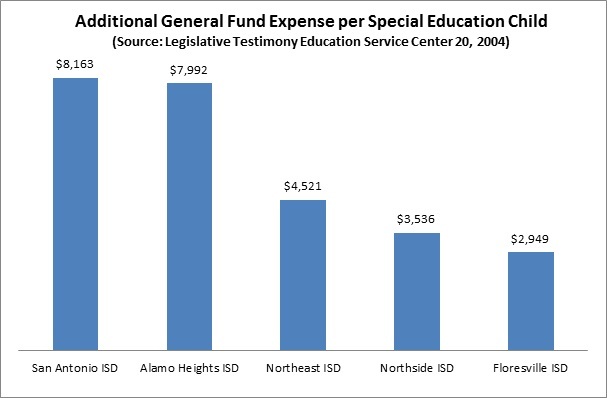
I had the opportunity to testify to the Senate Education committee in Texas today on the experience with parental choice programs for special needs children. One of the items of discussion was the following chart:

McKay Texas 1This phenomenon is often discussed regarding special education, but seldom quantified. In 2004 however officials from Education Service Center 20 (a regional body roughly covering school districts in the San Antonio area) provided the following chart to quantify the additional cost per special education student in a number of school districts. There were costs above and beyond those covered by state funding, and thus represented in effect a transfer from district general funds into special education funds on a per special education student basis.


Stanford economist Caroline Hoxby also testified to this interim committee in 2004, and she made the point that since school districts have been complaining that states don’t cover the full costs of special education for decades, that they have no cause to complain about students leaving with their (inadequate) funding. Districts can either keep these funds in the general education effort, or spend more on their remaining special education students (approximately 5% of Florida special education students directly utilize McKay but far more benefit from it) but either way they benefit.


Lotteries for School Choice

February 4, 2013

(Guest Post by Collin Hitt)

On Aug. 11 inside a school gymnasium in West Englewood, more than 200 parents scribbled their child’s name on a pink raffle ticket.

They crossed their fingers, prayed and waited.

Representatives of Freedom to Learn Illinois fished the names of 15 youngsters out of a bin. The kids whose names were called won scholarships to attend private schools of their choice. They wouldn’t be stuck at their designated neighborhood school. Fifteen children from at-risk families went home that day with a new backpack and a chance.

That’s from the Chicago Tribune’s excellent Monday editorial. Freedom to Learn is trying to succeed where public policy has failed, by giving kids a choice. The group – where I’m a board member – is a grassroots group dedicated to school reform. It currently commits most of its resources to opportunity scholarships. The obvious goal is to better kids’ lives, immediately. A larger objective of the group is to have its scholarship program become the model for a publicly funded program, like those in nearby Indiana and Wisconsin.

The Trib goes on to highlight a new school choice proposal in the Illinois legislature.

A bill introduced in Springfield takes a new approach to school choice that its sponsor, state Rep. La Shawn Ford, D-Chicago, hopes will temper opposition.

Ford’s bill would use money from lottery ticket sales to pay for 1,000 scholarships each year of up to $6,000. Students who live in the top-grossing ZIP codes for lottery sales would be eligible. Most of those ZIP codes are located in Chicago’s poorest neighborhoods. One Chicago ZIP code alone, 60619 on the South Side, generates nearly $30 million in annual ticket sales.

When it was launched in 1974, the Illinois Lottery was supposed to be the panacea for education funding. It never happened. Lottery money merely replaced, not supplemented, what the state was paying toward K-12 education…

Ford’s bill draws a straighter line between the lottery and education. It would cost the lottery about $6 million out of about $708 million in lottery proceeds that go toward special causes each year…

The bill gets around one important argument against traditional vouchers: The scholarship money wouldn’t come from tax dollars.

You have to give Ford an A for creativity. And I love the use of the lottery. In some states, like Georgia and Arkansas, the lottery is used to fund higher education scholarships; why not K-12 scholarships, which would actually do more to increase higher education attainment by decreasing dropout rates and increasing college attendance? Ford has a difficult fight on his hands (and some personal legal difficulties to manage as well). Illinois’ leading Democratic champions for school choice – Rev. James Meeks, Kevin Joyce and Karen Yarbrough – have all quit the General Assembly. The fight for school choice in Illinois likely remains a multi-year battle.

But in the meantime, Freedom to Learn and other Illinois charities will be putting kids through school, giving them the choice that our public education system currently denies them.