Who’s Responsible for the Technocratic Takeover of Ed Reform?

May 26, 2016

Robert Pondiscio has written a very important piece about the current state of the education reform movement.  He correctly notes that the previously diverse coalition leading ed reform is breaking down and he accuses the Left of taking over.  I’d modify his argument only slightly to note that the real divide in ed reform is not between Right and Left, but between Technocrats and those favoring more decentralized reforms. The danger is not just that Social Justice Warriors have seized control of ed reform, but that they are perfectly content to advocate no end of faux-scientific management and top-down regulation to impose their preferences.

Robert is not completely original in noting this hostile takeover.  I’ve been decrying the rise of the Petty Little Dictator Disorder for quite some time.  And Rick Hess warned last year about the wheels coming off of the old ed reform coalition.  However, the fact that the ever-conciliatory Fordham Foundation is declaring the Ed Reform Civil War seems to make it official.

In this post I’d like to talk a little about how we got to this point.  I blame the big ed reform foundations for facilitating this Technocratic/Social Justice Warrior takeover. An entire industry of ed reform activists has been created by foundation dollars.  They populate a host of organizations with a variety of banal names; few of which would exist if foundations didn’t pay their salaries.

So, we now have a giant industry of foundation-paid reformers staffed mostly by young, enthusiastic, and bright-but-lacking-in-wisdom, idealists.  It should come as no surprise that the profile of those who staff the ed reform industry tilts heavily toward the profile of Social Justice Warriors.  Their high education levels, lack of wisdom, and boundless self-confidence inclines them strongly toward Technocracy.

In addition, once you’ve assembled a large ed reform industry, what are all of these people supposed to do?  They aren’t likely to have a meeting at which they decide that parents and local communities are probably better situated than they are to devise solutions appropriate to the circumstances.  If they turned power over to families and communities, most of them would have to quit their jobs and close up shop.

Instead, they have meeting after meeting at which they sit around and dream about how other people should live their lives.  They develop plans, systems, and metrics, to guide, nudge, or force others to do the “right things,” typically from DC or other distant locations  And they have no doubts about what those right things are nor do they lack confidence in their ability to measure those good outcomes or to devise plans and systems for ensuring them.

I really wished that it would not come to this.  But I watched the New School Venture Fund Conference as Robert did and came to a similar conclusion.  Their hostility to the common values that held the diverse ed reform coalition together was manifest.  Their contempt for all non-believers was insufferable.  The way in which they swarm and bully dissenters on social media demonstrates anti-intellectualism and intolerance.

The good news is that this Technocratic Cult mostly doesn’t matter.  Education policy is mostly made by state and local governments paying virtually no attention to what foundation-funded organizations say or do.  It’s quite striking how national advocacy organizations promoting a Technocratic approach to school choice typically have no ability to anticipate where new choice proposals are going to make headway and usually play little or no role in shaping them.  Statewide school choice programs have been passed in Nevada and Arizona with only the Friedman Foundation and the Foundation for Education Excellence playing significant roles among national organizations. Students First actually tried to block Nevada’s universal choice ESA with the same lack of effectiveness that is typical of the national Technocrats.

The only thing lost by the Technocratic takeover of national ed reform efforts is the enormous amount of money being wasted.  But if the donors want to set giant piles of money on fire, they are free to do so.  I just hope they enjoy the warm glow because they aren’t getting much else good out of it.

(Correction — I incorrectly wrote Step Up for Students when I meant Students First.  My apologies.  Also, I changed Rob to Robert.  I keep forgetting which he prefers.)


Education Is Political

May 25, 2016

AM1ONHSI

(Guest post by Greg Forster)

This post on education philanthropy by Megan Tompkins-Stange could give us a lot to discuss, but the most alarming point for me is the total failure of the technocratic people to accept the legitimacy of the political. Of anything political. Of course education is deeply political, since it is (among other things) training for life in the polis. There really is no separating the question “what is a good education?” from “what is a good social order?”; they are distinct but interdependent questions.

But not for some:

For example, when asked about the foundation’s work on the Common Core, Bill Gates told a Washington Post reporter, “These are not political things,” he said. “These are where people are trying to apply expertise to say, ‘Is this a way of making education better?'”

Note he’s not saying that his education philanthropy is not political, which might be taken to mean that it doesn’t arise from a partisan preference – which is probably true. What he’s saying is that education itself is not political.

And of course, as we have known since Plato, the failure to recognize the political nature of political questions is only a way of concealing the tyrannical exercise of power over politics. The tyrannical nature of the action is disguised by defining it as “not political.”

Think I’m exaggerating? Tompkins-Stange draws our attention to this:

In a much-circulated piece in the Wall Street Journal last fall, founding Facebook president Sean Parker described “hacker philanthropy” as “a desire to ‘hack’ complex problems using elegant technological and social solutions, and an almost religious belief in the power of data to aid in solving those problems.” As an example, Parker proposed funding private militias to conduct peacekeeping operations rather than government armies.

She notes that “in response, Princeton historian Stanley Katz wrote: ‘I teach public policy, and I’d be very concerned about a graduate student who told me that he felt confident that private militias should replace government military forces in troubled parts of the world. Wouldn’t you?'”


Case Dismissed: Victory for School Choice in Florida

May 24, 2016

case-dismissed

(Guest Post by Jason Bedrick)

The legal attacks on school choice programs are dropping like characters in a George R.R. Martin novel. Last week, a Nevada judge dismissed a case against the state’s education savings account program. Today, a Florida judge dismissed a case against several of the state’s school choice programs.

The Florida lawsuit originally concerned whether the state was adequately funding public education, but in 2014 the plaintiffs amended their suit to challenge a wide range of policies, including state accountability statutes, charter schools, tax-credit scholarships, and the McKay Scholarship Program for Students with Disabilities. Last year, a judge ruled that the plaintiffs did not have standing to challenge the private school choice programs, but this ruling also rejects their substantive claims that the choice programs somehow harm the traditional district school system:

[T]he Court finds no negative effect on the uniformity or efficiency of the State system of public schools due to these choice programs, and indeed, evidence was presented that these school-choice programs are reasonably likely to improve the quality and efficiency of the entire system. […]

Plaintiffs’ specific allegations regarding the constitutional implications of three of Florida’s choice programs- charter schools, the FTC Program, and the McKay Program- are similarly unsupported by the weight of the evidence. […]

The Court has already held that Plaintiffs lack standing to challenge the FTC Program, and the Court further concludes that the weight of the evidence does not support their speculative allegations that the FTC Program diverts state funding or has any material, detrimental effect on Florida’s system of public schools.

The weight of the evidence similarly does not support Plaintiffs’ allegations about the McKay Program, which is limited to “Students with Disabilities” and requires eligible students to have an individual educational or accommodation plan under federal law. […] As indicated by the Florida Supreme Court, parental decisions to send individual children with special needs to private school do not implicate the uniformity of the broader public school system- regardless of whether some of those parents accept scholarship funds from the State.

BOOOOOOOOOOOOOOOOOOM!!!!!!!

tumblr_m6uv60m4ur1rqpx0x

This decision constitutes one more legal stake in the heart of the canard that educational choice programs harm students attending traditional district schools. As Jon East pointed out at RedefinED yesterday, judges presiding over a separate anti-choice lawsuit in Florida cast a gimlet eye on similar claims during oral arguments last week:

[Florida Education Association] attorney Lynn Hearn: “The loss of $300 million at a minimum to the Florida public school system … is absolutely a fact.”

Presiding Judge Lori S. Rowe: “In your complaint, you haven’t actually alleged that there is a $300 million loss to the Florida education budget, have you?… In fact, the $300 million you’re referring to are the funds that flow into the scholarship program, correct?”

Attorney Hearn: “Well, that’s where the number arrives from, your honor. But we absolutely do allege that that amount has left the public schools in favor of the scholarship program. That’s because of the way the Florida schools are funded. They are funded on a per-student basis. So, during that year, 2013-14, there were 60,000 students who left the Florida public school system.”

Judge Ross L. Bilbrey: “But doesn’t that mean there are 60,000 fewer students that the state has to pay to educate?”

Attorney Hearn: “It does your honor. But the funding of students in our public schools is, uh, we’re not funding widgets, the funding formula for students is not a perfect correlation to the variable cost of funding that student.”

Judge Rowe: “But exactly what is the special injury you are articulating here? You haven’t alleged that any individual student is suffering. You haven’t alleged that per-student funding has been reduced. You haven’t even alleged that the education budget has been reduced.”

Essentially, the union wants to argue the district school system has some special claim on students–and therefore the public funds attached to those students–without openly making that claim. After all, the district school system can’t suffer a “loss” unless they somehow owned those funds to begin with, but parents have no such obligation to enroll their children at their zoned district school, or any district school for that matter. They feel entitled to those children and the corresponding funding, but they know they can’t make that claim explicitly because, well, it’s ludicrous. That’s why the union is having such a hard time articulating any special injury–and why they’re likely to lose that lawsuit as well.

For more information on today’s decision, see Travis Pillow’s write up at RedefinED.

*****

UPDATE: Supplementing his opinion, the judge issued a 179-page Appendix for Findings of Fact which, among many other things, explains that Florida’s tax-credit scholarship program relies on private (not public) funding and explains that the plaintiffs failed to demonstrate any injury resulting from the program:

The Florida Tax Credit Scholarship Program (the ―FTC Program‖) allows Florida taxpayers to apply for tax credits ―to make private, voluntary contributions‖ to fund scholarships for children attending eligible K–12 private schools.767 Plaintiffs allege that the FTC Program violates the uniformity and efficiency requirements of Article IX, Section 1(a) by diverting public funds to private schools that are not subject to the same requirements as schools within the State‘s system of free public schools.

The Court has previously found that the FTC Program, which allows third parties to obtain tax credits for making private donations, does not involve public funds, legislative appropriations, or the State‘s ―provision‖ for a ―system of free public schools‖ under Article IX. Because the private donations that fund the FTC Program are not legislative appropriations, the Court has previously determined that Plaintiffs lack taxpayer standing to assert a challenge to this program under Florida law.

Plaintiffs have also failed to prove any special injury that would allow them to challenge the FTC Program. […]

[A]ny connection between the FTC Program and appropriations to support Florida‘s system of free public schools—not to mention the overall quality of that system—is purely speculative. There was no persuasive evidence presented that the FTC Program has any direct or indirect impact on public-school funding or on the uniformity, efficiency, safety, security, or quality of Florida‘s public schools. […]

Even if tax credits resulted in a decrease in the number of students attending the public schools, local school districts are not responsible for educating students who attend private schools.

The appendix is also is chock-full of citations of some dude named Jay Greene. Here’s a taste:

3rd Grade Retention Policy

Florida‘s third-grade retention policy also is supported by academic research. Dr. Jay Greene, a professor of education and head of the Department of Education Reform at the University of Arkansas, has extensively studied the effect of Florida‘s policy. Dr. Greene‘s studies, which are published in a peer-reviewed journal, concluded that Florida‘s test-based retention policy significantly improves the academic achievement of students who are retained.239 Plaintiffs did not present any evidence countering Dr. Greene‘s findings.

Resources & Results

Plaintiffs allege that the overall level of funding in Florida is not sufficient to provide a uniform, efficient, safe, secure and high quality system of public education.784 Plaintiffs assert that the performance outcomes for certain groups of students indicate that school funding is insufficient.

Plaintiffs, however, have not met their burden of proving a causal relationship between the level of resources available to schools in Florida and student outcomes. Indeed, as described below, the weight of the evidence presented on that issue establishes a lack of any causal relationship between additional financial resources and improved student outcomes. […]

In addition to Dr. Hanushek, Defendants presented findings of Dr. Jay Greene, a professor of education and head of the Department of Education Reform at the University of Arkansas. Dr. Greene statistically analyzed school district-level variables throughout the state of Florida, including per-pupil spending, teacher characteristics, and discipline rates, and found no relationship between these variables and student outcomes.

Specifically, Dr. Greene examined school district per-pupil expenditures and percentages of students proficient on the Florida Comprehensive Assessment Test (―FCAT‖)797 for grades 3 through 10 in reading and math; grades 5, 8, and 11 in science; as well as highschool graduation rates, for school years 2007–08 to 2012–13. The analysis revealed no connection between higher amounts of funding available in school districts and better student performance.

Dr. Greene also conducted regression analyses of spending and performance data, controlling for student demographic differences and prior levels of achievement across school districts. The demographic characteristics that were controlled included the proportion of minority students, proportion of students receiving free or reduced price lunch, the proportion of students classified as English language learners (―ELL‖), and the proportion of students with a disability who had an individual educational plan (―IEP‖), as well as academic outcomes in the prior year. The purpose of these analyses was to examine whether school districts would have better student outcomes if they had more resources, assuming school districts had the same demographic composition and prior year‘s academic outcomes. Dr. Greene‘s regression analyses revealed that there is no pattern between the level of spending in Florida school districts and student performance on the FCAT or high school graduation rates.

Teacher Experience

In addition, Dr. Greene evaluated the assertion by Plaintiffs that teacher qualifications and experience characteristics impact student performance, and that districts with high-minority and low-income student populations have a lower percentage of qualified, experienced teachers. Consistent with his other findings, Dr. Greene found no statistical relationship between the proportion of novice (first-year teachers) or ―highly qualified teachers, as defined by the Florida Department of Education, and student performance on the FCAT or high school graduation rates. Likewise, Dr. Greene found no statistical relationship between the percentage of minority and low-income students in a district and the proportion of novice or highly qualified teachers.

Suspension Rates

Dr. Greene also addressed Plaintiffs‘ assertion that high suspension rates are attributable to a lack of school district resources and lead to lower student performance outcomes. As above, Dr. Greene conducted regression analyses that controlled for student demographic characteristics and prior student outcomes. Dr. Greene found no relationship between the rate at which students are given out-of-school suspensions in Florida school districts and FCAT reading, math, or science proficiency, or graduation rates.

Court’s Conclusion re: the Evidence

The Court accepts Dr. Greene‘s conclusions and finds that they corroborate other evidence in the case showing the lack of causal relationship between the level of resources available in Florida schools and student outcomes, as well as evidence showing that the level of resources available is sufficient for a high quality system.

Although Plaintiffs bear the burden of proof in this case, neither Plaintiffs‘ expert witnesses nor their school-district witnesses presented analyses or studies rebutting the work of Drs. Hanushek and Greene. In fact, the weight of the evidence shows that despite budget cutbacks associated with the Great Recession, student performance continued to improve in the period 2007–08 to 2014–15.


Florida Mom Smacks Down Choice Deniers

May 24, 2016

momma-brown-bear-protecting-her-cubs

(Guest Post by Jason Bedrick)

Last week, the president and education chair of the Florida State League of Women Voters (LWV) — which is a party to the Florida teacher union’s lawsuit against the state’s tax-credit scholarship programargued that some parents are just not well-informed enough to choose a school for their own kids:

Choosing small, private, mostly religious schools is most likely a poor choice, but how can [parents] know?

What assurance do parents have that their children’s needs are being met? Not much. Teachers in private schools do not have the same certification requirements. Schools do not have to use the state curriculum or administer state tests. Private schools are not graded as public schools are.

Parents are told they can vote with their feet if they are dissatisfied. Some do, but many may have little idea that their children do not receive the same educational opportunities. Small private schools have cachet but may well lack quality.

The LWV apparatchiks provide zero evidence that private schools are “likely a poor choice.” Indeed, the best evidence shows that, on average, parental choice in education improves students outcomes.

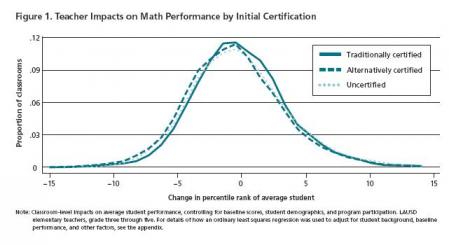
Sure, private school teachers don’t need to be certified, but as this handy chart from the Brookings Institution demonstrates (see page 8), such certification is a guarantee of absolutely nothing:

gordon-1-7398851

Traditionally certified teachers are no more or less effective, on average, than alternatively certified or even uncertified teachers.

Likewise, they present no evidence that the state curriculum is superior to other curricula. And private schools may not administer the state test, but they do administer other nationally norm-referenced tests that give parents information about how their children are performing compared to students nationwide. Funny that the LWV apparatchiks would omit that fact.

Lacking any evidence that parents aren’t choosing wisely, the LWV argument amounts to “trust us, we know what’s good for your kids better than you do,” and at least one mother is sick of it:

I’m tired of people who think they know better than I do, especially when it comes to my children’s education. Like the League of Women Voters.

The League joined the teacher’s union to file a lawsuit to end the Florida Tax Credit scholarship, which allows low-income and working-class parents like myself to send their children to private schools. Three of my daughters are among the 78,000 who use them.

The mother, Cheryl Joseph, is one of 15 parents of scholarship students who intervened in the McCall v. Scott lawsuit to defend the scholarship program, and she’s not taking any guff from the people who claim to speak for women voters but want to deny them access to more educational choices for their children:

Two leaders of the League said in the Tallahassee Democrat that the scholarship cannot support high quality education, and choosing private, mostly religious, schools is most likely a poor choice. They actually wrote that scholarship parents “have little idea that their children do not receive the same educational opportunities.”

Believe me, we know.

We know many people have school choice. Some have enough money to move into neighborhoods where the public schools are excellent. Others choose to send their kids to private schools. Many of us can’t afford to move, but thanks to the scholarships, we have choices.

The mother describes how her children’s zoned district school wasn’t rigorous enough for them, but she couldn’t send them to another school through the district’s choice program because it was full. Fortunately, they got scholarships to attend a private school that they “absolutely love,” where students regularly graduate and enroll in college, including Ivy League schools. She also appreciates that the school has separate-gender classes (for which there is actual evidence that it improves performance), the teachers communicate regularly with the parents, and the principal “shakes every student’s hand every morning and knows each by name.”

The school works for her kids, so why does the LWV want to take that option away? She concludes:

I’m tired of people with many choices trying to block the rest of us from having any. It reminds me of the civil rights battles over 50 years ago. Who is blocking the schoolhouse doors now?

Maybe if the League talked to more “struggling” parents, they’d learn from them. My job is helping public housing residents become self-sufficient, so I talk to working-class parents all day.

Many want their children in different schools for various reasons, but too often, they’re stuck with limited choices.

The scholarship gives them options, gives them the opportunity to have more choices for their children – just like parents with more money.

Anybody who believes otherwise really needs to think twice.

bear11


School Choice is Win-Win

May 19, 2016

Last week M. Danish Shakeel, Kaitlin Anderson, and Patrick Wolf released their meta-analysis of experimental studies of private school choice, finding significant test score benefits from the 19 studies they reviewed.  This week Greg joins the party with an updated edition of his “Win-Win” report reviewing the evidence on school choice.

Greg goes beyond the scope of the Shakeel, et al meta-analysis by also considering evidence on how expanding school choice affects traditional public schools, public finances, segregation, and civic values.  That’s covering a lot of different types of effects.  And what does he find?

The evidence points clearly in one direction. Opponents frequently claim school choice does not benefit participants, hurts public schools, costs taxpayers, facilitates segregation, and even undermines democracy. However, the empirical evidence shows that choice improves academic outcomes for participants and public schools, saves taxpayer money, moves students into more integrated classrooms, and strengthens the shared civic values and practices essential to American democracy. A few outlier cases that do not fit this pattern may get a disproportionate amount of attention, but the research consensus in favor of school choice as a general policy is clear and consistent.

This is a very handy resource.  Check it out!


Winning the Blaine Game in Nevada

May 19, 2016

case-dismissed

(Guest Post by Jason Bedrick)

As Matt noted earlier, a Nevada judge upheld the state’s ESA program yesterday. Here’s what the Institute for Justice had to say:

“Today’s decision is a powerful rebuke to the idea that school choice programs undermine education,” said Tim Keller, managing attorney for the Institute for Justice’s Arizona office, “The Nevada ESA program contains both hallmarks of a constitutional school choice program: parents, not the government, decide where their children go to learn, and the government stays entirely neutral with respect to religion.” The Institute for Justice (IJ) represents six Nevada parents who have been approved for ESAs.

ESAs are a cutting edge reform in finding ways to educate a booming population amidst strained state budgets. The ESA program deposits money into accounts controlled by participating parents, who then use it to design a customized education for their children. ESA funds may be used to enroll in private schools, hire tutors, buy textbooks and curricula, and even pick and choose among individual courses at public schools and universities.

“ESAs hand the reins over to parents,” explained Keith Diggs, also an IJ attorney in Arizona. “Kids don’t deserve to be stuck in a school that doesn’t suit them. ESAs will open up a huge array of options and create a market where parents can seek out the education their kids need.”

Over at the Cato-at-Liberty blog, I take a deep dive into the judge’s ruling:

Following the U.S. Supreme Court’s First Amendment jurisprudence, the judge held that the Nevada Constitution prohibits aiding one religion, preferring one religion over others, or aiding all religions in a manner that prefers religion over non-religion, citing in particular the state constitution’s declaration that the “free exercise and enjoyment of religious profession and worship without discrimination or preference shall forever be allowed in this State.” The Blaine Amendment had prohibited “sectarian” instruction in the public schools, but did not preclude the legislature from enacting religiously neutral programs that would provide funding to families to educate their children in the manner they preferred, whether at a religious or secular institution.

…the Nevada judge held [that] any benefit to religious schools from the ESA was ancillary and indirect. The Blaine Amendment “was not intended to preclude any expenditure that has an incidental benefit to religion, where such is made for a primary secular purpose,” and the ESA “was enacted for the valid secular purpose of providing financial assistance to parents to take advantage of educational options available to Nevada children.”

Case dismissed.

Let’s hope the Nevada Supreme Court agrees.


Idiocracy Arrives Much Earlier Than Anticipated

May 17, 2016

(Guest Post by Matthew Ladner)

Difficult for me to find much fault in this Jeff Rice column, keep hoping to wake up like Bobby Ewing and discover last season was a dream.


Portfolio Management Fails in New Orleans

May 16, 2016

Supporters of Portfolio Management have held up New Orleans as a model for what they are advocating.  They argued that every city should be like New Orleans in which a single, super-regulator could oversee a portfolio of schools to ensure that only quality schools are opened and expanded while bad ones are closed.  The Portfolio Manager could also issue regulations to govern school discipline, admissions, special education, and transportation as well as ensure “coordination” among the schools.

It was a beautiful dream until we woke up this month to discover that the Louisiana legislature is transferring responsibility for all schools in New Orleans from the Recovery School District, the city’s Portfolio Manager, to the locally elected Orleans Parish School Board, which has repeatedly declared its hostility toward charter schools.  This hostile school board will assume all responsibility for opening and closing all schools as well as continue regulating discipline, admissions, special education, transportation and other matters it deems necessary.  The fox has officially been awarded the keys to the hen house.

Those in denial about this failure cling to provisions in the state law that say charter schools will maintain their operational autonomy even after the school board takeover. But these declarations protecting autonomy are likely to be as meaningful as the Kellogg–Briand Pact declaring that war is illegal. If the school board can open and close schools as well as issue a host of regulations about their operations, they effectively control their operations.

A big problem with building a centralized authority — a Portfolio Manager — to govern all schools is that you cannot count on the good guys being in charge of that process forever.  Eventually, in this case barely a decade later, forces hostile to school choice will assume control of the Portfolio Manager and begin to strangle choice.

If only someone had warned backers of Portfolio Management about these dangers!  Oh wait…

In general, centralized, monopoly regulators are more susceptible to capture than decentralized, multiple regulators. The problem with portfolio districts is that they are trying to be one ring to rule them all…. The ability to control who operates all types of schools and what regulations govern them is too much power not to attract bad people to it or to corrupt those who possess it.

The solution is to decentralize power so that schools are governed by multiple regulators…. When that power is dispersed, it is too hard to capture all of them and they compete with one another to keep regulations reasonable. This is the logic behind separation of power and federalism. It is the virtue of Tiebout choice. The superiority of dispersing and checking power was understood by the founders. It was understood by Montesquieu. It was really Woodrow Wilson who launched a full-frontal attack on the idea of dispersed power and it is his progressive descendants who continue to this day to believe that they can wield the One Ring for good.

Arizona provides an alternative model for how to create a large and successful charter school sector.  Rather than building centralized machinery for controlling all schools of choice, like the Portfolio Manager in New Orleans, which can be captured by forces hostile to school choice, Arizona has multiple authorizers and light regulation.  No one will be able to capture the authorizers in Arizona and turn that machinery against them.

Of course, because choice creates its own political constituency, the charter schools in new Orleans will not collapse or be strangled immediately.  But the Portfolio Management approach has built the regulatory infrastructure to hassle those schools, prevent new ones from opening, and slowly squeeze them out.  At the very least, the progress of the charter sector in New Orleans will stagnate.  In Arizona, where charter schools will not have to run the gauntlet of a hostile regulator, that sector is likely to thrive.

Despite the fact that Portfolio Management is now one of the most popular reforms and despite the enormity of the setback in New Orleans, there has been relatively little discussion of this development in the blogosphere.  It’s bad enough not to have anticipated the rather predictable failure of Portfolio Management, but reformers can’t even acknowledge the failure.  How are we supposed to learn from this and avoid similar mistakes if we can’t even acknowledge that Portfolio Management has experienced a dramatic political failure in New Orleans?


Commode Core

May 14, 2016

image

(Guest post by Greg Forster)

Okay, with the president implementing his new Commode Core program, now can we finally admit it’s unrealistic to expect the federal government to keep its hands off schools?


Random Thoughts on the Passing Ed Policy Scene

May 13, 2016

deep-thoughts-hulu

(Guest Post by Jason Bedrick)

Every now and then, Thomas Sowell writes a column titled “Random Thoughts on the Passing Scene” where he offers up gems like this:

Stupid people can cause problems, but it usually takes brilliant people to create a real catastrophe.

I’m no Thomas Sowell, but here are a few of my own (much less pithy or clever) random thoughts the passing education policy scene:

Montana Department of Revenue: Religious Families Need Not Apply

Last October, the Montana Department of Revenue interpreted the state’s constitution to prohibit it from issuing tax-credit scholarships to students attending religious schools. Fortunately, a judge ordered them to reverse course after the heroes at the Institute for Justice — which deserves its title as the “nation’s pre-eminent courtroom defender of school choice” — filed suit. The injunction is only temporary, pending the outcome of the case, but the MT-DOR bureaucrats just filed an appeal. Can’t let parents get a taste of choice! Why, they might choose something else!

Sadly, they’re far from the only ones working to block educational choice…

The Left v. Educational Choice

Lawsuits against two of the most ambitious educational choice policies are each one step closer to resolution. In Florida, the teachers’ union (joined by the NAACP and others) is challenging the state’s tax-credit scholarship program, which served nearly 70,000 low-income students. A lower court tossed out the challenge based on standing but the union appealed. Earlier this week, an appeals court heard oral arguments in the case, where the union’s attorney struggled to explain how the choice law harms anyone:

Lynn Hearn, arguing for the groups challenging the program, said students receiving scholarships are spread unevenly across the state. The program affects public schools “by drawing students out of the system and sending the funding away,” she said, and schools don’t always reap savings from having fewer children to educate.

“You’ll have a few from this school and a few from that school, and so the school is left with exactly the same expenses,” she said.

Judge Lori Rowe, part of a three-judge panel that heard the case, was skeptical.

“You haven’t alleged that any individual student is suffering,” she said to Hearn. “You haven’t alleged that per-student funding has been reduced. You haven’t even alleged that the [state] education budget has been reduced.”

Meanwhile, the Nevada Supreme Court is preparing to hear oral arguments in a lawsuit challenging the state’s education savings account law. Last month, the attorney general’s office “formally nudged” a judge to rule on a separate challenge by the ACLU that was filed back in August. There’s a decent chance that the state supreme court will merge the two cases.

Why is the left so determined to keep families from exercising choice? In short, it’s about control. And that leads me to…

The Bathroom Wars

It’s frankly incredible that with all the serious problems this country is facing, the president thinks it’s a priority to issue a decree forcing public schools to let children pick which bathroom–or locker room–they want to use. Yes, that’s right, the feds have ordered public schools to give biological males access to the girls’ locker room, where teenage girls undress and shower. The White House press secretary, the Orwellianly named Josh Earnest, claims that the new decree is only “guidance” not a “threat,” but if schools don’t follow the “guidance” then the Obama administration promises to cut their federal funding.

Late last year, the feds intervened when a public school in Illinois required a transgender student who is biologically male to “change and shower separately from her teammates and classmates.” Rather than force the student to use the boys’ locker room, the school came to a compromise that attempted to respect the privacy of all the students involved. Nevertheless, the feds filed suit, demanding the transgender student receive “unfettered access” to the girls’ locker room, even though some teenage girls expressed discomfort undressing and showering with someone who is anatomically male. Eventually, the school caved. Outraged parents have filed a lawsuit seeking to overturn the school’s agreement with the feds, and this week the ACLU announced it was intervening to support the feds.

As Neal McCluskey (my wise and benevolent boss at the Cato Institute) often observes, the zero-sum nature of political control over schooling forces citizens into social conflicts like the Bathroom Wars. A much less divisive alternative would be (you guessed it!) a system of educational choice in which parents could select the schools that have their preferred bathroom policy:

As important, if not more so, is that allowing private entities to choose their own policies is consistent with individual liberty, including freedom of association and religion, while it is much better suited to enabling people with competing values to peacefully co-exist. There is no zero-sum contest: Those who want an open bathroom policy could choose schools in which all the staff and families also embraced it, while those feeling more comfortable with bathrooms and locker rooms restricted by biological sex could go to schools with like-minded people.

Perhaps the best examples of educational choice helping to bring peace and balance rights have been in many European countries, where religious conflicts in schools abated as governments decided to fund choices of Protestant, Catholic, nonsectarian, or other institutions. Getting to the place of greater peace requires something difficult – accepting that all people should be able to live as they want as long as they do not force themselves on others, and even if we do not like the choices they make – but living and letting live is the foundation of a free society.

But forget bathrooms–schools might want to consider separating the genders in the classroom as well…

New Study: Single-Sex Schooling Works

A new study by Prof. C. Kirabo Jackson of Northwestern University finds that single-sex schooling improves student outcomes:

The results show that single-sex education can improve both boys’ and girls’ outcomes. Three years after being assigned to a single-sex secondary school, both boys and girls have higher scores on standardized tests. Five years later, they are more likely to take and pass advanced courses. In the long run, both boys and girls are more likely to have completed secondary school and to have earned the credential required to continue to tertiary education. Importantly, boys are also less likely to have been arrested. Taken as a whole, the results suggest that being in the single-sex cohorts improved test scores and also improved longer-run non test score outcomes such as advanced course taking, high school completion and engaging in criminal activity.

As AEI’s Michael Strain highlighted, “the benefits of single-sex instruction are free to the taxpayer — all you have to do is sort children into the appropriate classrooms or schools.”

You won’t be surprised to learn that, evidence be damned, the ACLU opposes this as well.