Florida Tax Credit Analysis find Participant Gains

August 31, 2011

(Guest Post by Matthew Ladner)

A careful analysis of test score gains by David Figlio of Northwestern University has found a modest but statistically significant gains for Florida tax credit students. The data in this study are messy, and Dr. Figlio admirably goes about sorting through the various issues in an even-handed fashion.

Figlio employs a regression discontinuity design to analyze the data, and his finding of a small but statistically significant academic gain fits quite comfortably with the larger random assignment literature, which find small year to year gains which accumulate over time.

One of the under-appreciated features of the random assignment literature: the studies usually fall apart after three or four years due to attrition in the control group. Our window into the academic benefits of choice is therefore limited. Figlio’s employment of a different analytical technique provides confirms previous findings, and may (?) open the door to longer term assessment. The challenges with the data described in this paper, however, suggest that it may not be easy.

Money quote from the study, with a definite echo of previous random assignment studies:

These differences, while not large in magnitude, are larger and more statistically significant than in the past year’s results, suggesting that successive cohorts of participating students may be gaining ground over time.

Good discussion of the results over at RedefinED, including a discussion of the baseline results (tax credit students are poorer and less Anglo). Emerson also puts this study in the context (Figlio also found positive public school effects associated with the Step Up for Students program).

So, the Step Up for Students program has now been found to help improve public school results, help improve participant academic gains, generates high levels of parental satisfaction. Sounds like a rock solid justification for expansion to me.


Podcast on Power

August 16, 2011

(Guest post by Greg Forster)

Still catching up on a travel backlog – in case you missed it, here’s my latest pod-type casting module over the inter-net system of tubes via Heartland. Main topic: the delicate balance between truth and power, and how the late unpleasantness shows the dangers to which some education reformers are already succumbing as they displace the minions of the blob as gatekeepers to the center of the conversation. Our old friend Jack Jennings, aka the human torch, also makes an appearance!


Misleading “Market”

August 5, 2011

(Guest post by Greg Forster)

Over the past two weeks we’ve basically gone back to basics and done a ground up survey of why competition is preferable to technocracy (“scientifically” determine the “best” reforms and then strongarm schools into doing them).

Jay’s last post in particular, outlining why it’s better to build whole new institutions than try to gradually develop programmatic reforms within existing ones, made me want to step in with this point:

I think we who emphasize competition between different school models need to quit relying so heavily on the word “market” to describe the mechanism we’re trying to create. I’m not saying we should never use the word, I just think we’ve invested too heavily in it. Let’s focus on competition between different school models. If we can get people that far, which I think is very doable – consider how business-savvy the cool kids are; they know that competition is good and healthy – then we can let people think and discover what kind of mechanism creates that kind of competition. The realization that this mechanism is really a “market” can come later, or even never. Call it a bannana split if you want!

It’s bad enough that the word “market” is misleading to the many people who have limited conceptions of what a “market” is. For many if not most people “market” conjures up images of widget factories and green-eyeshade negotiations in which dollars and cents matter most. And you simply cannot deal with that by telling people that isn’t what a market “really” is. In a society like ours with no general social agreement on what counts as knowledge and meaning, it simply isn’t possible any longer to correct people’s misuse of words by telling them that the word “really” means something else. Not to them it doesn’t! And who are you to tell them their meaning is “wrong” while yours is “right”?

But more importantly, I think shallow thinking about what counts as a “market” has infected too many people in the school choice movement itself. On Jay’s post I left a comment with a snippit from this 1988 article by Milton Friedman:

In some ways, referring to “the market” puts the discussion on the wrong basis. The market is not a cow to be milked; neither is it a sure-fire cure for all ills.

Well, here’s a passage from that article that I think the school choice movement would do well to ponder. Discussing the privatization of government-owned monopolies, with particular concern for the opening up of China’s economy, Milton writes:

One way to overcome the opposition to privatization, widely used in Britain is, as described by Robert Pool,

To identify potential opponents and cut them in on the deal, general by means of stock ownership. The specific applications of the principle are (1) employee stock ownership, and (2) popular capitalism…

A pitfall to be avoid in adopting such expedients is to sweeten the deal by converting a government monopoly into a private monopoly – which may be an improvement but falls far short of the desirable outcome. The U.S. Postal Service illustrates that pitfall as well as the fallacy that mimicking the form of private enterprise can achieve the substance. It was established as a supposedly independent government corporation that would not be subject to direct political influence and that would operate on market principles. That has hardly been the outcome, and understandably so. It remained a monopoly and did not develop a strong private interest in efficiency.

Isn’t that what we’re doing in the school choice movement now? Not a single existing school choice program – not one – is designed in a way that is attractive and supportive for educational entrepreneurs who want to create new school models? Re-read Jay’s post about creating new institutions that reinvent the school from the ground up. If you were one of the cool kids and wanted to start a school like that, would any of the existing school choice programs be attractive to you? Or are we just transitioning from a government monopoly system to a public/private oligopoly in which a small group of powerful school systems (government, Catholic, and a few others) divide the spoils and keep entrepreneurs outside in the cold?

Something to think about, anyway.


Enlow’s Year of School Choice

July 29, 2011

(Guest post by Greg Forster)

Yesterday Robert Enlow had a piece in Education Week heralding the “year of school choice”:

Sixteen years ago, as students were enjoying their summer break, Nobel laureate Milton Friedman issued his own report card on the American education system. In a guest commentary in The Washington Post, he described it as “backward,” often producing “dismal results.”

Not much has changed in 16 years.

Friedman noted that education had been stuck in a 19th-century model for decades, producing results that hadn’t kept up with our fast-paced world…

The explosion of new and expanded school choice programs shows that Milton Friedman got it right when it comes to mounting frustration with monopolies.

“Support for free choice of schools has been growing rapidly and cannot be held back indefinitely by the vested interests of the unions and educational bureaucracy,” Friedman wrote in the Post in 1995. “I sense that we are on the verge of a breakthrough in one state or another, which will then sweep like a wildfire through the rest of the country as it demonstrates its effectiveness.”

In 2011, that wildfire broke out.

Let’s keep rubbing it in!


Command v. Choice Part II: Trust and Teamwork

July 27, 2011

(Guest post by Greg Forster) 

Jay P. Greene’s Blog Presents: 

Ineffective Teambuilding Techniques!

Group Religious Instruction

“Tryouts”

Mandatory Employee Leave Policy 

See Part I.

The existing school system persistently fails to pick up and reproduce best practices. Reformers have identified no end of good ideas that hold a lot of promise – provided you can get schools to try them. But no matter how good the ideas are, no matter how many high quality models you build and demonstrate, other schools never seem to pick them up and adopt them.

Therefore fixing schools will require the exercise of power. Somehow we have to get people to do things they currently find unpersuasive or excessively painful.

But people don’t like to be made to do things. They want to live in the way that seems right to them. And this is a legitimate desire – we can’t “live in the truth” if we have to live in ways that we experience as inauthentic. The more we have to do things that we don’t believe in because others, who have power, force us to to them, the more inauthentic our lives become. This makes us miserable, destroys motivation and idealism, shuts down the entrepreneurial drive for improvement, and breeds resentment.

That last item on the list can’t be stressed too strongly. Command and control is not only destructive in many other ways, it also fails to accomplish its explicit goals, because people who are subjected to it quickly develop a strong sense that cheating the system is okay, even virtuous, since the system itself is evil.

Reforms only work if you have three things. First you need a good idea – the reform itself. Next you need people who are capable of carrying it out – hence the rise of teacher quality as a focus of reform. But there’s a third thing you need, and this is why command-based approaches never work: you need an institutional culture in which reform is viewed as legitimate, necessary and empowering.

In any organization, institutional effectiveness is driven by trust and teamwork. To the extent that people are merely obeying rules, chasing carrots or avoiding sticks, effectiveness collapses. Effective institutions are ones that succeed in 1) cultivating trust and teamwork – for real, not the phony kind you get by making people do ropes courses and stuff; and 2) harnessing the trust and teamwork of the organization for effectiveness.

That second point is key. The trust and teamwork of an organization can be oriented toward goals other than the proper goal of the institution. They can even be oriented against the proper goal of the institution – as in Atlanta, where the whole system mobilized in a high-trust, intensive team project to cheat on accountability testing.

But trust and teamwork can only be mobilized for the right goals when people sincerely believe in the goals. The processes – and reforms – necessary to achieve those goals need to be understood and experienced as legitimate. Reform can’t just be imposed by power; it needs to become part of people’s truth.

Forgetting this fact, and actively corrupting the social processes that people rely on for truth, is the great temptation that always comes with power. The Gates Foundation, having succumbed to this temptation, is now embarking on what looks to be a wasted, deeply counterproductive decade or so (depending on how long it takes them to come to themselves) of command-and-control based reform.

So how can we accomplish reform in a way that is both humane and effective?

Let’s go back to the original reason we need power: “Somehow we have to get people to do things they currently find unpersuasive or excessively painful.” Emphasis added!

People need to be persuaded to adopt reform as part of their truth – something they experience as legitimate, necessary, and empowering.

“But wait!” I hear you cry. “That’s what we’ve been trying for decades, and it hasn’t worked!”

That’s right, so let’s ask why it hasn’t worked. I mean, isn’t it a little odd that 1) the system is so overwhelmingly dysfunctional that it’s destroying millions of children’s lives, 2) the people in the system are normal people, not psychotic or anything, people who by all accounts care about children’s education at least as much as the average person if not, you know, a lot more, and yet 3) the people in the system can’t be brought by any means to see reform as necessary?

What is it about the system as currently constituted that ensures reform is never embraced as something legitimate, necessary and empowering?

The system is moribund because it is a monopoly. When any institution has a captive client base, support for innovation vanishes. Reform requires people and institutions to do uncomfortable new things. Thus it won’t happen unless people are even more uncomfortable with the status quo than they are with change. So we need institutional structures that make the need for change seem plausible and legitimate. A captive client base ensures that such structures never emerge. An urgent need for change never seems really plausibile. An institution with captive clients can – or at least it will always feel like it can – continue to function, more or less as it always has, indefinitely. So why change, when change is uncomfortable, even painful?

This is why even small reforms that seem like they would be easy to implement have consistently failed to scale, and the attempt to impose such reforms through national command structures will fail even more spectacularly. Institutional culture in the existing system is hostile not just to this or that reform, but to reform as such, because it excludes the only institutional basis for making the need for change seem plausible and legitimate: the prospect of losing the client base.

This is what school choice advocates are talking about when they talk about the value of competition. “Competition” does not mean a cutthroat, ethics-free environment where individuals and institutions seek their own good at the expense of the good of others. Rather, competition is the life-giving force that drives institutions to become their best and continuously innovate, because it is the only way to hold institutions accountable for performance in a way that is both productive (because it aligns the measurement of institutional performance with people’s needs) and humane (because it creates accountability in a decentralized way rather than through a command-and-control power structure).

Where real competition is present, the cutthroats and self-servers are generally the first to fail. It is the individuals and institutions that focus on serving the needs of others who find success.

This is why big corporations, Wall Street firms, etc. are always opposed to free competition and are always seeking partnerships with government to undermine and eliminate it. They want to be able to use their dominant position to extract wealth without being accountable to serve anyone else’s needs.

This is the most important reason school choice has consistently improved educational outcomes for both the students who use it and for students in public schools. Studies of school choice programs consistently find that students using choice have better outcomes, and also that public schools improve in response to the presence of school choice. The explanation is simple: school choice puts parents back in charge of education, freeing the captive client base and creating an institutional environment in schools that makes the need for change seem plausible and legitimate.

Educators experience the urgency of the need for change when families not being served can leave for other schools – and they will never experience it any other way. Discomfort with change is also reduced for parents, because school choice restores their control over their children’s education.

This is not to say that power plays no role. The school choice movement needs power to break the union deathgrip on education policy and implement a real (i.e. universal) school choice program. And of course that means we need to be on our guard against the temptation to corrupt the knowledge process – to make power more important than truth, to say things that aren’t true but will help us get power. And power will continue to play a role, not only in continuing to defend real choice once it’s implemented, but also to enforce the rules of participation (to punish cheating, etc.).

But choice is the approach that is able to take both power and truth seriously. Command and choice are the two great methods of changing institutions. Command puts power in the driver’s seat, and sometimes (e.g. when punishing crimes) that’s necessary. Choice tends more in the direction of favoring truth over power.

I know which path I’m betting on. And so, I guess, does Gates. May the best man win.


Speaking of Intellectual Corruption!

July 27, 2011

(Guest post by Greg Forster)

We now interrupt this serialized political philosophy dissertation on how power corrupts knowledge systems to bring you something completely unrelated – the latest nonsense from the increasingly irrelevant, lifelong Democratic party hack Jack Jennings!

Talk about weasel words. Studies clearly and conclusively finding modest positive impacts from vouchers magically become studies finding that voucher outcomes are “similar” to outcomes at public schools, which then magically become studies provding no “clear” evidence that vouchers have any impact. Never mind that most studies of vouchers have been conducted at Harvard, Princeton, Cornell, Stanford, the Fed, etc. – they’ve been conducted by “pro-voucher” researchers, which is technically true if you define any researcher who does a study finding positive impacts from vouchers as a pro-voucher researcher. (By the same method, you can prove that all studies finding cigarettes cause cancer were conducted by “anti-smoking researchers.”) Extremely minute scrutiny of studies by think tanks have found no scientific flaws in their work, which proves that even more minute scrutiny is obviously needed. And for some reason, a shift in the political winds away from supporting smaller voucher programs toward supporting larger voucher programs is evidence that vouchers are failing! Right, sure they are.

For the record, the empirical evidence supporting school choice is overwhelming – stronger than the evidence supporting any other reform policy. Impact sizes are sometimes large but usually modest, not surprising given that existing programs are tiny, underfunded and overregulated. But the evidence is consistent that school choice produces benefits even under these disadvantageous conditions.

Oh, and more good news: everyone’s onto Jennings’ game, so no one cares about his nonsense. Mickey Kaus:

At this point if Jack Jennings doused himself in gasoline and set himself ablaze in front of the NEA, would anyone notice?

I have Jennings’ professional reptuation hanging on the wall in my trophy room, right next to my Jay Mathews meal ticket.


Command v. Choice, Part I: Truth and Power

July 26, 2011

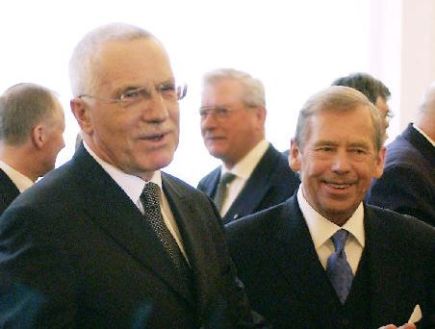
Vaclav Klaus and Vaclav Havel

(Guest post by Greg Forster)

Jay is causing quite a stir with his two-part deconstruction of the Gates Foundation. To those who may be upset, let me say the following two things.

First: Jay’s posts will have no important impact – unless they’re true.

Second: That fact itself demonstrates why the Gates command-and-control approach to education reform is bound to fail.

As Jay points out in his two posts, the Gates effort has undermined the intellectual integrity of many people associated with it. Why? The immediate answer is simple. The Gates strategy is a power agenda. And as Jay and I have both had occasion to point out, power agendas seek to subvert “science” in order to create the impression that their policies are scientifically supported. Other knowledge systems are equally vulnerable, but in our society “science” is the only knowledge system whose validity and importance is recognized by virtually everyone; hence science is the key target for corruption.

Don’t get me wrong; power, considered simply by itself, is good. It’s better to have it than not have it. You can’t get much good done without it. But all good things come with natural temptations and dangers, and one of the natural temptations and dangers that always – always – comes with power is the constant threat to subvert knowledge.

I don’t know their hearts, but I’ll bet the Gates people are not bad people, as people go. They just aren’t awake to, and taking steps to check, this natural danger. They’re not aware of what they’re doing and don’t recognize the process of intellectual corruption for what it is even when it’s held up to their faces – because that failure of recognition is itself the natural attendant danger of power.

But this just leads us to a deeper question. Why do power agendas always display this tendency to corrupt knowledge systems? Why does Gates invest hundreds of millions of dollars in research when it’s clear they already know what they want to be true and aren’t interested in following the evidence? And why does it spend hundreds of millions more subverting the individuals and organizations who talk about education research? Why does Gates care what a bunch of bloggers think? What explains this enormous investment?

Because truth has a power of its own. People want to believe what’s true. Even wicked people who deliberately decieve others for the sake of power would not be willing to be decieved themselves for the sake of power. Every human being has a desire to know truth and live in accordance with that knowledge. To be sure, other desires compete with this desire and often win out over it. But the desire is always there and can always be harnessed as a force for social change – that is, for power. So the people who care about power always have to worry about the people who care about truth.

This dynamic is as old as time. From Plato to Paul, from Martin Luther to Martin Luther King, people who care about truth more than they care about power have been a threat to those who care more about power than they do about truth.

And the reverse is also true, as can be surmised from the response of the powerful to the four people I’ve just named. Asked what he would do to help win support from the pope for the Russian war effort against Germany, Stalin snorted, “The pope? How many divisions has he got?” In a more reflective hour, however, he spoke with more shrewdness: “Ideas are more powerful than guns. We would not let our enemies have guns, why should we let them have ideas?”

Mind you, though, the trouble is not entirely on the side of the “power people.” We “truth people” have our own, equally dangerous dysfunctions. We know that the social systems of power are a threat to the social systems of knowledge production, so our natural instinct in many cases is to fear power. We build high ivory towers and steer clear of the world of power. And by doing so we render ourselves not only irrelevant and irresponsible, but even irrational – because our isolation from “the real world” leaves us extremely vulnerable to falling for spurious ideologies that flatter our prejudices.

For example.

The natural and intrinsic dangers of the life devoted to truth are themselves just as much a threat to the process of knowledge production as the natural and intrinsic dangers of the life devoted to power.

In spite of the natural rivalry between truth and power, or perhaps because of it, people who have gone all the way to the two extremes – those who care only about power and those who care only about truth – often make alliance with one another. The power people provide subsidies that allow the truth people to spend all day in their offices thinking, computing, writing, talking, and doing everything they like to do; in exchange, the truth people anoint the power people as legitimate. Everyone gets what he wants – except for the other 99% of us, who get screwed.

The answer to this dilemma, of course, is that we have to care about both truth and power. Not to care about truth is dishonest. Not to care about power is irresponsible. Both are self-destructive. (Not to mention other-destructive!)

In reality, however, human beings are rarely so balanced. All virtues come in matched pairs of opposites (e.g. courage and moderation, candor and tact) and each person tends to care more about one necessary virtue than its opposite. That’s why people need social systems in which the legitimacy of opposing virtues is respected and processed in a way that doesn’t subordinate the one to the other.

As a little vignette to illustrate this, consider the roles played by Vaclav Havel and Vaclav Klaus in Czech liberation. Under the Czechoslovak tyranny, Havel lived underground, writing tracts and plays and organizing a network of dissident intellectuals. He had no use for the regime’s systems of power, except as targets – and slow, fat targets they were for a powerful genius like his. Havel’s greatest non-fiction work may be his book-length essay “The Power of the Powerless,” in which he argues that truth is the power of the powerless because all people desire ” to live in the truth.” Unchecked power forces people to live a lie, and the more they have to live a lie the stronger the desire to live in the truth grows. When that desire grows stronger than the desire to live quietly, the power of the powerless becomes greater than the power of the powerful.

In 1989, Havel’s circle of dissidents triggered the crisis that brought down the regime. Protestors gathered in Wenceslas Square for days, then weeks, in defiance of machine-gun toting thugs who might gun them all down at any moment. Havel addressed the crowd daily, and was in little danger because wherever he went, throngs of ordinary people spontaneously surrounded him in an effort to shield him from snipers. “You have to kill us all” was the implicit message of the protestors – and the regime broke. Havel’s game plan, Havel’s leadership, Havel’s hour.

Klaus, on the other hand, was an economist for the state bank under the Czechosolvak tyranny. He was not a supporter of the regime, but he apparently saw nothing inconsistent between that and a banking career within the system. He joined the resistance movement early during the revolution of 1989, and before long he drew a large following of support backing him as a leader – two facts that indicate, I think, that he had legitimacy as a reformer.

Havel and his circle, however, couldn’t stand him. More important, they didn’t trust him. They still don’t. To this day, Klaus is dogged by whispers about all the nasty things he must have been doing to keep his position in the state bank, while people like Havel were going to jail for the sake of truth. And it’s not like there’s not some reasonableness to that disposition.

But the bottom line was that Havel didn’t know how to run a country, and Klaus did. In 1989-1991 those two facts rapidly became clear to a large number of people. Havel and his circle had founded Civic Forum as an umbrella party for the resistance movement, and after the regime collapsed it was the “national unity party” under which the new democracy was governed. A year after the revolution, to the surprise and disgust of the Havel circle, the national party deputies elected Klaus to chair the party. Before long an anti-Klaus faction walked out of the party and founded a new one, completing the transition to a system of electoral party competition. Havel, as president of the new nation, stood formally apart from these events, but everyone knew where his sympathies lay.

With the separation of the Czech Republic from Slovakia in 1992, Klaus became its prime minister. From then until Havel’s retirement in 2003, Klaus ran the government and Havel served as head of state. And a bang-up job they both did of it, too – Klaus’ political, economic and administrative leadership brought about a peaceful and successful transition from state ownership and command-and-control to prosperity and personal freedom, while Havel articulated for his nation a renewed understanding of the political community that grounded it in the humane and civil virtues of freedom and personal responsibility. Neither of those feats could have succeeded without the other.

Havel (truth) and Klaus (power) naturally dislike and distrust each other. But the Czech resistance after 1989 and the Czech government in the two succeeding decades made room for them both – Klaus became president after Havel’s retirement from office, while Havel has continued to write and speak. As a result, the Velvet Revolution and the subsequent history of the Czech Republic stand as miraculous modern models of peace, prosperity, order and justice.

So what would an education policy that took seriously both truth and power look like? Stay tuned for Part II.

(You can tell I’m smarter than Jay because I use Roman numerals for my serialized posts.)


WSJ Interview on New Choice Mini-Book

July 21, 2011

Jason Riley of the WSJ interviews me about my new mini-book, Why America Needs School Choice.

I can’t figure out how to embed the video, but click here to view it.


Technology and School Choice: The False Dichotomy

July 18, 2011

(Guest post by Greg Forster)

Terry Moe has a great article in today’s Journal about how entrepreneurial innovation taking advantage of new technology is putting the teacher’s unions on the road to oblivion. It’s a great article, except that it draws one false dichotomy.

Fans of JPGB know that we do love us some high-tech transformation of schooling around here. Matt has been on this beat for a long time, and hardly a week goes by that he doesn’t update us on the latest victory of “the cool kids” over “edu-reactionaries” in the reinvention of the school. But he doesn’t own that turf entirely; I made this the theme of my contribution to Freedom and School Choice (as did Matt, of course).

The problem is that Moe insists high-tech transformation of schooling, and the destruction of union control it entails, is absolutely, positively a separate phenomenon from the wave of school reform victories this year:

This has been a horrible year for teachers unions…But the unions’ hegemony is not going to end soon. All of their big political losses have come at the hands of oversized Republican majorities. Eventually Democrats will regain control, and many of the recent reforms may be undone. The financial crisis will pass, too, taking pressure off states and giving Republicans less political cover…

Over the long haul, however, the unions are in grave trouble—for reasons that have little to do with the tribulations of this year…The first is that they are losing their grip on the Democratic base…Then there’s a crucial dynamic outside of politics: the revolution in information technology.

Really? The victories of 2011 – “the year of school choice” – aren’t in the same category with the long-term path to oblivion the unions are on? On the contrary, 2011 is the year of school choice precisely because it has become obvious that the unions are on track for oblivion, for the reasons Moe identifies.

Moe’s argument relies on the assumption that when Republicans are in power, they always make dramatic and innovative school reform policies their #1 priority.

Sorry  . . . lost my train of thought I was laughing so hard . . . let me pick myself up off the floor . . . there, now where was I? Oh, yes.

The GOP hasn’t touched real school reforms with a hundred-foot pole in years. Why did it all of a sudden embrace real reform this year?

Could it be because…

  1. …the unions are losing their grip on the Democratic base, meaning squishy Republicans don’t have to worry about being demonized as right-wing loonies simply for embracing real reform, and…
  2. …the revolution in information technology has made it obvious to MSM and other key cultural gatekeepers that the unions are the reactionaries, once again reassuring squishy Republicans they won’t be demonized for embracing real reform?

Obviously the financial crisis was also a factor here, as Moe rightly points out. But is that really an immediate-term phenomenon, bound to disappear next week? What really counts is whether the nation feels so rich it can afford to ignore ballooning school costs. Technically the recession ended two years ago and we’ve been in “recovery” for two years. How’s that feeling? Do we feel rich and luxurious again? Are we on track to restore a widespread national sense of inevitable prosperity by 2012? By 2014? By 2020?

Bottom line, the unions losing Democratic support and taking their stand in opposition to entrepreneurial change was the crucial, indispensable precondition for this year’s wave of school reform success.

Oh, and guess what? Sustaining those policies, especially school choice, will be the only way this wave of advancing technology will produce the results Moe is expecting. Only school choice can prevent the blob from neutralizing any reform you throw at it. If the techno-innovators turn their back on choice and competition, they’ll be dead meat. (For more on that topic, see the aforementioned chapter by your humble servant in Freedom and School Choice.)


Why America Needs School Choice — Now Cheaper and Better!

July 14, 2011

Why America Needs School Choice

My new mini-book, Why America Needs School Choice is now cheaper and better!  Encounter is selling it on their web site for $4.19, which is 30% less than the $5.99 list price available at Amazon.

Encounter is also selling an e-book version for the Ipad, which is also available on the Encounter web site.  Amazon is not yet offering the e-book version.  I think the e-book is much more useful because it has hyperlinks to all of the sources.  So, not only will you get the arguments and evidence that policymakers and advocates need to expand school choice, you’ll also be able to go to the original studies so that you can read the details and confirm the accuracy of my summary.