Governor Bush on NH Tax Credits: A Good Deal for Poor Students

June 26, 2012

 (Guest Post by Matthew Ladner)

New Hampshire lawmakers will convene tomorrow in special session, with one of the items on the agenda being an attempt to override Governor Lynch’s veto of a scholarship tax credit. Governor Bush explains in the Concord Monitor today why the program deserves support.

Money quote:

Americans of all philosophical backgrounds desire schools designed to give all children – even those who start with the least – the best possible chance at success. The American dream of equality of opportunity will not be nearly fulfilled unless those less advantaged are given more power over where their children go to school.

New Hampshire will be a better and stronger state if the Legislature overrides the governor’s veto.


School Choice and the Greenfield School Revolution

June 5, 2012

(Guest post by Greg Forster)

Today, the Friedman Foundation is releasing a study I did with James Woodworth: The Greenfield School Revolution and School Choice. We know from previous research that vouchers (and equivalent programs like tax credits and ESAs) consistently deliver better academic performance, but the size of the impact is not revolutionary. Meanwhile, the whole world is watching as charter school operators (Carpe Diem, Rocketship, Yes Prep, etc.) reinvent the school from the ground up.

It’s ironic that these schools are charters, not voucher schools. A properly designed (i.e. universal) choice program would do a better job than charters of supporting these highly ambitious “greenfield” school models. But existing choice programs are not properly designed, so our impression was that they’re excluding these educational entrepreneurs, instead simply transferring students from one existing set of schools (public) to another (private).

We wanted to test our theory and make sure it was true, not just an accident of publicity or media bias, that the reinvention of the school wasn’t being supported by existing choice programs. We combed through twenty years’ worth of federal data (CCD and PSS) to see if we could find any evidence of disruption in the structure of the private school sector in places that had school choice programs.

We found that while existing school choice programs may be delivering moderately better academic outcomes, they aren’t disrupting the private school sector the way they need to be. In one or two places we found visible impacts, but nothing like a reinvention of schooling. The only impact of any considerable size is the dramatic change in racial composition in the private school population of Milwaukee.

In addition to the empirical findings, the study outlines 1) why radical “greenfield” school models are essential to drive the kind of education reform we need, and 2) why universal school choice would do a better job than charter schools of sustaining it.

Special thanks to Rick Hess, from whom we borrow the term “greenfield,” and Jay Greene for giving us their comments and insights as we developed this study!


Here’s Why Victory Looks Like This

March 7, 2012

(Guest post by Greg Forster)

Jay points to the way Democrats and progressives are now saying all the same things we’ve been saying for a decade, but acting like they thought of them, and remarks that this is What Victory Looks Like.

He’s right, and here’s why. To large extent, you have to let people “steal” your ideas in order to get victory. It’s not just a price we need to be willing to pay if necessary. It’s always necessary.

Major reform of a cultural system has to start with ideas and practices germinating outside the core institutions of that system. If major reform were welcome inside the core institutions, it wouldn’t be necessary in the first place. The incubators of reform can’t be seen as fringe groups – this is why organized libertarianism has had much less influence than its intellectual seriousness and devotion of financial resources might lead you to expect. But the reform incubators are never going to be inside the core, either. You need something that’s a happy medium between credibility and independence.

Now, for a long time in America, the Democratic party and the progressive ideological movement have been the “core” institutions governing education. When you ask the American people whom they trust to do the right thing about education, they overwhelmingly say Democrats and progressives. That makes them the core.

The key to victory is to get the core groups to adopt the ideas that incubated in institutions outside the core. The greatest challenge is that the core groups want to defend their “core” turf against outsiders. They want to keep control of the core, and they can’t do that if they admit that outsiders have superior ideas. The solution is to get the core groups to co-opt (i.e. steal) the ideas and pretend they thought of them.

So you’re never going to get (very many) Democrats and progressives saying, “Why, yes, as a matter of fact the conservatives were right about education all along!” Admitting that would require them to sacrifice their status as the cultural core institutions of American education. Instead they’re going to say, “What American schools need are good, liberal, progressive ideas like choice, competition, and accountability.”

That’s what victory looks like.


Virginia Lawmakers Pass Tax Credit

March 1, 2012

(Guest Post by Matthew Ladner)

Virginia joins the parental choice party with a $25m scholarship tax credit for low and moderate income students. The Mid-Atlantic is shaping up nicely after North Carolina came on board last year.

Who will be next?


Arizona Passes the First New Private Choice Program of 2012

February 29, 2012

 (Guest Post by Matthew Ladner)

Arizona Governor Jan Brewer signed the first new private choice program of 2012 into law today. The new law will create a new individual tax credit the same size as the current one ($500 for an individual and $1000 per couple) that will operate under the rules of Arizona’s corporate tax credit (i.e. means tested and aimed at students transferring from public schools). Individual taxpayers will be able to make donations under both credits each year. Arizona lawmakers are also considering an expansion of eligibility of the Education Savings Account program to students attending low rated schools.

Governor Jindal is gearing up for what sounds like a broad choice program. Florida lawmakers are considering an increase in their tax credit program, Virginia has a chance to join the ranks of choice states.

After the 2011 blowout, perhaps Greg’s original bet with Jay Mathews would make for a high but obtainable bar for a good year for private choice in 2012. Greg’s bet is to legislative monitoring what the NCAA tournament is the college basketball.


School Choice Researchers Unite in Ed Week

February 22, 2012

Pictured (L to R): Rick Hess, Jay Greene, Greg Forster, Mike Petrilli and Matt Ladner

(Guest post by Greg Forster)

Today, Education Week carries a joint editorial signed by nine scholars and analysists. We came together to agree that Mom and apple pie are good, Nazis and Commies are bad, and the empirical research supports the expansion of school choice:

Choice’s track record so far is promising and provides support for continuing expansion of school choice policies…Among voucher programs, random-assignment studies generally find modest improvements in reading or math scores, or both. Achievement gains are typically small in each year, but cumulative over time. Graduation rates have been studied less often, but the available evidence indicates a substantial positive impact. None of these studies has found a negative impact…Other research questions regarding voucher program participants have included student safety, parent satisfaction, racial integration, services for students with disabilities, and outcomes related to civic participation and values. Results from these studies are consistently positive…

In addition to effects on participating students, another major topic of research has been the impact of school choice on academic outcomes in the public school system…Among voucher programs, these studies consistently find that vouchers are associated with improved test scores in the affected public schools. The size of the effect in these studies varies from modest to large. No study has found a negative impact.

We have diverse viewpoints on many issues, but we share a common commitment to helping inform public decisions with such evidence as science is legitimately able to provide. We do not offer false certainty about a future none of us knows. But the early evidence is promising, and the grounds for concern have been shown to be largely baseless. The case for expanding our ongoing national experiment with school choice is strong.

This may well be the most important part:

The most important limitation on all of this evidence is that it only studies the programs we now have; it does not study the programs that we could have some day. Existing school choice programs are severely limited, providing educational options only to a targeted population of students, and those available options are highly constrained.

These limitations need to be taken seriously if policymakers wish to consider how these studies might inform their deliberations. The impact of current school choice programs does not exhaust the potential of school choice.

On the other hand, the goal of school choice should be not simply to move students from existing public schools into existing private schools, but to facilitate the emergence of new school entrants; i.e., entrepreneurs creating more effective solutions to educational challenges. This requires better-designed choice policies and the alignment of many other factors—such as human capital, private funding, and consumer-information sources—that extend beyond public policy. Public policy by itself will not fulfill the full potential of school choice.

Although I also feel particularly strongly about this:

Finally, we fear that political pressure is leading people on both sides of the issue to demand things from “science” that science is not, by its nature, able to provide. The temptation of technocracy—the idea that scientists can provide authoritative answers to public questions—is dangerous to democracy and science itself. Public debates should be based on norms, logic, and evidence drawn from beyond just the scientific sphere.

Signatories:

Kenneth Campbell is the president of the Black Alliance for Educational Options, in Washington.

Paul Diperna is the research director for the Friedman Foundation for Educational Choice, in Indianapolis.

Robert C. Enlow is the president and chief executive officer of the Friedman Foundation for Educational Choice.

Greg Forster is a senior fellow at the Friedman Foundation for Educational Choice.

Jay P. Greene is the department head and holder of the 21st-century endowed chair in education reform at the University of Arkansas, at Fayetteville, and a fellow in education policy at the George W. Bush Institute, in Dallas.

Frederick M. Hess is a resident scholar and the director of education policy studies at the American Enterprise Institute, in Washington, as well as a blogger for Education Week.

Matthew Ladner is a senior adviser for policy and research at the Foundation for Excellence in Education, in Tallahassee, Fla.

Michael J. Petrilli is the executive vice president of the Thomas B. Fordham Institute, in Washington.

Patrick J. Wolf is a professor and holder of the 21st-century endowed chair in school choice at the University of Arkansas, at Fayetteville.

Our color-coordinated mechanical lion battle chariots that join together into a giant robot are still under construction.

Defender of the empirical research universe!


Archbishop Charles Chaput Calls for Action to Expand PA Parental Choice

January 31, 2012

(Guest Post by Matthew Ladner)

Philadelphia Archbishop Charles Chaput released the following statement last Friday and published in today’s Philadelphia Archdiocesan publications, including every parish bulletin being distributed at Mass and published online.

Archbishop’s weekly column: Catholic Schools Week – How you and I can help

Monday, January 29, begins Catholic Schools Week. It’s a time to honor the unique value of Catholic education. Here in the Archdiocese of Philadelphia, we have a long record of dedicated service by the women and men who teach in our classrooms and run the “business” of Catholic schools. That record includes the legacy of thousands of women and men religious and diocesan clergy. In the single academic year of 1963-64, more than 4,100 religious and 1,600 laypersons taught more than 263,000 students enrolled in our schools. Today, scores of our pastors make extraordinary commitments of parish funds to keep our schools open and excellent.

Unfortunately, schools run on resources, not simply good will and heroic service. Our schools can no longer count on unlimited Church support. The resources simply don’t exist. Many of our parishes are financially strained. The archdiocese itself faces serious financial and organizational challenges that have been developing for many years and cannot be ignored.

So where does that leave us? We can honor Catholic Schools Week this year by actually doing something about the fiscal problems hurting our schools. We need to press our lawmakers, respectfully but vigorously, to pass school choice.

First, we need some clarity: School vouchers do not mean “government support for religious schools.” That argument is flatly false. No vouchers go to any school, religious or otherwise. Vouchers do, however, return the power of educational choice to parents, where it belongs. In doing so, vouchers make all schools more accountable for the quality of education they deliver. Parents get the voucher. Parents choose the school. This makes perfect sense. And if a school offers a poor education for young people, parents will rightly vote with their feet — and their vouchers. Of course, most Catholic schools do the opposite: They offer a strong education, in a safe environment, with a focus on developing good moral character. That’s why parents are so upset when they close.

Some people argue that school choice legislation only helps families in poor areas. Helping the poor is obviously vital, and vouchers would accomplish that. But vouchers would also assist many more families than the poor. If vouchers are approved, they will free up what’s known as EITC funds — Educational Improvement Tax Credit funds — along with other grant and scholarship monies for many thousands of other school families. In effect, the positive impact of vouchers translates to millions of dollars of additional educational resources potentially available to a wide range of school families each year — including Catholic school families.

Now here’s an unhappy fact: In 2011, the bishops of Pennsylvania made the passage of vouchers one of their priority legislative issues. People like Bob O’Hara in our statewide Catholic bishops’ conference and Jason Budd in our archdiocesan Office of Catholic Education worked hard to mobilize Catholic support. Their efforts failed — and not because they didn’t try, but because too few people in the pews listened. Very few Catholics called or wrote their state senators and representatives. Even fewer visited their offices to lobby as citizens. Despite this, vouchers passed in the state senate, before stalling in the house. One non-Catholic school choice activist — who has poured years of his time and millions of dollars of his own resources into fighting for vouchers as a social justice issue — was baffled at the inability of Catholics to mobilize around an issue so obviously vital to the public interest and so clearly helpful to the survival of their own schools.

In the coming week I’ll be writing every state senator and representative in the territory of the Archdiocese of Philadelphia to press them to support school vouchers. And I’ll continue doing it until vouchers pass. I hope my brother bishops and pastors across the state will do the same. More importantly: Our Catholic people need to do the same. Elected officials do listen, and they act when the noise gets loud enough. If nothing else, the crisis of Philadelphia’s Catholic schools is an unpleasant but finally very healthy wake up call. The bill for our failure to pass school choice over the past decade has come due. Now we’re paying for it.

When vouchers stalled, yet again, in the Pennsylvania house last fall, a frustrated Catholic school teacher friend of mine said “Catholics are suckers.” I don’t believe that. But then, I’m new in town. If we Philadelphia Catholics love our Catholic schools, and we obviously do, then the time to get active and focused is now. We need to begin pressing our state lawmakers to pass the school choice legislation — including vouchers and expanded EITC credits — that’s currently pending in Harrisburg. And we need to do it this week, today, right now. I plan to do that. I hope you’ll join me.

For more information on school choice, and to contact your legislator, please visit:  http://tinyurl.com/PASchoolChoice


Friedman Foundation Releases 2012 ABCs

January 24, 2012

HT Brandon Peat Design

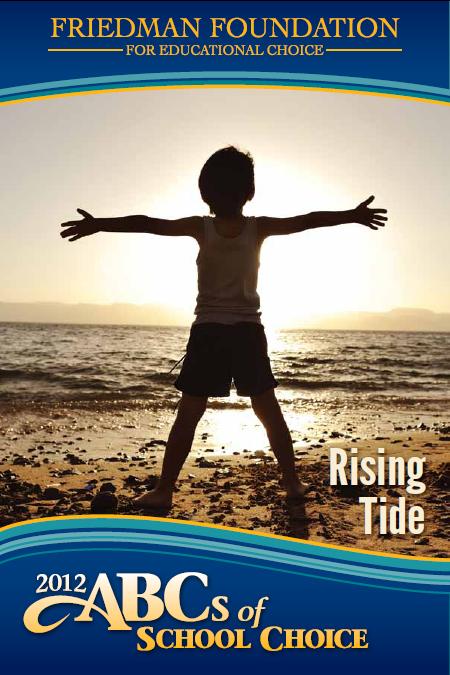
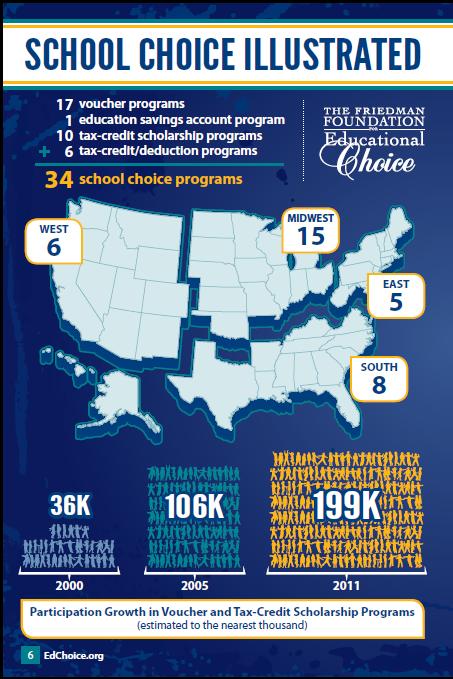
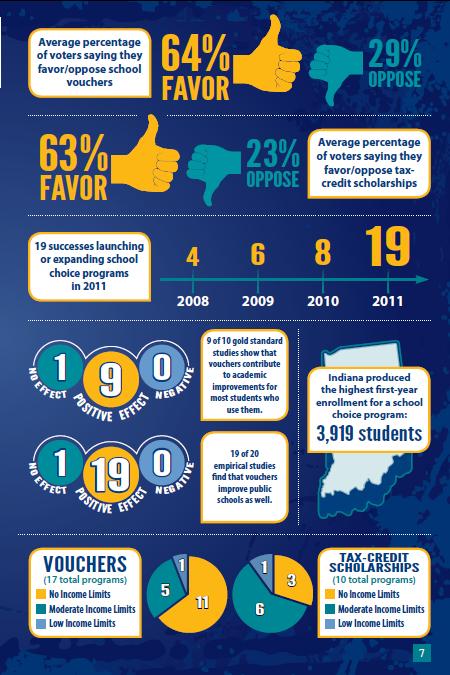
The Friedman Foundation has just released the 2012 edition of its annual publication ABCs of School Choice. It’s a busy week for releases!

There’s much to celebrate this year:

Milton and Rose D. Friedman envisioned a true revolution in American education. Their ideal was simple but powerful: give every parent the power and freedom to choose their children’s education. Unquestionably, 2011 was a breakthrough year in the quest to see that vision achieved in the United States. Thirteen states enacted school choice programs (this includes Washington, D.C., and Douglas County, Colorado). A total of 19 programs were enacted or improved—including the creation of eight new programs and the expansion of 11 existing ones.

Appropriately, this year’s report is subtitled Rising Tide. Check it out!

That’s a pretty big improvement over the plain text and little silhouettes of states it used to consist of when I edited it. Kudos!


PA lawmakers fail to expand school choice

December 16, 2011

 (Guest Post by Matthew Ladner)

As predicted, Big-10 country led the nation in expanding school choice this year. Just to recap, Indiana created the what will become the nation’s largest voucher program and expanded their tax credit. Wisconsin expaned the Milwaukee Parental Choice Program and created a new program for Racine. Ohio expanded their failing school voucher and created a new voucher program for special needs students. Michigan removed the cap on university sponsored charter schools after a decade plus long struggle.

Pennsylvania had proposed vouchers, a large expansion of their tax credit program and an expansion of their charter school law. It appears however that the PA legislature will choose to do nothing to expand parental options.


Vouchers and Low-Income: Reality Check

November 10, 2011

(Guest post by Greg Forster)

Have school vouchers moved away from their historic focus on low-income students? The political hacks at the Center on Education Policy think so. And as we know, whenever CEP weighs in, that’s reason enough to check the facts.

Paul DiPerna of the Friedman Foundation did a headcount and found that as of now:

  • 11 of 17 existing voucher programs have no income limits
  • 7 of these are statewide special-needs programs (FL, GA, LA, OHx2, OK & UT), 3 have geographic caps (ME, VT & OH) and one has a numeric cap (CO)
  • Of the 6 programs with income limits, 5 have limits that are above 200% of the poverty line

What do you know? CEP is right!

Of course, other kinds of limitations can be equally problematic. If our goal is to create a thriving marketplace of innovative options, the key is to provide enough students with enough choice to support new entrants – educational entrepreneurs – so we get beyond just moving kids from existing public schools to existing private schools. We don’t really have any existing programs that do that.

On the other hand, even among poorly designed programs there are better and worse forms. The income limitation was worse for educational entrepreneurship than, say, a straight numeric cap or a straight geographic limitaiton. As Milton always said, show me a program for the poor and I’ll show you a poor program. The hard reality is that lower-income people are not the population that throws its support behind truly innovative ventures. They have too much at risk. It’s the well-off, educated parents who are most likely to feel secure trying newer or more specialized schools. (Programs like EdChoice that are not “straight” geographic limitations but shift eligibility areas from year to year based on public school performance are another matter – they’re hugely problematic from this standpoint.)

The quickest way to unlock educational innovation and deliver better education to low-income students is to give vouchers to everyone. That way the innovations will, you know, actually happen.

Since I know you’re wondering, here are the tax-credit scholarship numbers for comparison purposes:

  • 3 of 10 tax-credit scholarship programs have no income limits
  • One of the three (AZ) is a statewide special-needs program
  • 6 of the 7 programs with limits have limits that are above 200% of the poverty line