American School Reform

September 28, 2011

“The spirit of enterprise, which characterizes the commercial part of America, has left no occasion of displaying itself unimproved.”

-Federalist 7

“In a state of disunion…that unequaled spirit of enterprise, which signalizes the genius of the American merchants and navigators, and which is in itself an inexhaustible mine of national wealth, would be stifled and lost, and poverty and disgrace would overspread a country which, with wisdom, might make herself the admiration and envy of the world.”

– Federalist 11

(Guest post by Greg Forster)

Jay, Rick Hess and Paul Peterson have all recently made really impressive scholarly contributions that all point to the same conclusion: “It’s not all about poor kids,” so it’s time to overcome “our achievement-gap mania” and get our “globally challenged” total population of kids – including the middle-class suburban white ones – “ready to compete.” Because it’s clear that they’re not, and it’s clear that they need to be, more than ever before.

This is a really encouraging development and a badly needed message for school reformers. There is no law of nature that says America will always be a flourishing and successful nation, and it will not in fact remain so unless we overcome our myopia and confront the mediocre performance of all our schools.

Raising the “floor” is important. But it’s much more important to get rid of the “ceiling” – the sense that in most schools we’re already good enough, the sense that we don’t need improvement. In fact, removing the ceiling will do more to raise the floor than any of our direct efforts to raise the floor.

Here’s my concern. As we move to confront the middle-class white suburbanites with the inadequacy of their schools, it’s important that the message not be “your school sucks and I can prove it.” Not that I hear Jay, Rick or Paul saying that; they’re not. But that will be the cariacature our enemies will deploy against us. We have to take proactive steps to preempt that tactic.

I think we can improve our message by grounding it in an affirmation of what’s best about America. America is an enterprise society; always has been. America was founded as the country that looked at Europe, clinging (bitterly) to the last remaining remnants of a thousand years of feudalism on the assumption that the basic ways of the world could never be changed, and said: “The old ways aren’t good enough. We can do better. We will plant our roots in the past, but our branches must grow upward.”

We can draw on that as we speak into suburban complacency. A tree that isn’t growing is dying; for nations as for forests, there is no comfortable plateau. Nations that seek comfortable plateaus, like those in Europe today, wither. Americans have never wanted a comfortable plateau; we want every generation to be more blessed than the last. However, the data in our schools show that our national future is clearly not being prepared for growth. But this is America. We don’t accept complacency. We don’t shrug our shoulders and accept decline. We know we can do better. And there are models of reform that can unlock our potential.

Grounding this new direction for school reform in the American culture as an enterprise society will keep us from descending into squabbling over whether we’re “anti-public schools” and keep everyone’s eye on the ball: the flourishing of our national future.


Amen Brother!

September 23, 2011

(Guest Post by Matthew Ladner)

Watch this, like right now. Don’t wait, do it now.


How Diane Promotes Civility

August 24, 2011

mail (1366×768)

Diane Ravitch’s hypocrisy has reached a new high, if that is possible.  A few months ago she pleaded for an end to “meanness” in education policy discussions after she was caught fabricating (or imagining) serious allegations of misbehavior against Deborah Gist, the education chief in Rhode Island: 

I despair of the spirit of meanness that now permeates so much of our public discourse. One sees it on television, hears it on radio talk shows, reads it in comments on blogs, where some attack in personal terms using the cover of anonymity or even their own name, taking some sort of perverse pleasure in maligning or ridiculing others.

I don’t want to be part of that spirit. Those of us who truly care about children and the future of our society should find ways to share our ideas, to discuss our differences amicably, and to model the behavior that we want the young to emulate.

And yesterday Diane sent a mass email praising a blog post by Mike Petrilli lamenting the name-calling in education debates.  She wrote:

Mike Petrilli is one of the few people in today’s education debates who is consistently thoughtful. He never resorts to mudslinging. There is a special place in heaven for him. We can all learn from his civility.

But the very same day Diane retweeted the following message to her 18,000+ Twitter followers:

@DianeRavitch thank you for being on the front lines for us. I would resort to violence were I confronted with Brill’s smugnorance.

I understand that a retweet does not necessarily mean endorsement, but people cannot avoid responsibility for what they choose to forward.  You can’t decry the incivility in discourse and then forward to your 18,000+ followers a message about resorting to violence in response to Brill’s “smugnorance.”

(edited for typos)


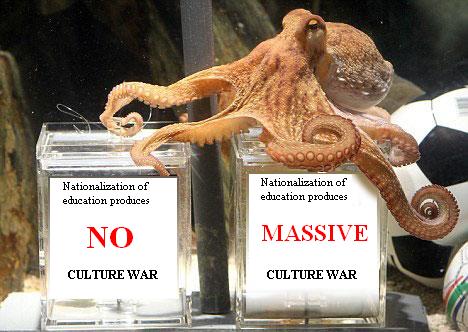
Big Shock! Nationalization Sparks Culture War

August 19, 2011

Paul the psychic octopus sez: “Toldja so!”

(Guest post by Greg Forster)

With the shooting war that’s emerging betweeen Arne Duncan and Rick Perry over national control of education, some of the people who helped facilitate the movement toward nationalization are now saddened to see that creating a giant lever in DC that has the power to impact every school in the nation leads directly to a vicious, snarling political war over education policy, such that education can’t be discussed and debated dispassionately because culturally aliented partisans who don’t trust each other are all too busy trying to be the first person to seize the lever.

Surely no one could have predicted this unforeseeable outcome! Oh, wait.

National control over curriculum creates a single lever you can pull to move every school in America. Would conservatives trust progressives, and would progressives trust conservatives, not to try to seize control of that lever to inculcate their religious and moral views among the nation’s youth? And if you don’t trust the other side not to try to seize the lever, is there any reasonable alternative to trying to seize it first?

And this would not be just a single conflict that would happen and then be over. Like the Golden Apple or the One Ring, national curriculum and testing will continuously generate fresh hostility and cultural warfare as long as they exist. And once you forge this ring, there’s no Mount Doom to drop it into.

See also. Plus Neal here. Not to mention Neal’s eternal platonic beauty queens.

The whole idea of “high standards” is now irreversibly associated with nationalization. Now that the standards people – most of them, anyway – have been foolish enough to start it, this war over nationalization is going to have to be fought to its conclusion before we can circle back and talk about “high standards” in any other context.


Podcast on Power

August 16, 2011

(Guest post by Greg Forster)

Still catching up on a travel backlog – in case you missed it, here’s my latest pod-type casting module over the inter-net system of tubes via Heartland. Main topic: the delicate balance between truth and power, and how the late unpleasantness shows the dangers to which some education reformers are already succumbing as they displace the minions of the blob as gatekeepers to the center of the conversation. Our old friend Jack Jennings, aka the human torch, also makes an appearance!


Arne Duncan, Suuuuuuuuuper Geeeeeeenius!

August 12, 2011

(Guest post by Greg Forster)

Before he goes ahead with the plan to set himself up as America’s first one-man legislature, Arne Duncan might want to read this detailed, devastating takedown by Rick Hess.

This is pretty much what I was trying to get at in the comments earlier this week, except a whole lot better both on substance and humor value. I couldn’t stop laughing, and I also couldn’t stop crying.

(Although I do think I should get points for working in an Iron Chefs reference.)

If Duncan doesn’t pick up the clue Rick is putting out on the table for him, here’s how his tenure might be remembered:


Nationalization Chickens Come Home to Roost

August 9, 2011

(Guest post by Greg Forster)

He who sleeps with dogs gets fleas. Conservatives who spent the last year pooh-poohing concerns about federal government coercion lying behind the “voluntary” “state-driven” adoption of Common Core, and stigmatizing as “paranoid” those of us who sounded the alarm, are now shocked and saddened to discover that – hold on to your hats! – the federal government is gearing up to use the ridiculous and unobtainable NCLB 100% proficiency requirement as a bludgeon to force the last remaining holdout states to bow down and adopt Common Core.

I am shocked – shocked! – to discover that nationalization is going on in here!

If it’s too much to ask that they come out and admit that it was always a bad idea to sign on to an agenda that was obviously being driven by nationalizers, much less that they apologize to those of us whom they smeared and laughed at along the way, could we now at least ask for a moratorium on the silly “we can quit any time we want!” argument?

I mean the assertion that once states have been forced to sign up for Common Core, the fact that they remain signed up rather than dropping out somehow counts as evidence that they’re really “voluntarily” on board. Leave aside the fact that it basically boils down to saying it’s OK for state political leaders to be prostitutes and destroy children’s lives for money as long as they then come out after the fact and admit openly that that’s what they were doing all along. Does anyone really think that strongarming is something that happens only once? I mean, if your corner grocery gets a visit from Guido and Rocco and immediately thereafter signs up as a member of the Legitimate Businessmen’s Neighborhood Business Protection Society, does its membership count as “voluntary” because it stays in the society year after year even though Guido and Rocco never set foot in the place again?

Suppoose the LBNBPS people swear – cross their hearts and hope to die – that they’ve fired Guido and Rocco and have gone totally legitimate? Would anyone believe them? Would businesses feel free to leave?

I get the sense that conservatives who like Common Core want a do-over. They want to disengage from their former allies among the nationalizers and reposition themselves as champions of high state standards.

Fine! Step one to getting a do-over is to actually do it over.

Common Core is irreversibly associated with nationalization. It already was before the latest word about NCLB waivers; that news doesn’t create, but merely confirms, the permanent link between CC and nationalization of education.

You want genuinely state-driven common standards? Create some.


The Gates Foundation and the Rise of the Cool Kids

July 28, 2011

(Guest Post by Matthew Ladner)

Jay and Greg have been carrying on an important discussion concerning the Gates Foundation and education reform. I wanted to add a few thoughts.

Rick Hess and others have noted the “philanthropist as royalty” phenomenon in the past. Any philanthropist runs the danger of only hearing what they want to hear from their supplicants, and Gates as the largest private foundation runs the biggest risk. The criticism of the Gates Foundation I had seen in the past emanated from the K-12 reactionary fever swamp, hardly qualifying as constructive.

The challenge faced by philanthropists: how do you challenge your own assumptions and evaluate your own efforts honestly? Do you hire formidable Devil’s advocates to level their most skeptical case against your efforts?

I don’t know the answer to these questions, just that if I were Bill Gates I would be terrified of everyone telling me how right my thinking is because they want my money. This is however the best sort of problem to have…

Jay’s central critique of the Gates Foundation strategy seems to be that they have put too much faith in a centralized command and control strategy. They would be wise to entertain this thought. If command and control alone were the solution, then we wouldn’t have education problems-district, state and federal governance have all failed to prevent widespread academic failure for decades.

The Gates strategy does however embrace decentralization. Over the years they have supported charter schools, and fiercely opposed the worst one-size fits all policy of all: salary schedules and automatic/irrevocable tenure. Riley’s WSJ article makes clear that Gates understands the benefits of private school choice, but that he falls for the Jay Mathews fallacy of thinking it is just too politically difficult.

Sigh…perhaps next year Greg can make a dinner bet with Bill.

Gates is also the primary backer of Khan Academy. This new article on Sal Khan in Wired magazine makes clear that Khan understands the danger of being swallowed by school systems and that he is not going to allow it to happen. Khan academy is both radically decentralized and is in the early stages of being used by people within the centralized school system to improve outcomes.

Whatever the mistakes to date, the Gates Foundation has in my mind has succeeded in serving as a counter-weight to the NEA, mostly through funding the efforts of a myriad network of reform organizations collectively known as the Cool Kids. Today, there is a struggle for power going on within the Democratic Party over K-12 policy and the Gates Foundation deserves some credit in my mind for supporting  the ideas behind the “Democrat Spring” on education policy. This spring is following more of the Syrian than the Egyptian model thus far, but it is happening, and it is very important.

Does that mean that they are the “good guys” and Jay should lay off of them? Of course not-reasoned critiques of large philanthropists are in short supply for all of the factors cited above. Jason Riley wished that Gates were bolder in embracing decentralization reforms, but noted that in the end that it was the Gates rather than the Riley Foundation. This is absolutely true, but it doesn’t make the royalty problem go away, and leaves a continuous question of how the emperor gets feedback on his new clothes.

I don’t agree with the Cool Kids about everything. The next time I hear someone ask a question about having Common Core replace NAEP (the very pinnacle of naive folly) for instance I may pull out entire tufts of my graying, thinning hair in utter exasperation. Reformers of all stripes need to be on guard against the ship-wheel conceit, which is to imagine that if only my strong hands steered the ship, we’d sail through the rocky shoals of ed reform without a hitch.

The East Germans ran a much better economy than the North Koreans, much to the benefit of Germans and to the detriment of Koreans. This is real and important in human terms- I do not make this point glibly. I never heard about an East German famine decimating the population, but food shortages have even soldiers starving to death in North Korea (pity the women and children). Better quality management is good and desirable, but…it will only take you so far. Today, Chinese apparatchiks are noisily crediting themselves for the tremendous economic progress in China without the slightest hint of irony. Without the market forces Deng introduced and with more apparatchiks, China would revert back to a starving backwater. With fewer apparatchiks, her progress would almost certainly accelerate.

As Sara Mead correctly noted in this guest post at Eduwonk, today’s education debate largely involves a mixture of technocratic and market-based reforms (neo-liberals) on one side and a group of reactionaries lacking realistic solutions on the other. A third of our 4th graders can’t read and have been shoved into the dropout pipeline. We need both technocratic and market based reforms, and we need stronger reforms of both sorts than those fielded to date.

Jay’s critique concerns the right mix of reforms within the bounds of the neo-liberal consensus. This of course is a matter of debate, and debate is the path to deeper understanding. The sheer size of the Gates Foundation has the potential to stifle such debate as it relates to their efforts, even passively, and reformers should recognize the danger in allowing it to do so. This isn’t about them so much as it is about us.


Command v. Choice Part II: Trust and Teamwork

July 27, 2011

(Guest post by Greg Forster) 

Jay P. Greene’s Blog Presents: 

Ineffective Teambuilding Techniques!

Group Religious Instruction

“Tryouts”

Mandatory Employee Leave Policy 

See Part I.

The existing school system persistently fails to pick up and reproduce best practices. Reformers have identified no end of good ideas that hold a lot of promise – provided you can get schools to try them. But no matter how good the ideas are, no matter how many high quality models you build and demonstrate, other schools never seem to pick them up and adopt them.

Therefore fixing schools will require the exercise of power. Somehow we have to get people to do things they currently find unpersuasive or excessively painful.

But people don’t like to be made to do things. They want to live in the way that seems right to them. And this is a legitimate desire – we can’t “live in the truth” if we have to live in ways that we experience as inauthentic. The more we have to do things that we don’t believe in because others, who have power, force us to to them, the more inauthentic our lives become. This makes us miserable, destroys motivation and idealism, shuts down the entrepreneurial drive for improvement, and breeds resentment.

That last item on the list can’t be stressed too strongly. Command and control is not only destructive in many other ways, it also fails to accomplish its explicit goals, because people who are subjected to it quickly develop a strong sense that cheating the system is okay, even virtuous, since the system itself is evil.

Reforms only work if you have three things. First you need a good idea – the reform itself. Next you need people who are capable of carrying it out – hence the rise of teacher quality as a focus of reform. But there’s a third thing you need, and this is why command-based approaches never work: you need an institutional culture in which reform is viewed as legitimate, necessary and empowering.

In any organization, institutional effectiveness is driven by trust and teamwork. To the extent that people are merely obeying rules, chasing carrots or avoiding sticks, effectiveness collapses. Effective institutions are ones that succeed in 1) cultivating trust and teamwork – for real, not the phony kind you get by making people do ropes courses and stuff; and 2) harnessing the trust and teamwork of the organization for effectiveness.

That second point is key. The trust and teamwork of an organization can be oriented toward goals other than the proper goal of the institution. They can even be oriented against the proper goal of the institution – as in Atlanta, where the whole system mobilized in a high-trust, intensive team project to cheat on accountability testing.

But trust and teamwork can only be mobilized for the right goals when people sincerely believe in the goals. The processes – and reforms – necessary to achieve those goals need to be understood and experienced as legitimate. Reform can’t just be imposed by power; it needs to become part of people’s truth.

Forgetting this fact, and actively corrupting the social processes that people rely on for truth, is the great temptation that always comes with power. The Gates Foundation, having succumbed to this temptation, is now embarking on what looks to be a wasted, deeply counterproductive decade or so (depending on how long it takes them to come to themselves) of command-and-control based reform.

So how can we accomplish reform in a way that is both humane and effective?

Let’s go back to the original reason we need power: “Somehow we have to get people to do things they currently find unpersuasive or excessively painful.” Emphasis added!

People need to be persuaded to adopt reform as part of their truth – something they experience as legitimate, necessary, and empowering.

“But wait!” I hear you cry. “That’s what we’ve been trying for decades, and it hasn’t worked!”

That’s right, so let’s ask why it hasn’t worked. I mean, isn’t it a little odd that 1) the system is so overwhelmingly dysfunctional that it’s destroying millions of children’s lives, 2) the people in the system are normal people, not psychotic or anything, people who by all accounts care about children’s education at least as much as the average person if not, you know, a lot more, and yet 3) the people in the system can’t be brought by any means to see reform as necessary?

What is it about the system as currently constituted that ensures reform is never embraced as something legitimate, necessary and empowering?

The system is moribund because it is a monopoly. When any institution has a captive client base, support for innovation vanishes. Reform requires people and institutions to do uncomfortable new things. Thus it won’t happen unless people are even more uncomfortable with the status quo than they are with change. So we need institutional structures that make the need for change seem plausible and legitimate. A captive client base ensures that such structures never emerge. An urgent need for change never seems really plausibile. An institution with captive clients can – or at least it will always feel like it can – continue to function, more or less as it always has, indefinitely. So why change, when change is uncomfortable, even painful?

This is why even small reforms that seem like they would be easy to implement have consistently failed to scale, and the attempt to impose such reforms through national command structures will fail even more spectacularly. Institutional culture in the existing system is hostile not just to this or that reform, but to reform as such, because it excludes the only institutional basis for making the need for change seem plausible and legitimate: the prospect of losing the client base.

This is what school choice advocates are talking about when they talk about the value of competition. “Competition” does not mean a cutthroat, ethics-free environment where individuals and institutions seek their own good at the expense of the good of others. Rather, competition is the life-giving force that drives institutions to become their best and continuously innovate, because it is the only way to hold institutions accountable for performance in a way that is both productive (because it aligns the measurement of institutional performance with people’s needs) and humane (because it creates accountability in a decentralized way rather than through a command-and-control power structure).

Where real competition is present, the cutthroats and self-servers are generally the first to fail. It is the individuals and institutions that focus on serving the needs of others who find success.

This is why big corporations, Wall Street firms, etc. are always opposed to free competition and are always seeking partnerships with government to undermine and eliminate it. They want to be able to use their dominant position to extract wealth without being accountable to serve anyone else’s needs.

This is the most important reason school choice has consistently improved educational outcomes for both the students who use it and for students in public schools. Studies of school choice programs consistently find that students using choice have better outcomes, and also that public schools improve in response to the presence of school choice. The explanation is simple: school choice puts parents back in charge of education, freeing the captive client base and creating an institutional environment in schools that makes the need for change seem plausible and legitimate.

Educators experience the urgency of the need for change when families not being served can leave for other schools – and they will never experience it any other way. Discomfort with change is also reduced for parents, because school choice restores their control over their children’s education.

This is not to say that power plays no role. The school choice movement needs power to break the union deathgrip on education policy and implement a real (i.e. universal) school choice program. And of course that means we need to be on our guard against the temptation to corrupt the knowledge process – to make power more important than truth, to say things that aren’t true but will help us get power. And power will continue to play a role, not only in continuing to defend real choice once it’s implemented, but also to enforce the rules of participation (to punish cheating, etc.).

But choice is the approach that is able to take both power and truth seriously. Command and choice are the two great methods of changing institutions. Command puts power in the driver’s seat, and sometimes (e.g. when punishing crimes) that’s necessary. Choice tends more in the direction of favoring truth over power.

I know which path I’m betting on. And so, I guess, does Gates. May the best man win.


Command v. Choice, Part I: Truth and Power

July 26, 2011

Vaclav Klaus and Vaclav Havel

(Guest post by Greg Forster)

Jay is causing quite a stir with his two-part deconstruction of the Gates Foundation. To those who may be upset, let me say the following two things.

First: Jay’s posts will have no important impact – unless they’re true.

Second: That fact itself demonstrates why the Gates command-and-control approach to education reform is bound to fail.

As Jay points out in his two posts, the Gates effort has undermined the intellectual integrity of many people associated with it. Why? The immediate answer is simple. The Gates strategy is a power agenda. And as Jay and I have both had occasion to point out, power agendas seek to subvert “science” in order to create the impression that their policies are scientifically supported. Other knowledge systems are equally vulnerable, but in our society “science” is the only knowledge system whose validity and importance is recognized by virtually everyone; hence science is the key target for corruption.

Don’t get me wrong; power, considered simply by itself, is good. It’s better to have it than not have it. You can’t get much good done without it. But all good things come with natural temptations and dangers, and one of the natural temptations and dangers that always – always – comes with power is the constant threat to subvert knowledge.

I don’t know their hearts, but I’ll bet the Gates people are not bad people, as people go. They just aren’t awake to, and taking steps to check, this natural danger. They’re not aware of what they’re doing and don’t recognize the process of intellectual corruption for what it is even when it’s held up to their faces – because that failure of recognition is itself the natural attendant danger of power.

But this just leads us to a deeper question. Why do power agendas always display this tendency to corrupt knowledge systems? Why does Gates invest hundreds of millions of dollars in research when it’s clear they already know what they want to be true and aren’t interested in following the evidence? And why does it spend hundreds of millions more subverting the individuals and organizations who talk about education research? Why does Gates care what a bunch of bloggers think? What explains this enormous investment?

Because truth has a power of its own. People want to believe what’s true. Even wicked people who deliberately decieve others for the sake of power would not be willing to be decieved themselves for the sake of power. Every human being has a desire to know truth and live in accordance with that knowledge. To be sure, other desires compete with this desire and often win out over it. But the desire is always there and can always be harnessed as a force for social change – that is, for power. So the people who care about power always have to worry about the people who care about truth.

This dynamic is as old as time. From Plato to Paul, from Martin Luther to Martin Luther King, people who care about truth more than they care about power have been a threat to those who care more about power than they do about truth.

And the reverse is also true, as can be surmised from the response of the powerful to the four people I’ve just named. Asked what he would do to help win support from the pope for the Russian war effort against Germany, Stalin snorted, “The pope? How many divisions has he got?” In a more reflective hour, however, he spoke with more shrewdness: “Ideas are more powerful than guns. We would not let our enemies have guns, why should we let them have ideas?”

Mind you, though, the trouble is not entirely on the side of the “power people.” We “truth people” have our own, equally dangerous dysfunctions. We know that the social systems of power are a threat to the social systems of knowledge production, so our natural instinct in many cases is to fear power. We build high ivory towers and steer clear of the world of power. And by doing so we render ourselves not only irrelevant and irresponsible, but even irrational – because our isolation from “the real world” leaves us extremely vulnerable to falling for spurious ideologies that flatter our prejudices.

For example.

The natural and intrinsic dangers of the life devoted to truth are themselves just as much a threat to the process of knowledge production as the natural and intrinsic dangers of the life devoted to power.

In spite of the natural rivalry between truth and power, or perhaps because of it, people who have gone all the way to the two extremes – those who care only about power and those who care only about truth – often make alliance with one another. The power people provide subsidies that allow the truth people to spend all day in their offices thinking, computing, writing, talking, and doing everything they like to do; in exchange, the truth people anoint the power people as legitimate. Everyone gets what he wants – except for the other 99% of us, who get screwed.

The answer to this dilemma, of course, is that we have to care about both truth and power. Not to care about truth is dishonest. Not to care about power is irresponsible. Both are self-destructive. (Not to mention other-destructive!)

In reality, however, human beings are rarely so balanced. All virtues come in matched pairs of opposites (e.g. courage and moderation, candor and tact) and each person tends to care more about one necessary virtue than its opposite. That’s why people need social systems in which the legitimacy of opposing virtues is respected and processed in a way that doesn’t subordinate the one to the other.

As a little vignette to illustrate this, consider the roles played by Vaclav Havel and Vaclav Klaus in Czech liberation. Under the Czechoslovak tyranny, Havel lived underground, writing tracts and plays and organizing a network of dissident intellectuals. He had no use for the regime’s systems of power, except as targets – and slow, fat targets they were for a powerful genius like his. Havel’s greatest non-fiction work may be his book-length essay “The Power of the Powerless,” in which he argues that truth is the power of the powerless because all people desire ” to live in the truth.” Unchecked power forces people to live a lie, and the more they have to live a lie the stronger the desire to live in the truth grows. When that desire grows stronger than the desire to live quietly, the power of the powerless becomes greater than the power of the powerful.

In 1989, Havel’s circle of dissidents triggered the crisis that brought down the regime. Protestors gathered in Wenceslas Square for days, then weeks, in defiance of machine-gun toting thugs who might gun them all down at any moment. Havel addressed the crowd daily, and was in little danger because wherever he went, throngs of ordinary people spontaneously surrounded him in an effort to shield him from snipers. “You have to kill us all” was the implicit message of the protestors – and the regime broke. Havel’s game plan, Havel’s leadership, Havel’s hour.

Klaus, on the other hand, was an economist for the state bank under the Czechosolvak tyranny. He was not a supporter of the regime, but he apparently saw nothing inconsistent between that and a banking career within the system. He joined the resistance movement early during the revolution of 1989, and before long he drew a large following of support backing him as a leader – two facts that indicate, I think, that he had legitimacy as a reformer.

Havel and his circle, however, couldn’t stand him. More important, they didn’t trust him. They still don’t. To this day, Klaus is dogged by whispers about all the nasty things he must have been doing to keep his position in the state bank, while people like Havel were going to jail for the sake of truth. And it’s not like there’s not some reasonableness to that disposition.

But the bottom line was that Havel didn’t know how to run a country, and Klaus did. In 1989-1991 those two facts rapidly became clear to a large number of people. Havel and his circle had founded Civic Forum as an umbrella party for the resistance movement, and after the regime collapsed it was the “national unity party” under which the new democracy was governed. A year after the revolution, to the surprise and disgust of the Havel circle, the national party deputies elected Klaus to chair the party. Before long an anti-Klaus faction walked out of the party and founded a new one, completing the transition to a system of electoral party competition. Havel, as president of the new nation, stood formally apart from these events, but everyone knew where his sympathies lay.

With the separation of the Czech Republic from Slovakia in 1992, Klaus became its prime minister. From then until Havel’s retirement in 2003, Klaus ran the government and Havel served as head of state. And a bang-up job they both did of it, too – Klaus’ political, economic and administrative leadership brought about a peaceful and successful transition from state ownership and command-and-control to prosperity and personal freedom, while Havel articulated for his nation a renewed understanding of the political community that grounded it in the humane and civil virtues of freedom and personal responsibility. Neither of those feats could have succeeded without the other.

Havel (truth) and Klaus (power) naturally dislike and distrust each other. But the Czech resistance after 1989 and the Czech government in the two succeeding decades made room for them both – Klaus became president after Havel’s retirement from office, while Havel has continued to write and speak. As a result, the Velvet Revolution and the subsequent history of the Czech Republic stand as miraculous modern models of peace, prosperity, order and justice.

So what would an education policy that took seriously both truth and power look like? Stay tuned for Part II.

(You can tell I’m smarter than Jay because I use Roman numerals for my serialized posts.)