It Took So Long Because They Were Learning It in the Wrong Style

September 7, 2010

(Guest post by Greg Forster)

I had to laugh when I saw this New York Times story. They’ve discovered that the existence of multiple “learning styles” has no sound basis in empirical evidence:

Take the notion that children have specific learning styles, that some are “visual learners” and others are auditory; some are “left-brain” students, others “right-brain.” In a recent review of the relevant research, published in the journal Psychological Science in the Public Interest, a team of psychologists found almost zero support for such ideas. “The contrast between the enormous popularity of the learning-styles approach within education and the lack of credible evidence for its utility is, in our opinion, striking and disturbing,” the researchers concluded.

Wow, those daring journalists at the Times and scientists at Psychological Science in the Public Interest aren’t afraid to buck the conventional wisdom!

Imagine how daring they’d have been if they’d been reading Education Next . . . in 2004?

(Admittedly, the Ed Next article is framed in terms of “multiple intelligences” rather than “learning styles,” but when you come right down to it, “multiple intelligences” was just the fashionable early-aughts buzzword for the same cluster of fallacies that goes by “learning styles.”)

HT Joanne Jacobs


Journalist Errors

July 14, 2010

Anyone who follows print and broadcast news knows that journalists make a ton of mistakes.  I don’t mean factual errors, although there are also plenty of those.  I mean reporting mistakes, like failing to frame the question properly, failing to put the issue in context, failing to gather information from the right sources, failing to treat received information with the proper skepticism, focusing on an analysis of motives rather than of facts, etc…  You especially notice this when the news is about something with which you are more familiar.

In case you have any doubts about the astounding frequency and magnitude of journalist errors, consider the claims that Toyota cars automatically and uncontrollably accelerate.  There were hundreds of news reports that repeated these claims as if they were credible, promoting a mass hysteria about runaway cars.  Toyota sales plummeted, they became the target of SNL ridicule, etc…

Now we hear that the Department of Transportation has investigated more than 2,000 cases of alleged automatic acceleration and could not find evidence to support any one of these claims.  In these cases the throttle remained fully open and the brakes were not engaged.  In other words, people were mistakenly pressing the accelerator while thinking it was the brake.

Anyone with half a brain and a reasonable amount of skepticism would have suspected that the driver was likely the least reliable part of a modern car and would have guessed that people were mistakenly pressing the gas.  But very, very few of the news reports on this issue emphasized this likely explanation.  Instead, most acted as if we lived in a John Grisham novel where evil corporations knowingly hide the defects of their products as they killand maime their customers to maximize profits.  This does happen, but it is very, very rare.  To treat these claims as evidence of real safety issues with cars was simply mistaken reporting.

This raises the question why reporters make so many mistakes like this.  Is it that reporters:

a) lack the necessary critical faculties

b) are more interested in sensational stories than reliable information

c) have an ideology that makes them irrationally inclined to a John Grisham view of corporations

d) all of the above

(correction:  Toyota was the one to investigate more than 2,000 cases, but their findings are so far the same as the US DOT from a smaller set of cases, which found: “The U.S. Department of Transportation has analyzed dozens of data recorders from Toyota Motor Corp. vehicles involved in accidents blamed on sudden acceleration and found that the throttles were wide open and the brakes weren’t engaged at the time of the crash, people familiar with the findings said.” )


CPS Officials Admit Vouchers Are No Problem

April 23, 2010

(Guest post by Greg Forster)

The new Chicago Tribune editorial buries the lede in a major way.

The editors praise the Illinois House Executive Committee for passing the voucher bill 10-1. But tucked away in paragraph eight we find this little stick of dynamite:

Chicago schools would wind up with less money, but also with fewer children to educate. CPS officials tell us privately that they could handle that. [ea]

That would certainly be consistent with the large body of high-quality research consistently finding that vouchers improve rather than harm public schools, as well as with the fiscal track record that shows vouchers leave public schools with more dollars per student because their costs fall faster than their revenues.

But I don’t think I’ve ever seen public school officials admit that before, even “privately.” The public school system can handle vouchers, but it can’t handle the truth.


USA Today Notices Cracks in the Dam

May 13, 2009

(Guest post by Greg Forster)

USA Today, the newspaper of American business travelers, has noticed the cracks in the Democratic dam.

You know what I’ve noticed? The blob isn’t just losing more Dems. It’s losing the MSM.


The UFT’s “Cue Card Check”

April 15, 2009

guy-holding-cue-card

All images from GothamSchools, whose Elizabeth Green broke the story

(Guest post by Greg Forster)

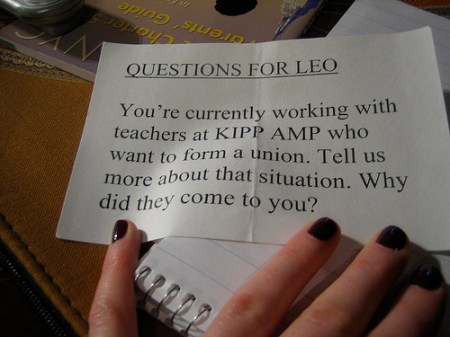
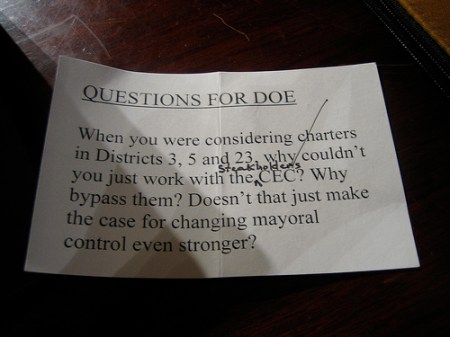
Last week, the UFT got caught handing out cue cards to New York City Council members before a public hearing of the council’s education committee. The council members dutifully asked the questions they had been given, which pointedly invited anti-charter diatribes from the teacher-union and DOE witnesses.

The members then unanimously voted to make Grigori Potemkin their new committee chairman.

Internet wags are calling the scandal “cue card check.” ALELR has consulted his deep moles within UFT and offered an intriguing report on the union’s strategy for the Council’s next hearing.

The cue cards have to be seen to be believed:

cue-card-2

cue-card

cue-card-leo

That’s “questions for Leo” as in our dear friend and Sith apprentice Leo Casey, who testified at the hearing. My pledge to you, the reader: from now on, every time Leo posts calumnies about Jay, I will post a link to this story.

cue-card-doe

And that’s “questions for DOE” as in officials from the Department of Education. The cue cards were handed out by the UFT, but is it plausible that the department officials had no idea they were being asked scripted questions?

HILARIOUS UPDATE! When I first posted this, I didn’t look closely at the handwritten edit made to this cue card. Check it out – note the spelling. And this is from an organization of teachers!

This story doesn’t seem to have broken out of the local circuit yet, but it’s getting a whole lot of attention in the city media. The Daily News is leading the way, documenting the extent of UFT political contributions to the council members who got cue cards and covering Randi Weingarten’s attempts to deflect blame by claiming that a charter school organizer once did the same thing. (Not true, says the organizer – and who has more credibility here?)

But ALELR notes that props are not being given to Elizabeth Green of the blog GothamSchools, who broke the story and snapped all the pictures you see above (and more, which you can enjoy in all their glory by following the link).

Green wryly notes that the cue cards with accusatory anti-charter questions were handed out by “a representative of the city teachers union, which describes itself as in favor of charter schools.”


Truth in Advertising on the Newspaper Bailout

April 8, 2009

pravda

(Guest post by Greg Forster)

You may have heard that Sen. Benjamin Cardin is proposing a government bailout of the newspaper industry.

Some enterprising legislator who loves free speech should propose an amendment to the bill stating that any newspaper accepting its terms shall be required to change its name to PRAVDA. Truth in advertising!

Actually, “bailout” may not be technically the right term. Cardin swears his plan involves “no infusion of federal taxpayer money.”

Note the word “federal.”

Instead of handing out cash, which would make government the de facto owner of America’s newspapers (as the examples of GM and AIG show all too clearly), Cardin would allow newspapers to reorganize as nonprofit “educational” institutions. But since the law already allows nonprofits to publish and distribute their own newspapers if they want to, the only possible rationale for Sen. Cardin’s proposal is that it allows newspapers to continue charging money to cover their costs while also recieving tax-free subsidies.

And who would be doing the subsidizing? Even if government (at the state and local level) doesn’t do it directly, it’ll do it indirectly. Politicians have lots of wealthy friends who would love to have their own pet newspapers.

In fact, Cardin’s proposal is actually worse than a direct government subsidy. At least a direct subsidy would be on the books and subject to disclosure, oversight, and some level of accountability.

Cardin invokes the old Jeffersonian saw that it would be better to have newspapers without government rather than government without newspapers. Yes – but either of those would be better than having government newspapers.

Even though the proposal is obviously going to go nowhere because it fails the laugh test, you’ll still get a lot out of reading Michael Kinsley’s deconstruction of it:

Few industries in this country have been as coddled as newspapers. The government doesn’t actually write them checks, as it does to farmers and now to banks, insurance companies and automobile manufacturers. But politicians routinely pay court to local newspapers the way other industries pay court to politicians. Until very recently, most newspapers were monopolies, with a special antitrust exemption to help them stay that way. The attorney general has said he is open to additional antitrust exemptions to lift the industry out of today’s predicament. The Constitution itself protects the newspaper industry’s business from government interference, and the Supreme Court says that includes almost total immunity from lawsuits over its mistakes, like the lawsuits that plague other industries.

Kinsley notes that just as capitalism built newspapers, it’s now destroying them in order to build something better:

But will there be a Baghdad bureau? Will there be resources to expose a future Watergate? Will you be able to get your news straight and not in an ideological fog of blogs? Yes, why not — if there are customers for these things. There used to be enough customers in each of half a dozen American cities to support networks of bureaus around the world. Now the customers can come from around the world as well.

There’s a good Michael Kinsley who writes about issues and an evil twin Michael Kinsley who smears his opponents with reckless disregard for truth; this column is  about as good as the good Kinsley gets.


School Boards and the Media

March 18, 2009

mark-steyn

(Guest post by Greg Forster)

I’ve argued before, against federalism cops and state-level ed reformers alike, that the biggest monkey wrench in the government school system is the local school board. The union demands that do the biggest damage to children – the uniform, performance-blind pay scale and the extraordinary obstacles to firing bad teachers – are enforced at that level. And while higher levels of government set the broad budget outlines, it’s the school boards that manage the budgets at the detail level – making them the primary people to blame for the tremendous wastefulness and zero accountability of the system.

And (as I argued to the federalism cops) that’s what we should expect, because local power is structurally more susceptible to these problems than state or federal power. If you run a scam at a high level, the scam is big and that means the suckers (that’s you and me) are more likely to 1) notice and 2) be willing to pay the price to stop it. But if, like the unions, you have your tentacles in thousands of tiny little school districts across the country, you can steal a little here and a little there and end up with a much bigger pile of swag, all while flying under the radar.

Well, yesterday Mark Steyn posted on NRO’s Corner about his experience serving on a school board subcommittee. Two stories he told got me thinking about a new aspect of the school board problem.

Story #1:

After one somewhat difficult meeting, I got back to find a telephone message from the reporter at the local paper: “Hi, Mark. I couldn’t make School Board but I have to file my story this evening. Did anything happen that I need to know about?”

Happily, no. And her non-attendance proved no obstacle to filing a bland happy-face report on the event.

Story #2 (the subcommittee was negotiating with a nearby town to build a joint high school):

On another occasion, I absentmindedly forgot it was a public meeting and launched a blistering attack on a neighboring town. As the evening ended, the nice lady reporter said to me, “Don’t worry, Mark. I won’t put any of those controversial things you said in the paper.”

School boards get a free ride from the relevant media. The broadcast media don’t have time to cover them – they’re too busy with more important stories, like whoever is the new Brangelina this week. And the local papers are at best too lazy to do their jobs (note that in Story #1 it was a “difficult meeting” about which the reporter filed a “bland happy-face report”) and at worst too cozy with the board members – who are, after all, the reporters’ neighbors and pillars of their communities – to report a big story even when it bites them right in their assignments.


Cincinnati Enquirer on EdChoice: Good Story, Bad Headline

January 28, 2009

(Guest post by Greg Forster)

On Saturday the Cincinnati Enquirer ran a story on how Ohio is sitting on a bunch of student outcome data for the EdChoice voucher program and neither doing anything with them nor releasing them to researchers who could do something with them. I’m told it was picked up by AP.

The story is generally good. Transparency is always preferable. Student privacy concerns do limit the extent to which the state can release data to the general public, but the state ought to be able to release a lot more than it has, and it also ought to license private researchers to use more sensitive data on a restricted basis, just as NCES does.

The story’s author, naturally enough, wanted to provide what little data are available. So she provided the number of EdChoice students who failed the state test in each subject.

Readers of JPGB probably already know this, but any outcome measurement that just takes a snapshot of a student’s achievement level at a given moment in time, rather than tracking the change in a student’s achievement level over time, is not a good way to measure the effectiveness of an education policy. A student’s achievement level at any given moment in time is heavily affected by demographics, family, etc. Growth over time removes much of the influence of these extraneous factors (though obviously it doesn’t remove absolutely all the influence, and further research controls or statistical techniques to remove these influences more are preferable).

Moreover, EdChoice program is specifically targetd to students in the very worst of the worst public schools. These are students who are starting from a very low baseline. We should expect these students’ results to remain well below those of the general student population even if vouchers are having a fantastically positive effect. So the need to track students over time rather than simply take a snapshot of their achievement levels is especially acute here. Only a rigorous scientific study can examine whether the EdChoice voucher program is improving these students’ performance – and to do that we’d need the data that the state is sitting on.

Also, a binary measurement of outcomes (pass/fail) is never as good as a scale. The state is sitting on scale measurements of the students’ performance, but from the Enquirer story it appears that it won’t release them.

And the Enquirer was only able to obtain these pass/fail results for 2,911 students out of about 10,000 served by the program.

All that said, I don’t blame the Enquirer for reporting what few data were available. The story is focused on the state’s stinginess with data, not the performance of the program as such.

But what headline did the paper put on the story?

“Ed Choice Students Failing.”

Of course the story’s author doesn’t choose the headline. And the person who did choose the headline almost certainly had to do so under intense deadline pressure, without much space to work with, and with no knowledge about the issues other than what could be gleaned from a very quick and superficial reading of the story. Still, since the story clearly focuses on the issue of the state’s sitting on valuable data without using them, you would think they could come up with something like “Voucher Data Not Used.”


Correction on MJS and the “Funding Flaw”

December 12, 2008

white-out

(Guest post by Greg Forster)

Yesterday I posted an analysis of a Milwaukee Journal Sentinel article. The article reported as fact, not opinion, that the Milwaukee voucher program has a “funding flaw” because it fails to pay the Milwaukee public schools to teach students whom the Milwaukee public schools do not teach.

The occasion for the article was a debate over whether it was still true, as it had been in previous years, that the Milwaukee voucher program increases costs for local property taxpayers – this is what people had always meant in the past when they talked about the “funding flaw” in the program.

The claim made by the local voucher movement that the program no longer increased costs for property taxpayers seemed solid to me at the time, and the voucher opponents quoted in the article tacitly accepted it by desperately trying to change the subject. To my knowledge, nobody else had disputed the claim. So I reported the claim as true.

Robert Costrell, who knows more about this than anyone, now says he thinks the claim that vouchers no longer cost extra in local property taxes is incorrect. Apparently it comes down to whether a certain element in the formula varies by enrollment or not.

So I’ve attached a correction to the original post, and I apologize that I didn’t wait longer to hear from more people before reporting the claim as true.

That said, the bulk of my post was on another subject (the attempt by some Milwaukee politicians to use the voucher program to fleece state taxpayers, and MJS’s docility in reporting their obviously specious claims as true) and on that subject I stand by everything I wrote. I only hope my carelessness on this other point doesn’t help get MJS off the hook for its irresponsibility.

(Edited to more clearly differentiate Costrell’s thoughts from my own.)

(UPDATE: Bob Costrell’s new analysis is here.)


MJS: Failure to Steal Money Is a “Funding Flaw”

December 11, 2008

pickpocket

“I beg of you, Monsieur, watch yourself. Be on guard. This place is full of vultures . . . vultures everywhere. Everywhere.”

HT mcgady.net

(Guest post by Greg Forster)

Update: Robert Costrell says he thinks the claim that vouchers are now saving money for local taxpayers is incorrect. Apparently it comes down to a question of whether a certain item in the funding formula varies by enrollment or not. Costrell knows this stuff better than anyone, so I’m happy to defer to him.

At the time I wrote this post, I only had the MJS story to go on, and even the school choice opponents quoted in the article (Mayor Barrett and Superintendent Andrekopoulos) weren’t disputing the savings claim. So I wrote the post as though the savings claim had been implicitly accepted by voucher opponents because it had, in fact, been implicitly accepted by them. But I shouldn’t have actually reported the claim as true just because voucher opponents were implicitly accepting it as true, and I apologize for my carelessness.

That said, the MJS story is still amazingly irresponsible and I don’t regret a word of what I said about its complicity in Barrett and Andrekopoulos’s attmept to fleece Wisconsin taxpayers. I only hope that my own carelessness doesn’t help get MJS off the hook for printing this stuff.

(This update has been edited to more clearly differentiate Costrell’s thoughts from my own.)

For years, the Milwaukee voucher program had what the locals call “the funding flaw,” under which some local Milwaukee property tax revenues were diverted for every student who used the voucher. When the program was first enacted in 1990, there was no “funding flaw,” and it saved money for both the state and local Milwaukee taxpayers, just like most voucher programs. But in 1999 the rules were changed, and the program began diverting property taxes; the state profited handsomly at the expense of the city, using the voucher program as an intermediary. As a result, from 1999 until 2007, the program was a drain on local resources. The school choice movement in Milwaukee never supported this practice and worked to help stop it, but of course state politicians were never interested in helping, and the voucher program was always blamed for the local tax drain.

But now things have changed. This year, the program is once again saving local money – the amount the city loses from the program is now down below what it saves in reduced educational costs because it doesn’t have to teach the students in the program. So there is no more “funding flaw.”

Not so fast! Over the weekend, the Milwaukee Journal Sentinel ran a very strange story claiming, not as opinion but as fact, that the “funding flaw” was never just about property taxes. Another, much more serious “funding flaw” has been lurking unnoticed in the bushes for all these years – namely, that the program fails to steal money from state taxpayers and transfer it to Milwaukee public schools.

I’m not sure anyone had ever heard about this “other” funding flaw before now. Call it the super double secret funding flaw.

1) The article begins by citing an argument between voucher proponents and opponents over whether the “funding flaw” still exists. It evenhandedly reports the claims on both sides: on the one hand, the school choice movement has facts and figures showing that voucher kids are now a net gain, not a net drain, for Milwaukee taxpayers. On the other hand, property taxes are going up and the people who run the public school system “associate a lot of that increase” with the voucher program. Facts and figures on one side versus mere assertion on the other – well, obviously there are two equally valid points of view about this controversial question! Who says the media aren’t evenhanded?


2) The article then lays out the facts: the “funding flaw” was always that a voucher student cost Milwaukee more than a public school student in property taxes. Now that’s not true anymore. The school choice folks are pointing out this inconvenient truth and saying, reasonably enough, that there’s no more funding flaw.

Then we get this: 

[Milwaukee Mayor Tom] Barrett and MPS Superintendent William Andrekopoulos dismiss that notion, saying the amount of property tax dollars per student illustrated only one part of the flaw. It was the main thing they pointed to because, frankly, it was easier to understand than other aspects. But, they say, the other aspects are actually a bigger deal.

So all these years they’ve been making a big deal over less important issues while concealing the real problem, but now, at last, they’re prepared to come clean and talk about the real problem.

Did you catch the casual insertion of the word “frankly” in the second sentence? This is the MJS reporter speaking in his own voice rather than quoting – but he’s such a puppet of the system’s defenders that their “frankly” comes out of his mouth. When Barrett stubs his toe, do MJS reporters say “ouch”?


 3) Then comes the really amazing part. MJS reports, as fact and not opinion, that the funding flaw always consisted of two problems. The first was the property tax issue, which now favors vouchers rather than public school kids – although when the story gets into the details of this, it never directly admits this as fact; it is reported as a claim being made by school choice proponents, and only sophisticated readers will be able to figure out from the reporter’s convoluted words that what the school choice proponents are saying is, in fact, indisputably true.

The alleged other part of the funding flaw, the super double secret one, is that voucher students are not counted as students being educated in Milwaukee public schools for purposes of setting the funding levels for Milwaukee public schools.


Got that? MJS reports as fact, not opinion, that the voucher program is flawed because it fails to force the state to pay Milwaukee public schools to teach kids that Milwaukee public schools do not, in fact, actually teach.


But of course the story doesn’t say this as clearly as I’ve just put it, or it would be obvious that this is sophistry in the service of a naked political agenda. A reader who didn’t already know the ins and outs of school finance would never realize from the article that the supposed other “flaw” is that the program doesn’t pay Milwaukee schools to teach students whom they don’t teach.


4) The article then goes on to note that fixing the super double secret funding “flaw” would be deeply unpopular because it would take money away from other areas of the state. The unstated implication is that it would be much more sensible to scrap the unworkable voucher program altogether.

Well, no kidding it would be unpopular for MPS to try to use the voucher program as an excuse to take money from state taxpayers to teach students that MPS doesn’t teach. Taking money to do something that you don’t do is called stealing.

What’s really galling is that this attempt to steal from state taxpayers is framed (by MJS as well as by Barrett and Andrekopoulos) as an attempt to “fix” an alleged funding “flaw” – the implication being that money is somehow being unfairly withheld from MPS. So the guy warning you about thieves is in fact the thief. I think that may actually be Andrekopoulos’s picture at the top of this post.


5) The article then parades Robert Costrell’s big cost analysis showing that vouchers cost more than they save for local taxpayers. At the very end of the paragraph, it quickly notes that this analysis “does not include figures from this fall.” In other words, the conclusion that the voucher program costs Milwaukee money is out of date because the facts on the ground have changed, and it has no relevance to the story (except by confusing readers who aren’t paying close attention).


6) Finally, at the end, the school choice movement is allowed to come back onstage and point out that Milwaukee public school spending and state aid to Milwaukee have both been growing relentlessly for years. Then we get this:


Andrekopoulos said in an interview that the main point is that something has to be changed, and the state funding system, including how vouchers are paid for, is the place to turn.

He said that Milwaukee residents are facing a 14.6% tax levy increase this year, even though the actual MPS budget went up less than 2%.

“Doesn’t that seem wrong?” Andrekopoulos said. “Something’s not right.”

This, like the previous claims about the super double secret “other funding flaw,” is sophistry pure and simple. Property taxes pay for much more than just schools, and the MPS budget gets a lot of revenue from sources other than property taxes. So these figures are apples and oranges; you can’t compare the two.


It would be like the UAW arguing that Rick Wagoner’s salary costs GM more than the UAW jobs bank, because budget category A (which includes spending on Wagoner’s salary, engine parts, steel bolts, and the company health plan) costs more than budget category B (which includes spending on the jobs bank, tires, car doors, and lunches in GM company cafeterias).


Until you break down the categories and look at what the individual components cost, you’re just blowing smoke. And when you break down the categories, vouchers save Milwaukee money – which is exactly what the MJS article established all the way back at the beginning.

I’ve seen a lot of irresponsible journalism, but this article just leaves me dumbfounded.

(UPDATE: Bob Costrell’s new analysis is here)