
(Guest Post by Matthew Ladner)
Dan Lips interviews Jeb Bush about education reform on National Review Online today.
(Guest Post by Matthew Ladner)
Dan Lips interviews Jeb Bush about education reform on National Review Online today.
 4 Comments |
  competitive effects, instructional reform | Tagged: Dan Lips, Jeb Bush |
  Permalink
 Posted by matthewladner
I have a piece in this morning’s Arkansas Democrat Gazette arguing that consolidating school districts in Arkansas to 75 countywide school districts is not a promising reform strategy. A number of state officials as well as the Dem Gaz have floated the idea of cutting the number of districts to less than one-third of the current number as a way of saving superintendent and football coach salaries while improving the capacity of high schools to offer state-required courses. I argue that the salary savings will be few, there are better ways to help high schools offer courses (such as with distance ed), and student achievement tends to suffer in larger schools and school districts.
Now, this doesn’t mean that reconfiguring larger urban high schools into “small” schools within a school, as the Gates Foundation once pushed, is likely to produce much of an improvement either. The benefits of smaller schools and school districts may be related to the tighter connection they have to their communities and the more competitive market provided by having more districts. Simply breaking up big high schools may not better connect schools to communities or create more competitive pressure.
Being able to choose among schools within a district is like being able to choose among the menu items at McDonalds. It’s nice that you could choose the Filet-O-Fish if you prefer to eat fish, but there is no change in competitive pressure from adding that menu item — all of the money still ends up in the same place. The same is true for choice within school districts — all of the money still stays with the school district, so their motivation is not significantly altered by your choice among their schools. We should only expect significant competitive pressure when money leaves one organization and enters another as a result of consumer choice. School districts are the main organizational unit of education funding.
3 Comments | competitive effects | Tagged: Arkansas Democrat Gazette, consolidation, Jay Greene, Jay P. Greene, small schools | Permalink
Posted by Jay P. Greene
Andrew Coulson at Cato does a great job of illustrating how disastrous it is to have had stagnant achievement outcomes for 17 year-old public school students since 1970, while per pupil spending has increased by a factor of 2.3 (adjusted for inflation). He likens it to paying $43,479 for a 1971 Chevy Impala, which is 2.3 times the $19,011 inflation-adjusted price back then ($3,460 before adjusting for inflation). Meanwhile, a brand new 2008 Impala sells for $21,975 and comes with features like On-Star, side air bags, and anti-lock brakes that weren’t even imagined in 1971.
In the automotive industry cars keep getting better with little increase in cost (after inflation), while education has not improved significantly and costs us 2.3 times as much (after inflation). It isn’t every day that people wish that an industry would be as efficient as car-makers.
4 Comments | competitive effects | Tagged: Andrew Coulson, Jay Greene, Jay P. Greene | Permalink
Posted by Jay P. Greene
(Guest Post by Matthew Ladner)
In 2007, a family of four needed to earn less than $20,650 to qualify for a free lunch. In Arizona, the median family income for a family of four is over $65,000.
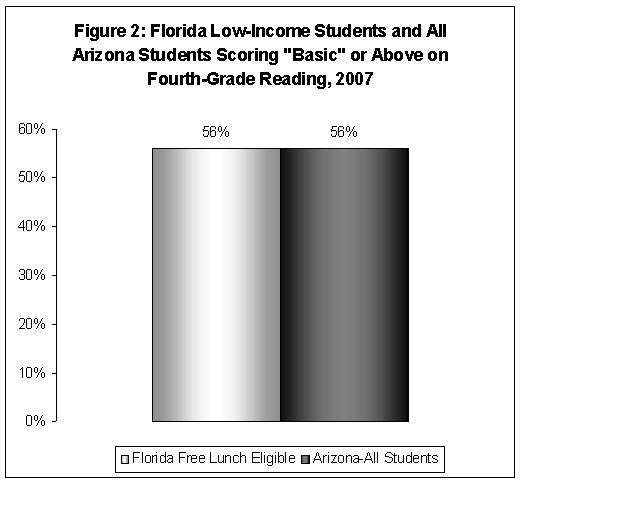
Here’s the surprising news: Low-income students in Florida—namely, those who qualify for free lunches—outperform all students in Arizona. That’s the insight to be gleaned by sifting through the treasure trove of data generated by the National Assessment of Educational Progress (NAEP), known as the Nation’s Report Card.
Figure 1 shows fourth grade reading scores for Florida students whose family income qualifies them for free lunch compared to all students in Arizona.

Figure 2 shows the percentage of Florida’s low-income children scoring basic or above on fourth grade reading and all Arizona students scoring at the same level.
You don’t need to take my word on these scores. You can go to the National Center for Education Statistics website and see them for yourself.
The point here is not to bash the underperformance of Arizona schools. Sadly, they have plenty of company. Rather, these data point to the enormity of the opportunity for improvement which we can and must achieve. Florida has found a way to significantly boost the performance of low-income students. Others should examine how and borrow everything we can.
3 Comments | competitive effects, vouchers | Tagged: Florida education reform, When Harry Met Sally | Permalink
Posted by matthewladner

(Guest Post by Matthew Ladner)
The Goldwater Institute released a new study today co-authored by yours truly titled Fortune Favors the Bold: Reforms for Results in K-12 Education.
The study makes the case for robust education reforms rather than incremental tinkering with a fundamentally broken system. Here in Arizona, for example, inflation adjusted spending per capita in the K-12 schools has tripled since 1960, and 44% of our 4th graders in public schools score “below basic” on the NAEP 2007 4th grade reading exam.
The kids are running around with their hair on fire, while we adults wonder whether to use a cup or a bucket of water to put out the flames. It’s time to use the fire hose.
The four reforms proposed:
Jeb Bush put in what seemed like a radical set of reforms in Florida in 1999, and they have paid huge dividends. The time has come not only for other states to emulate Florida, but to reach further, and do more. Fortune favors the bold and American education reform dithers between being misguided, pointless, and too timid.
3 Comments | competitive effects, instructional reform, vouchers | Tagged: Fortune Favors the Bold, Goldwater Institute, Matthew Ladner | Permalink
Posted by matthewladner
(Guest Post by Matthew Ladner)
In a recent article for the Goldwater Institute, I found that Florida’s Hispanic students outscore Arizona’s statewide average on fourth grade reading exams. Some readers emailed and wanted to know if this could be attributed to the fact that Florida’s Hispanic population is predominantly Cuban. The short answer is no, because the Hispanic population was also predominantly Cuban in the 1990s when scores were much, much lower.
Other inquiries involved questions about student poverty. Statewide averages for low-income students for Arizona and Florida are broadly similar, but I decided to investigate using the NAEP data. What I found was extraordinary.
Using the data analysis features on the NAEP website, you can get fourth grade reading scores broken down by both race and income. It is not only the case that Florida’s Hispanic students outscore the statewide average in Arizona, Florida’s low-income Hispanic students outscore the average Arizona student.
Arizona is not alone in this. Florida’s Free and Reduced lunch Hispanics also outscored the statewide average for all students on 4th grade reading of California, Hawaii, Louisiana, Mississippi, Nevada and New Mexico. They tied the statewide average for Alaska and South Carolina, and fell one scale point below Oregon and West Virginia.
In 2007, a family of four needed to earn $20,650 to qualify for a free lunch, $38,203 for a reduced price lunch. Nationwide, approximately 80 percent of free or reduced lunch children qualify for a free lunch.
Median family income in California, by comparison, is $64,563.
I appeared on a conference panel recently, and a fellow panelist noted the difference between a problem and a condition. A problem, she said, was something you tried to fix. A condition was something you had given up on and just grown to accept.
Low academic achievement for low-income and minority children is a problem not a condition. Florida under Jeb Bush put in testing and accountability with real consequences, implemented parental choice, reformed reading instruction, curtailed social promotion, liberalized teacher certification, and put in merit pay.
The results speak for themselves. To paraphrase that famous line from When Harry Met Sally: I’ll have what Florida is having.
UPDATE: The Wall Street Journal weighs in on the historic vote by Florida Democrats to expand the Step Up for Students tax-credit program.
34 Comments | competitive effects, instructional reform | Tagged: Florida education reform, When Harry Met Sally | Permalink
Posted by matthewladner

(Guest Post by Matthew Ladner)
I authored a study released by the Nevada Policy Research Institute this week on the Silver State’s education system. Nevada’s education system must address two urgent problems: an ever-growing quantity of students and the low average quality of schools. In spite of these problems, Nevada’s State Board of Education has moved to clamp down on a reform which could help with both problems: charter schools.
Between the year 2000 and the year 2005, Nevada’s school age population increased by 21 percent. This decade began with about 340,000 school age children, but will be nearing 550,000 by 2016.
Nevada is struggling to keep up with these demands. Nevada’s public school spending going for capital outlay in 2003 was over 40 percent higher than the national average on a per pupil basis.
Nevada’s school quality issue represents an even more serious problem. According the Nation’s Report Card from 2007, 43 percent of Nevada 4th graders scored “Below Basic” in reading.
Research shows that children who fail learn basic reading skills in the early grades very often fall further and further behind grade level with each passing year. Moving into middle school, they can scarcely read their textbooks. They begin dropping out in larger numbers in 8th grade.
In other words-the Nevada dropout class of 2015 is moving through the pipeline.
Nevada’s quality and quantity problems are interrelated. The need to construct new public school facilities ultimately draws educational funds out of the classroom. Likewise, the percent of per pupil funding going to service school debt was over sixty percent higher in Nevada than the national average.
A comparison between Nevada and its neighbor, Arizona, however proves that there are solutions to both the quantity and quality problems. Like Nevada, Arizona’s surging population has required a large increase in the supply of schools.
Despite similar rates of enrollment growth, Nevadans spent almost twice as much per student on capital costs as Arizonans in 2003-$1,468 compared to only $776 per pupil in Arizona. Arizona’s interest payments per pupil were also about half of what is paid in Nevada.
How has Arizona managed to manage its quantity problem so much more successfully than Nevada?
In 1994, Arizona lawmakers passed legislation creating choice between public schools and districts, and also one of the nation’s most liberal charter school law.
In 2007, Arizona has 482 charter schools educating over 112,000 children. Arizona charter schools have proven to be extremely diverse- focusing on everything from the arts to back to basics academics to the veterinary sciences.
In addition in 1994, Arizona lawmakers passed a very robust open enrollment law which thousands of students use to transfer between district schools and between school districts.
In 1997, Arizona passed the nation’s first scholarship tax credit law. This program gives individual taxpayers a dollar for dollar credit against state income tax for donations to nonprofit groups giving private school scholarships. In 2007, this program raised $54,000,000 and helped almost 25,000 students attend 359 private schools around the state. Arizona lawmakers created three new private choice programs in 2006.
Arizona’s ability to keep capital costs below the national average came about largely because of this embrace of parental choice in education. Choice options have relieved the need for Arizona’s school district to incur debt in the process of absorbing the increase in the student population.
What has parental choice done for school quality in Arizona? Charter schools comprise an amazing nine of the top 10 publicly funded high schools in the greater Phoenix area. The lone non-charter school on the list is a magnet school, also a choice based school.
Nevada, by comparison, has been hesitant in expanding parental options. In the five states surround Nevada (Arizona, California, Idaho, Oregon and Utah) and these states have 482, 710, 30, 81 and 60 charter schools respectively, collectively educating hundreds of thousands of students. With only 22 charter schools, Nevada is the tortoise of the region.
On November 30 of 2007, the Nevada Board of Education voted 8-0 to impose a moratorium on the approval of new charter schools. Board members told the press that the freeze was necessary because the state Education Department is being “overwhelmed” by 11 charter applications.
Arizona’s State Board for Charter Schools oversees 482 Arizona charter schools with a staff of 8. Nevada’s board overseeing cosmetology currently has 14 full time employees.
In addition, the Nevada legislature created a funding stream for charter school oversight of 2% of the per capita funding. Nevada policymakers must come to recognize the dire need for new high quality schools. Currently, even ultra-high quality charter school operators like KIPP are frozen out of opening schools. If those top 10 schools from Phoenix wished to replicate their success in Nevada, they would be shut out, an absurd denial of opportunity for children.
Nevada policymakers should loathe the status quo and fear the future unless they can radically improve learning, especially for the state’s rapidly growing Hispanic population. They shouldn’t fear or loathe charter schools.
Leave a Comment » | charter schools, competitive effects | Tagged: charter schools, Fear and Loathing in Las Vegas, Matthew Ladner | Permalink
Posted by matthewladner
(Guest post by Greg Forster)
Lately, Robert Enlow and I at the Friedman Foundation for Educational Choice have had to spend a lot of time responding to the erroneous claims Sol Stern has been making about school choice. I honestly hate to be going up against Sol Stern right at the moment when he’s doing important work in other areas. America owes Stern a debt for doing the basic journalistic work on Bill Ayers that most journalists covering the presidential race didn’t seem interested in doing.
But what can we do? We didn’t choose this fight. If Stern is going to make a bunch of false claims about school choice, it’s our responsibility to make sure people have access to the facts and the evidence that show he’s wrong.
That’s why Enlow and I have focused primarily on using data and evidence to demonstrate that Stern’s claims are directly contrary to the known facts. It’s been interesting to see how Stern and his defenders are responding.
I’ve been saddened at how little effort Stern and his many defenders are devoting to seriously addressing the evidence we present. For example, all the studies of the effects of vouchers on public schools that were conducted outside the city of Milwaukee have been completely ignored both by Stern and by every one of his defenders I’ve seen so far. Does evidence outside Milwaukee not count for some reason? Since most of the studies on this subject have been outside Milwaukee, this arbitrary focus on Milwaukee is hard to swallow.
And what about the studies in Milwaukee? All of them had positive findings: vouchers improve public schools. Unfortunately, Stern and his critics fail to engage with these studies seriously.
Stern had argued in his original article that school choice doesn’t improve public schools, on grounds that the aggregate performance of schools in Milwaukee is still bad. His critics pointed out that a large body of high quality empirical research found that vouchers have a positive effect on public schools, both in Milwaukee and elsewhere. If Milwaukee schools are still bad, that doesn’t prove vouchers aren’t helping; and since a large body of high quality empirical research says they do help, the obvious conclusion to reach – if we are going to be guided by the data – is that other factors are dragging down Milwaukee school performance at the same time vouchers are pulling it upward.
If an asthma patient starts using medicine, and at the same time takes up smoking, his overall health may not improve. But that doesn’t mean the medicine is no good. I also think that there may be a “neighborhood effect” in Milwaukee, since eligibility for the program isn’t spread evenly over the whole city.
There’s new research forthcoming in Milwaukee that I hope will shed more light on the particular reasons the city’s aggregate performance hasn’t improved while vouchers have exerted a positive influence on it. The important point is that all the science on this subject (with one exception, in D.C., which I’ve been careful to take note of when discussing the evidence) finds in favor of vouchers.
In Stern’s follow-up defense of his original article, his “response,” if you can call it that, is to repeat his original point – that the aggregate performance of schools in Milwaukee citywide are still generally bad.
He disguises his failure to respond to his critics’ argument by making a big deal out of dates. He says that all the studies in Milwaukee are at least six years old (which is actually not very old by the standards of education research), and then provides some more recent data on the citywide aggregate performance of Milwaukee schools. But this obviously has nothing to do with the question; Stern’s critics agree that the aggregate data show Milwaukee schools are still bad. The question is whether vouchers exert a positive or negative effect. Aggregate data are irrelevant; only causal studies can address the question.
Of course it’s easy to produce more up-to-date data if you’re not going to use scientific methods to distinguish the influence of different factors and ensure the accuracy of your analysis. If you don’t care about all that science stuff, there’s no need to wait for studies to be conducted; last year’s raw data will do fine.
Weak as this is, at least it talks about the evidence. The response to our use of facts and evidence has overwhelmingly been to accuse school choice supporters of ideological closed-mindedness. Although we are appealing to facts and evidence, we are accused of being unwilling to confront the facts and evidence – accused by people who themselves do not engage with the facts and evidence to which we appeal.
Stern, for example, complains at length that “school choice had become a secular faith, requiring enforced discipline” and “unity through an enforced code of silence.” Apparently when we demonstrate that his assertions are factually false, we are enforcing silence upon him. (We’ve been so successful in silencing Stern that he is now a darling of the New York Times. If he thinks this is silence, he should get his hearing checked.)
Similarly, when Stern’s claims received uncritical coverage from Daniel Casse in the Weekly Standard, Enlow and Neal McCluskey wrote in to correct the record. Casse responded by claiming, erroneously, that Stern had already addressed their arguments in his rebuttal.
Casse also repeated, in an abbreviated form, Stern’s non-response on the subject of the empirical studies in Milwaukee – and in so doing he changed it from a non-response to an error. He erroneously claims that Stern responded to our studies by citing the “most recent studies.” But Stern cites no studies; he just cites raw data. It’s not a study until you conduct a statistical analysis to distinguish the influence of particular factors (like vouchers) from the raw aggregate results – kind of like the analyses conducted in the studies that we cite and that Stern and Casse dismiss without serious discussion.
Casse then praised Stern’s article because “it dealt with the facts on the ground” and accused school choice supporters of “reciting the school choice catechism.”
Greg Anrig, in this Washington Monthly article, actually manages to broach the subject of the scientific quality of one of the Milwaukee studies. Unfortunately, he doesn’t cite any of the other research, in Milwaukee or elsewhere, examining the effect of vouchers on public schools. So if you read his article without knowing the facts, you’ll think that one Milwaukee study is the only study that ever found that vouchers improve public schools, when in fact there’s a large body of consistently positive research on the question.
Moreover, Anrig’s analysis of the one Milwaukee study he does cite is superficial. He points out that the results in that study may be attributable to the worst students leaving the public schools. Leave aside that this is unlikely to be the case, much less that it would account for the entire positive effect the study found. The more important point is that there have been numerous other studies of this question that use methods that allow researchers to examine whether this is driving the results. Guess what they find.
Though he ignores all but one of the studies cited by school choice supporters, shuffling all the rest offstage lest his audience become aware of the large body of research with positive findings on vouchers, Anrig cites other studies that he depicts as refuting the case for vouchers. Like Stern’s citation of the raw data in Milwaukee, these other studies in fact are methodologically unable to examine the only question that counts – what was the specific impact of vouchers, as distinct from the raw aggregate results? (I’m currently putting together a full-length response to Anrig’s article that will go over the specifics on these studies, but if you follow education research you already know about them – the notoriously tarnished HLM study of NAEP scores, the even more notoriously bogus WPRI fiasco, etc.)
But Anrig, like his predecessors, is primarily interested not in the quality of the evidence but in the motives of school choice supporters. He spends most of his time tracing the sinister influence of the Bradley Foundation and painting voucher supporters as right-wing ideologues.
And these are the more respectable versions of the argument. In the comment sections here on Jay P. Greene’s Blog, Pajamas Media, and Joanne Jacobs’s site, much the same argument is put in a cruder form: you can’t trust studies that find school choice works, because after all, they’re conducted by researchers who think that school choice works.
(Some of these commenters also seem to be confused about the provenance and data sources of these studies. I linked to copies of the studies stored in the Friedman Foundation’s research database, but that doesn’t make them Friedman Foundation studies. As I stated, they were conducted at Harvard, Princeton, etc. And at one point I linked to an ELS study I did last year that also contained an extensive review of the existing research on school choice, but that doesn’t mean all the previous studies on school choice were ELS studies.)
What is one to make of all this? The more facts and evidence we provide, the more we’re accused of ignoring the facts and evidence – by people who themselves fail to address the facts and evidence we provide.
I’m tempted to say that there’s a word for that sort of behavior. And there may be some merit in that explanation, though of course I have no way of knowing. But I also think there’s something else going on as well.
One prominent blogger put it succinctly to me over e-mail. The gist of his challenge was something like: “Why don’t you just admit that all this evidence and data is just for show, and you really support school choice for ideological reasons?”
I think this expresses an idea that many people have – that there is “evidence” over here and then there is “ideology” over there, and the two exist in hermetically sealed containers and can never have any contact with one another. (Perhaps this tendency is part of the long-term damage wrought by Max Weber’s misuse of the fact/value distinction, but that’s a question for another time.)
On this view, if you know that somebody has a strong ideology, you have him “pegged” and can dismiss any evidence he brings in support of his position as a mere epiphenomenon. The evidence is a distraction from your real task, which is to identify and reveal the pernicious influence of his ideology on his thinking. Hence the widespread assumption that when a school choice supporter brings facts and evidence, there is no need to trouble yourself addressing all that stuff. Why bother? The point is that he’s an ideologue; the facts are irrelevant.
But, as I explained to the blogger who issued that challenge, evidence and ideology are not hermetically sealed. Ideology includes policy preferences, but those policy preferences are always grounded in a set of expectations about the way the world works. In fact, I would say that an “ideology” is better defined as a set of expectations about how the world works than as a set of policy preferences. (That would help explain, for example, why we still speak of differences between “liberal” and “conservative” viewpoints even on issues like immigration where there are a lot of liberals and conservatives on both sides.) And our expectations about how the world works are subject to verification or falsification by evidence.
So, for example, I hold an ideology that says (broadly speaking) that freedom makes social institutions work better. That’s one of the more important reasons I support school choice – because I want schools (all schools, public and private) to get better, and I have an expectation that when educational freedom is increased, schools will improve. My ideology is subject to empirical verification. If school choice programs do in fact make public schools better – as the empirical studies consistently show they do – then that is evidence that supports my ideology.
Even the one study that has ever shown that vouchers didn’t improve public schools, the one in D.C., also confirms my ideology. The D.C. program gives cash bribes to the public school system to compensate for lost students, thus undermining the competitive incentives that would otherwise improve public schools – so the absence of a positive voucher impact is just what my ideology would predict.
Other evidence may also be relevant to the truth or falsehood of my ideology, of course. The point is that evidence is relevant, and truth or falsehood is the issue that matters.
Now, as I’ve already sort of obliquely indicated, my view that freedom makes things work better is not the only reason I support school choice. But it is one of the more important reasons. So, if you somehow proved to me that freedom doesn’t make social institutions work better, I wouldn’t immediately disavow school choice, since there are other reasons besides that to support it. However, I would have significantly less reason to support it than I did before.
If we really think that evidence has nothing to do with ideology, I don’t see how we avoid the conclusion that people’s beliefs have nothing to do with truth or falsehood – ultimately, that all human thought is irrational. Bottom line, you aren’t entitled to ignore your opponent’s evidence, or dismiss it as tainted because it is cited by your opponent.
UPDATE: See this list of complete lists of all the empirical research on vouchers.
Edited for typos
14 Comments | competitive effects, methodology, vouchers | Tagged: Best of Greg, City Journal, competitive effects, Daniel Casse, Greg Anrig, Greg Forster, methodology, Neil McCluskey, Robert Enlow, Sol Stern, vouchers, Washington Monthly, Weekly Standard | Permalink
Posted by Greg Forster
I’ll be on C-SPAN with Marcus Winters Monday morning at 9 am ET to discuss our new study on special education vouchers. The show is Washington Journal, which has a call-in format. We look forward to hearing from you!
You can find links to the study and some op-eds in the announcement below:
| New Report by Jay Greene and Marcus Winters |
| Manhattan Institute senior fellows Jay P. Greene and Marcus Winters have released a new report entitled, “The Effect of Special Education Vouchers on Public School Achievement: Evidence from Florida’s McKay Scholarship Program.” The authors conclude that the McKay program has had a positive effect on the quality of education that public schools provide to disabled students. To read the report, click here. WASHINGTON TIMES SERIES:Winters and Greene have been featured in a three part series for The Washington Times, read their articles below.The Politics of Special-Ed Vouchers Jay P. Greene and Marcus Winters, Washington Times,05-01-08 Vouchers for special-ed students Jay P. Greene and Marcus A. Winters, Washington Times, 04-30-08 Vouchers and Special Education Marcus A. Winters and Jay P. Greene, Washington Times, 04-29-08 OP-ED: A Special-Ed Fix, Jay P. Greene and Marcus A. Winters, New York Post, 04-30-08 INTERVIEW: An Interview with Marcus Winters: Special Education Vouchers, EdNews.org, 4-30-08 |
UPDATE
Here’s another op-ed in an Arizona newspaper.
Leave a Comment » | competitive effects, research reports, special ed, vouchers | Tagged: Jay Greene, Jay P. Greene, Marcus Winters, McKay, special education, vouchers | Permalink
Posted by Jay P. Greene
(Guest Post by Matthew Ladner)
In the Aviator, director Martin Scorsese tells the story of Howard Hughes, had perhaps the biography of Howard Hughes been written by Ayn Rand. Hughes is portrayed by Leonardo DiCaprio as obsessively pushing the envelope forward in aviation, breaking both technical and legal barriers to progress.

Hughes’ pursuit of progress runs him into conflict with Pan-American airlines and their minion in Congress, Senator Brewster, played by Alan Alda. Brewster seeks to protect the monopoly status of Pan American in providing trans-Atlantic flight, and uses the investigative powers of Congress in order to coerce Hughes. Consumers will be better served by a monopoly, Brewster explains, a position that Hughes finds “Un-American.”
Hughes asks Brewster “do you really want to go to war with me?” Brewster replies:
“It’s not me, Howard. It’s the United States government. We just beat Germany and Japan. Who the hell are you?”

This being a movie, of course, our rugged individualist hero prevails, decisively crushing Senator Brewster and Pan-American in dramatic fashion in a Senate hearing showdown. Travelers enjoy the enormous benefits of aviation competition to this day.
Sadly, in the real word, other monopolies have rather more staying power than Pan-Am, including sadly our education laws. A fine line exists between stability and stagnation. In education policy, we have been content to sail well past that line. Our answer to all education problems was to put in more money. In 1960, the average spending per pupil was $375 (around $2300 in inflation adjusted dollars). Today, we spend close to $10,000 per pupil. Even after adjusting for inflation, spending per pupil in the public school system as more than tripled since the first baby-boomers attended schools.
Our education problems worsened despite the increased spending. Today, 38 percent of our 4th graders have failed to learn basic reading skills, and around a third of our high school students dropout of high school. As today’s dropouts are largely those students who failed to learn to read in elementary schools, tomorrow’s dropouts are already in the pipeline.
Andrew Coulson recently noted that the last great innovation to transform American classroom instruction came with the invention of the chalkboard in 1801. Consider this level of stasis in comparison to the computer industry. Today, you could literally throw a dart in the computer section of a department store and have it land on a personal computer which is more powerful and cheaper than what was available two years ago. By comparison, the school system continues to plod along, always spending more but often producing less.
The productivity of spending in our public education system has collapsed over the past half century. We spend beyond the dreams of avarice for a public school superintendent of the 1960s, but we don’t produce better results. For decades, we have been throwing money at our public schools and failing to notice that students were failing to benefit.
Fortunately, this status-quo will not endure forever. A growing consensus on both left and right recognizes that our most disadvantaged students suffer most from the shortcomings of our schools. Children relying most heavily on schools to prepare them for the future are tragically the most likely to be shortchanged.
Our nation’s poorest families cannot afford to buy into high-quality suburban school districts, or to pay private school tuition in addition to their school taxes. Policymakers from both parties have therefore increasingly embraced policies creating options for parents. Nationwide, nearly a fourth of K-12 students won’t be attending their neighborhood public schools this fall, opting instead for an array of public and private options- including magnet, charter, private and home schooling. Arizona, Georgia, Iowa, Ohio, Rhode Island and Utah have all passed new school choice programs in the last two years. For many, especially for inner-city children, however, these options remain far too scarce and this momentum must accelerate.
Charter school operators such as KIPP, Yes Academies and Amistad have proven definitively that low-income inner city children can learn at an accelerated pace, and can even outperform our complacent suburban schools and attend elite universities. These innovators face huge political and practical obstacles in making these schools more widely available, but don’t bet against them. Already, they have settled the question of whether we must settle for today’s failed status quo: we don’t. Our students can learn. We adults simply have to learn how to follow the example of those who are getting the job done.
Our students need a market for K-12 schools. The market mechanism rewards success and either improves or eliminates failure. This has been sorely lacking in the past, and will be increasingly beneficial in the future. The biggest winners will be those suffering most under the status-quo.
New technologies and practices, self-paced instruction and data-based merit pay for instructors, may hold enormous promise. Before the current era of choice based reforms, they didn’t fit the 19th Century/unionized model of schooling, so they weren’t seriously attempted. Bypassing bureaucracy, a new generation has begun to offer their innovative schools directly to parents. Some have already succeeded brilliantly. Some states have been much keener than others to allow this process. Expect the laggards to fall in line eventually. We can hardly continue to cower in fear that someone somewhere might open a bad school when, in reality, we are surrounded by them now.
A market system will embrace and replicate reforms which work, and discard those that fail to produce. A top-down political system has failed to perform this task. Where bureaucrats and politicians have failed miserably, however, a market of parents pursuing the interests of their children will succeed in driving progress.
We cannot feel satisfied with a system that watches helplessly as a third of pupils drop out before graduation each year. We can do much better. The key lies in matching disadvantaged students with high quality teachers and school leaders. Parental choice programs help to achieve this by providing new education delivery methods.
While there will be enemies to fight this progress, but they won’t prevail. America is rousing itself from a century long slumber of stagnant schooling practices. We have nothing to lose and everything to gain from the coming education renaissance, so long as we have the wisdom to embrace it.
25 Comments | competitive effects | Tagged: market, Matthew Ladner, school choice, technology, The Aviator | Permalink
Posted by matthewladner
You are currently browsing the archives for the competitive effects category.

 Jay P. Greene's Blog