Greg in PJM Keeps ‘Em Honest With Choice

February 14, 2010

Greg has a great post today on Pajama’s Media about how school choice is the secret sauce that keeps all other reforms honest.  Think of it as a love letter to education reform. : )

Here’s a highlight:

… the biggest political winner in education by far in the past year has been charter schools. I’ll admit I was skeptical at first, but the Obama administration’s pro-charter rhetoric has been more than just talk. Charter caps are being lifted because the administration really does support charters.

Why? I think it’s mainly because a critical mass of their political base on the left has embraced the principle that parents should be put in charge through choice, and I think that has happened precisely because they want a reform that will keep the system honest. More and more people on the left are sick and tired of the empty promises they’ve been peddled for decades: that this time, throwing another huge chunk of money at the blob will fix the schools — and this time, we really, really, really mean it, cross our hearts and hope to die.

The social justice folks on the left just don’t buy it anymore. They now see that the blob has been pulling the wool over their eyes for generations. You can imagine how they’re feeling about that right now. And woe betide you if the wrath of the social justice folks falls upon you; they’re not known for being gentle with those whom they perceive as enemies of social justice.

Case in point: Did you know that the same team of scorched-earth, take-no-prisoners, scruple-at-nothing propagandists who produced An Inconvenient Truth has now made a hard-hitting documentary bashing teachers’ unions and advocating charter schools? And it was the very first film picked up for distribution at the Sundance Film Festival?

… The recent surge in the political fortunes of charter schools has been fueled by the less dramatic but steadily growing success of private school choice: school vouchers and similar policies that allow students to attend private schools using public funds. There are now 24 private school choice programs serving 190,000 students nationwide, up from just five programs in 1996. And private school choice is continuing to gain ground every year with the creation of new programs and expansion of existing programs, even in tough years like 2009.

As my friend Jay Greene likes to put it, vouchers make the world safe for charters. That is, it’s because of the more modest success of vouchers that charters have exploded. As long as vouchers are on the march and are thus a credible threat, triangulating legislators who need the blob’s support can embrace charters without paying too high a price for doing so. If the blob cuts off its support for legislators who back charters, it won’t have anyone on its side when vouchers are on the agenda. Because vouchers are out there, the blob has no choice but to suck it up and pretend to be OK with charters.

The next question, though, is whether charters alone are going to be sufficient to keep the system honest. Charters have ridden to success with the help of a lot of new supporters, but those supporters are a demanding constituency. The social justice folks expect results.


Coulson on Brookings Report

February 14, 2010

Over on the Cato blog, Andrew Coulson has a thoughtful post on the recent Brookings report on school choice which I  helped craft.  For the most part I agree with what Andrew has to say.  I agree that there is considerable international and historical evidence that could have been included in the Brookings report but was not.  I also agree that certain compromises on school choice can be counter-productive, particularly over the long run.

The disagreement I have with Andrew is that he is treating the Brookings report as if it were a piece of scholarship rather than the political document that it really is.  I do not say this to disparage the report, which I helped craft and endorse.  We self-consciously viewed our task in writing the report as trying to present policy options on school choice that would be viable in the current political climate and potentially attractive to the Obama administration.

Once you understand that, it is easier to understand why we would leave out most international evidence — it is generally considered irrelevant or unpersuasive by most current policy elites.  They may well be mistaken in dismissing this set of evidence, as Andrew argues, but that is their view so we didn’t waste their time or ours by reviewing that evidence.

It is also easier to understand why we didn’t advocate unregulated education markets.  That simply isn’t going to happen in the current political climate, so we didn’t bother with it.  Instead we advocated for a variety of compromises on expanding choice and competition within a regulated framework.

Of course, then we are left vulnerable to Andrew’s point that these compromises may be counterproductive, particularly in the long run.  My only response to that is that incrementalism is our only feasible strategy for getting the kind of choice and competition we really need.  While we must always be vigilent about the dangers of certain compromises, I think we have no choice but to try to build on incremental reforms.


Charter Chatter

February 10, 2010

Readers of JPGB have already seen the working paper, but Education Next now has the peer-reviewed and published version of Booker, Sass, Gill, and Zimmer’s study of the effect of charter high school on graduation and college attendance.  Since you are way ahead of the curve you already knew that attending a charter high school increases the probability that a student will graduate high school and go to college.

The study is so clever because it focuses on students who attended charter middle schools.  Some went on to charter high school and some did not.  By comparing the two groups Booker, et al reduce the selection bias of choice, since all of the students chose charter schools at least for middle school.  But there may still be some selection bias in who chooses to continue in charter high school, so Booker, et al address that with a neato instrumental variable.  Some students don’t go on to charter high school because there isn’t one available nearby.  Their analysis predicts whether students continue to a charter high school based on the availability of nearby charter options.

Check out the highly readable Ed Next article for yourself.  Also watch the podcast interview with Brian Gill.


UCLA Civil Rights Project Gets It Wrong

February 4, 2010

My friends over at Mid-Riffs take apart the new report from Gary Orfield’s UCLA Civil Rights Project claiming that charters produce segregation:

“The report finds:

that charter schools, particularly those in the western United States are havens for white re-segregation from public schools; requirements for providing essential equity data to the federal government go unmet across the nation; and magnet schools are overlooked, in spite of showing greater levels of integration and academic achievement than charters.

It looks like, based on a quick pass through the report, their main finding is based on demographic comparisons  between charter schools and traditional public schools at the state level. This method of comparison likely leads to inaccurate conclusions due to the fact that charter schools are overwhelmingly an urban phenomenon. The correct comparison is between charters and the demographics of their immediate geographic area. We have discussed this topic as it relates to Little Rock at length here.

The Economist’s take on this report is concise, to-the-point, and spot on.

In plain English, there are a lot of black kids in charter schools. This is because charter schools tend to get set up in neighbourhoods where the public schools are terrible, such as south-eastern Washington DC or the rougher parts of New Orleans. These neighbourhoods are disproportionately African-American. Charter schools are popular with poor black parents because their other choices are so awful. There are very few charter schools in rich white suburbs with nice public schools, because there is no call for them.

The important question about charter schools is: do they give kids a better education than they would otherwise have received? The answer is yes. Nothing else matters.”


Brookings School Choice Task Force

February 3, 2010

I’m a co-author on the Brookings School Choice Task Force report that was released yesterday in DC, following briefings on the Hill.  Andrew Coulson has already raised concerns about the report because he fears expanding the federal role in education even if it is in expanding choice.

I’m sympathetic to Andrew’s position but I should note that he wrote his post prior to the release of the report.  After reading it he might have a lot less to be concerned about.  The Task Force did not recommend a large federal program on school choice.  Instead, we emphasized improving the quality of information and providing incentives for states and localities to expand choice.  And we conceived of choice broadly, including vouchers, charters, virtual learning, magnets, inter-district, etc…

These measures are nowhere near the kind of choice that Andrew and I would ultimately like to see, but we have to understand political realities and embrace incrementalism.  I think there are a lot of sensible ideas in the report but you should read it and judge for yourself.  It can be found here.


Coming Soon to a Theatre Near You: The Lottery

January 28, 2010


(Guest Post by Matthew Ladner)

We’ve discussed John Rawls and the veil of ignorance a few times here on JPGB. What if you lost the cosmic lottery and were born a poor inner city child? What would you want the school system to work? If you said “anything other than a zip code based system which pervasively matches the most disadvantaged students with the least effective teachers” give yourself a gold star.

In any case, the Rawls lottery is only a thought exercise, but back here in reality, there are real lotteries held every year with thousands of children attempting to escape the system described above by applying for a charter school. There are winners and losers, families who celebrate in joy and families who weep bitterly. 

Someone made a movie about it. Check out the preview– I’m looking forward to it.

Question for Leo: have you figured out why you lost Barack Obama on charter schools yet? Buy a ticket and some popcorn and you may figure it out.


Pro-Choice Doesn’t Mean No Taste

January 25, 2010

Amy Gutmann and Suicide Bomber.jpg

Amy Gutmann poses with a student dressed as a suicide bomber at her Halloween party in 2006.  Talk about having no taste.

A regular indictment leveled against advocates of school choice is that they have no taste when it comes to the quality and purpose of education.  As Amy Gutmann, the president of the University of Pennsylvania and author of Democratic Education, put it: “advocates of parental choice and market control downplay the public purposes of schooling, and this is not accidental. It coincides with the idea of consumer sovereignty: the market should deliver whatever the consumers of its goods want.”  If schools should do whatever the consumer wants, according to this way of characterizing choice supporters, then those choiceniks can’t favor particular educational standards or approaches.  Choice supporters wouldn’t be able to denounce a Jihad school, for example, because consumer preference is the only issue that matters.

This caricature of choice supporters is mistaken on many levels.  First, just because choice supporters want to empower parents to select their school doesn’t mean that the choice advocates are unable to have their own preferences about what schools would be better for people.  Similarly, I might believe that smoking is bad for one’s health, even as I am willing to recognize other people’s liberty to choose to smoke or not.  Or perhaps an easier example — I may think a movie is awful and contains harmful messages and still believe that people have a right to see it.  Believing in liberty doesn’t mean being indifferent to what other people like or do.  It just means not wanting to coerce them into doing or liking what I prefer.

Favoring choice does not require abdicating all taste.  Advocating choice requires believing that people have a right to have their own bad taste.  Favoring choice can also be supported by a belief that people are less likely to make bad choices for themselves than someone else would on their behalf.

Second, most choice supporters recognize some need for public regulation of the schools that are chosen.  These regulations could be as minimal as the public health and safety regulations that affect restaurants or could be more extensive to include instructional issues.  The point is that almost no school choice supporters are anarchists, so there is no need for the Amy Gutmann’s of the world to act as if they all are.

Choice supporters can have personal taste and standards and most also favor public standards that place limits on choice.  At least most choice supporters would have better personal taste and standards than to pose for a photo with a Halloween party guest dressed as a suicide bomber, even though almost all of us would recognize someone’s right to have such awful taste.


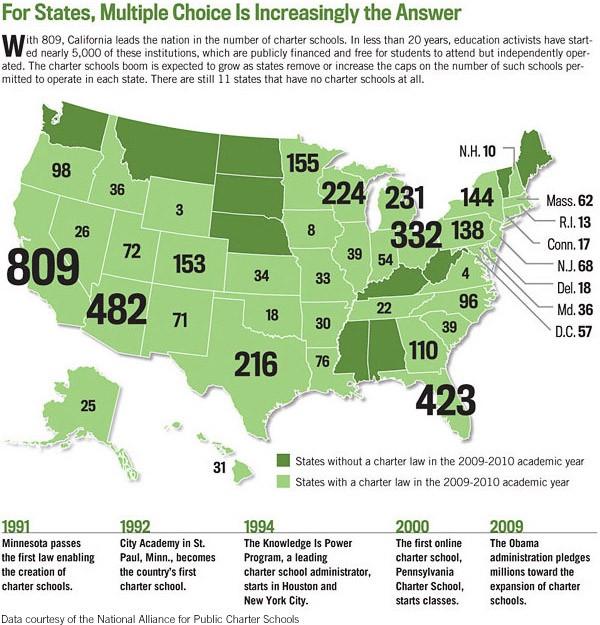
Cool Charter School Map

December 18, 2009

(Guest Post by Matthew Ladner)

Cool charter school map from U.S. News and World Report.


Marcus: RttT Is No Kabuki

December 16, 2009

(Guest post by Greg Forster)

In the past I’ve suggested, in response to Mike Petrilli’s cheerleading for it, that Race to the Top is just a bunch of kabuki. In today’s Washington Examiner, Marcus begs to differ:

Race to the Top has emboldened reform-minded policymakers like Bloomberg to push hard for their ideas. Just as importantly, the lure of earning federal dollars makes the reform position an appealing default for those policymakers whose primary interest lies outside education.

For instance, before Race to the Top, California Gov. Arnold Schwarzenegger paid only brief lip service to education reform. After the grant competition was announced, the Governator called a special session of the state legislature and pushed for a series of meaningful reforms such as eliminating the state’s charter school cap, using data to evaluate student and teacher performance, and adopting a performance pay program for teachers.

I would argue back, but I’m not sure I can. Just last week I praised Bloomberg’s move to push the envelope on interpreting the state’s ban on evaluating teachers with test scores as “gutsball.” By doing so, have I already conceded Marcus’s (and therefore Mike’s) point?

I suppose I could argue that Bloomberg was a reformer even before RttT came along. Maybe he would have played gutsball on the teacher test score ban even without RttT. But it’s hard to think that RttT has nothing to do with his renewed boldness. After all, using test scores in teacher evaluations is an agenda set by RttT. And, as Marcus points out, Bloomberg staged the announcement of his gutsball move in D.C., not New York. Was Bloomberg pushing for this particular reform before? And could he have won on that issue if not for RttT’s covering fire?

I suppose I could argue that the use of test scores as “one element” in teacher evaluations will inevitably be nothing more than a symbolic victory. Trouble is, I’ve always argued that symbols matter. There’s no such thing as a merely symbolic victory.

I suppose I could argue that RttT is promoting bad ideas as well as good ones. And that would be true – but it wouldn’t establish that RttT is kabuki. Quite the opposite; the more we fear RttT for promoting bad ideas, the more we confirm that whatever it is, it isn’t kabuki.

It’s beginning to feel like I may owe Mike an apology. Stay tuned.


Much Ado About Nothing

December 8, 2009

Education Week has an article suggesting that Education Sector’s recently released report on Charter Management Organizations may have been massaged to please big donors.  The author of the original draft of the report, Tom Toch, had his name removed, so the report was released without an author.  It’s unclear whether Tom was dropped as the author because he didn’t have time to review the final manuscript (having left Ed Sector for another job), because of a dispute over payment for the report, and/or because he disagreed with the revised content.

Whatever the reason for dropping Tom Toch as author, the attempt by Marc Dean Millot to turn this into a cover-up seems like a reach.  Millot leaked an earlier draft of Toch’s report on Alexander Russo’s blog. 

I’ve looked at the earlier draft and the final report and, frankly, I don’t think the basic message was changed very much between the two.  Both list a series of challenges that Charter Management Organizations have faced and steps that should be taken to overcome them.  Bother versions are just thought-pieces, not analyses of data.  Either version could have been influenced by the political pressures that regularly creep into DC think tank writing, so there is no reason to privilege the earlier draft as pure and the later as corrupted when it could just as easily be the other way around.  Or perhaps both versions are politically tainted.  Or perhaps neither are.

Read it for yourself and decide, but there is little sign of a conspiracy here.