What Research Will Charter School Opponents Quote Now?

June 25, 2013

(Guest Post by Collin Hitt)

A new report finds generally positive gains for charter schools across the country. This adds to a growing literature that finds positive results for charter schools. But more importantly, the report is from Stanford CREDO, whose previous research has been the most cited research by charter opponents over the past four years.

CREDO does not use random assignment methods, which are the gold standard in social science research. They use a matching method that has generated significant controversy, particularly because some have claimed that their results are biased against charter schools. There’s no need to rehash that debate here. For now let’s take CREDO’s results at face value. Their finding:

The National Charter School Study 2013 looks at performance of students in charter schools in 26 states and New York City, which is treated separately as the city differs dramatically from the rest of the state. In those states (and New York City), charter school students now have greater learning gains in reading than their peers in traditional public schools. Traditional public schools and charter schools have equivalent learning gains in mathematics.

I actually see CREDO’s newest report as a more significant political development than as an advance of scientific understanding. The group’s previous work had been used as a potent weapon against charter schools, despite the fact that there are mounds of gold standard studies that finds gains for charter schools.

In 2009, CREDO shot to prominence with a report that covered 15 states and the District of Columbia. Five states saw gains for charter students (AR, CO, IL, LA and MO). Six saw declines for charter students (AZ, FL, MN, NM, OH and TX). Three states (CA, GA and NC) and DC saw mixed results.

CREDO’s report was repeatedly used and misused by opponents of charter schools. I saw this firsthand in Illinois, where CREDO actually found positive results. The report was used to argue against charter schools generally. I even saw it used, repeatedly, as evidence against the creation of independent authorizers for charter schools – this despite the fact that the original report did not include any information from states like IN, MI, NJ, NY or WI that had some of the most active and well regarded independent authorizers of charter schools.

In the intervening four years, CREDO has released additional reports for six states. Five found gains for charter schools (IN, MA, MI, NJ and NY), while only one found declines for charters (PA). They’ve also updated previous state results, most recently in Illinois, with charters posting stronger gains than previously reported. These intermittent reports have done little to force charter opponents to update their talking points. I think this new report is different.

Anyone following CREDO’s work since 2009 will be unsurprised by today’s findings. The new national report includes several states that, by CREDO’s estimates, are home to high-performing charters that were omitted from their 2009 report. CREDO is arguing that charter quality in general has improved, as well. I’ll buy that, too, though I also suspect that districts have begun to more strongly respond to charter school competition in ways that have improved performance in district schools. Improvements systemwide from increased competition would actually obscure the benefits of attending a charter school, in studies like CREDO’s.

The next couple of weeks will be an interesting test for journalists who cover charter schools. For years, CREDO’s report has repeatedly been quoted as unambiguous evidence that charter schools don’t work. No one can now do that in good faith. CREDO now finds that the evidence on charter school performance is generally positive and improving significantly.


Two New Studies on How School Choice Impacts Students in Vulnerable Demographic Categories

May 15, 2013

Race Card w watermark

(Guest post by Greg Forster)

At Brookings, Matthew Chingos looks at a huge swath of CCD data and finds no evidence that charter schools increase racial segregation. No surprise there, as readers of Win-Win already know. It’s been a while since I had occasion to trot out the old race card graphic – my sense is that the segregation talking point has had its day in the sun.

In Education Finance and Policy, Rajashri Chakrabarti looks at Florida school data and contributes the latest in a line of studies showing that schools act in self-interested ways, responding to structural incentives, when classifying students into special programs. Chakrabarti finds that schools threatened with vouchers due to low test scores increased the classification of students as Limited English Proficient, removing them from the pool of tested students; however, schools did not increase classification of students into special education, where they would become eligible for McKay vouchers. The obvious conclusion? All students should be eligible for vouchers – then there’s no system to game.

PS Sorry for the awkward headline – I couldn’t come up with anything snappier or any pop culture references. Uh . . . release the kraken!


Panic on the Streets of Motown

April 20, 2013

Michigan Skunk Works tries to create better and cheaper schools…errr….I mean UX restores artwork in underground workshop…

(Guest Post by Matthew Ladner)

Just to take the UX theme a bit further, you can get a pretty good insight into much of what is wrong with our education policy discussion by reading this article from the Detroit News:

Education reform group forges voucher-like plan for Michigan

Proposal would create ‘value schools’ to operate at lesser cost than  now

From The Detroit News: http://www.detroitnews.com/article/20130419/SCHOOLS/304190361#ixzz2R1FbwpN1

Only in education could having a group of people working to design a more effective and cost-efficient service be viewed as some sort of dark conspiracy. I mean the Trial Urban District Assessment of NAEP reveals that a full 7% of Detroit 8th graders can read at a Proficient level- only 93% to go. Why would anyone want to seek a better return on the annual investment for the almost $20k per student spent in DPS? Perhaps when the people of Michigan evolve from their cheap skate tendencies and spend $40,000 per student per year they will get that proficiency rate up to 14%.

Or perhaps not.

Notice the use of the term “voucher-like” when in fact the Michigan constitution prohibits public funds following a child to a private school rather completely. I guess it is “voucher-like” however in that vouchers clearly deliver superior academic results for less money. Other than that this plan sounds like an interesting combination of digital learning, charter schools and education savings accounts. Sadly the Pascal Monnett types of the Motor City will quickly be trying to find ways to undermine them.

HT: RedefinED twitter feed.


Texas Freedom Fighters Bypass Borg Shields

April 12, 2013

(Guest Post by Matthew Ladner)

Improved news from Texas- the Senate Education committee passed both a special needs voucher and a scholarship tax credit proposal, and the full Texas Senate passed a modest increase in the charter school cap 30-1. Lotexas of Borg however shrugged off the damage and repeated the demand to be lead to Sector 78701 for more money, less accountability and no parental choice. Lotexas explained the collective’s position to a local Austin radio station succinctly: “You will be assimilated. Resistance is futile. You don’t want none of this, son!!”

You know what I love about the last decade of Texas public education? Every year I get a little older and they get more expensive without teaching students how to read any better.

Let’s see what happens next.


Charter school waiting lists: the other side of the story

April 3, 2013

half-truth.png (500×300)

(Guest Post by Collin Hitt)

WBEZ in Chicago has published one of the more incomplete stories on charter schools I’ve read in a long time.  It asserts:

Charter advocates and even the Chicago Tribune editorial board say 19,000 kids are on charter school waiting lists in the city.

There’s just one problem with that number: it’s not accurate. It significantly overstates demand.

Charter schools in Chicago each maintain their own lotteries and waitlists. Many eager families apply to more than one school, and then suffer the double disappointment of failing to win a lottery to get into either. Thus – WBEZ’s main point – waitlist statistics overstate the demand of the charter school because many children are on more than one waitlist.

The effect of the story is to discredit the school choice movement in Chicago. A full story would have reached the opposite conclusion. WBEZ presents this line as its coup de grace.

Though Andrew Broy from the Illinois Network of Charter Schools has insisted that 19,000 children are on waiting lists for Chicago charter schools, he now says he believes the real number is around 65 percent of that.

Assuming Broy’s guess is correct, that means as many as 6,650 students are on more than one waitlist. How does that undermine the case for charter school demand? Thousands of parents have sought numerous options to flee their current schools. These are determined and desperate people. But limits on charter school supply have denied them any option. To boot, WBEZ reports that there are waitlists at district-run magnet schools as well, suggesting that some parents on charter waitlists have tried and failed to win lotteries into other schools of choice as well. That’s a tragic story that, to me, calls for more charter schools.

WBEZ took particular pleasure in needling the Chicago Tribune, who frequently cites the 19,000 number. There’s a reason, however, that the Trib reports that stat. It’s officially reported by the Illinois State Board of Education. Neither the state board nor WBEZ calculated a different figure that adjusts for double counting. If they did, I’m sure the Trib would report it.

All of this boils down to an obvious point. Waitlists are a crude way to measure charter school demand. Some children land on more than one waitlist. Some families don’t ever apply, discouraged by the long waiting lists they read about. Some families attempt to transfer after enrollment periods and waitlists have closed. Other families haven’t yet found a charter school they like – an inevitable side effect of policymakers limiting the number of charter schools permitted to open.

A complete journalistic account would have found other ways to estimate demand. One such way: commission a survey of families. Guess who did that – the Chicago Tribune, in partnership with the Joyce Foundation.

On the Trib’s behalf, the University of Chicago conducted a scientific phone poll of Chicago adults. Half of the 1,010 respondents were Chicago Public School parents.  It reports:

Many existing charter schools in Chicago have waiting lists because more parents want to enroll their children in public charters schools than these schools can currently accommodate. Would you agree or disagree that Chicago Public Schools (CPS) should make it easier for public charter schools to expand in neighborhoods where public charter schools have waiting lists ? (AFTER RESPONSE, PROBE) Do you…

Strongly agree 46.4

Somewhat agree 17.3

Somewhat disagree 8.0

Strongly disagree 24.0

Neither agree nor disagree 2.4

DON’T KNOW 1.2

REFUSED 0.7

So 63.7 percent of Chicagoans support increasing charter schools to meet demand. Chicago Public Schools enrolls 400,000 students. There are 19,000 students on waitlists and another 40,000 or so enrolled in charter schools. Together that’s 15 percent of total enrollment, yet 63 percent of Chicago residents support increasing supply. So do we really think – as WBEZ suggests – that the 19,000 number overestimates demand?

Relying on polling, of course, has its limits. Here’s something else that WBEZ could have done: looked at charter demand elsewhere. Gary, Indiana is a beleaguered suburb of Chicago. It’s a rough place with its share of academic struggles. Indiana policy is more permissive of charter schools than is Illinois’. In Gary, 31 percent of students are enrolled in charter schools, as compared to 11 percent in Chicago. In Detroit, 41 percent of students are enrolled in charter schools. In Milwaukee, 21 percent are in charters and even more students are enrolled in that district’s school voucher program.

Chicago and Milwaukee and Detroit are different. But not so different that charter school demand would be two to four times lower in the Windy City. There is unmet and unmeasured demand for charter schools in Chicago, which brings me to my final point.

Charter schools create their own demand. There were zero students on charter waiting lists when there were zero charter schools in Chicago. As charter schools expand in the city, more families will sign up to attend them. Waitlists tell a compelling story – people want into charter schools. But they don’t tell the whole story, and neither did WBEZ.


Defeated at Wolf 359 but Texas is not completely assimilated yet

March 24, 2013

“The fight does not go well Enterprise…rendezous with fleet remnants at.. !*!Ktzzzzzzzzsszzz!*!”

(Guest Post by Matthew Ladner)

An old joke holds that you should never ask a man where he is from. If he is from Texas he will tell you, and if he is not, you don’t want to embarrass the poor feller.  Texans are famously/infamously proud of their state, and not without cause. Texans have been enjoying their national status as an economic juggernaut. Wildcatter George P. Mitchell is probably the first Texan to transform the economy of the 21st Century profoundly for the better but he won’t be the last.

Progressives will often bemoan the modest size of government in Texas and attempt to throw cold water on the state’s success by citing various statistics heavily influenced by the fact that the state is a huge destination for immigrants. And yet they continue to come on. Texas is an opportunity rather than a welfare magnet. Texas was the only state to gain 4 Congressional seats after the 2010 Census, all of which came from sclerotic regions of the country. Y’all have fun with that nanny state business and we will keep helping ourselves to your electoral votes, companies and jobs is a prevalent attitude in the Lone Star State.

Mitchell’s hometown of Houston, the global center of the oil business, is jumping but the good times extend well beyond the oil patch. Austin, once a smallish but funky university/state government town, now has condo towers dominating the skyline and far more on the way. A stroll through downtown during SXSW proved to be an eye-opening experience for this former Austinite. I’ve been gone for a decade and the city is both transformed and growing at a mind-boggling pace.  Oh sure, an old guard is still around to complain about traffic and the “lost golden age of Austin” back when they shared herbal blends with Willie at Liberty Lunch or whatever but no one seems to be listening much. The city and state is on a monstereous economic roll.

Texas however has an Achilles heel and doesn’t seem to be aware of it: K-12 education. To stretch a metaphor a bit, I would say that Texas is a horned frog boiling in water.

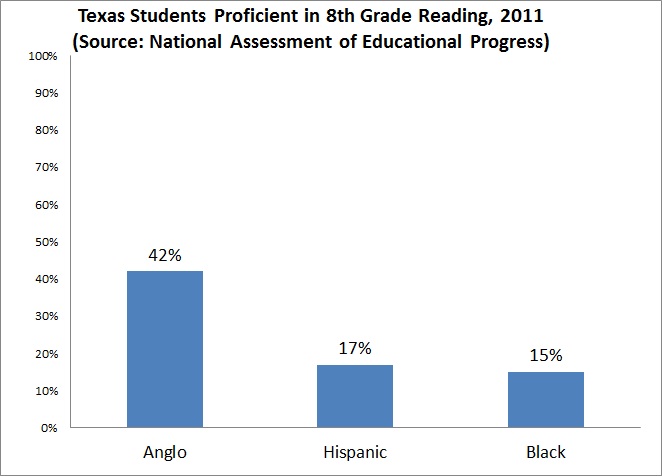
Here is the problem in two simple charts. First Texas 8th graders scoring “Proficient or Better” in 8th Grade Reading:

Texas 8th Grade NAEP ReadingSo let us take 8th Grade Reading Proficiency on NAEP as a rough proxy for solid preparation for college and/or career readiness. The NAEP proficiency standard is a high bar relative to the various state minimal skills tests floating around, but it equates well with international examinations.  The level below Proficient – “Basic” signifies “partial mastery” of grade level skills, so we are looking for full grade level mastery. So what we are looking for here is at least:

Eighth-grade students performing at the Proficient level should be able to provide relevant information and summarize main ideas and themes. They should be able to make and support inferences about a text, connect parts of a text, and analyze text features. Students performing at this level should also be able to fully substantiate judgments about content and presentation of content.

As the figure shows, not very many Texas students can actually do these sorts of things. Only a large minority of Anglo students along with a tiny minority of Hispanic and Black students show this level of reading ability.

Here is the kicker:
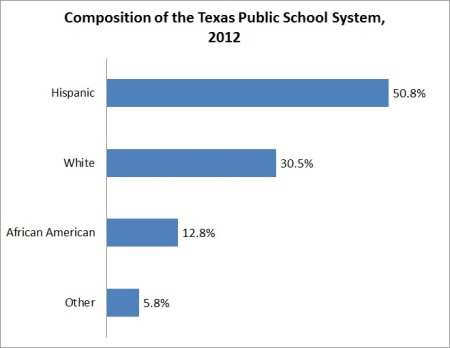
Texas K-12 ethnic breakdownNewsflash Tex: that 42% of Anglo kids being ready to face the rigors of the global economy doesn’t go nearly as far as it used to back in the day. Just in case I don’t have your undivided attention yet, check this out:
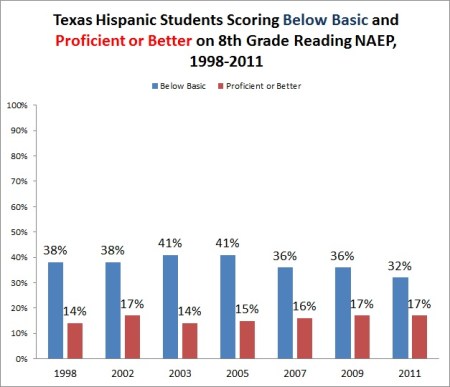
Texas HispanicAmongst Hispanics, the group that constitute a majority of K-12 students in the state, the functionally illiterate outnumber proficient readers by a very wide margin. Texas spent $11,146 per pupil in the public school system in 2010-11, which is an amazing sum when placed in context of just how much enrollment growth the state is attempting to accomodate. Texas has a public school population twice the size of Florida’s (with FL having the nation’s 4th largest btw) and approximately equal in size to the public school systems of the 20 smallest states combined.

The state has been adding around 80,000 students per year, which approximately equals the size of the Wyoming public school system. The public school lobbying groups pretend that any kind of choice program is going to leave the Texas public school system a financial ruin when in fact even the most far-reaching choice programs could at most put a dint in school district enrollment growth. If you waved a magic wand and moved every charter school that has opened west of the Mississippi River since 1990 into Texas, Texas school districts still would have gained hundreds of thousands of students.

Despite all of this, Texas Senate Education Chairman Dan Patrick, a strong supporter of parental choice, announced last week that he would be modifying a bill to eliminate the state’s charter school cap, and to instead raise it by a few dozen schools per year. Senator Patrick did this out of necesssity just to get the bill out of the committee. Worse still, this is happening in a session that seems destined to dummy down the state’s high-school graduation requirements in a major fashion. We have yet to reach the end of the movie, but this is the part where things are looking bleak for the good guys.

Don’t worry Tex…even though I control your K-12 vote I will still let you describe yourself as “conservative”…

Rather than blame the lawmakers, I’ll go ahead and blame people like myself. We reformers have done a poor job thus far in communicating the reality of the Texas situation. Consequently, there is a greatly misplaced complacency with regards to K-12 policy. We must do much better.

The greatest weakness of the powerful Status-Quo Collective that has assimilated many Austin decision makers is that they have no plausible plan for improving the Texas public education system. The problems embodied in the figures above (and others) will continue to go unaddressed while they seek yet more money for an outdated and ineffective system of schooling.

The current Texas public education system is however taking the state in a direction that almost no one will want to go. By educating only a small cadre of students to participate and prosper in the global economy, the future of the state will begin to look like that of Brazil in the late 20th Century, which one of my professors once described to me as “Belgium floating on top of India.”

As a purely economic matter, Texas can continue to import college educated workers from the less dynamic states indefinitely. As a matter of socio-economics however one cannot avoid asking fundamental questions regarding the long-term stability of both the prosperity and even democracy itself.  A public education system with only 17% of Hispanics and 15% of Black students reading proficiently constitutes a foundation of sand for the opportunity society needed to secure the future.

Time to choose…

In short, Texas can either continue to be Texas- a rapidly growing opportunity society, or it can morph into California. From my perspective in the nearby cactus-patch, California looks like a place from which Belgians are fleeing and have been for decades now-a rather loud wake up call. Ironically this leaves “progressive” California as a society increasingly divided by wealth and race. Politically incapable of addressing their education problems, California looks set to become Monaco floating on top of India. Good luck with that.

In the long run, Texans will either embrace their ideals or their education status-quo. It will become increasingly obvious that they cannot do both.


These go to Eleven: New Research on KIPP

February 27, 2013

(Guest Post by Collin Hitt)

Mathematica released a major study of KIPP charter schools today. KIPP is primarily a middle school network, with schools across the country. The Mathematica study uses a random-assignment research design, making it at least the eleventh such study we now have on charter schools. It found significant gains in math, positive but insignificant gains in reading. So, again, every random assignment study yet conducted on urban charter schools finds positive effects.

The random assignment study was limited to 13 KIPP charter schools in six states. KIPP’s network is much larger than that. So the authors employed a matching technique in order to evaluate the impact of a larger number of KIPP schools: they compared KIPP students to other kids who on paper were nearly identical. Matching techniques are far less rigorous than lottery-based estimates. But, since Mathematica had lottery-based estimates against which they could compare their matching technique estimates, they were able to validate their matched sample of students as a credible comparison group. They found that their random assignment estimates closely tracked their matching estimates, at relevant schools.

So they employed their matching techniques at a larger sample of 41 schools.  Mathematica then concluded that after just three years in KIPP, students made gains in math, reading, science and social studies that ranged from 8 to 14 months of additional learning. In the parlance of Matt Ladner, “boom.”


Washington Post on Charter Schools in DC

February 15, 2013

(Guest Post by Matthew Ladner)

Check out this fascinating article in the WaPo regarding the ever growing market share of charter schools in the District of Columbia. Blended learning schools will debut soon, DCPS continues to shrink, making some tetchy. Money quote:

Rocketship’s charter application — which is the largest ever to come before District officials, and which might win approval this month — arrives on the heels of Chancellor Kaya Henderson’s decision to close 15 half-empty city schools, highlighting an intense debate about the future of public education in the nation’s capital.

A growing number of activists have raised concerns that the traditional school system, facing stiffer-than-ever competition from charters, is in danger of being relegated to a permanently shrunken role. And they worry that Washington has yet to confront what that could mean for taxpayers, families and neighborhoods.

“Maybe we need an entire school system full of charters,” said Virginia Spatz, who co-hosts a community-radio talk show on D.C. education. “But we need to have that after public conversation, not by accident.”

With due respect to Ms. Spatz, there doesn’t seem to be anything accidental about this to me- DC parents will ultimately decide how many charter and district schools they want by voting with the feet of their children.


SEED Charter School: The Charter Research Keeps Piling Up

February 12, 2013

(Guest Post by Collin Hitt)

Earlier this winter on JPGB I summarized the nine studies of charter schools (that I knew of) that use a rigorous random-assignment research design. I missed one. Harvard’s Roland Fryer and Stanford’s Vilsa Curto have released a study of the SEED charter school in inner-city Washington D.C.

SEED enrolls most poor, minority students. But it isn’t your typical charter school. While open to anyone who wins a seat through its enrollment lottery, SEED is a boarding school that’s quite expensive. It’s a ‘No Excuses’ school with strict discipline and high expectations. With control over students’ schooling, diets and leisure time, the school’s founders promised big results. From Fryer and Curto’s November 2012 report:

Our lottery estimates reveal that SEED is effective at increasing achievement among poor minority students. Students who enroll in SEED increase their achievement by 0.211 (standard deviations) in reading and 0.229 (standard deviations) in math, per year. Thus, SEED schools have the power to eliminate the racial achievement gap in four years.

Those are remarkable gains. But SEED comes at a steep cost.

At the SEED School in Washington, D.C., about $39,275 is spent per pupil per year, compared to $20,523 per student in District of Columbia Public Schools (DCPS).

Leave aside for a moment that DC Public Schools spend $20,523 and get abysmal results. Sending a kid to SEED nearly doubles that cost. That marginal increase is somewhat understandable, since the school is housing and feeding adolescent kids. Nevertheless, those costs don’t typically fall squarely on the DC school system. So is it worth it?

Our lottery estimates suggest that attending the SEED school for one year is associated with a 3.8 percent increase in earnings (Chetty et al., 2012), a 1.0 to 1.3 percent decrease in the probability of committing a property or violent crime (Levitt and Lochner, 2001), and a 4.4 to 6.6 percent decrease in the probability of having a health disability (Auld and Sidhu, 2005; Elias, 2005; Kaestner, 2009). If SEED affects educational attainment as dramatically as achievement, the implied returns are dramatic (e.g. Card, 1999; Philip Oreopoulos, 2007). The public benefits alone from converting a high school dropout to graduate are more than $250,000.

For obvious reasons, SEED’s results are not indicative of all charter schools. It’s a unique type of charter school. But SEED’s results, while incredibly strong, shouldn’t have caught anyone by complete surprise. Fryer and Curto’s study is the tenth random assignment study of charter schools. All of them find gains for urban, low-income students.

(For the pointer, I thank Jon Mills)


Wolf and Witte Slam Ravitch on Milwaukee School Choice

January 18, 2013

Dwight Howard winning the 2008 Slam Dunk Contest.

As I’ve said before, I’m trying to avoid writing about Diane Ravitch because I think it’s now clear to all sensible people that she has gone completely nuts, lacks credibility, and was probablnever much of a scholar.  But I just can’t resist posting a link to the editorial my colleagues Pat Wolf and John Witte wrote today in the Milwaukee Journal Sentinel.  Wolf and Witte are responding to an earlier op-ed by Ravitch in which she declares:

Milwaukee needs one public school system that receives public dollars, public support, community engagement and parental involvement.

Vouchers and charters had their chance. They failed.

Wolf and Witte actually review the evidence on Milwaukee’s choice programs, including their own research.  They conclude:

Our research signals what likely would happen if Ravitch got her wish and the 25,000 students in the Milwaukee voucher program and nearly 8,000 children in independent charter schools were thrown out of their chosen schools. Student achievement would drop, as every student would be forced into MPS – the only game in town. Significantly fewer Milwaukee students would graduate high school and benefit from college. Parents would be denied educational choices for their children.

That’s not a future we would wish for the good people of Milwaukee.

There’s no point in trying to persuade Ravitch or her Army of Angry Teachers, since they abandoned rationality a long time ago.  But Wolf and Witte have done an excellent job of equipping sensible people with evidence that could help inform their views about school choice in Milwaukee.  Angry blather and bold (but false) declarations cannot compete with actual facts.

[Edited to correct typo in title.]