
(Guest Post by Matthew Ladner)
He’s going to stab it with his steely knife, and he just might kill the beast…
(Guest Post by Matthew Ladner)
He’s going to stab it with his steely knife, and he just might kill the beast…
 52 Comments |
  teacher union | Tagged: Chris Christie, New Jersey Education Association, New Jersey teacher unions, NJEA |
  Permalink
 Posted by matthewladner

(Guest Post by Matthew Ladner)
A new study by David Figlio links higher gains among Florida public schools with higher levels of competition from the Step Up for Students tax credit program. You can read the St. Pete Times story by Ron Matus here. Matus wrote:
Figlio emphasized the boost was significant, but modest.
“Anybody looking for a silver bullet has to keep looking,” he said. “What we find is certainly positive and statistically strong, but it’s not like public schools are revolutionizing overnight because of this, either.”
So it turns out that the public school gains associated with a state program with an initial statewide cap of $50m in a state with a multi-billion dollar public school budget were statistically significant but modest. Would it be reasonable to expect anything more from such a modest program? I suggest we scale this public school improvement program up to say a cool billion per year and then measure the impact.
My favorite line in the story comes from a hostile academic:
Another researcher remained skeptical. Stanford labor economist Martin Carnoy, who has studied the impact of vouchers and reviewed the latest study, said Figlio and Hart did “an honest job with the data.”
“But here is the real story: even after several years the effect size is TINY,” he wrote in an e-mail. “They are so small that even small downside effects would nullify them, leaving vouchers as mainly an ideological exercise.”
This is one of the more unintentionally hilarious statements I have read in some time. The field of education reform battle is covered with the dead bodies of reforms that show nothing in the way of a statistically significant impact. Increasing per pupil funding, Head Start, teacher certification, almost everything studied by the “What Works” clearinghouse so far, etc. All of these failures cost a great deal of money and deliver nothing in the way of sustained academic gains.
So the state of Florida passes a small law that actually saves the state money and shows a statistically significant and small result of improving public schools, and we are supposed to wring our hands and despair because something bad could come along and nullify the gains? Ummmmm, no.
First of all, nothing bad did come along and nullify the gains- quite the opposite. This program was only a part of the strategy to increase parental choice in Florida. That strategy also includes charter schools, McKay vouchers and virtual schooling- all of which either already are or soon will be much larger programs than Step Up for Students.
Second, the parental choice strategy was itself a part of a larger effort to improve Florida public schools. Parental choice reinforced the central K-12 reform of grading schools A-F. Transparency, rewards for success, consequences for failure formed the core of the Florida strategy.
Did it work?

The Step Up for Students program played a contributing role in Florida’s symphony of success rather than “destroying public education.” This is what Milton Friedman argued all along. Bravo- the obvious conclusion to draw is to push both parental choice and public school reform still further in Florida and elsewhere.
3 Comments | competitive effects, tax-credit scholarships | Tagged: David Figlio, Florida education tax credits, school choice, Step Up for Students | Permalink
Posted by matthewladner

(Guest Post by Matthew Ladner)
The NAEP released the 2009 Urban District NAEP results recently, which of course was an invitation to go exploring the data. I thought it would be interesting to look at the results for 4th grade reading.
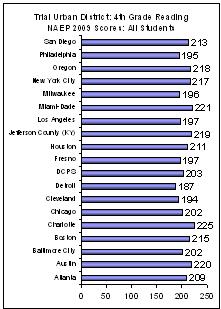
So Charlotte, Miami and Austin come out looking pretty good among urban districts. Oh, and Oregon too. Silly me, I must have accidentally slipped the statewide average for all kids in Oregon into the comparison of urban school districts. When you throw in all the rich kids in Oregon into the mix, they look like a decent urban school district, although not, I will note, the best urban school district.
Perhaps a bit of control for demographic differences between these jurisdictions is in order. After all, some districts like Austin (and I suspect Charlotte) have quite a few affluent kids attending them. So in the next chart, I only look at free and reduced lunch eligible children in the districts for more of an apples to apples comparison.

So Miami wins overall with a score of 215 for FRL kids, followed closely by NYC at 214. Both of these scores exceed several statewide averages for all students- such as California’s. Miami not only was the low-income reading champion for 4th grade, but the both the low-income and the overall reading champion for 8th grade.
Oregon low-income kids perform **ahem** like a mid-tier urban district despite the inclusion of suburban kids, and approximately a grade level behind both Miami and NYC. Some might also find it interesting that the Miami school district is 91% minority, while Oregon is 72% Anglo.
I certainly do. Quite a bit actually.
When I read Bernard Lewis’ book What Went Wrong? about how the Islamic world went from being the premier civilization to an economic backwater, it seemed to me that Lewis had asked the wrong question. Most of the world, after all, is a backwater. The real question is What Went Right? with the West more than what went wrong in the Islamic world.
It behooves us to ask both questions in this case: what in the world is wrong with Oregon, and what is going right in Miami? I have a very good idea of what is going right in Miami. Good standards and testing, transparency, letter grade rankings for schools, parental choice, alternative certification, curtailment of social promotion. I don’t know what Oregon has been doing, but it looks to me like they should make some rather dramatic changes.
Leave a Comment » | competitive effects, instructional reform | Tagged: NAEP Trial Urban District Assessment, The best urban school districts, Urban school district performance | Permalink
Posted by matthewladner
(Guest Post by Matthew Ladner)
Leave a Comment » | teacher quality | Tagged: Whitney Tilson | Permalink
Posted by matthewladner

(Guest Post by Matthew Ladner)
Last week I visited the Carpe Diem charter school in Yuma Arizona. Yuma is off the beaten path, in far western Arizona near the borders of California and Mexico.
Carpe Diem is a 6-12 school with 240 students. A value added analysis of test scores found that they have the biggest gains in the state of Arizona. Their math results are really off the chart, with some grades averaging at the 98th percentile on Terra Nova.
Carpe Diem is a hybrid model school, rotating kids between self-paced instruction on the computer and classroom instruction. Their building is laid out with one large computer lab, with classroom space in the back. They had 240 students working on computers when I walked in, and you could have heard a pin drop.
Carpe Diem has successfully substituted technology for labor. With seven grade levels and 240 students they have only 1 math teacher and one aide who focuses on math. Covering 6-12 and 240 students and getting the best results with a demographically challenging student body = no problem for Carpe Diem. Their founder, Rick Ogston, told me they use less staff than a typical model, and have cash reserves in the bank despite relatively low per pupil funding in AZ. They have never received support from philanthropic foundations, making due with state funding, but their model seems like it could be brought to scale with the right investment.
They have a classic innovation story in that they tried this radically different approach because they lost their space they were renting some years ago, and the only one available did not lend itself to a traditional approach. The only space they could find was at a University of Phoenix campus. The available space did not lend itself to the traditional 22 kids in multiple classroom model, so they innovated.

Mr. Ogston and his team have created a much more sophisticated version of the Rock Star Pay for Rock Star Teachers model I have written about over the last two years. One math teacher, seven grade levels, 240 students, best value added gains in the state, 90th plus percentile ranking, diverse student body. Check, check, check, check and check!
When I first bounced the idea of the Rock Star Pay for Rock Star Teachers model off of Gisele Huff some years ago, she told me in her delightful French accent “Matthew, you must incorporate TECHNOLOGY into this model. Then the teachers would be SOCRATES!” I knew she was right, and Rick Ogston has proved it.

You are the value-added champion of the year dude!
I want to congratulate the Carpe Diem team for creating a truly innovative school, and encourage others to make the trek from San Diego or Phoenix to see the school for themselves.
7 Comments | charter schools, class size myth | Tagged: Carpe Diem E-learning Community, Rick Ogston | Permalink
Posted by matthewladner

(Guest Post by Matthew Ladner)
Big news out of Oklahoma today: lawmakers passed the Lindsey Nicole Henry Scholarships for Students with Disabilities Program. Governor Henry, a Democrat, is expected to sign the bill. Text of the bill here (starts on around page 12).
Great win for the kids in Oklahoma, and hopefully a sign of things to come for even broader K-12 reform.
Leave a Comment » | special ed, vouchers | Tagged: Oklahoma vouchers, Special Needs Vouchers | Permalink
Posted by matthewladner
(Guest Post by Matthew Ladner)
Someone please explain to Jim Stergios why it is such a great idea for the federal government to force his state to dummy down its standards and tests. Money quote from the press release:
“These proposed national standards are vague and lack the academic rigor of the standards in Massachusetts and a number of other states,” said Pioneer Institute Executive Director Jim Stergios. “The new report shows that these weak standards will result in weak assessments. After so much progress and the investment of billions of tax dollars, it amounts to snatching mediocrity from the jaws of excellence.”
3 Comments | instructional reform | Tagged: common core standards, Pacific Research Insstitute, Pioneer Institute | Permalink
Posted by matthewladner
(Guest Post by Matthew Ladner)
Thumbing through the latest edition of Education Next I found a letter from Sara Mead taking exception to Jay and Stuart’s previous article on McKay Scholarships. Mead’s argument seems to boil down to the idea that Jay and Stuart forgot that vouchers for children with disabilities are bad.

Jay and Stuart note in their response that Mead failed to cited any evidence for her opinions about special education vouchers. I will be happy to present some evidence that Ms. Mead is entirely mistaken. The above chart shows gains on the 4th grade NAEP reading exam between 1998 and 2009 for the nation and for Florida.
For those squinting at your IPAD, that big red column more than two and a half times bigger than the blue column is Florida. Florida beats the nation in progress for students with disabilities on all four big NAEP tests.
Now several other factors certainly were involved in driving Florida’s gains among children with disabilities. For instance, policy changes such as heavy weighting of children in the bottom 25% certainly played a role, and I suspect that the revamping of literacy instruction did as well. I make no claim that McKay was the sole cause of this improvement.
If however the fact that all children with disabilities gained the ability to attend private school early in the Aughts negatively impacted their learning, it is awfully difficult to see any evidence of it in their test scores. In fact, it seems far more reasonable to assume that it helped.
Mead wrote:
But there’s no evidence that children with disabilities need additional education options more than any other youngsters in underperforming schools, or that vouchers address the underlying problems in special education. Rather, voucher proponents have seized on this population because they are more sympathetic beneficiaries than poor and minority youngsters. Using children with disabilities to increase public support for vouchers may be smart politics, but it doesn’t mean that special education vouchers are good policy.
On the first point, I can’t help but wonder how much Mead has spoken to parents with children with disabilities. More broadly, this is quite an achievement for a single short letter: a number of unsupported assertions and faulty ESP regarding the motives of McKay supporters. It falls to me to break the news to Mead, but the case for special education vouchers is extremely powerful. If for some strange reason you wish to halt their progress into law, you’ll have to do better than to imagine theoretical problems.
1 Comment | special ed, vouchers | Tagged: New America Foundation, Sara Mead | Permalink
Posted by matthewladner

(Guest Post by Matthew Ladner)
Paul Peterson details research showing that the class size amendment was ineffectual in improving student achievement in Florida . These findings are entirely consistent with the substantial empirical literature on class size reduction as an education reform strategy.
Leave a Comment » | class size myth | Tagged: Florida class size amendment, Paul Peterson | Permalink
Posted by matthewladner

For he who comes to his senses on vouchers shall be my brother...
(Guest Post by Matthew Ladner)
Must read column this morning from Jeff Jacoby on the growing support for vouchers on the American left.
2 Comments | vouchers | Tagged: Anti Defamation League, Jeff Jacoby, School Vouchers | Permalink
Posted by matthewladner

 Jay P. Greene's Blog