(Guest Post by Matthew Ladner)
Louisiana Governor Bobby Jindal is all in for education reform, and his charter school/voucher bill cleared the first legislative hurdle last night.
(Guest Post by Matthew Ladner)
Louisiana Governor Bobby Jindal is all in for education reform, and his charter school/voucher bill cleared the first legislative hurdle last night.
 4 Comments |
  vouchers | Tagged: Bobby Jindal, Louisiana Education Reform |
  Permalink
 Posted by matthewladner

"Forest?" We trees haven't seen one of those...
(Guest Post by Matthew Ladner)
Sherman Dorn takes issue with Andrew Coulson’s spending/NAEP chart and my use of it. Just a reminder, here it is again:
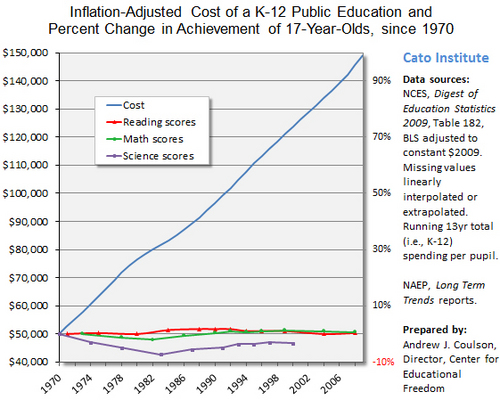 Professor Dorn infers that Andrew took a present inflation adjusted spending per pupil figure and multiplied it by 13 to arrive the inflation adjusted cost per pupil instead of adding 13 seperate spending per figure numbers.
Because we spent less in the past than we do in the present, such a proceedure would be more appropriate for a projection of the future (with an inflator) rather than a documentation of the past. Dorn correctly notes that the per pupil numbers double rather than triple as implied by the chart pointing to the NCES source data. Unless Andrew is calculating some sort of net present value type of cost, Dorn seems to be on solid ground so far.
After that, Dorn’s post gets silly by taking the log function of spending data, etc. in a successful attempt to create a far more troublesome chart based on the same data. Dorn however is missing the forest for the trees, even if he is right.
First note the absurdity of the phrase “only doubles” in practical terms. Let it breathe a bit, twirl it around in your glass, sample the aroma of it. When you partake of it, let it set in your palate for a bit before moving on.
What does a doubling of effort look like? Well, fortunately, all the charts in the post that Dorn ignored answer that question. Here they are again:
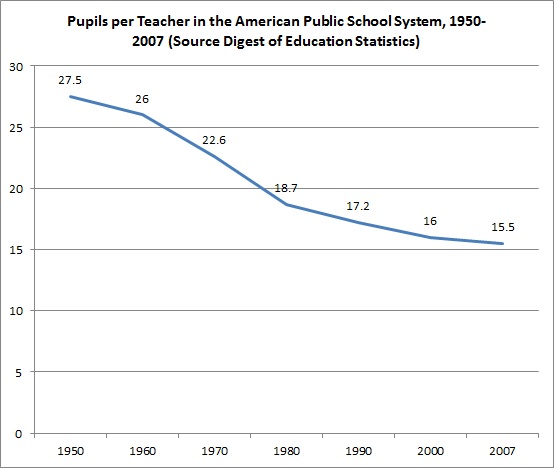 Yep, that looks closer to a doubling than a tripling all right, unless of course the real total cost of the average teacher has gone up rather than down over the decades. Teachers of course are a small issue compared to this:
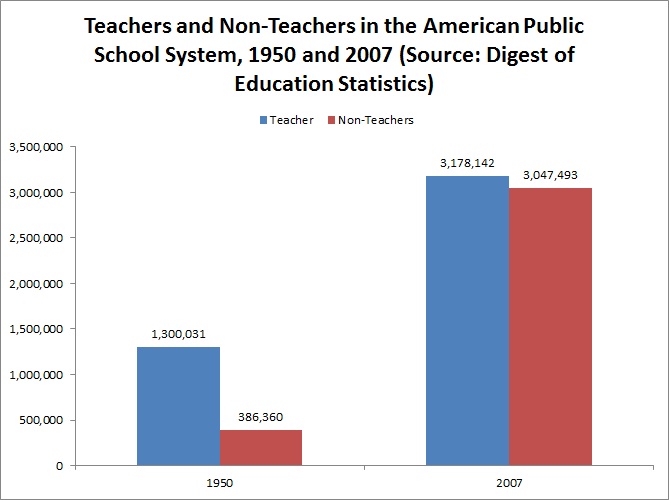 Oh, but not to worry- all these extra employees per student have vastly improved the quality of learning for our students. Err, except…

Hey no fair! The reading scores for 17 year olds may have only gone up one point despite a doubling of spending, but the math score gains have been better!
 Umm…like a two point instead of a one point gain!
Bottom line: we’ve bombed our students with extra school employees and have very little to show for it in terms of academic outputs.
Now you won’t be getting any “fake but accurate” arguments from me. Unless I get a solid explanation from Andrew, which I still might, I won’t make any further use of the chart. These other charts make the point just fine.

6 Comments | school funding | Tagged: Andrew Coulson, Sherman Dorn | Permalink
Posted by matthewladner
 (Guest Post by Matthew Ladner)
Florida looks to be the third state to expand private school choice in 2012 after Arizona and Virginia.
In terms of the original bet between Greg and Jay Mathews, I put the legislative chamber count at seven: two in Virginia, two in Florida and three in Arizona (two for the tax credit expansion, and the Arizona House has passed an expansion of the Education Savings Account program).
If Louisiana can pass Governor Jindal’s expansion of the New Orleans program to meh and below ranked schools statewide and the Arizona Senate passes the ESA bill (it passed out of committee last week in the Senate) then the ten chambers. If we are fortunate, some other states will help run up the score.
UPDATE: The Wisconsin Assembly has passed a voucher program for special needs students. That puts the chamber count at eight.
1 Comment | Uncategorized | Tagged: Florida Tax Credit Scholarship program | Permalink
Posted by matthewladner
(Guest Post by Matthew Ladner)
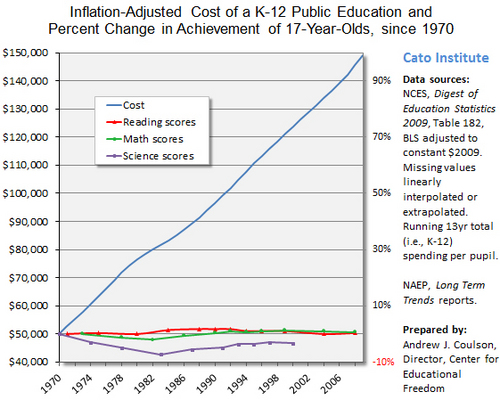
Previously on JPGB, I wrote about how the world is getting better all the time, with the notable exception of K-12 education. That post included the following chart from Andrew Coulson of the Cato Institute:
 So just how did we manage to pull this off? The Digest of Education Statistics illustrates how we managed it on the spending side. First, the number of teachers per pupil expanded substantially. Now I am writing this in my pajamas before having my morning caffeine, so feel free to double-check my numbers from the source.
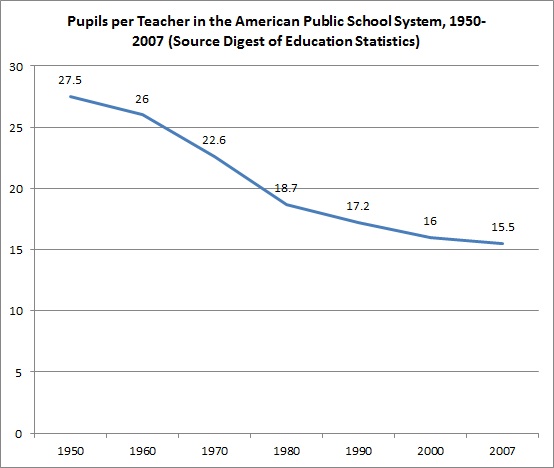
The vast expansion of the teaching workforce is entirely overshadowed however by the truly mind-boggling expansion of the non-teacher workforce. Take special note of the ratios of teachers to non-teachers:
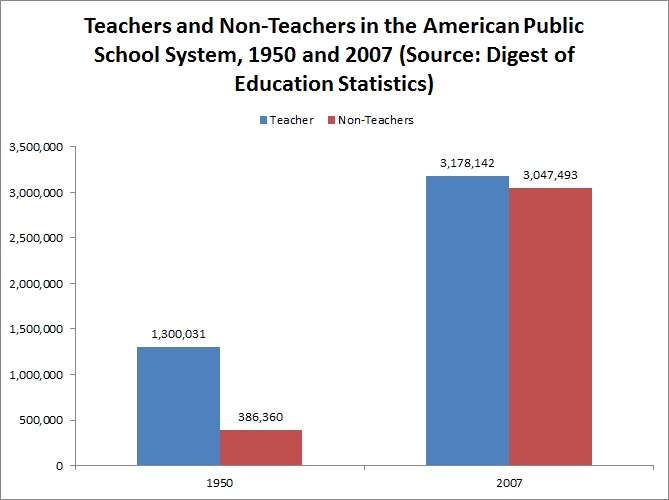 So the trend in the overall pupil per public school employee ratio:

So while the public school system has been busy vastly increasing employment, what has been going on with student achievement? The long-term NAEP reading trend looks like this:
 While the long-term NAEP math trend looks like this:
To sum up, we had a vast increase in the number of public school employees per student in the American public school system. In terms of outputs, we managed a two point gain in the average 17 year olds math achievement, and another point in reading. Mind you, that’s one point on a 500 point scale exam.
I’m ready to try something different.
50 Comments | money myth | Tagged: Andrew Coulson, spending and academic achievement | Permalink
Posted by matthewladner

(Guest Post by Matthew Ladner)
An analysis of Florida test score data from Georgia State Economist Tim R. Sass provides encouraging news for supporters of alternative teacher certification. The Florida data warehouse contains information about the route that teachers took for certification, and information about the types and number of courses taken in college. Sass includes a number of tables on background characteristics of teachers, and finds that alternatively certified teachers tend have higher SAT scores and took more math courses in college than traditionally certified teachers.
Sass performs an analysis of student learning gains by certification route, and finds that alternatively certified teachers have similar academic gains to traditionally certified teachers. This is similar to the findings previous certification studies. Sass however found better than average results for ABCTE:
The performance of ABCTE teachers in teaching math is substantially better, on average, than for preparation program graduates. Across all specifications and tests, ABCTE teachers boost math achievement by six to eleven percent of a standard deviation more than do traditionally prepared teachers.
The ABCTE route receives no state money and costs a fraction what students must pay for the College of Education route. Sass rightly cautions that the ABCTE cohort is not huge (there are multiple different routes to certification in Florida) so there should be further research conducted. Like the TFA research, the gains for reading are much smaller than those for math, which merits further investigation. The cut-scores for the ABCTE content knowledge exams are challenging, so it is gratifying to see the ABCTE teachers achieving larger student learning gains.
The philanthropists who have strongly supported Teach for America over the years should take note of these findings. The universe of potential career switchers with solid content backgrounds can add to the ultimately limited pool of Ivy League students willing to serve through TFA, and our students need all the help they can get.
As for teacher certification and Colleges of Education why do we have those again? The descriptive tables in the Sass study show that alternative certification can be a method for increasing the selectivity of the teaching pool (higher college entrance scores, more content knowledge courses, etc.). The results of this study reinforce previous findings that whatever is going on during those 30 hours of course work, it doesn’t seem to have much to do with better student results on the back-end.
5 Comments | teacher quality | Tagged: ABCTE, Tim R. Sass | Permalink
Posted by matthewladner
(Guest Post by Matthew Ladner)
The Kung Fu Panda of the School Choice Movement talks Friedman, 2011 and more in this Reason TV video:
Leave a Comment » | vouchers | Tagged: Friedman Foundation, Reason TV, Robert Enlow | Permalink
Posted by matthewladner
(Guest Post by Matthew Ladner)
Rational optimism or irrational exuberance? You be the judge…probably some of both.
I especially love the part about the progress over the last century and his story about the executive assistant in Manchester.
2 Comments | Uncategorized | Tagged: Peter Diamandis | Permalink
Posted by matthewladner
(Guest Post by Matthew Ladner)
I have been contacted about the Report Card on American Education that I coauthored for the American Legislative Exchange Council by people who have drawn a mistaken impression from a quote from Winston Churchill included in the book. We are dedicated to not taking ourselves very seriously on this blog, but I do want to be serious about this. The people who have made contact with me are sincere, so I wish to be very clear about this issue.
I graduated from public schools and universities, and thus I am indebted to public education. As the son of a former public school educator, I appreciate the self-less dedication and invaluable talent of our nation’s educators. As a board member of a public school and a father of children who are in public schools, I am completely invested in the success of today’s students and schools. To use a poker term, I’m all in.
The Winston Churchill “End of the Beginning” quote was solely intended to communicate that America is at a turning point in the continued struggle to equip all students with the knowledge and skills necessary to reach their potential. I sincerely regret any interpretation linking our nation’s educators to those who carried out many of the horrific events of Churchill’s era. I did not make such a link and moreover I did not intend for anyone to draw such an inference.
Leave a Comment » | Uncategorized | Permalink
Posted by matthewladner

(Guest Post by Matthew Ladner)
Virginia joins the parental choice party with a $25m scholarship tax credit for low and moderate income students. The Mid-Atlantic is shaping up nicely after North Carolina came on board last year.
Who will be next?
4 Comments | tax-credit scholarships | Permalink
Posted by matthewladner
 (Guest Post by Matthew Ladner)
Arizona Governor Jan Brewer signed the first new private choice program of 2012 into law today. The new law will create a new individual tax credit the same size as the current one ($500 for an individual and $1000 per couple) that will operate under the rules of Arizona’s corporate tax credit (i.e. means tested and aimed at students transferring from public schools). Individual taxpayers will be able to make donations under both credits each year. Arizona lawmakers are also considering an expansion of eligibility of the Education Savings Account program to students attending low rated schools.
Governor Jindal is gearing up for what sounds like a broad choice program. Florida lawmakers are considering an increase in their tax credit program, Virginia has a chance to join the ranks of choice states.
After the 2011 blowout, perhaps Greg’s original bet with Jay Mathews would make for a high but obtainable bar for a good year for private choice in 2012. Greg’s bet is to legislative monitoring what the NCAA tournament is the college basketball.
1 Comment | tax-credit scholarships | Tagged: Arizona Tax Credits, Education Savings Accounts, School Vouchers, tuition tax credits | Permalink
Posted by matthewladner

 Jay P. Greene's Blog