This Just In: Money is Still Not the Answer…

February 7, 2014

NAEP 4r dot chart

(Guest Post by Matthew Ladner)

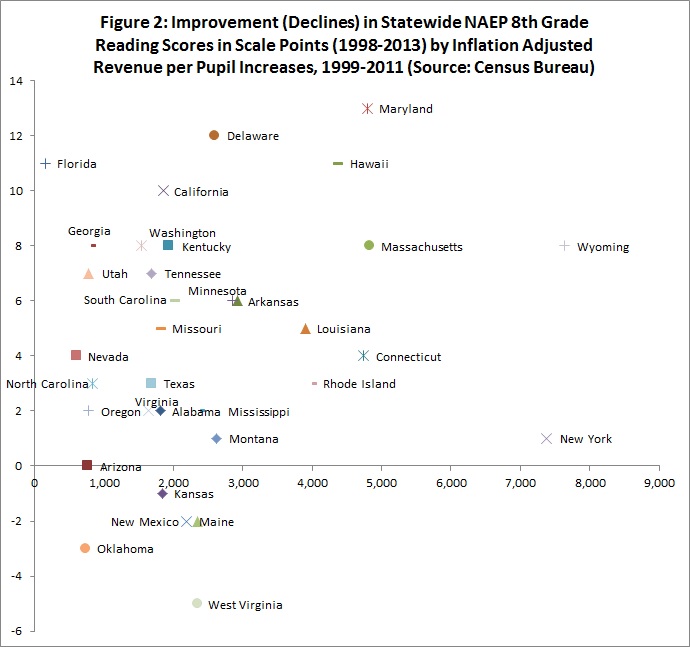
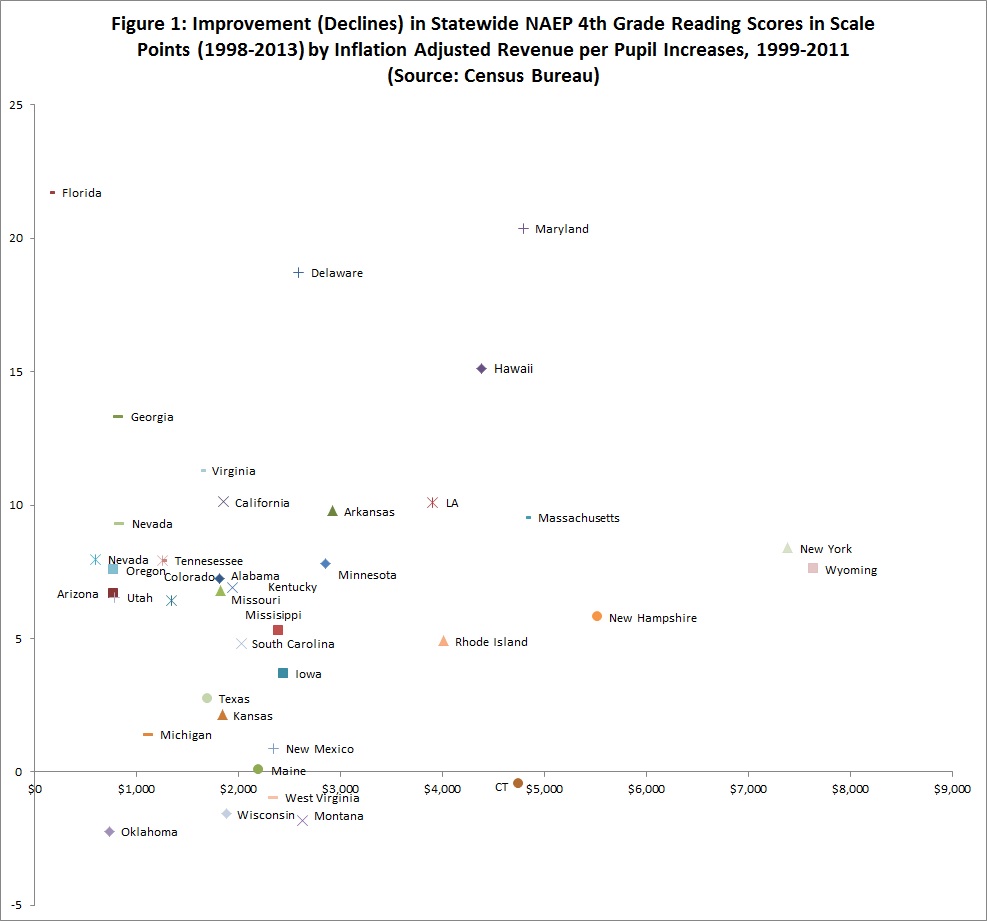
Which is a relief since we are running out of money in any case. I took a stab at updating my favorite state NAEP chart ever for the 2013 NAEP.  My favorite chart ever of course is:

Hanuskek 4

I decided that it would be a bit easier to digest to do the chart by individual subjects and use points rather than percentages of a standard deviation and combined tests as an axis. Also revenue per pupil was easier to find than expenditures.  So what you see up there is a first crack at 4th grade reading between 1998 and 2013.  No shock- money is still not the answer (yes I am looking right at you New York and Wyoming).

8th Grade Reading Chart looks pretty similar:

NAEP 8r dot chart

Wyoming at least scores meh improvement this time for their gigantic increase in spending, New York- fuggedabouit.  Florida just blew you a kiss from the top left quadrant and said that you should come up and see her sometime.

In any case, these are prototype charts that have as yet been double checked by no one other than our family cat Charlie. Treat them accordingly for now, just putting them up for fun and feedback.


Children with Disabilities Have Much to Gain from Parental Choice in the Magnolia State

February 6, 2014

(Guest Post by Matthew Ladner)

Mississippi legislators are considering a statewide choice program for children with special needs. Florida pioneered choice for special needs students in 1999, passing a pilot program that went statewide in 2001. Since 2001, all of Florida’s special needs students attending public schools have been eligible to take a McKay Scholarship to a public or private school of their choice.

More than a decade later, we find that 6 percent of special needs students use the McKay Scholarship Program directly by using it to transfer. Special needs students choosing to remain in the public school system however still benefit from the McKay program because it is there if they need it.

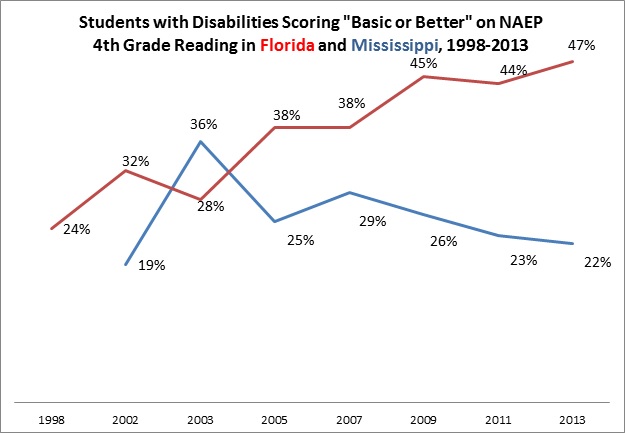
The charts below show that special needs students in Florida have made remarkable academic progress since McKay went into law. The first chart shows the progress for public school students with disabilities in Florida and Mississippi on 4th grade reading:
Florida vs. MS Spec 4R

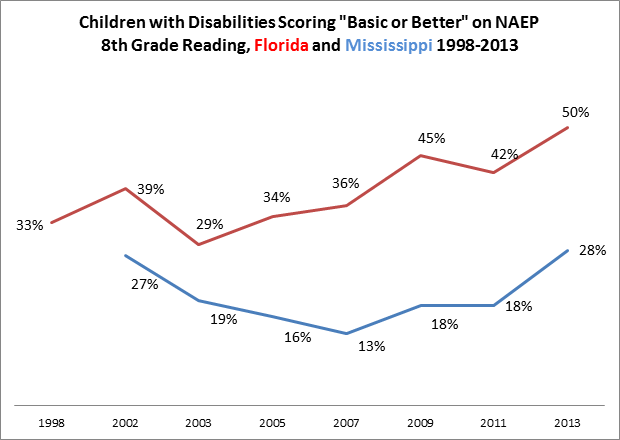
Today Florida children with disabilities are now more than twice as likely to show basic reading skills as their peers in Mississippi. You find the same pattern in the 8th grade reading scores:
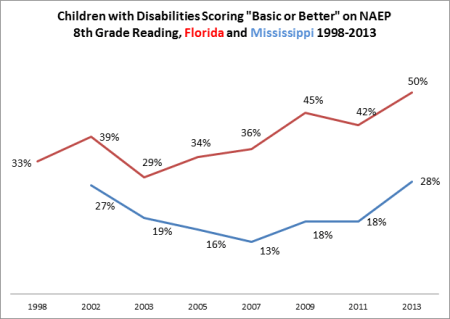
Florida vs. MS Spec 8R


Math scores show the same trend: narrow gaps opening to larger gaps over time. The point of these charts is not to brag about Florida, but to note a crucial source of improvement for special needs students in Mississippi. In the end, choice is no threat to the public schools in Mississippi but rather an opportunity. Florida’s public schools have more students (including students with disabilities), spend more and employ more people than before the onset of choice programs. That’s not the issue. The most important thing of all for special needs children is that the public school system now does a much better job in meeting their needs.

Florida enacted multiple reforms during this same period, so we cannot attribute all of these improvements to the choice program. Statistical analysis of variation in trends among special needs scores in individual Florida schools however confirmed that the McKay program contributed to the improvement.  Florida’s other reforms are also available for consideration.

Choice is not a threat to public schools in Mississippi, but rather a mechanism of the improvement of outcomes to the most disadvantaged students.  We can and should judge policies in large part with regard to how they treat the most vulnerable in our society. Look at the charts above and ask yourself the following question: if you had to be born as a child with a disability, would you want to grow up in Florida’s system of choice or Mississippi’s system of school assignment by zip code?  Would you want choice, or something much closer to “take it or leave it” in your schooling?

If you answered that question the way I expect, the next question is: what can Mississippi do to move ahead of Florida?

The answer- Mississippi should consider an even more advanced form of choice for special needs students than McKay. Choice for special needs students has the ability to empower parents to seek out the right type of education to meet the specific needs of their individual child. The Mississippi proposal draws inspiration from the Arizona Empowerment Scholarship Accounts program, which is a refinement of the McKay concept. This allows parents to choose to educate their child through a variety of different methods, including public and private schools, certified private tutors and therapists, online education programs and college/university courses. The idea is to give parents the maximum amount of flexibility possible so that they can deliver a customized education to meet the exact needs of their child.

When the federal government passed what became the Individuals with Disabilities Education Act in the 1970s, a million special education students nationwide had been denied access to public schools. That was wrong, and IDEA stands as an important pillar of civil rights legislation. The law however promised an “Individual Education Plan” for every special needs child, and it failed to deliver the substance of this promise for far too many children.  More than a decade ago, the center-left Progressive Policy Institute and the center-right Thomas B. Fordham Foundation used the analogy of a maze to describe the bog of federally mandated paperwork emphasizing process over results to the frustration of both educators and parents.

You can’t really have an individual education plan without choice over who delivers what sort of education. Today it is time for the states, not the federal government, to take the lead in truly delivering the ability for parents to deliver a really meaningful individual education plan for students. Students, parents and the public school system will all win as a result.


Mississippi Lawmakers Send ESA for Special Needs Proposal to the Floors of Both Chambers

February 5, 2014

(Guest Post by Matthew Ladner)

The Clarion-Ledger gives the details and a video of the upper chamber sponsor, Senator Nancy Collins.


Education Savings Account Effort in Iowa

February 4, 2014

(Guest Post by Matthew Ladner)

The Iowa Alliance for Choice in Education put out the following video to explain their next school choice goal: Education Savings Accounts.

The Iowa choice team has an impressive track record, having passed both individual and scholarship tax credits in the past, and having increased the scholarship tax credits with bipartisan support in recent years. Folks in Iowa have long been proud of their high NAEP scores, but the recent years have not seen a strong record of improvement, and others have passed and closed the gap with them as a result:

Hanuskek 4

Iowa needs to get moving again, I am excited to see what happens next.


Hackschooling Makes Logan Happy

February 4, 2014

(Guest Post by Matthew Ladner)

Logan seems to be having a better 13 than anyone I knew at that age.  I have wondered whether he would discuss the Stanford course he was taking online, but maybe that is more of a 14 year old kind of thing.

The reenactment of course reminded me of:

Logan seems to be well on his way to grasping the pebble.  Expect even more to follow in the future.


Whose Tribe Wanted This?

January 27, 2014

(Guest Post by Matthew Ladner)

Last week on NRO Kathleen Porter Magee wrote what reads like a lament for the death of the center-right education reform coalition:

(W)e must resist the centrifugal forces that threaten to pull apart the core policies that together have made the conservative reform movement so successful. Narrowing the scope of this tradition by removing standards and accountability from the theory of change would be a remarkably shortsighted decision, with far-reaching consequences for everyone seeking reform.

I also regret the current controversies, but one has to expect a fight under the tent here and there.  Since actions speak louder than words, I’m guessing it is going to take more than broad expressions of regret to stop this one, even after the current Common Core controversy fades from relevance.

My recollection of how this fight under the tent started would begin with this self-indulgent attack followed by more expression of poor reasoning by the standards tribe like this. Quoting Hirsch:

The choice movement is a structural approach. It relies on markets to improve outcomes, not venturing to offer guidance on precisely what the schools should be teaching. Such guidance would go against the “genius of the market” approach, which is to refrain from top-down interference with curriculum. Stern shows—rightly, I believe—that this is a fundamental failing of the choice movement.

Ironically enough, Dr. Hirsch fails to recognize that a great many schools that have opted in to his benevolent guidance are choice schools of various sorts.  This seems truly odd given that these schools are listed on his own website.  More than a few leading lights of the standards movement, while undoubtedly learned, seem to lack a basic understanding of pluralistic interest group competition. Who drove the classics out of the American public school curriculum in the first place? Why would you expect it to be different in the future?

Here in Arizona the Great Hearts schools have revealed an almost insatiable parental demand for a rigorous classical education- they have 6,000 students, 10,000 students on waiting lists, and every time they open a new school their waiting list grows rather than shrinks.   If you are having trouble understanding why the districts were basically oblivious to this demand before the advent of the dastardly “structural reform” some remedial course work in political science is in order. To the limited (but growing) extent that a classics based approach is proceeding in Arizona districts it is because the combination of parental demand and (**gasp**) charter schools and even more wildly liberal home-schooling movement has created the incentive to move in that direction.

KPM to my knowledge is not responsible for any of this, and this is all in the past. More recent stuff like this however certainly does not help. State testing may be a near total disaster in a great many states, but that’s no reason not to apply it to choice programs. Egads.

The tension between the standards and choice movements boils down to one between centralization and decentralization. It is not impossible to reconcile these urges, but a necessary if not sufficient step on the part of the standards tribe will be to show greater respect for diversity and self-determination. Until such time, remember whose tribe wanted this fight.


DC District Schools are Improving Fast but not Fast Enough to Catch DC Charters

January 23, 2014

(Guest Post by Matthew Ladner)

When the National Center for Education Statistics first released the 2013 NAEP data, the website refused to cooperate with requests to give charter/district comparisons for the District of Columbia.  This is of especially strong interest given that 43% of DC public school children attend charter schools.

Well lo and behold the NAEP website decided to start cooperating, and the data tells a pretty amazing story: district schools are improving over time in DC, but charters show even stronger growth.

NAEP takes new random samples of students in each testing year, but judges performance consistently across time. Making comparisons between district and charter students isn’t easy.  The percentages of students in special programs for children with disabilities and English Language Learners can potentially impact average scores. So for instance if DC charter schools have fewer children with disabilities enrolled, or fewer ELL students, or fewer low-income children enrolled, they could appear to be doing a better job educating students when the truth could be quite different.

Fortunately NAEP allows us to take these factors into account.  The charts below show NAEP data that gets as close to an “apples to apples” comparison as possible, comparing only the scores of Free and Reduced lunch eligible students in the general education program. Two other sources of bias that could be expected to work against charter schools involve new schools and newly transferred students. Organizations tend to not be at their best during their “shakedown cruise” and schools are no exception.  Also students tend to take a temporary academic hit as they adjust to a new school after transferring.  Charter schools tend to have lots of new schools full of kids who just transferred in-providing a double whammy when looking at any snapshot of performance.

Unfortunately, NAEP does not contain any tools for taking the age or the school or length of enrollment into account. Thus DC charter schools are fighting at a bit of disadvantage, and a very substantial funding disadvantage, in the below charts.

DC charter 1

DC charters may be fighting with one hand tied behind their back, but it did not stop them from scoring a knockout on NAEP. DC charters widened their advantage in the percentage of children scoring “Basic or Better” from 4 points in 2011 to 9 points in 2013.

DC charter vs district 8r

DC district students saw a large improvement in 8th grade reading between the 2011 and 2013 NAEP, but still found themselves trailing the achievement of DC charter students by 5%. In 4th Grade math, district students scored a very large gain, but charter students achieved an even larger improvement.

DC charter 3

On 8th grade math, district students demonstrated impressive gains, but DC charter students were 19% more likely to score “Basic or Better.”

DC charter 4

Hopefully the race to excellence will continue and even accelerate. Meep! Meep!


Wonks of the World Unite!

January 22, 2014

Ah the undergrad years….ok, yes, that’s me with the lampshade hat. Hook ‘Em Horns!

(Guest Post by Matthew Ladner)

My email inbox has been filling up since Mike P. let loose with the “comrade” reference.  Bob Bowden interviewed me over differences in dogma between myself and Commissar Petrilli here, wherein I attempt to correct ересь in an effort to restore harmony within the Politburo. Glasnost and perestroika must continue comrades, but with a human face.


Buckle Your Seatbelt Dorothy…

January 20, 2014

(Guest Post by Matthew Ladner)

Glenn Reynolds previews his new book The New School  in the Atlantic.  He foresees a lot less 19th Century Prussian factory style schooling and a great deal more customized education in our future.  Germane to our recent discussion of education accountability, reformatting our factory model of schooling will also require us to update a 1990s model of academic transparency.  As education becomes increasingly customized through old mechanisms like dual enrollment and new ones like MOOCs the notion of holding any single provider accountable with a minimal skills test will grow increasingly out of date. Texas moved to a system of end of course exams-quite reasonably posing the question “if a student takes a Calculus course, shouldn’t we see whether they learned any ‘Calculus’ or not?”

Good question-but thus far this Texas system has endured an Obamacaresque roll out. Time and technology however continue to march on and we should expect an accelerated pace per Reynolds.  Mastery based learning will inevitably require far more precise measurement of what students have learned.

Meanwhile, the Economist is citing an Oxford study’s conclusion that 47 percent of current jobs could be automated in the next two decades as we see a massive substitution of technology for labor across a whole host of industries. The Economist dutifully notes that technology creates far more wealth and jobs in the long run, but notes that the less than long run can prove quite messy.  Ultimately the article recommends that we get on with updating our education system post-haste:

The main way in which governments can help their people through this dislocation is through education systems. One of the reasons for the improvement in workers’ fortunes in the latter part of the Industrial Revolution was because schools were built to educate them—a dramatic change at the time. Now those schools themselves need to be changed, to foster the creativity that humans will need to set them apart from computers. There should be less rote-learning and more critical thinking. Technology itself will help, whether through MOOCs (massive open online courses) or even video games that simulate the skills needed for work.

The definition of “a state education” may also change. Far more money should be spent on pre-schooling, since the cognitive abilities and social skills that children learn in their first few years define much of their future potential. And adults will need continuous education. State education may well involve a year of study to be taken later in life, perhaps in stages.

Add to this chaotic tumult the fact that the country has already begun to enter an era of unprecedented demographic change that will impact all aspects of public policy as the Baby Boom generation moves into retirement.  The working age population will shrink as a percentage of the total, leaving them straining to pay the taxes necessary to maintain the pension, health care and education systems. As an added bonus, even if the Oxford study overestimates  matters, the working age population will face unprecedented professional volatility as technology disrupts the labor market.


If you like your calm, predictable life, you can keep your calm predictable life. Period.

So what to make of all of this?

A certification of knowledge mastery model seems like a realistic way forward to provide continual retraining within a feasible cost structure.  We already give verified third-party end of course exams and MOOC final exams for $89 a pop. Free online coursework continues to expand.  How people socially organize themselves to navigate this tsunami remains to be seen, but it will obviously require a much more flexible, effective and cost-effective system than the one we have today.   As Reynolds notes:

The thing about this is this kind of change tends to happen kind of like the quote about bankruptcy in The Great Gatsby, you know, very slowly and then all at once. I think that we’re coming to the end of the “very slowly” phase and getting to the “all at once.” I think there is going to be fairly dramatic change and a lot of new models. Some of these new models won’t work that well and some of them will, and there will be a period of where are we now? And then it’ll work out.


Oklahoma Lawmakers Introduce ESA legislation

January 17, 2014

(Guest Post by Matthew Ladner)

Oklahoma lawmakers have introduced Education Savings Account legislation. You could not ask for a more capable and committed champion than Rep. Jason Nelson and Oklahoma could benefit from the reform. Oklahoma could benefit from broadening the opportunities available to students. The Census Bureau projections for youth population increase are well above the take-up rates for private choice programs, so the public school establishment should take a deep breath before going into “the sky is falling!” mode. There is going to be plenty of students, but others demographic trends will be more problematic. The elderly population of Oklahoma will increase by 53% by 2030, meaning that there will be fierce competition for public funds between health care and education, young and old.

The people who will have to provide those public dollars in 2030 include the kids in the Oklahoma public school system now. When you look at NAEP, between 25% and 36% are at full grade level proficiency depending on subject/grade level.  Improving learning is not a task for 2030, but rather for right now. Oklahoma needs to improve K-12 outcomes as fast as possible, and needs to expand flexibility in the system in order to become both more effective and cost-effective in the future. The Oklahoma ESA legislation provides for eligible students with between funding 90 percent to 30 percent of the funds that would have gone to a participating child’s public school. If parents want to have a go at producing savings for the state treasury in return for the maximum possible flexibility in educational methods, it can be a mutually beneficial exchange that advantages everyone.

In addition to the possible benefits for Oklahoma students, the ESA concept itself would benefit by expanding the universe of people actively engaged in the model. We’ve only scratched the surface of what is possible here in Arizona. I am anxious to see the innovations that new teams people in other states develop-new methods to educate students, new ways to oversee accounts, etc.  I’m hoping that the next laboratory of reform fires up the beakers in 2014.