James K. Polk’s Way of the Future

September 15, 2014

(Guest Post by Matthew Ladner)

I am in the middle of reading a fascinating book about James K. Polk called A Country of Vast Designs. Stow that scoff soldier! Any reader of this book will quickly reach the conclusion that Polk has been hugely underestimated. This book details non-stop intrigue within Polk’s Democratic Party, political warfare between the Democrats and the Whigs, and Polk’s high stakes gambit to obtain sole possession of the Oregon territory (disputed by the world’s then preeminent military power), the Republic of Texas and the American southwest. Polk risked simultaneous war with both Great Britain and Mexico and national ruin in the process. Love him or hate him, Polk was a man of purpose and resolve that played a huge role in creating the country we live in today.

In any case, 132 pages in the book contains a striking passage describing a national zeitgeist that seems sadly diminished today:

The United States that accepted James Polk’s leadership in March 1845 was a nation on the move, animated by an exuberance of spirit. The population, having roughly doubled every twenty years since the Revolution, now stood at 17 million, equivalent to that of Great Britain. The national economy had been expanding at an average annual rate of 3.9 percent. Not even the Panic of 1837, for all of its destructive force, could forestall for long this creation of wealth. And throughout the land could be seen a confidence that fueled national success. “We are now reaching the very height, perhaps, to which we can expect to ascend,” declared the Democratic Wilmington Gazette of Delaware. “Every branch of industry is receiving its reward, and a just, settled policy…is all that is required to prolong, if not perpetuate, such blessings.”

The faith in the future produced an explosion of new technological developments, most notably steam power and Samuel F.B. Morse’s magnetic telegraph. Steam was propelling people and goods across the country at speeds never before imagined-over rails connecting more and more cities and through the waters of America’s many navigable rivers and man-made canals. By the 1830s, during Jackson’s Presidency, the country had 450 locomotives pulling trains over 3,200 miles of track. Now the country’s track mileage exceeded 7,000, and train travel over vast distances had become routine. Henry Clay’s first trip to Washington from Lexington Kentucky, in 1806 had taken three weeks; now he could make the journey by rail in four days-and with much greater comfort.

As remarkable as this was, it seemed almost commonplace alongside Morse’s ability to send information across vast expanses almost instantaneously-“the improvement that annihilates distance,” as Thomas Benton put it. Morse had strung his famous wires from Baltimore to Washington in time for the Democrats’ nominating convention the previous May, and had thrilled Washingtonians with the latest news of developments there. On the rain-soaked day of Polk’s inauguration, Morse had been on the platform, hunched over his little gadget, clanking out detailed descriptions of the inaugural events an expectant crowd in Baltimore and for subsequent readers of newspaper extras rushed to the streets with unprecedented immediacy.

Now the idea was emerging of those wires crisscrossing America along with the expanding ribbons of locomotive transport-connecting North and South and stretching westward with the human migrations then becoming an increasingly powerful element of the American story. All this served as a resounding reply to the hidebound skeptics who asked whether America’s expansionist impulse would eventually outstrip the country’s ability to govern itself. The answer was no: Just as America was encompassing ever greater distances, technology was obliterating the sluggishness of distance.

And so the impulse of exuberant expansionism continued-sending more and more citizens westward and into ever greater cities; fueling an entrepreneurial spirit and technological inventiveness that in turn generated an ongoing economic expansion; spreading a sense of national destiny. “America is the country of the Future,” declared Ralph Waldo Emerson in 1844. “It is a country of beginnings, of projects, of vast designs and expectations.”


The Way of the Future: Attorney General Abbott to Call for Texas Universities to grant course credit for MOOCs

September 3, 2014

(Guest Post by Matthew Ladner)

Read all about it here.  After reading the article, let me know if you find it as amusing as I do that the same people that complain about a 13% MOOC completion rate are the same crowd that would like to deny granting credit to the 13% who made it through the course and demonstrated their mastery of the material in a third-party administered end of course exam. Let’s see what happens with completion rates once we give people an incentive to complete courses eh? Those who have demonstrated mastery deserve credit regardless of the percentage of people who choose to watch some coursework rather than Baywatch.

The case for denying credit died with the third party administration of exams. The day is soon coming if it has not already arrived where students in other states and other countries can receive college credit for courses provided online by Texas universities, but Texas students students taking these same courses cannot receive credit in Texas universities for course developed using Texas tax dollars. Good luck trying to justify that higher-ed reactionary guy.

Don’t worry admin bloated and underperforming higher ed establishment- I’ll save you!

Attorney General (and soon to be Governor if the polls are to be believed) Abbott is wise to put this on his to-do list, and while he is at it, someone should certify successfully completed MOOCs for high-school credit, as it does not make the least bit of sense for a 16 year old who successfully navigates a Stanford calculus class for college credit to have to sit through a similar high-school course.


National School Choice Litigation Week?

August 29, 2014

(Guest Post by A.D. Motzen)

By Friday, school choice advocates were beginning to ask themselves, “what color scarf does one wear during National School Choice Litigation Week?” No, that’s not an official date on the calendar, but it sure seemed like that this week.

The biggest news of course, was the lawsuit filed on Thursday by the Florida teachers union and others to take away the scholarships of 67,000 low-income students. The scholarship tax credit program, enacted in 2001, is the largest in the country and has support of many African American and Hispanic Democratic legislators and community leaders. An overwhelming majority of participants are minority students and the attempt to end a longstanding, successful and popular program makes the lawsuit a highly unusual tactic in the battle of school choice.

Agudath Israel of Florida director, Rabbi Moshe Matz traveled to Tallahassee and spoke at a press conference in opposition to the lawsuit. Rabbi Matz called the lawsuit “shameful” and argued that the program should be lauded and expanded, not litigated.” More than 1000 students attending Jewish day schools are at risk of losing their scholarship if the lawsuit prevails.

On a positive note, the New Hampshire Supreme Court overturned a lower court ruling which had prevented the state’s new scholarship tax credit program from being used at religious schools. The court found that the plaintiffs had no standing and could not show how they were harmed by the program.

In other states however, our opponents are not giving up easily. In North Carolina, school choice supporters and lawmakers petitioned the State Supreme Court on Monday to allow students to receive scholarship funds from the Opportunity Scholarship Program while the case is litigated. The case has bounced back and forth between Superior Court Judge Robert Hobgood, the North Carolina Court of Appeals and the North Carolina Supreme Court.

Finally, in Oklahoma County District Court on Thursday, a judge ruled against students using the Lindsey Nicole Henry Scholarship Program for Students with Disabilities (named after the daughter of Democratic Governor Brad Henry who signed the original legislation into law) to attend a religious school. Thankfully, State Attorney General Scott Pruitt promised to appeal the ruling.

So is school choice at risk? Lawsuits are never good. They scare parents and schools from participating in these programs. They waste valuable resources which could have been better used helping promote the programs passed by legislators. However, the reason we see more lawsuits is because more programs are being passed around the country as the movement gains momentum. These lawsuits, especially ones litigating established programs such as in Florida and Georgia, are acts of desperation by those opposed to giving choices to families.

Around the country, more than three hundred thousand students are attending a private school thanks to a scholarship program. Parents, we need you to speak up. Let your legislators and your local news media know that you support these vital programs. With your help we will prevail.


Florida Teachers are Poorly Represented by the Offensive Actions and Attitudes of the Florida Education Association

August 28, 2014

FEA protestors

(Guest Post by Matthew Ladner)

The Florida Education Association already filed a lawsuit against an expansion of the Florida tax credit program and the Personal Learning Scholarship Accounts on procedural grounds. In so doing, the FEA leadership broadly and Vice President Joanne McCall in particular engaged in utter hypocrisy as they had used an identical procedure to get a large teacher pay raise the session before. In the process a FEA official described the special needs students who could benefit from participation in the Personal Learning Scholarship Account program as “collateral casualties.”

So well, if referring to children with disabilities as casualties wasn’t revealing enough about where the well-being of children fall on the priority list of the FEA, today we have a new example from Florida FEA Vice President Joanne McCall. The FEA joined with the Florida School Boards Association in a legal attack on the Florida tax credit program. The families of 60,000 low-income Florida children use this program to finance their education. As mentioned earlier the program has generated a variety of positive evaluations.

Parents feel very strongly about outside groups trying to force their child out of the school they have selected to best meet their needs. Their child’s learning and their network of friends is all being put under assault by this incredibly callous action by the FBSA and FEA.  In a move that should shock no one, a group of these aggrieved parents have protested the FEA’s action outside of their headquarters in Tallahassee.

Here is the response from Twitter for Florida Education Association VP Joanne McCall:

FEA


I can’t imagine a more revealing statement. First children with disabilities were “collateral casualties” to the absurd and misguided fears and hatred of the FEA. Now low-income parents who simply want to exercise the same freedom that higher income families take for granted to choose the best school for their child are “hit dogs.” Perhaps it is necessary to dehumanize your victims in your mind before making them into a casualty.

These children and these parents of course are human beings-people with hopes, dreams and aspirations. The only thing accurate about the statement is that the FEA has indeed struck these people. They have cruelly and needlessly introduced fear and uncertainty into their already difficult lives. McCall and her entire organization should be ashamed of what they have done.


BOOOOOOOOOM! New Hampshire Supreme Court Rules in Favor of Tax Credit Program

August 28, 2014

(Guest Post by Matthew Ladner)

Instant analysis from Jason Bedrick.  Ironically enough the Florida School Boards Association and other members of the public school non-profit industrial complex filed suit again the Florida tax credit today. Florida judges would do well to apply the question of harm (and thus standing) to these litigants, because the reality is that Florida public schools have far more money, more students, and employ more people today than before the Florida tax credit passed. The state appointed academic evaluator (and others) have found that part of the source for the remarkable improvement in public schools originated from the tax credit program.  The districts would have higher enrollment in the absence of the program, but they have local funding to cover their fixed costs and have been dealing with enrollment growth for decades and will deal with more in decades to come.

I’d love to hear a coherent claim of harm in any of this. The New Hampshire Supreme Court was wise and just in drawing this conclusion, and thousands of low and middle income children will have greater options because of it. I hope that Florida’s judges will prove equally adept.


Florida School Boards Association Prepares to File Suit Against Tax Credit

August 27, 2014

Florida census

(Guest Post by Matthew Ladner)

Despite the wishes of the parents of 69,000 low-income children, despite the fact that Florida districts improved outcomes substantially during an era of increasing parental options, despite positive third-party academic evaluations of the tax credit program, and despite Census Bureau projections that show that Florida’s district schools will likely face a severe overcrowding problem, the word is out that the Florida School Boards Association is set to file suit against Florida’s tax credit program.  As you can see from the post below, Florida is one of the lower-income states. As you can see from the chart above, both the youth and elderly populations of Florida are set to substantially grow over the next decade and a half.  Elderly people already consume a majority of Medicaid funding, and when your population of 65+ projects to grow from 3.4m to 7.8m you’ve got a huge problem on your hands.

The tax credit program will not begin to solve this problem by itself, but nothing will.  Florida is going to need a series of policy innovations to improve state outcomes while lowering costs to get through this.  Innovations with results **ahem** like the tax credit program.  The average scholarship amount is about half of the public school spending rate. Better still, the third-party academic evaluations by Northwestern economist David Figlio found academic gains for both participating students and for public schools facing higher levels of competition.

If the Florida School Boards Association has a plan to deal with the age demographic storm on the horizon, which includes a projected million plus increase in the size of the K-12 population while the state ages, I would like to know what it is.  Stamp out successful reforms and then cover the playgrounds with trailers and hope for the best?  School districts are always going to be the backbone of the education system in Florida. Funding for education is guaranteed by the Florida Constitution and supported by the public.

Nevertheless, Florida urgently and badly needs improvement and innovation in the public sector, especially in K-12.  This lawsuit represents a step in the wrong direction and more worrying still speaks to a complete lack of either awareness or seriousness about the challenges facing Florida’s future.


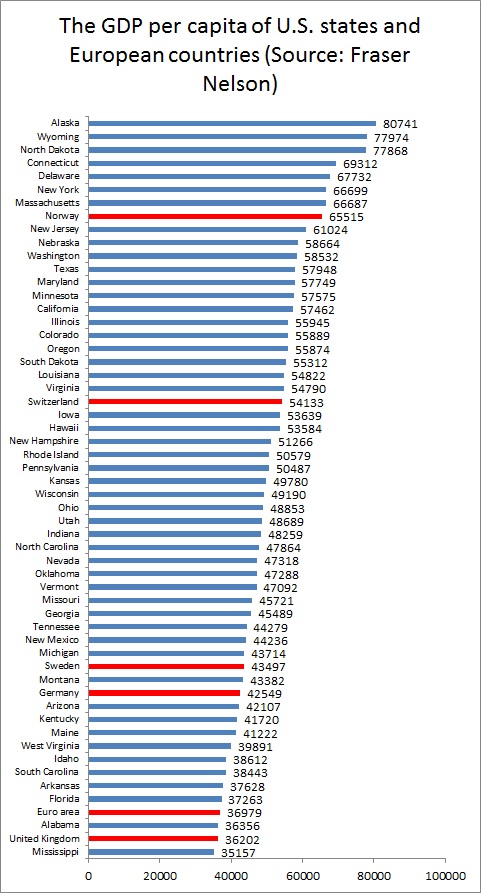
Alaska on top (for now) while the Euro Zone, Alabama, Britain and Mississippi bring up the rear

August 27, 2014

GDP

(Guest Post by Matthew Ladner)

Readers of a certain age will recall the days when European films got over 10% of the American box office. I recall being told that this was the thing to do, but being fairly consistently disappointed with the products. European governments are apparently willing to subsidize bad films on an ongoing basis, but I was not. Eventually the American public also found better ways to spend their entertainment dollars, and European film-going shrank in America.

It looks to me like the devotion of some Americans to European economic policies deserve the same fate. Even our versions of small population/big oil territories (Alaska and North Dakota) beat the stuffing out of their version (Norway). Germany is the economic titan of Europe but finds itself sandwiched between Montana and Arizona. Move an American state with a large population and high-end GDP per capita to Europe (say New York or Texas) and there would be a new sheriff in town.

Read the WaPo for more.  Someone explain to me again why the PISA rankings would look so much different than the economic rankings. Don’t bother trying to say that there is poverty in Alabama but none in the Euro zone because I’m not buying it. The last per student spending rankings I saw had Alaska (the top state at GDP per head) at $18,000 per year per kid and NAEP says 42% of the 4th graders score below basic in reading. It would be a great idea to concentrate on getting bigger bang for the buck because, ahem, well…


Bustin’ Makes Butcher Feel Good

August 24, 2014

ghostbusters butcher

(Guest Post by Matthew Ladner)

So if the above picture looks like a sloppy attempt at photo editing by someone goofing around with a program for the first time, it is only because it is in fact just such an attempt.

So Arizona voters passed an initiative long ago that provided for inflation adjustments to K-12 spending. During the bubble years spending went up faster than inflation, but during the catastrophic collapse of the economy it went down less. The AZ school district non-profit industrial complex eventually sued to get the funding restored, and they recently won, sticking lawmakers with a $317,000,000 bill. Arizona is broke and unlikely to find that sort of change in the sofa, and requires a 2/3 vote of each chamber to raise taxes. So, what happens next?

The Goldwater Institute’s Jonathan Butcher went to the pages of the Arizona Republic to suggest a couple of ways to recoup the money. First- stop funding ghost students. Districts get paid on last year’s student count, charter schools on this year’s count. Ergo every time a child transfers from a district to a charter school the state pays for them twice for a year. This is a pure waste of money that will continue to grow with Arizona’s charter school sector. Butcher estimates this could gain the state $125m of the needed $317m. If I were Arizona’s higher education community I would jump on the Ghostbuster bandwagon because otherwise that $125m is likely to come out of higher education spending sooner rather than later.

Second Butcher proposes that some of the base funding for schools be conditioned on kids actually learning something. With half the high-schools in the state having 5% or less of the graduating Class of 2006 finish a Bachelor’s degree in six years, this sounds like a promising if tricky idea.  The taxpayers ought to be getting an ROI from Arizona public school spending dominated by student learning, not by mere babysitting.


Open Letter to David Plouffe: When Fighting an Entrenched Status-Quo, Don’t Stop at Transportation

August 20, 2014

(Guest Post by A.D. Motzen)

Dear Mr. Plouffe,

Congratulations on your new position as senior vice president of policy and strategy at one of my favorite companies, Uber.  Ever since I spent 35 minutes waiting for a cab outside of LaGuardia airport, I’ve become a dedicated Uber customer.

Before you get too settled in at your new office, however, I would like to offer you a position at my new start-up. I call it UberEd.

You were recently quoted as saying that you would work “to ensure drivers and riders are not denied their opportunity for choice in transportation.”

Presumably you were hinting at the challenge you will face from an entrenched monopoly which doesn’t like competition. Rather than improve their product and meet the needs of their customers and employees, your adversaries will spend millions of dollars on political donations and lobbyists to ensure that laws and regulations will be written to keep out the competition.

But you and Uber CEO, Travis Kalanick, apparently believe in transportation choice. While perhaps not a Constitutional right (yet), transportation is one of the most basic needs of every American citizen, especially for those who live or work in urban areas. By providing choices and flexibility you will be able to offer a better product that meets the needs of individual customers at a lower cost. Why, even the employees will be happier! Most importantly, even the competition – those dreaded yellow taxi unions – will ultimately be forced to compete and either lower their prices or improve their service.

My start-up is based on those same principles, so it should be a good fit with your philosophy. Rather than working “to ensure drivers and riders are not denied their opportunity for choice in transportation,” my idea would ensure that parents and children are not denied their opportunity for choice in education. My motto would be “everyone’s private or public school.”

It’s a simple concept that was already Beta tested in more than a dozen states using “experiments” such as charters, vouchers, scholarship tax credits, and now education savings accounts. In all of those vehicles, parents have a choice on how to get their child from point A to point B – traditional public, charter, or private school.

Using UberEd, a parent can check which schooling options are available for their child simply by pressing a button on a smartphone. The name of the closest schools (or alternative program) come up on the screen and by clicking on the school icons, the parent can find out information about each option. Parents don’t have to worry about tuition bills as the app is set up so that the state funding allocated to that specific child would be credited to their spending account. Just tap the payment button and the school will get the money through a third-party without having any access to your personal bank account. If a parent wants a more expensive school they can always  choose UberEd Xtra and supplement the state-allocated funds with their own personal resources. Schools could be rated by a parent based on any number of criteria so that other UberEd users would know what to expect.

I could go on, but I don’t want to give up too much information just in case someone actually goes out and files a patent (I haven’t) and raises some venture capital before I do.

Uber was recently valued at $18 billion because it will completely redefine and improve transportation as we know it. UberEd (a.k.a. school choice) is radically changing education as we know it. Education is the uber-vehicle to a brighter future for our children. Isn’t that priceless?

But as you probably figured out by now, I can’t offer you a job just yet. Parents first need more states to actually allow school funding to follow the child. Maybe I’ll give you a call at that point and you and Mr. Kalanick can help me build that app.

In the meantime, I wish you all the luck in the world.

Together with millions of parents across the country, I am hoping that your arguments of opportunity and choice will prevail against the status quo. We are hoping that your former boss, President Obama, and elected officials across the country will take heed and be forced to choose a side.

Entrenched status quo or innovation, opportunity, and choice?

Choose one. Then tap on the UberEd app.

A. D.