Destruction of Public Education or Pressure Release Valve? You Make the Call…

February 16, 2015

AZ enrollment trends

(Guest Post by Matthew Ladner)

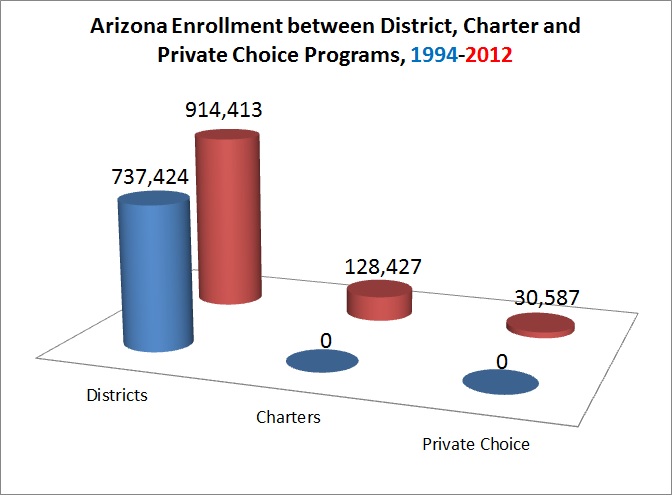
This is what the “destruction of public education” looks like in extremist, wild west Arizona…oh….wait…what? The increase in district enrollment is greater than the growth in charter school students since the creation of the law charter law in 1994 and 2012-176,989 to 128,427?

Yeah, but…

What is that you say? Even if you combine all of Arizona’s private choice students with all the charter school students, the increase in district enrollment still outstrips the increase in choice enrollment 176,989 to 159,014?

Ok but if those choice programs didn’t exist, the number of students and the amount of money going to districts would be higher than it is now. So…

High demand schools surrounded by portable buildings? C’mon that would never happen! Already common in Texas? Arizona has been broke since 2007, unable to afford much new district building space eh? Well we could just raise taxes…what? Arizonans raise millions of private dollars to finance charter and private school spaces? Census Bureau projects hundreds of thousands more students over the next 15 years? Already high elderly population set to vastly expand too?

Ok, sign me up.


Road Trip Heads to Oklahoma

February 12, 2015

(Guest Post by Matthew Ladner)

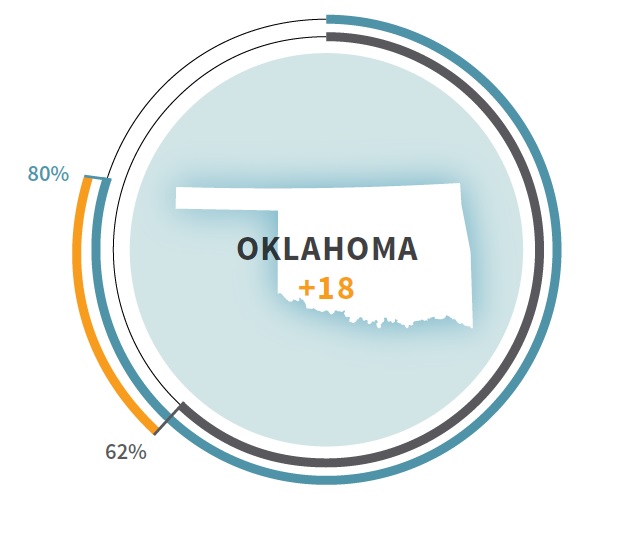
Over on the Ed Fly blog I have a post on the age demography challenge in Oklahoma from Turn and Face the Strain. Spoiler alert: if Oklahoma’s K-12 system has a next 15 years similar to the last 15 years they will be adding to what looks to be already looks to be a very considerable challenge in 2030.

Oklahoma strain


Mississippi Senate Passes ESA

February 11, 2015

(Guest Post by Matthew Ladner)

Congrats to Senator Nancy Collins on passing Senate Bill 2695.


Do you really think you have a chance against us Mr. Cowboy?

February 8, 2015

(Guest Post by Matthew Ladner)

The late great George P. Mitchell, winner of the Al Coleman Humanitarian Award among various lesser honors has joined the great rodeo in the sky but those who have taken up his legacy have a very interesting fight on their hands.

First of all, you may have noticed that gasoline prices have collapsed. The vast new supply of oil unleashed by Mitchell had a great deal to do with that, although the immediate precipitating event was a decision by OPEC not to attempt to restrict supply in order to keep up the price. By all accounts, the Saudis drove this decision, and explained it as desire to preserve their market share.

The OPEC cartel has had profound difficulties in the past in actually having members keep to their production targets. When the price of oil increases, so too does the incentive for members to cheat by producing over the caps. Historically Saudi Arabia has had vast production and relatively low extraction costs, giving it the role of swing producer.  In the mid 1980s depending upon which story you believe the Saudis tired of making up for the cheating of other OPEC members or wanted to bankrupt the Soviet Union or perhaps both. In any event, the oil market flooded, the price dropped to $9 a barrel. Stateside the Savings and Loan debacle unfolded and oil-producing states like Texas crashed Icarus-like to earth.

The price of oil tumbled after the OPEC decision, inspiring various theories. The Russians think that the Saudis are out to get them, the Iranians think the Saudis are out to get them, and the frackers also think the Saudis are out to get them.  Note however that these things are not mutually exclusive, and the Iranian theory seems more plausible than others to me. In any case, the general thinking was that all three of these competitors needed prices over $100 a barrel, and with their low extraction costs the Saudis were well situated to wring “excess supply” out of the market.

Good ole fashioned American innovation however thus far is winning the day.

No that is not a shot put, but rather a disintegrating frac ball, made of “electrolytic metallic nanoconstructed material.” It eliminates a step in the fracking process, and it was only one of a number of new drilling technologies discussed at a recent conference in the Woodlands in Houston (probably not coincidentally a property development project of George P. Mitchell). The article linked above discusses how American drillers are busy figuring out how to get more oil and gas out of already drilled wells. The number of new wells drilled in the United States has declined, but total production of oil and gas has not followed suit. Other interesting developments include the development of techniques without water, substituting CO2.

Now to be sure there are going to be some highly leveraged American oil firms who are going to go bust because of the decline in prices. Many of them have been through bankruptcy before, and you can expect them to see them back out in the fields soon. Anyone want to bet on OPEC welfare states displaying this same level of flexibility?

Place your bets- I’m all in on the high-tech wildcatters. Yippie kai yay!


Politico on ESAs-“A Radical Idea is Catching Fire Across the Country”

February 6, 2015

(Guest Post by Matthew Ladner)

Two programs with 2,600 or so students in two states doesn’t feel like a wildfire yet, but it is great to see the increase in legislative interest. Our merry band of ESA warriors is having fun!


Will Texas Turn to Face the Strain?

February 5, 2015

(Guest Post by Matthew Ladner)

Road trip! First stop- Texas!

Over the next few weeks I’ll pick a few states whose age demography data to examine a bit more closely from our new study Turn and Face the Strain. Rather than start with a state that looks to be in huge trouble, let’s start with one with the potential to rule the roost of the year 2030 if only it could put its affairs in order.

When we peer into the United States Census Bureau’s forecasts for Texas, the news is challenging vis a vis today but relatively forgiving compared to the rest of the nation. Texas will be one of the six states with an elderly population smaller than the percentage in Florida in 2030 according to Census projections.

Hurricane Gray is going to hit Texas, but in relative terms it will be delivering a glancing blow- mostly due to the fact that the state has a huge youth population now (potentially very handy for 2030).

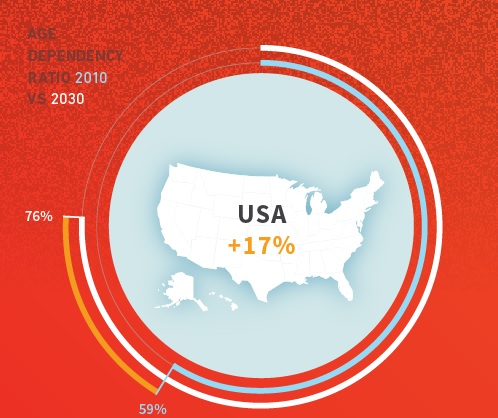
Here is the Census Bureau’s projection for the total age dependency ratio of Texas between 2010 and 2030:

TX1


And here are the gory details:

TX2

Mind you, this is no walk in the park- the Census Bureau projects the elderly population to more than double and educating an additional 1.6 million students is not free. The projected total age dependency ratio is far higher than any state has now. Texas however has some powerful factors working in its favor, including robust job growth, two of the world’s great oil fields and that large youth population destined to turn into a huge working age population.

Oh, about that huge youth population, well:

Texas K-12 ethnic breakdown

And…

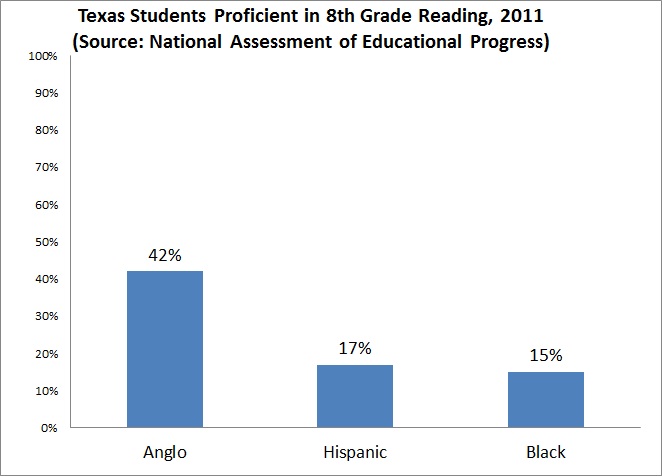
Texas 8th Grade NAEP Reading

The need to improve K-12 results is the Achilles heel of the Texas juggernaut. Among Anglo 8th graders 43% proficiency among 30 percent of the total student population gets you 12.6% of the total student population reading proficiently as 8th graders. Seventeen percent of the 50% of Texas students who are Hispanic nets you another 8.5% of the total population. African-Americans contribute less that 2 percent. There is nothing acceptable about any of this.

Call me crazy but this does not look like a recipe for either prosperity or a stable democracy in the decades ahead. Let’s just put it on the table that having far more Hispanic students scoring “Below Basic” than proficient in reading is incredibly dangerous for the future of Texas.

Texas Hispanic

It’s not too late for Texas but her policymakers are going to need to walk outside of the school district industrial lobbying complex echo chamber (aka the Texas Capitol) and think deeply about where the education status-quo is taking the nation’s leading state. Alternatively a new set of voices need to intrude on the conversation in a dramatic fashion. Sure the state can import college educated workers from other states with less vibrant economies, but no one should be under the delusion that simply going through the motions of educating a huge majority of students is not going to bite you in the end-it inevitably will.

Just as important, it places an incredible strain on the way Texans desperately want to see ourselves-as an opportunity society.  Texas can go either way-towards a nationally leading and globally significant society or towards a deeply bifurcated state with a small and pale minority nervously attempting to prosper among a large majority ill-equipped to prosper in a changing world (see California circa now). Texas will need to choose to embrace the ideals of America or the realities of Brazil. Every additional year of inaction brings the state another step closer to Brazil.


New Report-Turn and Face the Strain

February 4, 2015

Turn and Face the Strain

(Guest Post by Matthew Ladner)

Excel in Ed and the Friedman Foundation have co-released a study on state age demographics authored by yours truly.  The title reflects a couple of different things. First, I dig me some Bowie. Second, people are generally aware of the looming crisis in age demography we face, but they primarily have it framed as a federal issue. With 10,000 baby boomers reaching retirement age every day between now and 2030 (when they all reach retirement age) this certainly does represent a federal issue- trillions of dollars of unfunded liabilities in Social Security and Medicare, etc. The federal issue is not the only issue…

State policymakers must turn and face the strain that changing age demography will have on state government in the form of Medicaid, public pensions, a drag on economic growth and in many states an increasing K-12 population. Spoiler alert but all states have it bad with some states having it far worse than others.

The Baby Boom generation has already started retiring, and will be sending their grandchildren off to school. The United States Census Bureau projects the percentage of working age people to shrink in every state, meaning fewer people in the prime earning (and thus taxpaying) years to support a growing number of seniors and youth.  All states will be getting older, with only a handful of states projected to have a smaller elderly population than 2010 Florida by 2030. Many states also face large projected youth population increases.  With Medicaid currently constituting 23 percent of the average state budget and education approximately half, a fierce battle between the need for health and education spending looms with fewer working age people to foot the bill.

A great many of the working age population of 2030 btw sit in American classrooms right now. According to NAEP around a third of them can read proficiently. While a broad and difficult rethinking of the provision of vital public services will prove necessary including especially subjects such as health, pensions, immigration-the most urgent need is to improve both the effectiveness and cost-effectiveness of the K-12 system.

Most of the K-12 debate ultimately boils down to whether or not to change the status-quo. The status quo however is going to change us whether we like it or not.

More over on the EdFly blog, let me know what you think.


Denny and Alan put the 2014-15 season in the Books

February 2, 2015

(Guest Post by Matthew Ladner)

So Denny, another football season has moved into the books. What did you make of the Superbowl last night?

@puff@

Superbowl?

Yes Denny, the Superbowl…

*sip*

Was that last night?

Yes Denny. Did you watch it?

Yes now that you mention it I did watch it. Good to see the hometown team win. Otherwise pretty boring. When did The Onion start producing the half-time show? *sip*

Over a decade ago Denny, but I agree, the whole thing seems stale. @@puff@@

Just can’t stay interested. How long until college football kicks off?

We have many desolate months to face Denny, with only National Signing Day and the NFL Draft to tide us over in the meantime.

I can muster a little interest in March Madness. Have you ever gone to watch the games at a Vegas sports book? So many people have bet on the games that there are hundreds of people cheering and groaning at the end of every game. Good fun @puff@

You’ll have to take me out in the Gulf Stream. What did you think about the first college football playoff?

I told you not to sleep on the Bucks, but I’m still amazed that they beat Alabama and Oregon with their 3rd string quarterback.

Yes that was a bit of a shock. First start, crushing victory in the Big 10 championship, second start whip Alabama, third start national championship. Jones should drop the mic, lift his arms in a V and walk off the stage.

Only Denny Crane could avoid regression to the mean after that. Of course, if he were Denny Crane, he’d just be getting warmed up. @puff@pufffff@

*sip* Quite. Any thoughts on next year Denny?

Getting clobbered in the bowl games is not going to sit well with the SEC West, but they can’t keep the East down forever. TCU might have been the second best team last year and should rule the roost in the Big 12. Out west, keep an eye on Stanford, UCLA and Arizona. In the Big 10, the Harbaugh era begins but the Bucks have a head start. Keep an eye on the Domers.

See you next year Denny?

@puff@ Bet on it!


Only 31 of 84 Archdiocese of New Orleans Schools Participate in Louisiana Voucher

January 28, 2015

(Guest Post by Matthew Ladner)

In a positive article about the role of parental choice programs on Catholic schools nationally in the National Catholic Register comes a bit of confirmation on the recent Kisida, Wolf and Rhinesmith study:

Such increases in enrollment bring with them questions. First, not all Catholic schools — even those located in the same diocese — choose to participate. In the Archdiocese of New Orleans, only 31 of the 84 schools participate.

“There are a variety of reasons that schools don’t participate,” said Jan Lancaster, archdiocesan superintendent of Catholic schools. “Many have their own financial aid and scholarship programs in place to accommodate families that cannot afford to pay tuition. Others have waiting lists and are at capacity.

“Some don’t want to participate because of the mandates that are imposed on participating schools from the Louisiana Department of Education.”

Among these demands, she said, are testing and audits.

Read more: http://www.ncregister.com/daily-news/vouchers-provide-much-needed-infusion-of-students-to-catholic-schools/?utm_source=dlvr.it&utm_medium=twitter#ixzz3Q94WsHqa