
(Guest Post by Matthew Ladner)
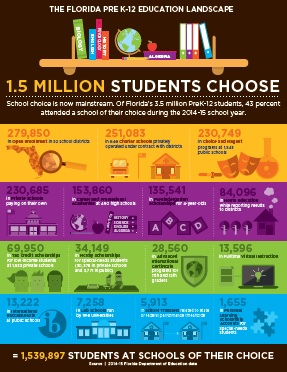
RedefinED has published their sixth look at the changing landscape of Florida education, reporting over 88,000 new choice students over the last two years.
(Guest Post by Matthew Ladner)
RedefinED has published their sixth look at the changing landscape of Florida education, reporting over 88,000 new choice students over the last two years.
 3 Comments |
  charter schools, tax-credit scholarships, vouchers | Tagged: Florida school choice, RedefinED |
  Permalink
 Posted by matthewladner

(Guest Post by Matthew Ladner)
After some boilerplate chest beating over the injunction granted in Nevada, which is under appeal, NVESA opponent Shelia Leslie has the following to say in the Reno News Review:
In Washoe County, our crowded schools are about to get worse thanks to the large businesses attracted by the state’s economic development giveaways and their new employees’ thousands of children. As predicted, the committee tasked with choosing which taxes should be raised to build more schools has decided to ask voters to agree to a substantial increase in local sales and/or property tax in November, raising $600-800 million.
Tray Abney, a lobbyist for the Chamber of Commerce, is worried about his son who attends an especially crowded south Reno elementary school. He told KUNR, “We can’t fit the kids we have now, much less the Tesla kids and the Switch kids and the other kids that are coming here.” So much for the arguments that growth pays for itself and that these new subsidized jobs are for people who already live here.
The tax proposal seems unlikely to pass unless the school district’s superintendent, Traci Davis, and the companies most responsible for the sharp uptick in projected students are willing to put their “skin in the game.”
Davis and Tesla could voluntarily offer a “claw-back” on the ridiculously generous taxpayer-funded handouts they demanded and were provided by the school board and the Legislature. Davis could give back her five-month longevity bonus, her attorney fees, and her back-dated extra salary compensation. That gesture might start the healing that is necessary for the taxpayers to regain confidence in the district’s leadership.
Tesla’s billionaire executive, Elon Musk, and his stockholders could offer to build an elementary school or two instead of insulting us with their $37.5 million “donation” to Nevada’s schools, since we’ll have to wait 20 long years before realizing any sales tax from their megafactory.
If they’re not willing to help fund new schools, why should we?

Right, so let me see if I can get this straight. Nevada schools are already overcrowded with many schools surrounded by trailer parks staffed by substitute teachers who often don’t have so much as a BA degree. Check. The willingness of taxpayers to pay billions of dollars for new facilities has limits, including apparently the author who has begun to fantasize about “voluntary claw backs.” Check. The Census Bureau projects continued enrollment growth for as far as the eye can see. Oh and by the way your Baby Boomers are retiring and will need additional health spending and generate less tax revenue. Check, check, check…and check. So obviously a scholarship program that would have allowed 4,000 students to seek an alternative to said overcrowded system this year for less overall money per pupil must therefore be stopped at all cost!
Ground control to Major Kong….you might want to think this over a bit more.

3 Comments | Education Savings Accounts | Tagged: Shelia Leslie | Permalink
Posted by matthewladner

(Guest Post by Matthew Ladner)
Jason may have not yet developed the shameless self-promotion bug that afflict the rest of us here at JGPB, so I’ll mention for him that he has a new study out along with Jonathan Butcher and Justice Bolick (ah….I just love the sound of that…) on tax-credit ESAs.
The Three Bs make a strong case on the desirability of converting existing tax credit programs over to multiple uses, and also correctly note possible constitutional advantages under some state constitutions for a tax credit approach. The technology for allowing multiple uses for funds looks to be better and cheaper than one might expect (account management/oversight technology is fairly advanced) which may allow for oversight within the admin fees typically allowed by scholarship tax credit programs.
The Three Bs did not directly address the topic of scale. The mighty Florida tax credit program currently looks likely to reach the practical limits of its ability to scholarship children somewhere below 100,000 out of Florida’s 2,500,000 students. This might change if new taxes can be added to credit, but the mechanics of creating a credit against some taxes seems somewhere on the speculative to work-in-progress spectrum at present.
Thus I enthusiastically support conversion of existing tax credit programs to multiple uses, and under some state constitutions, it might be a very good idea to choose this option over a state funded model. Outside of those circumstances, I’d recommend taking your chances with a state funded model if aiming for more than a pilot project.
Leave a Comment » | Education Savings Accounts, tax-credit scholarships | Tagged: Cato Institute, Clint Bolick, Education Savings Accounts, ESAs, Jason Bedrick, Jonathan Butcher, scholarship tax credits | Permalink
Posted by matthewladner

(Guest Post by Matthew Ladner)
The Rev.Martin Luther King III, a long-time parental choice supporter, addressed a crowd of 10,000 strong at a rally in Tallahassee yesterday.
“I just find it interesting that in our country we have the gall to debate about how our most precious resource — our children — are treated,” he said.
“My dad, I don’t really know if I can actually speak to what he would speak today, but I can say is that he would always stand up for justice,” he added. “This is about justice.”
Meanwhile the VP of the Florida Education Association, who once referred to children with disabilities and low-income children benefiting from Florida choice programs as “hit dogs” had this to say:
“What are they so afraid of going to the courts to ensure this voucher scheme is legal?” Joanne McCall, the union’s president, asked. “Let’s let the courts decide this once and for all. We’re not dropping our legal challenge.”

Let me get out my Big Chief Tablet and crayons and draw a picture for McCall here really slowly and with bright colors so she can follow along. Why are they so afraid of a judicial assault on their program? That’s easy:
To Rev. Martin Luther King III this is about justice and the opportunity of children. Joanne McCall says this about adult turf and adult power. If there is a moral difference between redneck governors standing at the school house doors to keep kids out of school with a baseball bat, and union bosses wanting to go into schools to kick kids out of schools with legal baseball bats, the distinction escapes me.
11 Comments | tax-credit scholarships | Tagged: Florida School Choice Rally | Permalink
Posted by matthewladner

(Guest Post by Matthew Ladner)
The Florida legislature strikes first in 2016- expanding their special needs ESA program and renamed them the Gardiner Scholarship program after the Florida legislature’s tireless champion for special needs children. RedefinED reported on the floor debate in the Florida Senate:
“This is a bill that people come up to us with tears in their eyes and talk about how it’s changed their life,” Gardiner said, calling attention to a girl with special needs who was seated in the back of the chamber.
“She said, ‘I just want to go to college,’” Gardiner said. “Your bill will provide that path, from cradle to career.”
Senate President Gardiner, the original sponsor of the Florida ESA law, follows in the footsteps of former of another special needs father and former Senate President John McKay in crafting an innovative program to serve the needs of Florida’s special needs students. Senator Gardiner is deeply deserving of the honor that the Florida legislature has bestowed upon him, just as Senator McKay was before him.
Greg btw is one signature away from 1 down, 6 to go in piling up yet another victory over Jay Mathews.
3 Comments | Education Savings Accounts | Tagged: Education Savings Accounts, Gardiner Scholarships, Senate President Andy Gardiner | Permalink
Posted by matthewladner

(Guest Post by Matthew Ladner)
Jason and John White have been having a public dispute over the interpretation of the NBER Louisiana study. I await Jason’s response, and given the importance of the subject I hope both sides of this debate will take pains to avoid vitriol as it unfolds. A reasoned examination of the evidence will best serve us, and everyone should acknowledge in advance that we bring a variety of assumptions to the table with us in this debate.
There is one point in John’s response that I would like to address presently. Early on the Superintendent says:
More important, however, is the larger implication I take from Mr. Bedrick’s thesis: that private school choice advocates in America, Mr. Bedrick among them, have failed to establish a coherent, prevailing belief system about the role of private schools in providing an education of measured quality, at scale, for the nation’s most disadvantaged youth.
Towards the end he says:
Absent better systemic answers than those offered by ideologues, publicly funded private school choice for all children will continue to be more of a factor in legislative debates and scholarly conferences than in the homes and neighborhoods of America’s youth.
The use of the word “measured” in the first statement brings up the observer effect from physics: the act of observing can in itself change what you attempt to measure. People can have honest disagreements over how much private school participation we are willing to sacrifice for what type of measurement, but let’s not start with the premise that the answer is “whatever it takes no matter what.” For almost going on two decades now for instance the McKay Scholarship program has reigned as the largest voucher program in the country. Would I prefer having an evaluation component of some sort? Yes-I’m pretty confident that we would learn valuable information. Would I be willing to do it if a large portion of participating schools were likely to pass on participating? No- I would be content to let parents work out testing on an individual basis with their schools.
In other words I want to prioritize the needs of parents over my needs as an advocate.
On the issue of scale and having a plan, I think we could have a long debate about this, but ultimately I don’t think it is necessary. I think that the sort of effort that Superintendent White is referencing may relate to the sort of private philanthropic efforts we see going on in the New Orleans charter school space. An unexplored possibility to consider by the way, is that the Herculean private human capital efforts we see going on in the charter space may have eclipsed the private school sector. How many rational actors would open a private as opposed to a charter school in New Orleans given the totality of policy and private philanthropic efforts? But I digress…
The reason I don’t think we need to spend too much time debating the sort of genuinely heroic efforts we see going on in the New Orleans charter space: I don’t think we can afford to scale them. You don’t see it discussed often, but ah, well, the cost per teacher placement from sources like Teach for America has not been going down. Quite the opposite from what I understand. Don’t get me wrong- I love TFA kids and I fully support the efforts of philanthropists in rebuilding the New Orleans education system. I simply have my doubts that our collective philanthropic efforts could have handled a district the size of Houston had Katrina veered that way, much less the rest of the country.
This raises the question- can we achieve “an education of measured quality, at scale, for the nation’s most disadvantaged youth” without these sort of efforts? If you care about the disadvantaged, the answer had better be “yes” because otherwise they will be remain holding the short end of the stick in life. To answer the question, I decided to examine the NAEP results and trends for low-income kids in the relatively regulated and highly philanthropic supported charter sector in Louisiana with similar kids in the Wild West and (relatively) lightly supported Arizona charter sector.
To get as close to apples to apples as possible, I compared the results for Free and Reduced lunch eligible students in general education programs attending charter schools in both states. The general education focus is due to possible differences in participation among ELL and SPED students in the two states. Louisiana has a comprehensive effort to support charters and to shut them down when they under-perform. If you see race as a proxy for other unmeasured factors etc. the average low-income charter child in Arizona is likely to be Hispanic, whereas I’m guessing in Louisiana they are more likely to be Black. Every state has their story about how their poor kids are the toughest to educate in the world (here is AZ it is “they come up North and they don’t even read Spanish!”) but I view all such claims as suspect-poor kids are tough to educate everywhere.
In terms of charter sectors, Arizona has an almost entirely decentralized process of school creation, and the only people making plans are those opening schools and parents seeking places for their child- no common app, the state rarely shuts a school down. etc. We have some TFA kids but I met more of them in a visit to the French Quarter than in 13 years of living here in AZ. The West in short doesn’t get any wilder.
The NAEP will only provide data for this comparison between 2013 and 2015, and I make no claims regarding this being a definitive comparison, merely suggestive. So with those caveats: here is what the gains look like across all four NAEP exams for FRL general ed charter students:

So both sectors did well in generating gains overall for low-income kids- so bully for them. Louisiana charters enjoyed larger gains in 4th grade gains, but Arizona charters enjoyed a still larger advantage at the 8th grade level. If we look at the overall scores for these students rather than the gains, we see no decisive advantage for either state.

Those who care about the interests of poor children should celebrate the ability of Arizona charter schools to deliver big gains for low-income kids. They did it without direction from the state and without massive support from philanthropists. This is to be celebrated in large part because we don’t have enough philanthropy to do New Orleans everywhere even if we wanted to.
So- as one of the school choice Jeffersonian types, I’ll address Superintendent White’s point about a plan squarely. What is my plan? On charter schools, my plan is to let ‘er rip. It’s working out a splendid fashion and I love it when a plan comes together…

On private choice, I’d like to see a system that gives a meaningfully higher level of public subsidy to disadvantaged children (low-income, ELL, SPED) with some light touch academic transparency measures (NNR testing required by students rather than schools, academic studies, parent surveys) and then let that rip too. The great virtue of this plan in my view is that it doesn’t require me or anyone else to manage or direct it.
In other words, I think school choice technocrats should aspire to be in control of as little as possible. The NBER study reinforces my view of its desirability.
UPDATE: Jason’s response to Superintendent White is up at Ed Next
1 Comment | charter schools, Education Savings Accounts, vouchers | Tagged: Jason Bedrick, John White | Permalink
Posted by matthewladner
(Guest Post by Matthew Ladner)
Many of us feel like part of our childhood just vanished. Rest in Peace.
4 Comments | random pop culture | Tagged: david bowie | Permalink
Posted by matthewladner

(Guest Post by Matthew Ladner)
My friends at the Arizona Charter School Association put together this rocking graphic on Cactus Patch charter students RAWKING the 2015 NAEP. Make sure to check out the two mini-graphs at the bottom showing just how much more diverse AZ charters are than the states in their neighborhood of scores and how how the per pupil funding stacks up. Stare at them long and hard, and think about the times you’ve heard people say things like the following. Maybe you said them yourself:
Oh but it’s the Wild West out here. Oh they really should not have let so many charter schools open, they should be more cautious about authorizing like right thinking people back East. Tut-tut, KIPP won’t open a school there at that funding level.
Line forms to the left to either update your flawed thinking and/or offer your heartfelt apology. There’s still room on the bandwagon for those who follow the evidence where it leads.
1 Comment | charter schools | Tagged: Arizona Charter School Association, Arizona charter school NAEP scores | Permalink
Posted by matthewladner

(Guest Post by Matthew Ladner)
Outstanding choice by Governor Ducey, and it is exciting that Clint will get the chance to serve in this capacity. I had the chance to work for Clint at the Alliance for School Choice and with him at the Goldwater Institute and on the board of the Arizona School Choice Trust for over a decade. While I fear we may miss him in courts around the country, as an Arizonan I couldn’t be more thrilled to have someone of his caliber on our Supreme Court. Video here. With the recent retirement announcement by Chip, one may infer that the torch is being passed to a new generation of constitutional litigators.
I think they are ready.
Congratulations Clint!
2 Comments | tributes | Tagged: Arizona Governor Doug Ducey, Arizona Supreme Court, Clint Bolick | Permalink
Posted by matthewladner

(Guest Post by Matthew Ladner)
Almost a decade ago I posed a Moynihan Challenge to choice opponents: I could produce a pile of random assignment voucher studies with significant positive results, but if you could produce two random assignment studies with statistically significant and negative results I’d buy you a steak dinner. I started here with skeptics in Arizona and when I got cricket noises extended it nationwide and got more cricket noises. Before your gut gets too greedy, yes it had a time limit. If you keep doing these studies long enough you will eventually get false negatives by random chance.
What we have now does not look like a false negative but rather a very poorly designed program in Louisiana with the release of a new study on the first year results. They look **ahem** decidedly negative.
We’ve covered this ground before on JPGB so I will avoid beating the equine corpse, but over the years there have always been concerns that voucher programs would become overly regulated. The response has always been that if this were to occur, that private schools would choose not to participate. Well lo and behold Louisiana’s heavily regulated voucher program comes along, 70% of private schools choose to sit it out, including a large majority of Catholic schools in Orleans Parish. Catholic schools have a long history of putting up with a lot of red tape around the country and around the world, so their choice to pass on the Louisiana Scholarship Program speaks volumes about the program.
What do we know about the 30% of private schools who did participate? Well now we know that their students had a very rough first year and we also know from the study:
Survey data show that LSP-eligible private schools experience rapid enrollment declines prior to entering the program, indicating that the LSP may attract private schools struggling to maintain enrollment. These results suggest caution in the design of voucher systems aimed at expanding school choice for disadvantaged students.
So…..many of the desperate on their way to folding schools decided to grit their teeth and participate in the program. We can also infer from the contrast between this evaluation and all the others that a disproportionate number of stable and successful Louisiana private schools read over the red-tape of the program and decided “thanks but no thanks.”
The ironic dagger cutting deep here- this program was designed to help some of the most disadvantaged students in the country. If you are a low-income student attending low-rated schools in one of the lowest performing states, you got the short end of the stick in life. The very good people who designed this program had every intention of this program being a path out. Tragically in designing to keep bad schools out, they ironically kept the good schools out and invited the bad schools in. The road to this hell was built out of the cobblestones of good intentions, but it still led straight to this debacle.
Those students, among the lowest of the low academically, have been victimized by the design of this program. The high quality private schools among the non-participating schools stand every bit as out of their reach as they had been before the creation of the program. In theory it could have worked out differently, but now we must rid ourselves of all illusions: every system is perfectly designed to produce the results associated with it.
You live and learn. This is a very bitter lesson but one we choice supporters need to take to heart in order to correct our mistake and to prevent future missteps.
8 Comments | vouchers | Tagged: Atila Abdulkadiroglu, Christopher R. Walters, Louisiana Scholarship Program, Louisiana vouchers, Parag A. Pathak, School Vouchers and Student Achievement: First-Year Evidence from the Louisiana Scholarship Program | Permalink
Posted by matthewladner

 Jay P. Greene's Blog