Please Check the Scoreboard

March 16, 2016

(Guest Post by Matthew Ladner)

The Arizona Republic ran the following LTE from your favorite bearded wonk today. Okay, okay…fourth or fifth favorite…geez…

Linda Valdez (“How school choice sabotages Latino kids“) asserted that Arizona’s school choice options have been undermining the education of Hispanic students attending district schools.

This assertion cannot, however, withstand scrutiny. The National Assessment of Educational Progress shows that Arizona Hispanic students have made large academic gains.

Since all states began participating in NAEP in 2003, Arizona Hispanic students tied for first for the highest Hispanic on eighth-grade math, third among states in eighth-grade reading gains. Arizona Hispanic students tied for 6th in fourth-grade math and reading gains.

Arizona charter schools have more than done their part with a majority-minority student population and gains above and beyond the statewide average. Arizona Hispanic students attending charter schools, for instance, tied the statewide average for Delaware on eighth-grade math in 2015 on NAEP.

We have ample reason to desire a faster rate of progress, and I agree with Valdez that Arizona’s future rests heavily upon the success of Hispanic students. District schools, however, remain the most generously funded of Arizona’s school options by a wide margin and outcomes for Hispanic students have been trending in a positive direction.


John McCain on the Choice Card vs. Bureaucratic Blob

March 14, 2016

(Guest Post by Matthew Ladner)

Senator John McCain took to the pages of the Arizona Republic today to describe how a giant, corrupt and bureaucratic organization has attempted to actively thwart a reform known as the Choice Card. The Choice Card allows beneficiaries the option of seeking services from outside of the indifferent/corrupt/self-serving system.

McCain is describing the Veteran’s Administration, but the song has a familiar tune. Very familiar in fact.


Why Relinquishment Would be a Good but Insufficient Idea for DCPS

March 7, 2016

(Guest Post by Matthew Ladner)

Andy Smarick has written about the next phase of reform for DC, calling for a relinquishment model. Given that DC charters receive a lot less revenue per pupil than DCPS and get substantially better results, this idea has merit.

Ladner DC 4

So scoring about a grade level worth of average progress higher for considerably less money constitutes an impressive accomplishment. However when we rank both DCPS and DC charters against the other urban districts in TUDA (for students with parents having similar education backgrounds) we find:

Ladner DC 5

The same pattern appears if you slice by family income etc. Not only to DC charters have a clear advantage over DCPS- they also demonstrate the only impressive gains for free and reduced lunch eligible students to be found in the NAEP data. Don’t go diving too far into the punch bowl however because those overall scores, even for charter students, are still trying to catch up to Mississippi:

Ladner DC 6

So- I agree with Andy that DC policymakers should consider pursuing an achievement district type strategy. DC policymakers and students should not turn their noses up at any strategy with a clear theory of action for improving outcomes at a lower cost. It’s not as if $29k per child in revenue will last a lifetime, but these terrible DCPS results will.

The data however seem to strongly suggest the approximate limits of such a strategy. We have no evidence as yet for instance suggesting that DC charter schools can produce a 20 percent boost in graduation rates the way DC OSP managed. Moreover, the status quo in DC is heading straight towards the extinction of private schools rather than utilizing their potential as partners. An achievement district approach would not have to finish this sad job as it looks likely to be finished long before.

DCPS has lost half of its students. It receives an unsustainable amount of revenue per pupil and does very little with it.  The appearance of improvement in the first figure above is mostly a mirage driven by gentrification. That same gentrification has helped to make DC the achievement gap capital of the nation as the one thing that DCPS has seemed to master is educating kids born on third base. Even if one mistakenly takes DC gains at face value, it still leaves DC ranked near the bottom as seen in the second figure and chart above.

As a resident of a distant patch of cactus, I don’t get a vote on any of this. DC residents will ultimately work this out for themselves. Call me crazy-it’s been too long since anyone has- but I would not be looking for incremental change.


NAEP Reading Gains and Spending Trends by State

February 26, 2016

(Guest Post by Matthew Ladner)

2003 to 2015 NAEP reading by spending

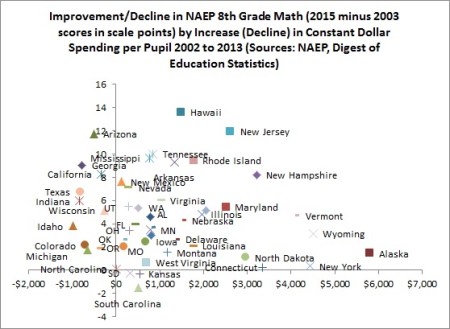
New York and North Dakota are your team captains of the Washington Generals in the spending up NAEP scores down sweepstakes. Meanwhile out west AZ and California did more with less.


NAEP Gains by Spending Trend- Some States are the Harlem Globetrotters, Others the Washington Generals

February 24, 2016

(Guest Post by Matthew Ladner)

Notice the large number of states on the negative side of zero on the spending bar. In the immortal words of Lee Ving it’s already started.

Winning

Once again let me note with insufferable state pride that Arizona is your ROI champion doing things that no one would have thought possible.

Go majority-minority, cut funding and improve scores? No problem-nothing but net!

So it is tough to pick a Washington Generals, but I’ve got mine narrowed down between Alaska, New York and Wyoming.


Arizona Senate Votes to Phase In Universal Public School Student ESA Eligiblity

February 22, 2016

(Guest Post by Matthew Ladner)

Congrats to Senator Debbie Lesko and the band of happy school choice warriors for passing SB 1279 today, which would phase in making all Arizona public school students eligible to participate in the Empowerment Scholarship Account program.


DCPS Tragedy

February 22, 2016

Ford table


Note: I am very grateful to longtime Jayblog reader Peter D. Ford III for sharing his first-hand perspective on DCPS. -ML

(Guest Post by Peter D. Ford III )

While I have been a public school educator in the Los Angeles area for the past 20 years, DCPS will always have an impact on my teaching being the son of career DCPS educators through three decades (60’s through 80’s). Followers of professional sports wax nostalgic about the feats of great players from the past and the numbers they produced ‘before records were kept.’ The tragic data portraying the minimal academic growth of Black DCPS students would not surprise my parents as they confronted the seeds of this tragedy when they were teaching. Unless there are fundamental changes in the teaching profession the educational crime perpetrated upon Black children in our Nation’s Capital may never end.

Until this day the question posed by one of my Daddy’s colleagues, “Who’s gonna teach these kids?” still resonates. In the 70’s when I first heard that over another dinner conversation that statement implied there were too many teachers not committed to teaching Black children, poor Black children specifically. Back then Parliament called it ‘Chocolate City’ for a reason, thus the lyric “…the last percentage count was 80…” The typical retort ‘but most teachers do a great job’ has never held up to my scrutiny. For example, very recently the Los Angeles Unified School District (LAUSD) has had about 30,000 teachers. If 95% were ‘doing a good job,’ that leaves 1500 teachers ruining children’s futures year after year after year. Unlike the military you cannot staff the neediest schools with the best teachers, even if you could figure out who the best teachers were as seniority isn’t an automatic identifier.  Not all teachers can teach in upper Northwest or the Gold Coast; somebody has to teach in Hanover or Anacostia. For decades before NAEP and NCLB there’s been a deficit of teachers willing and committed to teaching these children, or at least there has been enough poor education in the neediest schools that has grown like a cancer with no chemotherapy.

The late, great, Dr. Barbara Sizemore, first African-American to head a major city school system in the 70’s, was my parents’ hero no matter how embattled her tenure as head of DCPS. Dr. Sizemore’s quote, as told from my parents, also predicted the horrid learning we see in DCPS students today: “These teachers aren’t teaching these kids anything.” Dr. Sizemore and my parents were not happy with their colleagues getting into a classroom and doing their own damn thing vs. inspiring and expecting young people to acquire the very same body of knowledge they did to earn their education. If you were to talk to 50-60 year old native Washingtonians it would appall you how many of them were allowed to stop taking math after their freshman year in high school, let alone the natural sciences. My father was a music teacher, and a pretty damn good one. Music instruction in DCPS began a slow death from the late 70’s onward; the famed Ellington School for the Arts today was no better than Cardozo or McKinley Tech in music instruction was then. Listening to NPR’s ‘From the Top’ you see these incredible young performers are great students, just as my father’s best musicians were good at math. Black children in DC aren’t getting this, and haven’t for decades. When you combine teachers not committed to teaching these children with teachers not teaching them much of anything, the current data we see was inevitable. This perfect storm of malfeasance is the root of poor Black academic achievement in every major metropolitan area. In a K-12 career all it takes is to have a lousy 3rd grade teacher, so you don’t learn your times tables, then an 8th grade teacher who couldn’t control your classroom, and your math career is all but ruined.

I hope, no I pray Ms. Davis’ plan includes giving school cites more control over whom they can hire to teach the children who need the best instruction. I pray there isn’t another finger pointed at poverty from educators. None of us have credentials in violence prevention, dysfunctional family mitigation, or poverty abatement. Like coach Belichik says teachers must ‘do your job,’ and that must be a 100% commitment to the young people in your classroom, and a laser focus on students acquiring a body of knowledge, skills, thus reasoning from your respective content.  If you’re going to point to poverty, then also point at everyone else who has a hand at fixing it. When Ms. Davis hopes for “the voice of those working with the students in the classroom is a meaningful part of the improvement discussion,” that’s a direct indictment of the other impediment to academic achievement for Black children: bad school leadership.

Don’t save your trump card waiting for DCPS admin to respond; during my parents’ time as now the so-called leaders of DCPS were pretty much who drove them to retire (their sons were educated and out the house, so they said ‘to heck with these knuckleheads’ running things). Is Ms. Davis willing to challenge traditional union contracts to allow teachers to be assigned where they’re needed? Is the DCPS bureaucracy willing to decentralize control to allow schools to meet the needs of their students as Dr. Sizemore sought? DC’s per student revenue has always been one of the highest in the country; I remember being aghast at $18,000/student, let alone $29k./ student. Who will demand for parents to be able to use that $29k as they see fit?

When I transitioned from my military career to teaching the only thing my father told me was “Focus on the students, not the adults.” My corollary to his words of advice: “It’s not the students (who are the problem), but the adults.”

While I have been a public school educator in the Los Angeles area for the past 20 years, DCPS will always have an impact on my teaching being the son of career DCPS educators through three decades (60’s through 80’s). Followers of professional sports wax nostalgic about the feats of great players from the past and the numbers they produced ‘before records were kept.’ The tragic data portraying the minimal academic growth of Black DCPS students would not surprise my parents as they confronted the seeds of this tragedy when they were teaching. Unless there are fundamental changes in the teaching profession the educational crime perpetrated upon Black children in our Nation’s Capital may never end.

Until this day the question posed by one of my Daddy’s colleagues, “Who’s gonna teach these kids?” still resonates. In the 70’s when I first heard that over another dinner conversation that statement implied there were too many teachers not committed to teaching Black children, poor Black children specifically. Back then Parliament called it ‘Chocolate City’ for a reason, thus the lyric “…the last percentage count was 80…” The typical retort ‘but most teachers do a great job’ has never held up to my scrutiny. For example, very recently the Los Angeles Unified School District (LAUSD) has had about 30,000 teachers. If 95% were ‘doing a good job,’ that leaves 1500 teachers ruining children’s futures year after year after year. Unlike the military you cannot staff the neediest schools with the best teachers, even if you could figure out who the best teachers were as seniority isn’t an automatic identifier.  Not all teachers can teach in upper Northwest or the Gold Coast; somebody has to teach in Hanover or Anacostia. For decades before NAEP and NCLB there’s been a deficit of teachers willing and committed to teaching these children, or at least there has been enough poor education in the neediest schools that has grown like a cancer with no chemotherapy.

The late, great, Dr. Barbara Sizemore, first African-American to head a major city school system in the 70’s, was my parents’ hero no matter how embattled her tenure as head of DCPS. Dr. Sizemore’s quote, as told from my parents, also predicted the horrid learning we see in DCPS students today: “These teachers aren’t teaching these kids anything.” Dr. Sizemore and my parents were not happy with their colleagues getting into a classroom and doing their own damn thing vs. inspiring and expecting young people to acquire the very same body of knowledge they did to earn their education. If you were to talk to 50-60 year old native Washingtonians it would appall you how many of them were allowed to stop taking math after their freshman year in high school, let alone the natural sciences. My father was a music teacher, and a pretty damn good one. Music instruction in DCPS began a slow death from the late 70’s onward; the famed Ellington School for the Arts today was no better than Cardozo or McKinley Tech in music instruction was then. Listening to NPR’s ‘From the Top’ you see these incredible young performers are great students, just as my father’s best musicians were good at math. Black children in DC aren’t getting this, and haven’t for decades. When you combine teachers not committed to teaching these children with teachers not teaching them much of anything, the current data we see was inevitable. This perfect storm of malfeasance is the root of poor Black academic achievement in every major metropolitan area. In a K-12 career all it takes is to have a lousy 3rd grade teacher, so you don’t learn your times tables, then an 8th grade teacher who couldn’t control your classroom, and your math career is all but ruined.

I hope, no I pray Ms. Davis’ plan includes giving school cites more control over whom they can hire to teach the children who need the best instruction. I pray there isn’t another finger pointed at poverty from educators. None of us have credentials in violence prevention, dysfunctional family mitigation, or poverty abatement. Like coach Belichik says teachers must ‘do your job,’ and that must be a 100% commitment to the young people in your classroom, and a laser focus on students acquiring a body of knowledge, skills, thus reasoning from your respective content.  If you’re going to point to poverty, then also point at everyone else who has a hand at fixing it. When Ms. Davis hopes for “the voice of those working with the students in the classroom is a meaningful part of the improvement discussion,” that’s a direct indictment of the other impediment to academic achievement for Black children: bad school leadership.

Don’t save your trump card waiting for DCPS admin to respond; during my parents’ time as now the so-called leaders of DCPS were pretty much who drove them to retire (their sons were educated and out the house, so they said ‘to heck with these knuckleheads’ running things). Is Ms. Davis willing to challenge traditional union contracts to allow teachers to be assigned where they’re needed? Is the DCPS bureaucracy willing to decentralize control to allow schools to meet the needs of their students as Dr. Sizemore sought? DC’s per student revenue has always been one of the highest in the country; I remember being aghast at $18,000/student, let alone $29k./ student. Who will demand for parents to be able to use that $29k as they see fit?

When I transitioned from my military career to teaching the only thing my father told me was “Focus on the students, not the adults.” My corollary to his words of advice: “It’s not the students (who are the problem), but the adults.”


Much to her credit, Washington Teachers Union President Elizabeth Davis responds to DC achievement gaps before anyone in DCPS or in the broader DC Reform Community

February 19, 2016

(Guest Post by Matthew Ladner)

Washington Teacher’s Union President Elizabeth Davis left a response to the post here on Jayblog showing that DCPS black students would go well into their high school years before catching up to where White DCPS students stood in 4th grade. I disagree in large part (but agree partially) with her take, and will briefly explain why below. Let the record show however that the score as of now stands WTO 1, DCPS 0 on the acknowledgement scorecard. Anyone? Anyone? Kaya?


Perhaps the large community of DC K-12 reform oriented organizations would like to join the conversation that Heritage started as well. I know the allure of delving into the minutiae of federal statutes can be very powerful, but it’s okay to leave the tower now and again to examine what is going on around you. As in right around you with your own tax dollars.

But silly me I digress! Ms. Davis’ response:

The PARCC scores showed that 24% of students in grades 3-8 in public and public charter schools met or exceeded expectations in math and 25% of those same students met or exceeded expectations in English Language Arts. The bottom line is that a full 75% of our students failed to meet expectations.

The Washington Teachers’ Union acknowledges that some aggregate gains have been made, and some of those gains have been significant. However, those significant gains are found in schools that have been least effected by the so-called reform strategies. In other words, where the school district has made the greatest gains is in the schools that were already high performing and not a target of the reforms. Conversely, students in schools where the most teachers were fired, that attended schools that were closed due to low test scores, and had the most teacher turnover saw meager gains compared to their wealthy counterparts.

For years the WTU has called on the District Administration to adequately address these unacceptable and rapidly growing achievement gaps. Those calls were met with hubris and more of the same top-down failed policies.

Today we ask the community to review these data and understand that doing more of the same will only make a bad situation worse. In the coming days we will share more data that helps explain this unfortunate situation and share the plan we proposed to the district many months ago.

We can close the achievement gap. But that will only happen when the current failed policies are discontinued and the voice of those working with the students in the classroom is a meaningful part of the improvement discussion.

Maybe most importantly, we must ensure that the school district’s teacher evaluation system does not penalize those teachers who take on the challenge of educating our neediest students. Over the past eight years, DCPS has replaced over 3,000 of its teachers. So the bad teacher narrative no longer applies as a credible reason for the growing achievement gap in our school district. Many of our members have told us that the IMPACT evaluation system victimizes those who teach in low-performing schools.

-Elizabeth Davis, President of the Washington Teachers’ Union

My brief take on the substance: yes the gentrified schools will have been least affected by the reforms but when they are posting NAEP scores that make Massachusetts blush policies aimed at removing ineffective educators won’t be very much in play.  Given the plight of disadvantaged children in DCPS it would seem difficult at best to argue that the staff hired to educate these children have too little job security. I am however willing to hear the case made.

Please note further that the DCPS charter sector has made progress in closing the achievement gap with significantly fewer resources per pupil than those granted to DCPS. I’ve seen but have not explored claims that these reforms are contributing to progress in DCPS, but I will say this much to agree with Ms. Davis- it is very difficult to find evidence of that claim in DC NAEP scores to date. While there is absolutely blindingly clear evidence that DC choice policies (charters and OSP) have clear benefits to disadvantaged DC children, you are hard pressed to make the case that anything else has done much for these kids to date in terms of generating positive trends.

I am entirely open to discussion and debate on that point, but when you have schools with scores barely above Detroit receiving over $29,000 per student in revenue, I find it difficult to reach any other conclusion. DC charters get less and show higher NAEP scores and gains. OSP shows higher graduation rates for profoundly disadvantaged kids with a fraction of the spending.

I’m at the point where it only makes sense to decentralize power further into the hands of the parents and let them sort things out. The details over equity (more money for low-income kids), academic transparency (light touch please) and financial accountability (brutal is better) would be crucial, but disadvantaged children in DCPS have nothing to lose and much to gain.

(edited for typos)


The Way of the Future-Doomed to Slow Economic Growth?

February 19, 2016

(Guest Post by Matthew Ladner)

Must read article by Adam Davidson in the New York Times Magazine on America’s prospects for growth. Easily the most important debate in economics today imo- the inequality debate being a symptom of a slow growth disease. The article doesn’t mention societal aging but easily could have, as it is widely acknowledged by economists as serving as a headwind to growth.

In the end however I fully agree with Davidson’s conclusion about technology (3d printing for instance is clearly in the early stages of moving out of the hobbyist phase in my mind) and his ultimate conclusion:

If we are indeed doomed to a generation of slow growth, it’s a lapse in our collective imagination, not in technological innovation, that is holding us back.

I would add only this proviso- improving the productivity of the public sector will be key to a better future. You can’t for instance get much further away from constantly improving productivity than this:

Is it even possible to increase the productivity of education spending? Arizona says hello! but buckle up because the politics are rough.


DCPS Black Students need six years to reach where DCPS White students stood in 4th grade

February 15, 2016

“DC achievement gaps now, DC achievement gaps tomorrow, DC achievement gaps FOREVER!”

(Guest Post by Matthew Ladner)

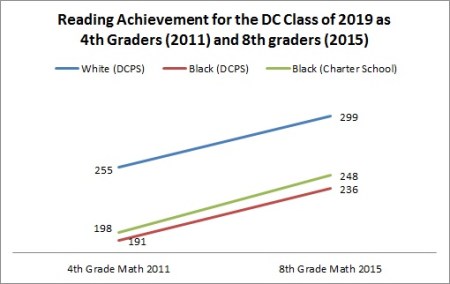
Last week I told you that White DC 4th grade students were outscoring the average achievement of Black 8th graders on math by a wide margin. The below chart presents data from the 2011 4th grade math NAEP along with 8th grade scores from 2015. Data for White and Black students from the DCPS and Black students from DC charters are presented.

DC gap trend 1

I’ve looked at the both the main NAEP and the Trial Urban District Assessment and you simply cannot find another spot that matches DC for achievement gaps. As you can see, by 4th grade DC White students have already demonstrated  a level of mastery of mathematics that 8th grade Black students come nowhere close to matching by 8th grade. At fourth grade a sixty point gap between the achievement of White and Black students yawns (272 to 212). Meanwhile DCPS Black students have not come close to catching up to the 4th grade White score 4 years later. In fact at the rate of progress shown by DCPS Black students we would expect them to catch up to the 4th grade scores of DCPS White students somewhere around their sophomore or junior year of high-school.

No one should view the closing of these gaps as easy. Notice that DC Black students attending charter schools started 8 points ahead of their district counterparts in 2011 and then gained more between 2011 and 2015 (46 points for charter students, 36 for District). This left DC Black students within striking distance of the 4th grade score of DC White students (272 to 266) but still far behind DCPS 8th grade White students (314 to 266). Still DC’s Black charter school students made the largest overall gains (46 points) and did so for about half of the average revenue per pupil in DCPS.

Sick to your stomach yet? Can’t believe it? Well let’s check the tape for the NAEP reading exam.

DC gap trend 2


We see precisely the same pattern- by 4th grade DC White students demonstrate a level of mastery of reading that Black students will not equal by 8th grade. A huge gap between DCPS White and Black students (64 points) yawns out in the 2011 4th grade scores and does not meaningfully narrow by the time the cohort reaches 8th grade in 2015 (63 points). DC Black students attending charter schools demonstrated a smaller gap in 2011 (57 points) and had narrowed it a bit further by 2015 (51 points) but had still not caught up to the score of DCPS White students in 2011.

Before you reach for your demographic fatalism pistol let me just note that FRL eligible Black students attending district schools in Boston scored 24 points higher than FRL Black students attending district schools in DC. New York City and Houston clobbered DCPS by 16 points in the same comparison. None of these districts receive $29,000 per student in revenue. Houston didn’t sniff half of that figure. We cannot disentangle the effect of schooling and family with these data, but other systems seem to do much more for similar students with much less.

Getting back to the Heritage study– someone take a look at this data and tell me why oh why would we want to shower $29,000 per student on the system that produces such catastrophic results for disadvantaged kids. Charters receive only $14k per student that and get better results. Congress provides a constantly politically imperiled $8k per child on a small voucher program for low-income DC kids that merely gets them over the high-school graduation finish line at a 20% higher rate. This system of finance has been in place for decades now. Piling money on a system proficient only at serving the needs of the already advantaged while starving systems serving the disadvantaged for funds makes sense to someone.

It just doesn’t make sense to me. It shouldn’t make sense to you either.