Will the Ed Reform Band Continue to March into the Alley?

June 14, 2016

(Guest Post by Matthew Ladner)

Robert Pondiscio’s now famous piece on ed reform’s leftward drift brought to mind the above scene from the masterpiece of American juvenile cinema Animal House. It’s hardly impossible to imagine ed reform going off course as, well, it happened before and in the recent past. Tom Loveless for instance argues that the entire Common Core effort has been worth less than a single NAEP point (on a 500 point scale) and that this gain is already reflected in the 2015 exams. I would not bet my left foot that Tom is absolutely correct about that, in fact I hope he’s wrong and the entire effort has some sort of delayed reaction since it is a sunk cost. I have yet to see anyone attempt to muster a credible refutation, and Tom’s analysis finds support from Hanushek’s work as well.  The could be mistaken, but calling the question as of now makes it look like:

Well yes maybe that has not worked out as well as hoped, but the teacher evaluation systems pushed by Race to the Top are going to close the achievement gap by…oh wait watch out….gahhhgh my trombone!!!!!!

Not all such diversions are of recent vintage. Some are more of a persistent folly sort of phenomenon. For instance, it is fairly clear that the school voucher movement never would have launched in Milwaukee without a strange bedfellows coalition of liberals and conservatives. This was terribly exciting at first, but with the benefit of hindsight…
It now seems painfully obvious that the means testing of private choice programs has served to politically marginalize private choice vis-a-vis charter schools, district schools, magnet schools, digital learning and/or **fill in the blank here** because almost nothing else in K-12 education funding has adopted the view that actively discriminating against the children of the people who pay the highest rates of tax constitutes an inspired political strategy.

This is not at all to say that equity issues are anything less than vitally important or that we should not engage in an ongoing and thoughtful discussion about how best to reflect them in a system of private choice. The means testing fetish however has persisted so long that some very prominent charter school supporters for instance failed to recognize the rich irony of their criticism of the Nevada ESA program for being universal in nature when in fact every charter school law also involves universal eligibility by income.  Come to think of it, I don’t know of many charter school laws that give additional state dollars to low-income kids, but the NVESA does provide additional state funds to low-income students….

Anyhoo, means testing for thee, but not for me won’t do- wake me up when our friends on the left means test district or charter schools. Otherwise the worthy conversation lies in settling upon the level of additional resources should be provided to disadvantaged children. All of which leads to Paul Peterson’s great valedictory piece as Editor in Chief of Education Next making the case that the regulatory approach to school reform led us down a blind alley reached its ceiling. Peterson calls on reformers to double down on parental choice as an improvement strategy. This approach, while promising, requires a level of modesty notably lacking from today’s would be technocrats. I’m happy to pass the ed reform baton to those who can snatch this particular pebble, as my next career creating Rhino Record compilation cds of Dean Martin and punk rock classics awaits (Martinis in the Mosh Pit, Volume 7!!!) and would be even more fun than anything in ed reform, other than jayblogging.

Ooops, day dreaming again, so getting back on track the above sort of issues deserve deliberation and debate in my view. I could be in the grips of an enormous folly that is invisible to me, just as my friends in the charter school movement seem oblivious to their means testing double standard. I’ve been wrong before, and I will be wrong again so have at it if you disagree. I’d rather debate these sort of issues than endure any further virtue signalling in the form of therapy sessions where Ivy League ed reformers work out their guilt from lacking an urban Horatio Alger story in public.  Such burdens are best born in private with a determined stoicism, terrible though they may be, as they seem lacking in utility.


Send in the Nimitz!

June 6, 2016

Most interesting man

(Guest Post by Matthew Ladner)

Every so often you just have to ask yourself “What would TMIMITW do?” Given that TMIMITW is actually from New York, maybe he can be persuaded to run! His substantive political accomplishments already approximately equal and perhaps greatly exceed those of the two nominees combined and let’s face it- who do you want to be stuck with on your television set for the next four years?  In addition, his position of the two party system has been long-established, so he cannot be accused of opportunism:

Christopher Buckley eerily predicted this election back in 2008 and disguised his prophecy as satire. Send in the Nimitz!


Competition and Core Knowledge-Let’s Keep an Eye on a North Phoenix Neighborhood

June 3, 2016

(Guest Post by Matthew Ladner)

So I have been reading with interest the comment section discussion on Jay’s missed the point piece, which inspired me to follow up on a post I wrote in 2012. Your humble author took the above photograph of Shea Middle School in Arizona’s Paradise Valley School District. This was the neighborhood I used to live in, and I was zoned to send my children to this school (they were elementary age at the time). In the 2012 piece I relate circumstantial evidence that leads me to believe that the 9000 pt font banner you see in the photograph was prompted by the announcement of both a BASIS and a Great Hearts school opening in the area.

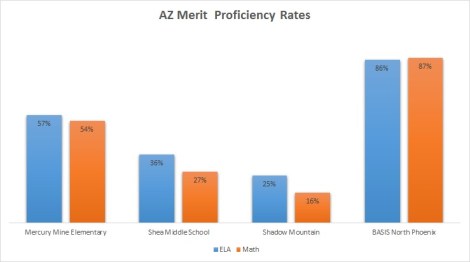
The following chart, making use of the AZ Merit results, gives a flavor of why long before the banner hung that my wife and I had already decided that we would explore other options for middle and high school.

MM Shea SM

Mercury Mine Elementary School feeds into Shea Middle School, which in turn feeds into Shadow Mountain High School. These schools are all within easy walking/biking distance from each other, with the middle and the high school being literally next door.  Mercury Mine had a larger number of open enrollment transfers attending when my children attended, which speaks well of the school’s reputation (the neighborhood had a larger number of empty nest residents so transfers were welcome.)  These schools operate in a relatively advantaged area overall, but the slippage over time from elementary to middle to high school scores is evident in both the AZ Merit and the older AIMS data. An examination of parent reviews in Great Schools failed to convince me that my lying eyes were leading me astray in examining test scores. I cast no aspersions here-I’m entirely confident that these schools have a great many dedicated people working very hard in them, but as a parent the trend you see in the chart above was gravely concerning.

So in 2012, BASIS opened a new school within walking/biking distance. What does that look like?

MM Shea SM Basis

BASIS has a dedicated band of internet detractors who complain that BASIS does this/that/and the other thing to pick and choose their students. Some of the enormous difference in scores you see here may indeed be due to factors other than great instruction and hard work by students, but as you can see there is a lot of room to give. Such arguments are ultimately moot without a random assignment study (which we lack) and the discussion is off mission. My intention in showing you this chart is to suggest why neighborhood school leaders seemed to be freaking out in the email to parents referenced in the 2012 post. Er, wouldn’t you?

Now this brings us back to Shea Middle School, which proudly and loudly adopted Core Knowledge starting in 2013.  Due to changes in the testing regime during this period, it is difficult to assess the overall direction of scores, but let’s stipulate that neither Core Knowledge nor the advent of competition proved to be a wonder cure than instantly transformed Shea Middle School overnight. That is not how the real world works after all. It could be the CK and competition will lead to incremental gains over time. Alternatively, maybe the losses to competition come to be viewed a sunk cost and the district schools fail to realize the potential of the curriculum.

Have a good summer- I’ll update this next year with new data and we’ll see how this little neighborhood experiment goes.

Disclosure: your humble author formerly served on the board of BASIS, and sends two of his three children to Great Hearts schools (although not the one mentioned in the post).


Liberty and Justice for All

June 1, 2016

(Guest Post by Matthew Ladner)

Kingsland writes a hilarious post on five theories of change in K-12 philanthropy.  Over on the Ed Next podcast, Paul Peterson explains why he believes top-down command and control improvement strategies have jumped the shark and calls for a renewed focus on choice as an improvement strategy.


Time Vault Tuesday- Six-year checkups on 2010 Predictions

May 31, 2016

(Guest Post by Matthew Ladner)

The Western Free Press unearthed an Arizona Horizon video from 2010. I was at the Goldwater Institute at the time, and we had Governor Jeb Bush and Foundation for Excellence in Education President Patricia Levesque out to the cactus patch to discuss Florida reforms in Arizona. The Arizona legislature went on to enact two of the key Florida measures-school grading and literacy based promotion, during that legislative session. The video makes for a great time vault to explore predictions at the time.  Notice that the discussion in the video between myself and John Wright, the then-President of the Arizona Education Association, mirrors the later orbit of Mercury discussion– I predicted that we could make academic progress despite our economic difficulties, Wright predicted failure and doom without more money.

Here is a key prediction from Patricia:

If Arizona does some of the policies that are floating through the legislative process right now, you won’t see immediate results. I will take time, it takes determination, it takes a comprehensive set of policies that makes sure that the focus is on student learning, but Arizona could be where Florida is in a decade.

So let’s check the tape, or rather, check the NAEP. Mind you, there are many ingredients in the complex Arizona K-12 gumbo, so I would not wish to claim a simple causal relationship between these policies and outcomes.  Nevertheless the general drift of Arizona policy has been towards greater levels of parental choice and improved academic transparency, which are things our tribe supports. This recording was made in 2010, which means the reference point at the time would have been the 2009 NAEP. Has Arizona made progress towards getting to where Florida was in 2009? It’s six years later, so Arizona has some sand left in the hour-glass, but have we made progress?

Answer- yes Arizona in fact is ahead of schedule overall.

On all four NAEP exams, Arizona has either substantially closed the gap on where Florida stood in 2009 or else (in the case of 8th grade math) already exceeded where Florida stood at the time. The largest gap remains in 4th grade reading. In 2009 a sixteen point gap yawned between Florida and Arizona. In 2015 Arizona’s scores were 11 points behind where Florida’s stood in 2009.  The gaps on the other three exams however have been substantially narrowed. On the 8th grade side, Arizona basically entirely closed the gap with their 2015 scores and where Florida stood in 2009.

Here’s another prediction, made by yours-truly when asked about increasing spending.

Right now we face a gigantic structural budget deficit and I think that whether the sales tax proposal passes or not the truth is that there is not going to be any money for any increases in public school spending any time soon. In fact there is likely to be cuts. Having said that, I think that it is absolutely still possible for us to make progress, to get better bang for the buck the way Florida has whether that new money materializes or not.

John meanwhile generally expressed skepticism regarding the Florida reforms, and described funding cuts as “pulling the rug out from under” teachers. So how does this look, six years on?

NAEP Math Cohort gain 2015

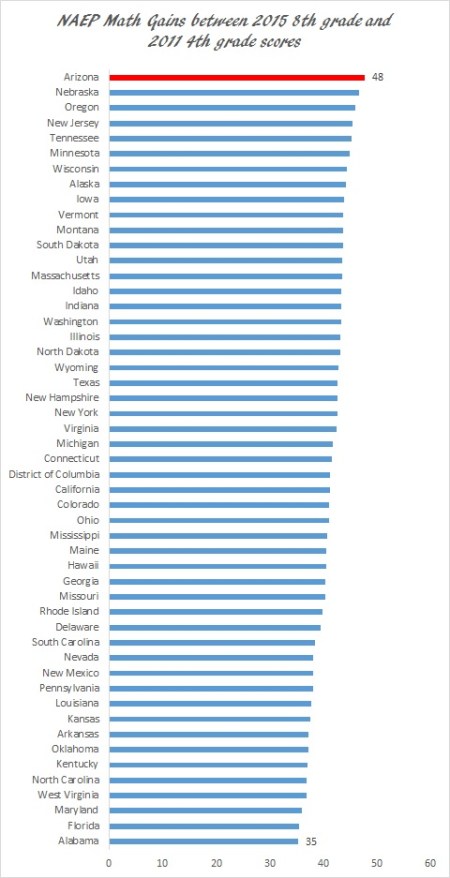
The video was from 2010, and little could we have known that Arizona students were poised to lead the nation in 4th to 8th grade NAEP gains between the 2011 4th grade NAEP and the 2015 8th grade NAEP.  The predicted funding cuts did in fact come to pass, which was very unpleasant for those running our schools, but meanwhile our students showed the rest of the country how it is done on gains. Time to CeleNAEP!


The Unknown History of the Mother of All K-12 Competitive Effects

May 24, 2016

(Guest Post by Matthew Ladner)

How did this happen?

NAEP Math Cohort gain 2015

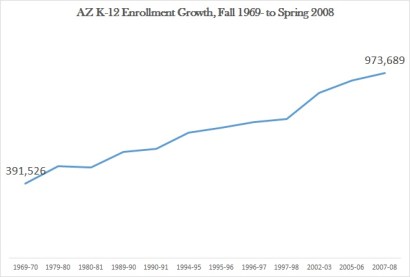
As per usual, there is no one single simple answer, but the elephant sitting in Arizona’s K-12 room over the last decade has been abrupt and bracing change in a decades long trend of district enrollment growth and funding increases.  Arizona has experienced more than a century of population growth as the rest of you figured out that it was possible not to dig your car out from the snow, and even to play golf in February in Arizona. Arizona K-12 enrollment boomed for decades, with almost all of it going to the districts. In 1995 the first charter schools opened, but at first they were like little mammals scurrying around fearfully in the Age of Dinosaurs.


AZ enrollment growth

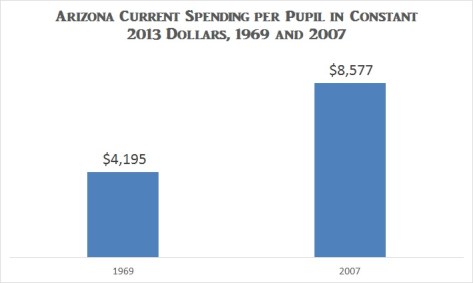
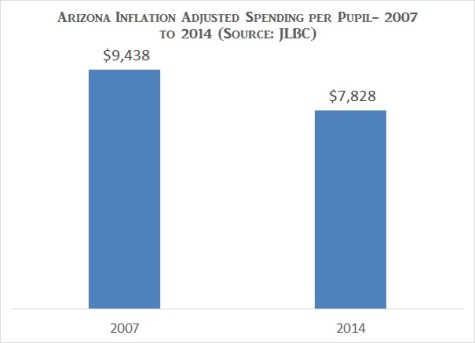
During the booming age of plenty, the districts were not only getting ever more students, but the spending per pupil steadily increased. Arizona has never been a wealthy state and has long had a relatively small working age population due to the presence of beaucoup retirees and children (relatively large LDS families, immigrants etc.) so this increase was even faster in most states, but was still very large in Arizona:

AZ spending


So in this sort of lost, antebellum Arizona of pre-2007, the school district folks would complain about more of these charter schools popping up, but really they were just whining- spending per pupil had been going up, and they had more pupils than they knew what to do with. Mind you the NAEP of 1992 showed that only 28% of Arizona Anglo students could read proficiently in “English” so a reasonable person could conclude that the districts and their swelling enrollment and growing funding could use a little competition.

As fate would have it, they got competition with both barrels after 2007. In fact, I will have to nominate Arizona as having gone through the mother of all competitive effects.

The Great Recession hit Arizona early and hard. Arizona’s general fund dropped 20% in a single year. When your main industry is building houses on golf courses and all of the sudden everyone nationwide has a difficult time selling their house, your economy takes a beating something like:

Great Recession SMASH AZ economy! Great Recession is the STRONGEST ONE THERE IS!!!!!

I…..wish…..I……could…………spend..more……on……..schools!

So the federal stimulus and a temporary sales tax increase engineered by former Governor Jan Brewer temporarily staved off cuts, but they were eventually necessary and they were not insignificant:

AZ spending

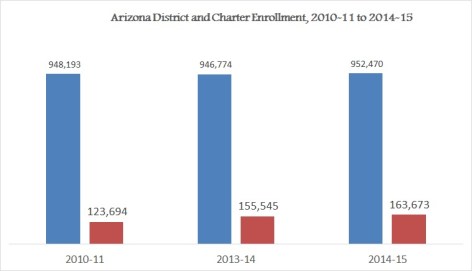
At the same time per pupil spending declined, enrollment growth came to a screeching halt in the districts, in part because of the continued growth of charter schools:

AZ enrollment

Now mind you that the absolute size of district enrollment was quite modest, but the normal experience for Arizona schools had been non-stop growth for decades.  That growth not only stops and reverses a bit, but state assistance per pupil declines as well. Thus at exactly the same time you might want to make up per pupil funding losses with more pupils, you suddenly stop getting as many pupils.

Now as I have written about before, the Newtonian model of K-12 mechanics would have concluded that Arizona’s NAEP scores would have declined under the weight of this pressure. (In fact, Mike Petrilli still owes LGK and I beers on that front….hmmmm….interest accruing daily btw.)

What actually happened during the Great Recession however is that while the economy was smashed, outcomes in schools continued to improve, even defying the national trend in the 2015 NAEP. As the first chart in this post shows, Arizona’s students made more math progress between their 4th grade scores in 2011 and the same age cohorts scores as 8th graders in 2015 than any other state. What gives?

While funding decreased, competition for students increased. An ever higher percentage of students continued to apply to attend charter schools and their waiting lists continued to swell.  Fancy Scottsdale Arizona somehow has a couple of empty schools. The state wisely moved to outlaw LIFO in school district layoffs, because layoffs were necessary. A skillful school leader would have taken the opportunity to preserve as many highly effective teachers as possible in this process.

In short, this was a productivity increase that you see in private industry on an ongoing basis. Arizona schools became less expensive and more effective. It is however at complete and utter variance with the state’s history of ever growing budgets and students along with relatively stagnant scores.  The Mother of All Competitive Effects (so far) was great for kids and taxpayers, tough on providers and it came about as a combination of deliberate policy and accidental economic catastrophe.

Where do we go from here? Proposition 123 will provide an extra $3.5 billion over the next 10 years, the baby boomer teacher cohort will continue to retire and need replacing, new charter schools will continue to open. Enrollment growth has already returned but the working age population will continue to shrink as a percentage of the total population.  The need for further academic gains remains acute. In short, the need for a less expensive and more effective education system is not going away, nor will the political battles surrounding the K-12 debate.

If however Arizona policymakers play their cards skillfully, the state can continue its ongoing move out of the NAEP cellar and towards a world class system of education. Some Arizona schools have already arrived at this enviable spot.

The challenges are very real, but the sky is the limit on our opportunity to improve.


Arizona Post-Prop 123

May 20, 2016

(Guest Post by Matthew Ladner)

Arizona Education Association President Andrew Morrill and I hit NPR to discuss the Arizona school finance landscape post Prop. 123.


Sweet Reason Prevails in Arizona

May 19, 2016

(Guest Post by Matthew Ladner)

Arizona voters have passed Proposition 123, wisely (if narrowly) settling a lawsuit over education funding in the process.

This will be a week long-remembered! It has seen the end of the Texas Supreme Court being used as a sock puppet and the end of a Nevada lawsuit that attempted to use KKK inspired constitutional provisions to keep kids trapped in an overcrowded and under-performing school system. It has now seen the end to a distracting lawsuit that if left to fester would have threatened Arizona’s nation-leading pace of academic improvement. We have put an end to this destructive conflict and brought order to the cactus patch!


Ok all kidding aside this was the best possible outcome- it has been a rough decade for Arizona schools since the Great Recession drop kicked our economy and I for one am happy to see our schools get some additional resources without raising taxes in what is still a less than robust recovery. Congrats to the lawmakers, school advocacy groups, business community and especially to Governor Ducey for providing the leadership to make it happen.


Sorry ACLU-Court Rejects Blaine Challenge to ESA

May 19, 2016

(Guest Post by Matthew Ladner)

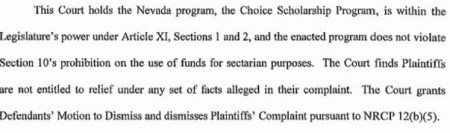
A Nevada judge dismissed one of the two lawsuits challenging NV ESA. From the ruling:

NV ruling


BOOOOMILICOUS victory, but the program injunction remains in place from the other case, and this all ends up in the Nevada Supreme Court.  It is always sickening to me to see anyone attempt to use provisions created by a past wave of anti-Catholic bigots, so it is always good to see such attempts fail.

From the Las Vegas Sun:

Education insiders around the country are keeping a close eye on the Nevada program, and its success or failure could determine whether similar sweeping programs are pushed in other states.

When it comes to the ACLU’s lawsuit, the judge dismissed the group’s argument that Nevada’s constitution only tasks the Legislature with ensuring a public school system.

“The framers indicated they intended to create two duties, a broad one to encourage education by ‘all suitable means,’ and a specific, but separate, one to create a uniform public school system,” judge Eric Johnson wrote in his opinion. “The Legislature can provide for a uniform system of common schools, free from religious instruction and open to general attendance by all Nevada children, and still adopt other suitable means of encouraging education.”

Johnson also dismissed the ACLU’s contention that allowing public money to be used to pay tuition at private religious schools violates the state constitution, which has been a central argument in lawsuits against ESA and voucher programs elsewhere.

Ruling can be read here.


Texas Supreme Court Makes Room for School Finance Democracy, will Arizona Democracy (narrowly) embrace reason?

May 18, 2016

(Guest Post by Matthew Ladner)

In 2013, I was discussing a reform agenda (non-choice related) with a seasoned observer and participant in Texas education politics.  I asked this individual whether he was taking steps to advance this reform in the then ongoing legislative session. He responded “no this is a lawsuit year.” My puzzled look must have spurred him to elaborate, whereupon he told me:

Let me explain to you how the districts use the courts to manage the Texas legislature. The districts do everything they can to block reform, and then they file a lawsuit. The lawsuit takes years to wind through the Texas court system, making a ready made excuse against reform.  The lawsuit eventually gets a final ruling and they go back to blocking reform and preparing for the next lawsuit.

This is a lawsuit year.

I recall distinctly “I wish I could have learned this six months ago rather having than my brains beat out in Austin.”

Well in the latest round of this cycle of Texas school finance litigation, the Texas Supreme Court finally decided to stop being the school establishment’s puppet, making some space for the whole “democracy” thing to play out.  Much better late than never imo.

Speaking of school finance lawsuits, out here in AZ the voters took to the polls yesterday to vote on a settlement of such a suit. Back in 2000 Arizona voters enacted an inflation based spending increase for schools. During the first year of the Great Recession the state’s general revenue dived 20% in a single year and lawmakers began digging up money from the couch rather than stop payments to hospitals or close state prisons.  During the boom years lawmakers had increased funding above and beyond inflation, and an arcane dispute broke out over whether than above and beyond spending counted against the voter mandate or not, and the school groups filed a lawsuit.

The Arizona School Boards Association and the Arizona Education Association agreed to settle the suit in part by increasing the payout from the State Land Trust from 2.5% to 6.9% per year for 10 years.  The trust is funded by sales of state land, and has grown to a multi-billion dollar fund not because the state sells much land, but rather because you can fall out of bed and beat such a low payout rate over time. Federal law requires private charities to pay out 5% per year and you may have noticed that most of them are functionally immortal. There is nothing either sacred or even reasonable about a 2.5% payout.

Some have worried about a “fiscal cliff” in 10 years, but this seems to have a fairly simple solution to me- sell a bit more state land (the state retains an estimated $70 billion worth while the Land Trust is worth less than $6 billion) and permanently put the payout at 5% to match private charities a decade hence.  In addition to state land, Arizona has a ton of open space in the form of national parks, federal land, tribal lands, state parks etc. so the great outdoors is not in any danger.

Well the election was held last night and it is a cliffhanger with the Yes holding a slight lead.  The Arizona Republic’s Bob Robb has been at pains to explain the incoherence of the arguments made against the settlement but there is no need to let mere reason get in the way in a year like 2016.  There are different flavors of opposition, but my personal favorite are the armchair strategists who believe they have a keener grasp on the risks of continuing the lawsuit than those who brought the suit. Ah well <<Insert Churchill quote about democracy about here>>

We should have a final result by Friday- stay tuned.