Small Schools 18, Big Box 2

October 4, 2016
Why is this man smiling? Read on MacDuff...

Why is this man smiling? Read on MacDuff…

(Guest Post by Matthew Ladner)

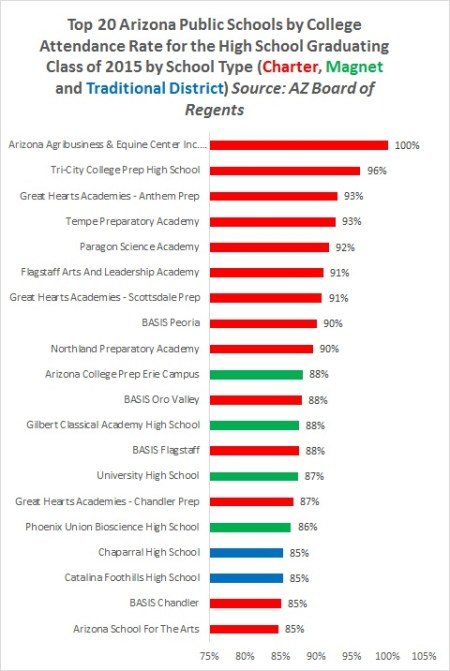
So last week I used an Arizona Board of Regents Report to show you the top AZ high schools year after graduation college attendance:

az-college-attendance

So now let’s take the chart immediately above, and rather than emphasize school type, let’s instead look at the number of high school students. The above chart still ranks the same 20 schools by their 2015 college attendance rates, but simply provides attendance rates.

school-size-az

The two large high-schools that made the list (Chaparral and Catalina Foothills) may be the most leafy of leafy suburban schools in Scottsdale and Tucson respectively. The other 18 schools in the top 20 are small charter and magnet schools. Of course a score of 18 to 2 is merely suggestive, but rigorous evaluations of small schools in New York City point to a similar conclusion: good outcomes come with small schools.


The Agony and the Ecstasy of the Nevada ESA Ruling

September 30, 2016

(Guest Post by Matthew Ladner)

I’ve read a few school choice related Supreme Court decisions over the years, but I’ve never seen anything quite like the ruling that the Nevada Supreme Court made yesterday. To this untrained reader, it appears to be a determined exercise in cutting the baby.

The decision reads very cleanly until the matter of standing arises. Standing involves being able to demonstrate some personal harm, and the Court implicitly acknowledges a lack of harm on the part of the plaintiffs by creating an exception to standing out of whole clothe in the ruling:
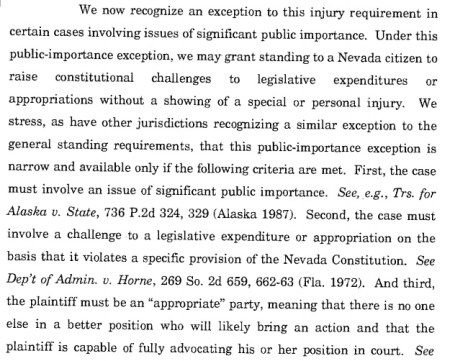
nv-ruling-1

So…..I am inferring from this that under the standing requirements that existed for every previous case in the history of the state of Nevada, that the Nevada Supreme Court would have felt compelled to acknowledge the obvious truth that the plaintiffs had claimed harm when in fact none actually existed. I’m no lawyer, and I don’t play one on television, but I’m also astonished that the Court felt free to willy-nilly change standing requirements unilaterally and in the late stages of an important case.  If you can explain to me how this makes the least bit of sense, and it not entirely arbitrary and capricious, please feel free to educate me in the comments.

Having performed this incredibly one sided act of mental gymnastics, the court moves on to consideration of constitutional issues. First up, our old friend the “uniformity clause.” Quite rightly, the Court squashes this bug of a claim under their boot:
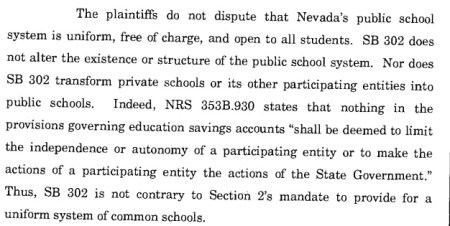
nv-ruling-2

Jolly good, moving on to sectarian purpose Blaine claim. This is where the Court makes a potentially very far-reaching conclusion:
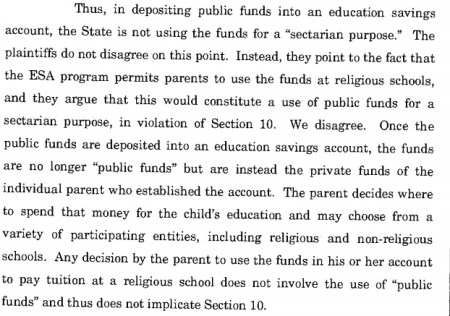
nv-ruling-3

Note that this was an argument that Nick Dranias and I made in our paper for the Goldwater Institute that made the case for the Arizona ESA as a replacement for the voucher program for children with disabilities: that once a set of mutual benefits between a parent and the state had been realized that funds deposited into an account were private rather than public funds. Jason does a great job of expounding on this point in his Cato post on the decision and how this precedent is followed in other policy areas. No one can claim that a state worker cannot use their salary to pay for Catholic school tuition for instance- as the check from the state is exchanged for the labor of the worker and thus becomes private funds. Likewise in an ESA, the state realizes the benefit of paying for a traditional education for the child, and the parent realizes the benefit of flexibility under the rules of the account.

The Arizona ESA decision implicitly recognized this argument, but the Nevada decision explicitly embraces it.

After that we get back into agony, with the court sifting through a complex mess of requirements and dates of bills passing. Basically in the end the court emphatically holds that ESAs are constitutional, but finds that the way the legislature funded the ESA program was itself not constitutional. Basically the program exists but currently has no funding.

So where does this leave things?  It leaves the 7,000+ students who applied for NVESA out in the cold. As the Wall Street Journal noted today, a looming special session on building a football stadium for an out of state billionaire also represents an opportunity to fund the educations of thousands of Nevada children.

Let’s see what happens next.


Competing Against Non-Consumption

September 28, 2016

(Guest Post by Matthew Ladner)

HT to good Kevin Carey (the entertaining higher ed version) for drawing attention to this Harvard regression discontinuity analysis of the Georgia Tech $7,000 Masters Degree in Computer Science. Making use of a natural experiment the researchers found that the inexpensive Georgia Tech program was competing against…nothing. In other words, those that applied and did not get admitted did not enroll in a different, more traditional program.

It remains to be seen whether a Georgia Tech online students learn as much as their in person peers or how the market views these sort of degrees. On the learning side, it is not terribly hard to teach students more than what they would have learned in their other program (i.e. nothing) and the amount of knowledge gained per tuition dollar will run laps around the in-person program. The in-person program btw only can accomodate 300 students at a time, while the online program has 4,000.

Much more research to be done. Just as the vast legions of the University of Texas at Austin film school eventually lapped the accomplishments of back east finishing schools for global technocrat film schools (albeit some get to claim scoreboard due to a black swan) just maybe…

It's about numbers boys and girls and they have more!

It’s about numbers boys and girls and they have more!


Arizona Charter and Magnet Schools Top the List for College Attendance of 2015 Graduates

September 26, 2016

az-college-attendance

(Guest Post by Matthew Ladner)

‘Nuff said…


Segregationist Neanderthal 1, Florida’s First Integrated School 0

September 22, 2016

(Guest Post by Matthew Ladner)

Make sure to catch this post over at RedefinED by Patrick Gibbons about the racist “founder of Florida public education” and his 18 year jihad to close a racially integrated private school.

You couldn’t make this stuff up, and even if you tried, no one would believe you, which is why Gibbons included a sources appendix at the end of the post. Very worth the read.


John Oliver Has it All Wrong- We WANT ineffective schools to close

September 22, 2016

bottom-10

(Guest Post by Matthew Ladner)

So I went through the Arizona Board of Regents report on college graduation by high-school some more, and looked this time at the bottom to see whether charter schools were over-represented at the bottom as well as the top. A few caveats I eliminated alternative high schools from the list, as these schools are basically dropout recovery programs. Second, there is a lot of missing data for a lot of high schools, so this may not be the actual bottom 10, more like the bottom 10 for the schools we have data on. Another * goes to Metro Tech which is teaching career and technical skills which might keep graduates gainfully too busy to finish college in a six-year span (although many CTE students do eventually earn college degrees).  Metro Tech may be great or it may leave a lot to be desired but I would not conclude much of anything from their place on this list.

My method for eliminating alternative schools was to look at the oldest available list from the Arizona Department of Education, having said that when you look at the website for the International Commerce High School it mentions serving adult high school students and my spidey sense tells me that it is an alternative school. The other charter school on the list (delightfully imo) closed.

Regular ole district high schools dominate the bottom of the list even more than charter schools dominate the top.  John Oliver should do a segment on how horrible it is that bottom dwelling schools flounder indefinitely without any fear of closure.


Arizona Board of Regents Releases High School Graduate College Tracking Study for the Class of 2009

September 21, 2016

top-az-high-schools

(Guest Post by Matthew Ladner)

The Arizona Board of Regents released their annual college attendance/completion study for Arizona public high schools for the Class of 2009.  The aggregate numbers continued to inch up- the total percentage having been 18.6% of the Class of 2007 earning a four year degree in six years, 19.4% of the Class of 2008, and 20.8 percent for the Class of 2009. When you include two year degrees the numbers improved from 25.8% to 27.9%.

Now if you would happen to like to send your child to a school that beats the living daylights out of a statewide one in five college completion in six years rate, we’ve got what you are hankering for in the form of charter schools, magnet schools, and leafy suburban district schools. I’m happy to say that the Ladner kids are attending the #2 and the #5 schools on the list.

Tempe Prep was the prototype for the Great Hearts system, so special kudos to my band of great books happy warrior nerds for effectively capturing the top two spots!


TXESA

September 20, 2016

(Guest Post by Matthew Ladner)

The Texas Public Policy Foundation, the Texas Business Leadership Council and Excel in Ed teamed up to publish a new white paper by yours truly called The Yellow Rose The Achilles Heel of Texas: Improving College Eligibility Rates through K-12 Savings AccountsBottom line: only a minority of Texas public school students get prepared for even a moderately selective college or university, and the percentage moves to catastrophically low levels when looking at the ethnic minority student groups which now constitute a large majority of Texas students. Meanwhile an annual 90k+ of new students per year has been driving resources out of the classroom and into debt, with no end in sight and an aging population that will slow revenue growth and create new costly problems in health care and pensions.

Judging from the number of applications received in the first year of NVESA, enrollment growth in Texas could be substantially slowed by a universal ESA program, which would give the public system a chance to focus resources away from the debt spiral of constantly building new facilities and then surrounding them with portable buildings. We could expect such a system to have the well-established positive effects for both participating and non-participating students, but also represents an opportunity for low-income students especially to save and build assets for future higher education expenses.


The 2016 AZ Merit: Improving but Meh versus Mehssachusetts

September 19, 2016

(Guest Post by Matthew Ladner)

The Arizona Department of Education released 2016 AZMerit data last week, and charter school students show an across the board advantage.

az-merit-2016

Breaking down the data by subgroups consistently show charter advantages as well. Let’s start with Anglos:

azmerit-anglo

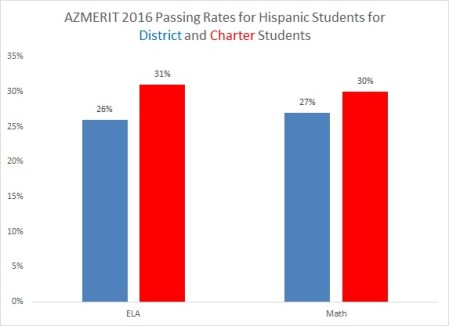
Move on to Hispanic students:

az-merit-hispanic

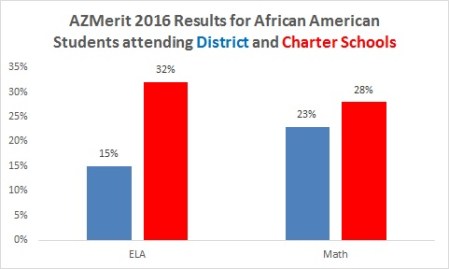
African-American students:

azmerit-black


Native American students:

azmerit-native-american

Asian students:

azmerit-asian

Special education students (btw the percentages of special education students among district and charter schools were roughly equivalent among tested students):

azmerit-sped

Economically disadvantaged students, but with an *.  A high percentage of Arizona charter schools do not participate in the federal free and reduced lunch program, and about 85% of alternative (dropout recovery) schools in Arizona are charter schools. Having said that, charter schools score higher again:

amerit-ecodis

This next chart required me to dust off my algebra skills and use the existing data to solve for X:

azmerit-non-disadvantaged

What we can take from this: while differences in student populations explains some of the differences between overall charter and district scores, when the charters lead in each and every subgroup it does not explain anything close to all of the difference. Every difference across every subgroup counts, and in the end the add up to:

az-ma

For those of you squinting at your Ipad, that is the statewide averages for Massachusetts (the highest scoring state) on the left, Arizona charters in the middle, and Arizona Districts.  MA of course is much wealthier and spends a great deal more than AZ, but when you break down the subgroups Arizona charter students outscore like students from Massachusetts, which makes me want to CeleNAEP good times here in the cactus patch: