The North Carolina legislature has passed an Education Savings Account program for children with disabilities as a part of the budget. If the budget becomes law as expected North Carolina will become the sixth state to join the ESA family.
Next month Texas legislators will return in special session, and Governor Greg Abbott has put a choice program for special needs children on the session call. Governor Abbott quite rightly has called for a choice program as part of an effort on the part of the state to dig itself out of a deep hole with special needs parents after 12 years of secretively running a de facto cap on the number of children who would receive services. Today in the Texas Tribune I make the case for why such a program would be especially beneficial to special needs children in Texas:
Put yourself in the shoes of a special needs student or parent for a moment: Would you desire a limited set of options and cold-blooded state policies discouraging districts from meeting your needs? Or would you desire a system in which you have additional options if things don’t work out?
Lawmakers can and should take other actions to improve the dismal state of special education in the Lone Star State. However, any reform effort should include the broadening of opportunities and should not preclude other efforts. After all, children with disabilities will only have the best opportunity to thrive and flourish when they have the ability to choose their service providers.
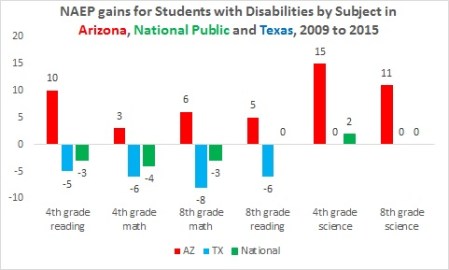
During the same period Texas bureaucrats covertly implemented a cap, Arizona lawmakers began increasing the options for special needs children. Let’s see how that has been working out for the special needs children:
K-12 reactionaries dragged us through the court system twice trying to stop us from offering options to these students in Arizona. We had to invent an entirely new form of school choice in order to ultimately prevail. It.was.worth.it.
Important new study from the Fordham Institute on open enrollment in Ohio. The map above shows dark blue show districts not participating in open enrollment, and they just happen to be leafy suburban districts who are both higher income with student bodies that tend to be pale complected that also happen to be near large urban districts with many students who are neither of these things. Feel free to reference this map the next time someone claims that public schools “take everyone.”
Many moons ago I wrote a study for the Mackinac Center about the interaction between charter schools and open enrollment in Michigan. I found a very clear pattern among some of the suburban districts whereby charter schools provided the incentive for early open enrollment participants to opt-in. After one district began taking open enrollment transfers, and some additional charters opened, it created an incentive for additional nearby districts to opt in- they were now losing students to both charters and the opted in district. Through this mechanism, the highly economically and racially segregated walled-off district system began to:
Not every domino fell however. I interviewed a superintendent of a fancy inner ring suburb who related that they saw their competitors as elite private schools, not charter schools. When I asked him why his district chose not to participate in open enrollment, he told me something very close to “I think historically the feeling around here is that we have a good thing going, so they want to keep the unwashed masses out.”
Contrast this as well with Scottsdale Unified in Arizona, which is built for 38,000 students, educates 25,000 students, 4,000 of whom transferred into a Scottsdale Unified school through open enrollment. 4,000 transfer students would rank Scottsdale Unified as the 9th largest CMO in Arizona, and they are far from the only district participating in open enrollment in a big way. Why is Scottsdale willing to participate unlike those fancy Ohio districts? They have 9,000 kids living within their boundaries attending charter and private schools.
Why haven’t choice programs torn down the Berlin walls around suburban districts? Sadly because they have been overly focused on urban areas. The National Alliance for Public Charter Schools Dashboard shows that 72.6% of Ohio charter schools operated in urban areas. The voucher programs likewise started in Cleveland, and then expanded out to include failing schools (and children with disabilities statewide). More recently a broader voucher program has begun the process of phasing in slowly on a means-tested basis, but the combination of adding a single grade per year and means testing promises to unlock a very modest number of walled off suburban seats.
These programs have benefits, but they will not provide an incentive for fancy suburban districts to participate in open enrollment any time soon. Informal conversations I have had with Ohio folks related to me that Ohio suburban and rural dwellers- aka the people who elect the legislative majorities-tend to look at charter schools as a bit of a “Brand Ech” thing for inner city kids. Rest assured that the thousands of Scottsdale moms sitting on BASIS and Great Hearts charter school wait lists do not view charters as “Brand Ech.” Likewise these folks probably see themselves as paying most of the state of Ohio’s bills through their taxes and just might come to wonder why the state’s voucher programs seem so determined to do so little for their kids and communities.
A serious strategic error of the opening act of the parental choice movement was to look out to places like Lakewood Ohio or Scottsdale Arizona and say “those people already have choice.” This point of view is both seriously self-defeating in terms of developing sustaining coalitions, it also fails to appreciate the dynamic interactions between choice programs. Arizona’s choice policies include everyone and have created a virtuous cycle whereby fancy districts compete with charter and private school options for enrollment. This leads to a brutal crucible for new charter schools in Arizona whereby parents quickly shut many down because they have plenty of other options. Educators open lots of schools and parents close lots of schools-leading to world-class Arizona charter scores. Arizona’s charter NAEP score triumph was more or less mathematically inevitable once this process got rolling. Did I mention the part about Arizona leading the nation in statewide cohort NAEP gains since 2009? That too but Ohio not so much.
I’m open to challenge in the comment section from any of my Ohio friends or anyone else, but by contrast to these eyes Ohio’s choice programs look to be mired in an urban quagmire and they need the leafy suburbs to play in order to win. Current policies not only have not unlocked Ohio’s Scottsdale Unified equivalents, they likely never will. NACSA put Ohio’s revised charter school law in their top ten, but allow me to pull up a couch and heat up some popcorn for the next few years as charters lawyer up and parents resist arbitrary bureaucratic closures, and the rate of new schools opening goes glacial.
Competition is by far the best method of quality control and bringing the leafy suburban districts into the melee is crucial if you are in the urban fight to win. The districts currently largely untouched by charters and private choice overlap with those not participating in open enrollment. Regulating urban charters is not going to make your suburban districts into defacto CMOs. This.isn’t.hard.to.figure.out. While counter-intuitive to many if you want to secure improved education options for the poor, you need to include everyone.
The Nevada legislative session appears headed to a disappointing end on the school choice front. Governor Sandoval backed away from his threat to veto the budget without funding for the ESA program, and a deal to increase the state’s modest tax credit program passed the Nevada Senate last night. Worse still, despite the wee-tiny Silver State charter sector a bill which appears replete with regulatory measures for charters are headed to Governor Sandoval’s desk. What do you do when you are the state with a catastrophic district overcrowding problem and the charter school tortoise of the region? More bureaucracy to the rescue!
Sigh.
In combination these actions signal an unwillingness to address Nevada’s K-12 challenges seriously. The overcrowding problem isn’t going away. The Review Journal reports that a majority of Clark County schools are over 100% capacity and they included this handy illustration:
Does this look like a state that should be only cautiously dabble with private parental choice? Should Nevada be rolling out the red carpet for charter school operators, or subjecting them to state-sponsored harassment? Can the new NFL football stadium being built for a billionaire be used for classroom space? From the Review Journal:
Of data for 344 schools, 230 are over capacity, according to the report. Among those schools, 68 are operating at 125 to 150 percent capacity and 35 are operating at 150 to 175 percent. Two are taking more than double their load, at over 200 percent.
Growing class sizes have been the result of both a budding population — particularly in the high-growth area of Henderson — and multimillion-dollar budget shortfalls.
Budget constraints in 2015-2016 increased class sizes in grades 4-12 by 0.5 students, saving $9.1 million, according to the district. Cuts in 2016-17 added one student in elementary classes and 1.5 students in secondary grades, saving $21.5 million.
That translates to a tight squeeze for teachers and students.
“I think (my son) has suffered, I’m sure he has,” said Rebecca Colbert, a Beatty Elementary parent who said her fifth-grade son is in a class of 39 students. “I know the teacher has. She’s been doing double work.”
8,000 students had filed applications to opt-in to the ESA program. This alone would not have solved Nevada’s overcrowding problems, but it certainly would have helped. The 2015 problems that prompted the NVESA program are larger in 2017 and will continue to worsen. The strain believes in Nevada, even if Nevada tries not to believe in the strain.
The NVESA program continues to exist in an unfunded state, awaiting the possibility of more enlightened leadership who are willing to take the steps necessary to get serious about Nevada’s K-12 problems.
The same district leaders who complain about the Legislature and call for a veto also say they need charter schools to accommodate population growth, as funds are scarce to build new schools. This is especially true in the southernmost part of the county, where approved developments that were dormant during the recession are now springing to life.
Some also recognize that charter schools can give a second chance to students who fall through the cracks in the district system. Board member Susan Valdes, speaking at the May 16 board meeting, described two such students, one who lost a parent to military combat and the other who had been ill.
“If the governor signs the bill,” Valdes said, addressing administrators in the auditorium, “hey, life lesson that we should learn about really, truly taking care of our children — not just taking their money.”
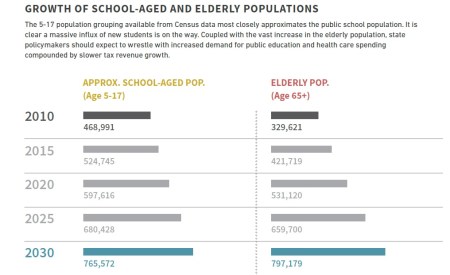
This is all going to get more challenging as Florida’s youth and elderly populations continue to expand. The current bill that stands at the center of the controversy includes a series of small but important steps in the needed direction. The yearned for veto will do nothing to address the reality that the Florida public school system must adapt to changing circumstances. Moreover “just taking their money” was an entirely reprehensible waste of human potential even during the easiest of times, which these are surely not. Just remember where you heard it first folks.
One finds the largest gaps between charter and district performance in the entire NAEP in the Trial Urban District Assessment (TUDA) results for Los Angeles. On 4th grade math, LA charters scored 249, LA district 221, 4th grade reading 237 for charter students, 200 for LA district students. On 8th grade math, LA charter students scored 294, while LA district students 261, while in 8th grade reading LA charter students scored 276 while the district students scored 249. Sadly the TUDA did not participate in the 2015 4th and 8th grade Science exams. For you incurable skeptics out there, feel free to look the numbers up for yourselves.
Each of the Los Angeles charter school score averages were in very near vicinity of the highest statewide average scores (Massachusetts). I don’t have demographic information on LA charter students, but the California charter sector as a whole is majority-minority by a wide margin. I would expect the Los Angeles sector to be as well. Massachusetts and the other states clustered towards the top of state NAEP rankings meanwhile tend to have substantial socio-economic student body advantages. Massachusetts stacks up well with the top European and Asian schooling systems in international comparisons, so kudos to Los Angeles charters as your scores dinged the globally competitive bell. Is it worth mentioning that California charters received about $7,800 per pupil while New England states average almost twice that amount? Yes? Ok good well then that too.
As just a small random aside, NACSA’s scoring of state charter school laws from 2014, the most proximate ranking to the 2015 NAEP, gave California an 11 out of a possible 30 (see page 6). So Los Angeles joins Arizona and Colorado in the Low NACSA/High NAEP score combo club. I’m guessing there are other examples out there…
**Nerd Alert Time Out** Only a proper random assignment study would allow us to measure the degree to which school quality is responsible for the academic beat down that Los Angeles charter students administered to LAUSD averages. Let’s just note however that when the gaps in question are larger than the performance gap between Massachusetts and Alabama, you’ve got plenty of space for multiple factors and probably plenty of room left over for school effects. Standard errors for charter sectors are larger than for statewide samples, but sampling error can go either way-meaning that if we had actually tested all students rather than samples the scores could be either lower or higher. Random chance guiding Los Angeles charter students far to the right side of the bell curve on a single test could happen, but random error is very unlikely to behave the same way with four separate samples of students.
**TIME IN!** Congratulations to educators, students and investors in the Los Angeles charter school sector! Hopefully evaluations of long-term outcomes will match test score success in the Los Angeles charter sector, which is no longer something we can take for granted. Students have already taken the 2017 NAEP exams, with results expected in the fall. Let’s see what happens next.
UPDATE (6/1): One of the steps I took to explore Arizona’s charter school NAEP numbers involved looking at subgroup scores. So for instance Hispanic students attending AZ charters score quite well compared to the top statewide averages. I looked these up for Los Angeles charters this morning, but the TUDA does not provide information for some major student subgroups- including Hispanic students-on any of the four exams. Hispanics make up 73% of Los Angeles charter school students so it seems odd for TUDA to provide Anglo subgroups scores but not Hispanic subgroup scores.
I’ve made an inquiry with the NAEP folks and I will report back. Arizona’s case the state exam data displayed an even larger academic advantage for charter students than NAEP. The opposite appears to be the case with regards to Los Angeles charters. For now an * and some additional investigation seems warranted for Los Angeles charter TUDA scores.
The legacy of Al Copeland Humanitarian Award winner George P. Mitchell just continues to grow and grow. President’s Trump’s budget proposal aims to sell off half of the United States 688 million barrel Strategic Petroleum Reserve over the next ten years because…well…we don’t need it any more. We kind of don’t import oil these days. Especially if you consider the exchanges between the United States, Canada and Mexico’s integrated energy markets local rather than international. Read details here.
I can think of a few more assets Uncle Sam should sell…like the badly mismanaged great outdoors of the American West for instance.
I had the pleasure of participating in a debate/discussion on tensions in the education reform movement at the New Schools Venture Fund Summit yesterday in San Fransico. I attempted to make the following points:
Big Tents are good and disagreements are okay, failure even is okay, but an unwillingness to learn from failure is a huge problem.
If you hold focus groups on K-12 education you learn that the public hates current standardized testing practices and that the deeply misguided federal opt-out provision that passed the United States House of Representatives was no fluke.
The failure of Question 2 in Massachusetts is screaming a warning into our deaf ear about the dangers of excluding non-urban communities from parental choice efforts. Everyone should go back and read the Rick Hess 2011 National Affairs piece “Our Achievement Gap Mania” in light of the Question 2 disaster. School choice needs to decide whether it wants to be Social Security or AFDC. For much of the history of the movement we chose an AFDC model where everyone pays in but only certain people benefit, and, well…http://www.youtube.com/watch?v=Ubw5N8iVDHI
The federal government is deeply in a growing amount of debt and has $75 trillion in unfunded entitlement liabilities to contend with. The pendulum has already swung against a large federal role in K-12, and Uncle Sam’s solvency issues are likely to freeze it that way for a long while if one assumes a prioritization for programs like Social Security and Medicare. We are only five years out from half of the Baby Boomers reaching age 65.
Folks should do their best to remain calm on private choice because it ultimately not a threat to public education and helps kids find a good fit school.
I have a minority viewpoint on K-12 reform, and I appreciate Stacy Childress including me in the discussion. We should have far more discussions like this, and less bomb throwing over social media.
I had the chance to meet some of the folks from Raise Your Hand Texas a few years ago, and they seemed entirely delightful and respectable people. I’m afraid however that they have rushed off to form a judgement about the subject of education freedom from students with disabilities without examining the available evidence. We have statistical analyses of the impact of such programs on student outcomes for children with disabilities, surveys of parental satisfaction for participating parents, etc. but in the end this comes down to a gut check: do you believe choice for children with disabilities should be limited to those who can pay for it themselves or hire high-priced attorneys? Or do you believe that everyone can benefit from giving all children with disabilities the opportunity to seek education solutions with their share of funds?
Put me down in the latter category. If you put yourself in the former category, please feel free to explain how Arizona children with disabilities managed to show such strong gains during a period when they were being “oppressed” by not one but two different private choice programs for children with disabilities. You don’t have to trust me- go look up the numbers yourself.
As you can see, a large number of states (including Texas) either made zero progress or else saw declining scores for students with disabilities during this period. None of the states with functioning private choice programs for children with disabilities made it into the “Zero or less” club. Oddly enough several states with such programs operating during this period made it into the top 10, including Arizona, Oklahoma, South Carolina, Georgia and Indiana. Others with long-standing programs-including Florida and Utah- had more modest gains during this period but high overall scores in 2015 (NAEP science scores only go back to 2009 in the current framework).
None of this demonstrates that private choice programs drive academic improvement for students with disabilities remaining in public schools. Far more thorough studies make that case. The opposite proposition that such programs harm the academic progress of children remaining in districts- can survive neither a cursory examination of evidence nor formal statistical evaluation.
It is deeply misguided for Raise Your Hand Texas to attempt to “protect” Texas children with disabilities from more diverse schooling options, the ability to hire certified academic tutors and therapists, assistive technologies etc. Given a 12 year long effort on the part of the Texas Education Agency and 1,054 Texas school districts to undermine the intent of IDEA, I’m inclined to think that these children could use some protection from the public schooling system-as in the option to leave. As for the question of whether participating students have things to gain, you should listen to parents directly involved:
The Raise Your Hand Texas group has released a white paper opposing an ESA program for special needs students in the Lone Star State. It is alas replete with boiler-plate nostrums etc. but if private choice is terrible for children with disabilities attending district schools, you have an awfully hard time finding evidence for it in the NAEP. We can get NAEP trends for children with disabilities on all six NAEP exams for the 2009 to 2015 period. The Arizona legislature passed a private choice tax credit for special needs children in 2009, and followed that up with the Empowerment Scholarship Accounts program in 2011.
Texas meanwhile during this period had the Texas Education Agency implementing a defacto cap on the number of special needs students in districts, without the slightest apparent protest from Texas districts, who implemented the program quite effectively. Ah, well, at least those Texas districts should have been doing a better job delivering special ed students for the children with disabilities they served, right?
Wrong.
Arizona authorities decided to expand options and increase freedom. As you can see, Arizona students with disabilities have demonstrated academic progress much better than the nation as a whole, which has either been treading water or actually declining. This looks pretty bad until you examine the scores for Texas students with disabilities, which are not only consistently worse, but which failed to show improvement in any of the six subjects covered by NAEP.
These trends obviously have factors other than choice which impact them, but if the theory is that ESAs are terrible for children with disabilities in public schools, we can reject the hypothesis. Texas has a special education disaster on its hands, while Arizona is making progress far and away above the national average. No student group has more to gain from choice than children with disabilities- including those who choose to remain in districts.


 Posted by matthewladner










 Jay P. Greene's Blog