Sad and Lonely is a Bad Look-Even More Than Usual When You Lead in Gains

January 30, 2018

(Guest Post by Matthew Ladner)

Arizona Republic columnist Bob Robb turned in a gem recently on the improvement in Arizona academic achievement:

The furious reaction to an ad campaign by some Arizona business organizations raises a question that deserves more than a superficial ponder: Why is there such resistance, hostility even, to good news in Arizona, particularly about K-12 education?

Arizona schools are seriously underfunded compared to other states. Legions have made the leap, based upon this indisputable fact, that Arizona children are getting a lousy education compared to the kids in other states.

That has never really been the case.

According to the 2009 results from the National Assessment of Educational Progress test, the most reliable cross-state measure of student learning, Arizona kids, considered as a whole, did lag behind the national average.

But that was mostly a function of demography. When the data was disaggregated, Arizona was right around the national average. White students in Arizona did as well as white students elsewhere. And Latino students in Arizona did as well as Latino students in other states.

When the 2015 NAEP results came out, Matt Ladner, senior research fellow at the Charles Koch Institute, made a startling discovery. Arizona students led the country in gains between 2009 and 2015.

According to the NAEP administrators, who work for the federal government, Arizona results for students as a whole in 8th grade reading and math were now “not significantly different” from the national average. Arizona white students now score above the national average for white students. As do Arizona Latinos compared to Latino students elsewhere.

This should be very big news. It should have catalyzed an intense discussion and inquiry about what was happening in Arizona classrooms that yielded such astonishing results, particularly during a period when the schools were on starvation rations when it came to resources.

 Instead, these remarkable results have created barely a ripple in the discussion of K-12 education in Arizona.

Robb gives yours truly too much credit as there were others who noticed the Arizona gains earlier than me. I simply dug into the details and subgroups trends. In any case, Robb does an admirable job of describing the climate in Arizona. The dedication in some quarters to what seems to be an entirely self-defeating and irrational strategy is truly astounding.

The strategy strikes many of us as follows: how many entrepreneurs attempting to raise investment capital would make the argument that even vaguely sounds like “our product is HORRIBLE and you should be ASHAMED unless you give us more money. Buy our stock or you are a bad person!” How do we imagine such a strategy would work out?

“Everything is HORRIBLE!!!!” is a whip-up the base type strategy, but contributes to skepticism and ultimately defeat by poisoning the well with the public. In 2012, the districts put a tax measure on the ballot to support education, which failed almost 2-1 on election day. Then, as now, people were touting polls allegedly showing that the public supported the measure, but on election day the voters rejected it overwhelmingly. Proponents still grouse about the no campaign, but the no campaign won for a reason and in fact people on the yes side of the effort swear up and down that the support for the measure had begun falling before opponents launched their campaign.

The reason is simple: the public lacks confidence that increased spending will see the inside of a classroom. In other words they fear (rationally) that the money will simply be wasted. A non-stop narrative of “Everything is HORRRIBLE!!!!” is like the soundtrack to building public skepticism regarding sending good money after bad in AZ K-12.

Robb notes in his column that district supporters fear that drawing attention to Arizona’s nation leading gains may undermine the case for additional revenue, allowing some to make the case that current funding levels are “good enough.” I however believe that the opposite is true- instead of the self-defeating misguided pitch above, what if the pitch became “Arizona has the fastest improving public education achievement scores in the nation. We are asking for your increased support in order to accelerate our momentum in providing our students the knowledge, skills and character necessary for success in life.” Imo:

I’m content to let this whole democracy thing work itself out on the question of funding. Arizona has lots of old people and large average family sizes. The states just above and below us on the funding rankings are Idaho and Utah, respectively. Hmmm…what do those states have in common? Here’s one:

Arizona (and Idaho and Utah) have large average family sizes and we should not want or expect this to change. Arizona has lots of retirees living on fixed incomes anxious to vote every election- and this is increasing. Arizona has no oil gushers or hedge fund billionaire clusters paying sky high income taxes. Add on top of that a self-defeating trash-my-own product fundraising strategy reinforcing a notion on the part of the public that Arizona schools could not find their posterior with both hands and a map. Call me nuts, but disabusing the people of this latter notion, rather than reinforcing it, is helpful rather than harmful to the case for increased funding.

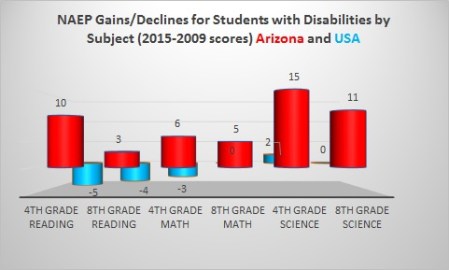
Arizona is never, and I mean EVER going to win a spending per pupil contest, but some cards could be played much better. Instead of winning a spending contest, we have been winning a bang for the education buck contest and leading the nation in academic gains. I’ll eventually once again become one of the millions of voters on a statewide funding vote. So far I am batting a thousand as far as landing on the winning side, but my vote is very unlikely to be decisive. If funding were driving results, we would not be seeing trends like this:
So cheer up Arizona- we’ll eventually put the 2018 elections behind us and while the capacity of the school crowd to pull defeat from the jaws of victory is strong, at least the Arizona business community seems to have embraced a positive path forward. Oh and also there is a whole lot to be happy about in improving faster than any state, especially if we can keep it up.


Wild West Parents to Ineffective Schools-DRAW!

January 25, 2018

(Guest Post by Matthew Ladner)

Yours truly has a new piece at Ed Next today called “In Defense of Education’s Wild West: Charter Schools in the Four Corner States.” Here’s the punchline:

Just as the country benefits from political diversity, we also benefit from a diversity of policy approaches at the state level. There are those who seek greater uniformity among state charter-school policies—urging that all charters should be for five years and that default closure provisions should be spelled out, among other guidelines. Such advocates should consider the success of these western states, which have chosen not to adopt such policies. The 50 states will become less useful as laboratories of reform if we adopt a single set of policies everywhere.

Many states—including three of the four featured here—have experienced high rates of overall K–12 enrollment growth, which raises the opportunity cost of imposing a stringent charter-authorizing process. It does not follow that every state should rush to amend its charter policies to match those of Arizona, Colorado, New Mexico, or Utah, but the obvious flourishing of the charter sectors there offers food for thought. Questions to consider and debate include: What factors have led to success in these states? What steps can policymakers and philanthropists take to enable parents to take the leading role in closing undesired schools? How important a role does open enrollment in suburban districts play in creating a successful bottom-up accountability system?

We don’t know the answers to these questions. But we do know that relatively freewheeling charter-school systems have prospered in multiple states. Surely we have as much to learn from these success stories as we do from the cautionary tales from states that have experienced difficulties.

Check it out and let me know what you think.


Moving from Caps to Freedom for Special Needs Children in Texas

January 24, 2018

(Guest Post by Matthew Ladner)

Yours truly is in the Houston Chronicle today on the U.S. Department of Education’s finding on the special education cap in Texas. Here’s a sample:

This sad affair reminds us of aspects of human nature we might feel more comfortable forgetting. Yale psychologist Stanley Milgram ran a series of fake experiments to test the willingness of people to obey an authority figure in the early 1960s. Milgram’s experiments asked students to administer what seemed to be electric shocks to subjects who were actors. Disturbingly, a large percentage of people were willing to administer what seemed to be fatal shocks if an authority figure told them to do so.

Texas Gov. Greg Abbott and Education Commissioner Mike Morath took prompt action to end the TEA practices after the Chronicle revealed them. Education officials, however, have a long road to walk to restore broken trust. One of the best steps policymakers could take would be to make the families of special-needs children more independent of bureaucracies.

Several states – Arizona, Florida, Mississippi, North Carolina and Tennessee – have given the families of special-needs students the ability to control their own education destiny by passing Education Savings Account programs. ESAs give these students an opt-out of the public school system in lieu of a state-funded account families can use to pay for individual public school courses, therapies, certified tutors, private school tuition and other expenses.

ESAs give special-needs families the opportunity to customize the education of their child. Families participating in these programs report sky-high levels of satisfaction, and two of the pioneering states that have been expanding options for special-needs students the longest – Arizona and Florida – have also demonstrated some of the strongest academic improvement for special-needs students remaining in the public schools.


Crocodile Tears of Unfathomable Sadness

January 22, 2018

(Guest Post by Matthew Ladner)

While some of us continue to CeleNAEP good times, Arizona’s spending lobby continues to inexplicably lament because Arizona spent more money during the housing bubble. One might, as Cartman, even refer to it as unfathomable sadness. Dana Naimark of the Children’s Action Alliance provides an illustrative example of the genre:

Ducey likes to brag about moving government at the speed of business. He says economic growth will take care of our public schools.

But for three years, he has put his foot on the brake for public school funding while directing more of our state’s precious resources to cut taxes for corporations, grow tax credits with no accountability, and support private and religious schools with tax credits and vouchers. 

The vast majority of parents who choose public schools have already waited a decade for funding to be restored. Arizona can’t afford to wait another five years without a clear financial plan. We expect reinvestments we can count on, with funding that is permanent and equitable and not built on gimmicks.

Governor, it’s time to answer that call.

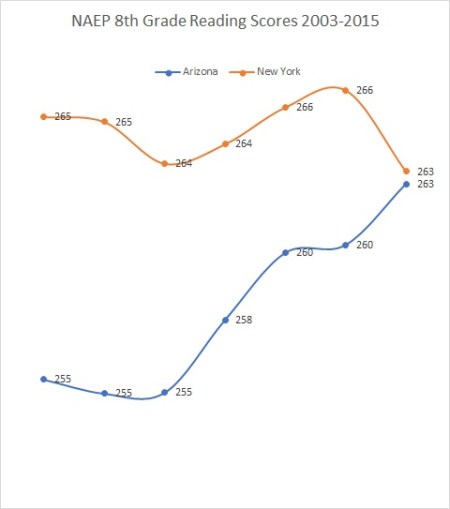
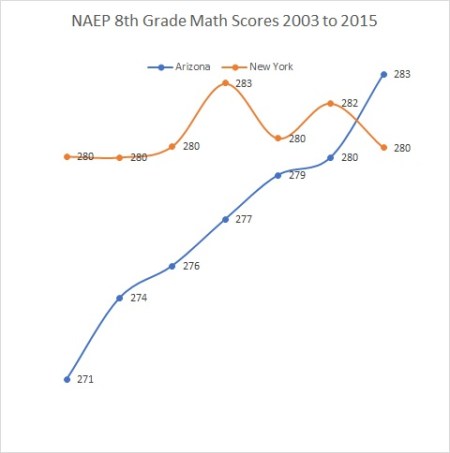
I could provide links showing AZ spending per pupil spending increasing over the last three years (could someone please put their foot on my personal finances like this?) but that is just too easy. The genre features either an explicit or implicit assumption that spending is tightly tied to academic outcomes. The folly of this assumption is easily demonstrated. The National Center for Education Statistics for instance pegged current (not total) spending per pupil in Arizona at $7,562 in 2013-14 and New York at $20,440. Delightfully however Arizona students closed the academic gap with New York students.

Just in case you suspect some sort of Math fluke:

If you are a New Yorker, your sadness is entirely fathomable. Data like those in the above charts ought to have people rioting in the streets of Albany demanding to know just what is being done with their tax dollars?

If you live in Arizona, sadness looks unfathomable indeed. If you can’t be happy leading the nation in academic gains then you either have very odd K-12 priorities or else just lack the necessary talent for living happily ever after. Neither problem here!


Organizations Can’t Disrupt Themselves

January 17, 2018

(Guest Post by Matthew Ladner)

I’ve been hearing through the grapevine for a long time that Denver’s much ballyhooed portfolio strategy was in deep trouble. Robin Lake calls it out today in Denver’s Storied Portfolio District is Starting to Act Like Just Another City School System.

It might be more useful to think of this as: the Denver district has acted like just another city school system for almost its entire history, flirted with the idea of being something different, but then yielded to political gravity in an entirely predictable fashion.

Clayton Christensen explained years ago that organizations don’t disrupt themselves. Mainframe computer manufacturers did not deftly transition to making personal computers rather than die- they just died. Every other brand in General Motors took every opportunity to slip their knives into Saturn’s back- sure enough GM eventually squandered an enormous amount of public goodwill for Saturn before it eventually died. School districts don’t willingly hand over empty buildings to outside operators. All of this falls somewhere on the water is wet, objects fall to the ground, you don’t fight a land war in Asia spectrum of the self-evident.

Jay noted years ago that you can call your district Superintendent a “harbor master” but in the end it is a tomatO tomAto exercise, especially if they are still hired and fired by boards elected in single digit turnout elections dominated by incumbent interests. Building new rather than attempting to reform the old remains the best strategy.


The Houston Almond Dome?

January 16, 2018

(Guest Post by Matthew Ladner)

California’s drought riddled Central Valley produces 80% of the world’s almonds, but each nut takes a gallon of water to produce. Hmmm.

By spraying mineralized water on plant roots, vertical farming techniques have succeeded in reducing agricultural water use by 91% in some crops. You need enclosed climate controlled space, and the price of real estate is a key consideration.

Now comes word that scientists have succeeded in increasing crop yields by keeping plants under lights 24/7.

Which leads us to…the Astrodome.

The so-called “8th Wonder of the World” when it was built became antiquated. The Houston Oilers moved away to become the Tennessee Titans in search of a modern stadium, and the Astros eventually moved to their own space as well. When the NFL put an expansion team in Houston, a new stadium was the price of poker. The Houston Texans modern stadium sits right next to the Astrodome.

There was a city referendum on turning the old dome into some sort of park. It failed. It was said that they would tear the thing down if it didn’t pass, but perhaps because of the expense of hauling away the rubble it is still sitting there.

So…anyone see where I am going with this? Houston would be better off selling the dome for a dollar than spending millions to demolish it and haul away the remains. Especially if you could, you know, steal another California industry in the process. The Astrodome is dead, long live the Almond Dome!


But conscience asks the question,  ‘Is it right?’ 

January 15, 2018

(Guest Post by Matthew Ladner)

JPGP reader Charles Miller, a great Texas education reformer that we lost in 2017, authored one of my favorite guest posts back in 2010, reprinted below. Miller rose to the defense of the DC Opportunity Scholarship program during the days in which the Obama administration was attempting to kill it. Miller quoted the great Martin Luther King Jr. in defense of the program, making it an opportunity to remember both men. Happy trails Charles, and thank you for taking time to share your wisdom to the next generation:

Early in the Obama administration I was surprised and deeply disappointed by their decision to kill the “DC Voucher” Program.  I wrote most of the piece below at that time and the decision brought me back into the public K-12 debate.  The U.S. Senate recently voted 55-42 to confirm that decision, essentially on a party line vote, so I am sending this to go on record about something I think is horrendously wrong. –Charles Miller
————————————————————————————————————————————————–
April 4, 2010

What Martin Luther King Said About Speaking Out

“Our Lives Begin to End the Day We Become Silent About Things That Matter”
(Martin Luther King)

The Obama administration, through stimulus funding, the Race to the Top program, its presentation of budgets and proposals for reauthorization of NCLB/ESEA , has moved fast and furiously in the public education policy arena.  It seems very unlikely to me that high aspirations—and hasty action— equate to effective public policy.  In fact, these efforts seem to amount quite clearly to an overreach–strategically, systemically, politically, and culturally

However, what bothers me the most personally is what I consider the most unprincipled action in public education policy since the existence of segregated schools:  The willful decision by the Obama administration, supported by the Democrats in Congress, to kill the D.C. Opportunity Scholarship Program, also called “D.C. Vouchers”

The Obama administration has tied its education policy declarations to a mantra of being non-political and non-partisan, choosing instead a policy focus only on “what works”.  This principle has been repeated incessantly.

However, the D.C. Opportunity Scholarship Program (OSP) is a successful program.

The Department of Education’s official evaluation using rigorous “gold standard” experimental evaluations determined that the OSP has produced significant achievement gains.

The OSP is serving those families and children most in need in one of the worst school districts in America.  Average income of participating families  is less than $24,000 annually and more than 85% of participating students would otherwise be attending a failing school under NCLB guidelines.

D.C. residents polled by three unaffiliated firms in ’07, ’08, and ’09 showed between 66 and 75% support for the OSP.  The D.C. superintendent and the Mayor support the program.

The decision to kill the program is contradictory to anything the administration claims to be its guiding principle.   The cost of the successful OSP is financially very small by comparison to any K-12 standard while at the same time there has been a gigantic increase in education spending nationally— to support status quo systems which are widely considered failures. Strong evidence of success, academically and financially, clearly makes the decision to kill OSP unprincipled.

The reason for killing OSP is the intense opposition of national teachers unions to a voucher program of any kind, anywhere, anytime—even if it is academically successful, financially responsible and so popular with the community served that there are long waiting lists.

If this successful program had been able to be replicated—a fear obviously driving the decision to kill OSP—the number of students from the most disadvantaged families whose life prospects could have been enhanced could be quite large.  This consideration makes the decision to kill OSP even more egregious, although even helping a small set of students is the principled thing to do.

Notably, from the Washington Post, “Duncan had the temerity to admit that OSP students ‘were safe and learning and doing well…but we can’t be satisfied with saving 1 or 2 percent of children and letting 98 or 99 percent down’.”

The effect of the decision to kill OSP on the lives of the students who could have benefited from its continuation is extremely negative.  There is no way to avoid this conclusion. If a social scientist extrapolated the trends of two sets of students, one in OSP and one in a typical DC school, the loss of life opportunities would be stark for the typical set of students.

The inescapable conclusion I reach is that killing OSP is a despicable and unconscionable decision made for political purposes and with cynical disregard for the lives of the children affected.  “Obama could have stood up for these children, who only want the same opportunities that he had and that his daughters now have.  Instead his education secretary, Arne Duncan, proffered an argument that would be funny if it weren’t so sad:  Scholarships for poor students aren’t worth supporting because not enough of them are given out” (Washington Post, 3/8/10)

This when joblessness for 16-to-24-year-old black men has reached Great Depression proportions — 34.5 % last October and estimated to having exceeded 50% by last year end.

The other conclusion I reach is that policy advocates or officials who turn their face away or avoid taking a strong stand against the decision to kill OSP because it is not pleasant or not convenient to their own activities have a hand in the ignoble results of the decision.  “In the end, we will remember not the words of our enemies, but the silence of our friends” (Martin Luther King)

So, for me personally, I can’t justify supporting such an administration or its policy makers even if some of their other policy choices are more productive, nor can I see believing anything they say or trusting anything they do.  It can no longer be acceptable to be principled just some of the time.   No Mas.

“Cowardice asks the question, ‘Is it safe?’  Expediency asks the question, ‘Is it politic?’  Vanity asks the question, ‘Is it popular?’  But conscience asks the question,  ‘Is it right?’  And there comes a time when one must take a position that is neither safe, nor politic, nor popular, but one must take it because one’s conscience tells one that it is right.”  (Martin Luther King)

Charles Miller


Time to Bet on Black in 2017

January 11, 2018

(Guest Post by Matthew Ladner)

I am going to be on a panel at the Arizona Townhall tomorrow about racial achievement gaps, so this had me taking a look at data. Arizona’s Black students had the highest NAEP 8th grade math scores in the country in 2015, so this got me curious to how close this would get them to the lowest average statewide scores for White students (not that this bar is high enough but better to pass it than not and sooner rather than later or never).

Put me down for $20 on the 2017 NAEP- I’m betting on Arizona Black baby!


Will Arizona school funding volunteer to serve as electoral cannon fodder?

January 10, 2018

(Guest Post by Matthew Ladner)

Back in 2016 word reached my ears that Arizona Democrats planned to nominate a particular candidate for Governor and to put a replacement for Proposition for 301 on the 2018 ballot with or without Governor Ducey’s support. Prop. 301 was a voter approved six tenths of a cent sales tax passed by voters in the early aughts and set to expire in 2021. The sales tax raises a significant amount of funding. Like clockwork, sure enough the candidate is running and efforts are apparently underway on the tax front as well.

So…where to start?

The history of ballot tax proposals for education is very consistent: without the active support of the Governor, they fail. With the support of the incumbent Governor they pass, often by narrow margins. Prop. 301 narrowly passed with the support of Governor Hull, First Things First narrowly passed with the support of Governor Napolitano, a temporary sales tax increase passed with the support of Governor Brewer, Prop. 204 failed almost 2-1 with Governor Brewer staying neutral in 2012, Prop. 123 narrowly passed with Governor Ducey’s support in 2015 (no tax increase involved).

An interesting divide emerged during the Prop. 123 campaign. While the Arizona School Boards Association and the Arizona Education Association agreed to the settlement, deciding that getting an additional $3.5 billion today and seeking more tomorrow constituted a reasonable decision. Much of the Arizona left however resisted the settlement. Stated motives involved misgivings about wanting more money, but the risk of getting zero dollars from the suit were substantial. They therefore decided to settle the case, which required a vote of the public to increase the state land trust payout.

The South Carolina legislature has apparently ignored a SCSC school funding order for decades. Something about separation of powers and legislative authority to appropriate money I take it. If you can’t imagine the Arizona legislature seeing things in a similar fashion, you might want to exercise your imagination a bit more often. Prop. 123 was a reasonable compromise in my book and personally I decided my yes vote was a no-brainer- why pile up additional money into a trust with a payout set at a fraction of that required by public charities?

Much of Arizona’s left however seemed to see this primarily through the lens of electoral politics. While public statements focused on a (highly speculative) case for more money, privately the left fumed that the settlement had foiled what they saw as a golden political opportunity. I never heard anyone say that they yearned for the constitutional crisis described above, but let’s just put it on the table that there were people yearning for a constitutional crisis. The Arizona Republic’s Bernie-Bro columnist brigade gave every appearance of falling into this category. Education interests divided between those who actually cared about funding and those who are happy to use school funding as a sacrificial pawn to their partisan ambitions imo.

In any case, rumor around town is that the ASBA and AEA were effectively paralyzed by the divide in their bases, leaving Governor Ducey in the position of getting the proposition over the finish line. It has probably never been harder to give away $3.5 billion.

Which leads us up to the present day. Governor Ducey has stated publicly that he is open to renewing Prop. 301 before expiration, but apparently some think it is better to go in 2018 without his support. The risk of this to school funding is considerable. Imagine Governor Ducey wins reelection and a son of 204 fails goes on the 2018 ballot. The prospects for 301 renewal would appear to fall somewhere on the grim to implausible spectrum. This is of course is a risk worth taking if you don’t actually care about school funding a la those who claimed to support public schools but wanted a political issue more than $3.5 billion in school funding.

I’m not sure whether this strategy represents the best available for the Arizona Democratic Party or not. Whether it is or isn’t it is obviously very risky for school funding. As the folks who actually care about school funding grapple with the polarized nature of their tribe it is worth considering the following: even if the wildest dreams of the left came true there is no giant pot of money here in Arizona to put into K-12- regardless of the outcomes of the 2018 elections.

Imagine for a moment that a Democrat takes office as Governor in 2019 and for the first time since who knows when Democrat majorities in the legislature. Even in this wildest dream scenario, the same competing demands for funds, and the same 2/3 requirement in each chamber needed to raise taxes. In other words, the only avenue would be the ballot just as it is now.

The question therefore boils down to whether a bipartisan vote in 2019 have a better chance of prevailing, or a blatantly partisan 2018 effort that will not have the support of the Governor? This boils down to a debate on the left between those who actually care about school funding, and those who mostly prize it as a political issue.


Winners and Losers in the John Rawls Reading Challenge 2003 to 2015

January 8, 2018

(Guest Post by Matthew Ladner)

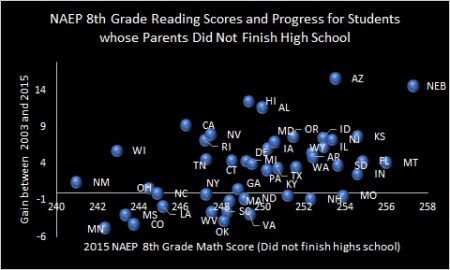
So I’m just going to leave this chart here:

Feel free to blubber in the comment section about how somehow the kids with parents that did not finish high school are the hardest to educate in the planet in state X. On second thought feel free to skip it. Every state has their excuse. That sound you hear is us laughing them off here in our pleasant patch of cactus (our state’s excuse used to be kids crossing the border not being able to read English or Spanish).

Scores unavailable in Alaska, Maine, Utah and Vermont. Rawls background here.

The 2017 NAEP results will arrive in March or April. I hope your state does better next time. I’ll update this chart when the new data comes out, but in the meantime, I am reminded of the below quote: