Tampa Tribune Beats the Rush

July 1, 2009

Greetings from Tampa

(Guest post by Greg Forster)

The editors of the Tampa Tribune have decided not to join the misinformed rush to judgment on Florida’s tax-credit scholarship program:

It’s too early to accurately gauge the students’ academic progress, as the University of Florida economics professor who oversaw the report emphasized. It measured only first-year test gains. Researcher David Figlio was handicapped by incomplete data for a baseline.

I’m shocked to see that in print. A newspaper actually checked the facts!

I do have to quibble with the editorial’s assertion that the Figlio study shows students who select into the program are among the most “academically challenged.” We don’t, in fact, know that. We know that they are more likely to come from schools that are among the most academically challenged. But school characteristics and individual student characteristics can vary considerably.

This matters because choice opponents have relied upon unsupported assertions about selection bias to wave away the consistent empirical research consensus showing that school choice works. In fact, the Figlio study doesn’t allow us to address this question, as the study itself explicitly says. Other research that does examine this question has not turned up any serious evidence that vouchers either “cream” (selecting high performers) or “dredge” (selecting low performers).

But the editors are back on solid ground when it comes to finances:

The program is a good deal for taxpayers.

Attending public school costs more. When local, state and federal costs, plus capital costs, are factored in, the average cost per student in public school is $12,000.

In the voucher program, the maximum scholarship is $3,950, about 57 percent of the roughly $7,000 the state pays per public school student.

And a scholarship parent pays on average $1,000 a year for their child to attend the private school. The program requires the parents and child to be motivated.

By taking challenging students from poor-performing schools, the Tax Credit Scholarships are easing the burden on the public school system, not diverting resources.

Kudos to the Tribune for checking the facts rather than rushing to judgment!


Welcome to School Choice, Indiana!

July 1, 2009

Welcome to Indiana

(Guest post by Greg Forster)

Yesterday, Indiana Gov. Mitch Daniels signed a budget bill that contained a $2.5 million school choice program. It’s a tax-credit scholarship program that will serve a couple thousand students.

So much for the negative nabobs who think school choice can’t win! No matter how many times it wins, they just keep sticking their fingers in their ears.

There are some eligibility restrictions, but they’re not as bad as the ones on the “legacy” programs in Milwaukee and DC that are restricted to the poor. This program is more in the mold of existing tax-credit scholarship programs in places like Pennsylvania, which include moderate-income families – in Indiana, the eligibility is set at 200% of the cutoff for free and reduced lunch programs. Also, like the program in Florida, Indiana’s program is limited to students who were in public school the previous year.

This means that the program isn’t ideal, but will be much easier to defend against union chicanery than the highly vulnerable “legacy” programs, which don’t provide much benefit to powerful constituencies able to mobilize and preserve the program. Indiana’s program isn’t leading us toward universal choice the way Georgia’s is, where a universal voucher bill is moving through the legislature. But it’s maintaining the gains school choice has made in the last five years, as the movement has moved toward more and more universal choice.


Pass the Popcorn: The Red Violin

June 26, 2009

Title Screen

(Guest post by Greg Forster)

I don’t get to see many movies anymore – at least, not many by my standards. And when you can only see maybe four to six movies a year in the theater, you’re going to end up seeing the obvious ones – Batman, Star Trek, whatever Pixar does this year, etc.

But there was a time when we used to see a lot of movies. And that meant we had the luxury of picking through the enormous pile of garbage that is the arthouse and finding the few movies that make the arthouse worth going to. So I’m going to start using our Pass the Popcorn feature to show off some of our “finds,” in the hope that they won’t fade too far into obscurity.
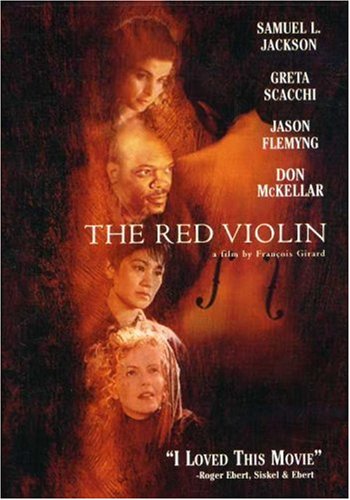
The Red Violin

The Red Violin stars Samuel L. Jackson as the most badass professional musical instrument appraiser you will ever see depicted on screen. I’m serious, don’t mess with this guy. At one point a clerk fails to deliver an important package to him promptly, and he tears into the clerk so hard I thought he was about to start reciting passages from Ezekiel.
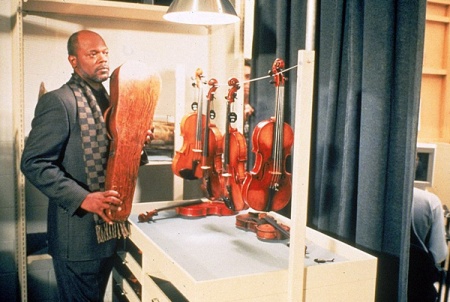
Jackson & violins

“And you will know my name is the LORD when I lay my violin upon thee!”

OK, now that I’ve sold Matt, here’s what the rest of you need to know.

The movie tells the story of a violin that was created by a Renaissance Italian craftsman as his greatest masterwork. Over the course of the movie, the action shifts back and forth between three storylines.

Making the violin 2

In 17th century Italy, we see the craftsman’s initial aspiration – to create an instrument worthy of his love for his unborn child, due to arrive any day, to whom he intends to give the violin as a gift. But in a surprise twist at the end, the violin comes to have a different, but equally profound, significance for him.

Jackson peeking

In our own time, the violin is going up for auction. Everyone else thinks the violin is nothing special, but badass appraiser Samuel L. Jackson suspects otherwise – that it may be the long-lost “red violin” made by that famous Italian craftsman. Once the truth becomes known, everyone wants the violin – but nobody other than Jackson wants it for the right reason, leading to a surprise twist at the end in which Jackson triumphs over the greed and pride of his adversaries.
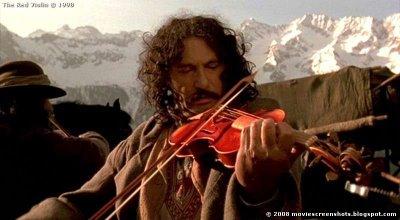
Gypsy

In between, we see what happened to the violin as it travelled around the world between its creation and its eventual rediscovery. Each vignette in this storyline illustrates the characteristic ways in which different civilizations have responded to the mystery of great art.

Kaspar dressed up

18th century Vienna is so obscessed with technical skill that art is reduced to mere performance – the ability to play very complex pieces very fast is valued above beauty. Following this path ultimately leads to the reduction of art into the novelty act of child prodigies – because the younger you are, the more amazing your skill is, and that’s all that counts. Form obliterates matter, and since form can’t exist without matter, it obliterates itself, ending in tragedy.

Victorian couple playing violin

In Victorian England, by contrast, “art” is put up on a pedastal and idolized. “Creativity” is fetishized to the point where mere novelty and thrill displace beauty, just as mere technique had displaced it a century earlier. Craftsmanship goes out the window in favor of irresponsible artistic self-indulgence. Matter obliterates form, and since matter can’t exist without form, it obliterates itself, ending in tragedy.

In China with violin

In 20th century China, during the cultural revolution, just to have an interest in art as such is a life-threatening proposition. The state holds that art, like everything else, exists only for political ends, so the desire to make art for the sake of beauty is an act of treason against the people. Far worse to make art that has western origins, given the regime’s awkward attempt to fuse its totalitarian ideology with crude appeals to nationalistic Chinese chauvanism. Yet in the end, the totalitarians prove as incapable of eradicating the desire for beauty as they are at eradicating any of the other fundamental desires of human nature.
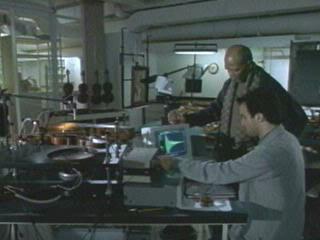
Jackson & restorationist

What do we want beauty for? All answers other than “we want it because it’s beautiful” ultimately prove futile. The goodness of beauty, like the goodness of knowledge or the goodness of virtue, is categorical. Make it instrumental towards some other good and you destroy it.

What, then, should we do with beauty when we find it? To that, the movie has a definite answer, and I think it’s exactly the right one. But to find out what it is, you’ll have to see those two surprise twist endings I mentioned earlier – and I’m not spoiling them for you. Go rent it and find out.

The Supreme Court’s Special-Ed Vouchers

June 24, 2009

(Guest post by Greg Forster)

Following up on Jay’s observations on the Forest Grove School District v. T.A. decision – not being a lawyer, I’m not going to dwell on this point. But it seems to have passed under the radar and I want to bring it out into the open so that others, who may be better qualified than I, may give it the debate it deserves.

For years, whenever I’ve explained that if the IEP procedure (over which schools have predominant control) does not deliver to students their IDEA rights, the only recourse parents have is a lawsuit, people have looked at me like I was nuts. They just stare with this dumbfounded look on their faces. The system can’t really be that crazy, can it?

The Supreme Court seems to have the same dumbfounded look on its face:

Having mandated that participating States provide a FAPE [free and appropriate public eduction] for every student, Congress could not have intended to require parents to either accept an inadequate public-school education pending adjudication of their claim or bear the cost of a private education if the court ultimately determined that the private placement was proper.

Now, as a psychological observation (which it is formally presented as being) this is farcical. Why couldn’t that have been Congress’s intention? Why assume Congress had pure and unsullied motivations when it created IDEA, rather than allowing the possibility – just as a possibility – that Congress knew darn well what it was doing, and decided to screw over children with special needs in order to serve its real constituents?

But, of course, while this is formally a psychological observation, it is serving the function of legal reasoning. What the court is really saying is that it would be fundamentally unjust – it would be a disgusting inversion of the fundamental function of the law – for Congress to deliberately legislate a right and then create a process desigend in a way that effectively denies relief to people if they are denied that right. So the court is entitled to assume that this was not Congress’s intention.

This takes us very rapidly into deep philosophical waters. Should the court interpret the law on the assumption that Congress does not intend to use the law as a cover-up to screw innocent people?

This, it seems to me, is one of the problems that motivates Scalia’s distaste for framing legal interpretation in terms of “original intent” rather than what he calls “original public meaning.” And I’ve always thought, without being an expert in the field, that “original public meaning” was a much more plausible standard for legal interpretation.

Does that explain Scalia’s dissent in this case?

Discuss among yourselves.


The Lie Seems to Be Spreading

June 15, 2009

Pinnochio

(Guest post by Greg Forster)

Here on JPGB we’ve been tracking the progress of Dick Durbin’s lie that the DC voucher program didn’t show academic gains – which is all true except for the part where it says that the program didn’t show academic gains. (We’ve also had some fun passing along the AP’s reprot that Durbin tried to help Rod Blagojevich make a deal for Barack Obama’s vacant Senate seat.) Now it would appear that we’ve made our way back upstream to the source.

A little bird told me the NEA has mailed out the following letter to all U.S. Senators. Note the line I’ve highlighted.

June 11, 2009

Dear Senator:

On behalf of the National Education Association’s (NEA) 3.2 million members, we would like to express our strong opposition to proposals reportedly under consideration in the Armed Services Committee to provide private school vouchers for military families.

Vouchers are not real education reform.  Pulling children out of the public school system doesn’t solve problems – it ignores them.  Real reform will put a qualified teacher in every classroom, keep their skills up to date with continuing education, and raise pay to attract and retain the best teachers.

Proponents of a military family voucher program have cited the District of Columbia voucher program as a model.  However, the DC voucher pilot program, which is set to expire this year, has been a failure.  In fact, over its five year span, the pilot program has yielded no evidence of positive impact on student achievement.

Vouchers are clearly not the right solution to ensure every student the highest quality education.  Voucher schools are permitted to maintain their admissions standards and can reject any public school student they choose.  They can reject students based on prior academic achievement and on the basis of gender.  Students with special needs often cannot find a private school that can serve them.  In contrast, public schools serve all students who come through their doors.

Providing vouchers for 750,000 students in military families stationed in the United States would be a huge expense.  These resources would be much better spent on to ensure ALL children the highest quality education.  The U.S. Department of Education has created the What Works Clearinghouse (WWC) clearinghouse to help school districts, educators, parents, and other stakeholders choose programs that have been proven effective.  A brief review of their database revealed dozens of programs that have been scientifically proven effective at improving student achievement in reading and math, at increasing the likelihood of students staying in school and completing their education, and at improving the language and achievement of English language learners.  We have attached examples of these programs for your information.

Again, we urge your opposition to any proposals to create a private school voucher program for military families.

Sincerely,

Diane Shust
Director of Government Relations

Randall Moody
Manager of Federal Advocacy

Of course, the whole letter is shot through with dishonesty – but it’s the sort of dishonesty that’s routine in politics. (E.g. The empirical evidence consistently shows that vouchers do in fact “solve problems,” not only by helping the students who use them but by improving public schools.)

The highlighted sentence, on the other hand, represents the kind of thing you normally can’t get away with. No matter how many Senators you buy.

Hey, here’s a question (and not just for Leo): If vouchers are really so bad, why do their opponents have to lie about them all the time?


Pass the Popcorn: Where Are They Now?

June 12, 2009

(Guest post by Greg Forster)

Don’t let anyone tell you Pass the Popcorn doesn’t take accountability seriously. Opinion about pop culture is so ephemeral, it’s easy to get away with writing crud because you know nobody will remember it in ten minutes anyway.

So to hold myself to a higher standard, here’s a retrospective of my 2008 movie posts, along with an updated opinion with the benefit of 20/20 hindsight (including home viewing where applicable).


Speed Racer

Speed Racer

What I thought last year: Fantastic. Much more than a thrill ride – an exceptionally well constructed and executed melodrama. One of the best movies I’ve seen in years. But I probably won’t enjoy it as much on a small screen.

What I think this year: Boy was I wrong about that last part.


Iron Man

Iron Man

What I thought last year: A better-than-just-good movie that could have been great, except the marketing suits wouldn’t allow the movie to be either clearly pro-weapons-makers or clearly anti-weapons-makers, so the central character development around which the whole movie is built is left ambiguous. That and the climactic battle is lame.

What I think this year: The ambiguity isn’t as bad as I had thought – there are some subtleties that I missed. What’s driving Stark’s crisis of conscience is not that making weapons was bad per se, but that his weapons are being abused. So I’ll upgrade the movie from better-than-just-good to really good. But the battle is still lame.


Hulk 1

The Hulk

What I thought last year: The last Hulk movie really stank in spite of having been made by one of the few really great moviemakers of the 1990s, and this one doesn’t look any better. The Hulk character is probably unfilmable; the emotional intimacy you get in comics and (to a lesser degree) on TV isn’t available in the movie format, so the character’s dependence on anger probably just can’t be well exploited on film. I’m going to skip it.

What I think this year: No regrets.


The Happening

The Happening

What I thought last year: Shyamalan got lazy and his work has gone precipitously downhill. Early reports indicate this doesn’t look like the movie that will turn him around. Skip.

What I think this year: No regrets.


Wall E

Wall-E

What I thought last year: It’s an “A” movie about a lonely robot who discovers companionship, wrapped in a “C” movie about the evils of consumerism.

What I think this year: The more I watch it, the easier it gets to ignore the “C” movie.


Hancock 3

Hancock

What I thought last year: Boy, it’s fun to remember Will Smith’s early-90s novelty act. And this was a fun movie. But not one I’d feel the need to see again.

What I think this year: Yup.


Joker 2

The Dark Knight

What I thought last year: Well, I wrote about it six times (here, here, here, here, here and here) so that gives you an idea of what I thought.

What I think this year: Was six posts really enough?


Quantum-Of-Solace

Quantum of Solace

What I thought last year: Fantastic potential. Squandered.

What I think this year: Can’t wait for the next movie. Can wait to buy this one.


WSJ Dances Kabuki

June 12, 2009

Pollyanna

(Guest post by Greg Forster)

First it was Mike Petrilli, now the Wall Street Journal joins the Obama/Duncan dance on charter schools.

Kids, simply having a charter law does not mean you actually have charter schools worthy of the name.

It can’t be! The Journal!

Jim, we knew this was a possibility when we first confirmed the presence of the kabuki phenomenon.

But . . . the Journal!

The Wall Street Journal is a newspaper, subject to the same political imperatives as any other. To expect it to be immune to kabuki would be illogical.

Oh, come of  it! This is the Journal we’re talking about, you green-blooded hobgoblin! Can’t you think about anything but logic at a time like this!

Shouting will not remedy the situation, doctor. I recommend we ask Mr. Checkov to arm the photon torpedoes.


What Is Competition?

June 5, 2009

Monopoly - Pennybags

He’s done such a good job with your schools,
now he’s going to run your health care!

(Guest post by Greg Forster)

Mike Petrilli notes that Barack Obama and Paul Krugman are using the language of “competition” to mask Obama’s ambitions for a government takeover of the health care sector.

Krugman writes:

The “public option,” if it materializes, will be just that – an option Americans can choose. And the reason for providing this option was clearly laid out in Mr. Obama’s letter: It will give Americans “a better range of choices, make the health care market more competitive, and keep the insurance companies honest.

Mike responds:

You mean just like creating charter schools will give Americans “a better range of choices, make the education system more competitive, and keep the teachers unions honest”?

So in education, where the government is the major player, we’re trying to create competition via the private sector. But in health care, where the private sector is still a major player, we’re trying to create competition via the public sector?

Weird.

Mike, “weird” is not the word you’re looking for. Try “wrong.”

In health insurance, as in education, there’s no “market” deserving the name. But the way the government eliminates the market is slightly different. In education, government destroys the market by providing the service for “free” (of course you pay for it in your taxes, but it’s free at the point of service), making it impossible for anyone to compete; other providers are stuck serving niche markets. Whereas in health care government uses the tax code to force almost everyone to get insurance through their employers, which also eliminates the market, but more sneakily.

It’s as though government told you that from now on, your employer gets to pick one restaurant for you, and from now on you’re only allowed to eat out at that restaurant. They’d say that it’s a free market – because, hey, the restaurants are privately owned and there are multiple options available!

So it’s not surprising if the health sector and the education sector seem similar. Both are government-controlled command economies. The difference is, in the health sector you have these huge privately owned companies acting as rent-seekers, siphoning off tons of money and getting away with it because government has abolished the market forces that ordinarily weed out leeches – as Matt once explained to our Sith apprentice Leo. Whereas in the education sector, the rent-seeker siphoning off tons of money is the government itself.

The Obama/Krugman proposal isn’t about creating competition for private health insurers. That’s a smokescreen. It’s simply the first step toward making the command economy in the health sector more like the command economy in the education sector.


Twin Editorials on Milwaukee Vouchers

June 4, 2009

Weasley Twins

(Guest post by Greg Forster)

This morning the Wall Street Journal and National Review Online both take on the covert effort to destroy Milwaukee vouchers by political subterfuge.

From the Journal:

Because the 20-year-old program polls above 60% with voters, and even higher among minorities, killing it outright would be unpopular. Instead, Democratic Governor Jim Doyle wants to reduce funding and pass “reforms” designed to regulate the program to death. The goal is to discourage private schools from enrolling voucher students and thus force kids to return to unionized public schools.

From NRO:

Last week, the legislature’s Joint Finance Committee approved a series of auditing, accrediting, and instructional requirements that will force successful voucher schools to shift resources away from classrooms and into administration. Several schools will have to comply with new bilingual-education mandates, even though many immigrant parents choose those schools precisely because they emphasize the rapid acquisition of English instead of native-language maintenance.

Both editorials also mention looming cuts in funding for vouchers, even though the program saves huge taxpayer dollars and the bloated government schools are getting increases in funding. Both editorials cite Robert Costrell’s calculation that the difference between private school efficiency and public school bloat has saved taxpayers $180 million – though only NRO mentions Costrell by name.

And NRO also gets a gold star for this:

Researchers say that the program is beginning to show systemic effects. In other words, it doesn’t merely help its participants. It also gives a lift to non-voucher students because the pressure of competition has forced public schools to improve.

C’mon, Wall Street Journal, get on the ball!


Was He Stupid or Lying? Durbin-Blagojevich Edition

June 3, 2009

Durbin

(Guest post by Greg Forster)

A while back, noting Sen. Dick Durbin’s flagrantly false statements about the DC voucher study – he said the study didn’t show voucher students outperformed the control group, which is entirely true except for the fact that it did show voucher students outperforming the control group – Jay asked “is he stupid or lying?”

“Of course,” he added, “when it comes to an Illinois pol, one doesn’t have to choose. He could be both.”

Not long ago, when Sen. Durbin made similarly misleading (though now more carefully weaseled) statements in USA Today, Jay remarked, “I’m beginning to lean toward the lying end.”

The first sign of a good scientist is that he adjusts his theory in response to new data!

Well here’s another new datum to factor into our “stupid or lying” calculus. The AP reports that Durbin offered to help Rod Blagojevich make a deal for Barack Obama’s Senate seat. Take it away, AP (emphasis added):

CHICAGO (AP) – Just two weeks before his arrest on corruption charges, then-Gov. Rod Blagojevich floated a plan to nominate to the U.S. Senate the daughter of his biggest political rival in return for concessions on his pet projects, people familiar with the plan told The Associated Press.
 
Blagojevich told fellow Democratic Sen. Dick Durbin he was thinking of naming Illinois Attorney General Lisa Madigan to the seat vacated when Barack Obama won the presidential election, according to two Durbin aides who spoke on condition of anonymity…
 
The aides said the concessions Blagojevich wanted in return were progress on capital spending projects and a health care bill that were stalled in the Legislature…
 
According to the Senate aides, Durbin was delighted to hear that Blagojevich was thinking of naming Madigan to the seat. He believed she would be a popular figure in Illinois and stood perhaps the best chance of holding the seat against a Republican.
 
Durbin volunteered to call the attorney general or the speaker to get the ball rolling and possibly broker an agreement, the aides said.

When the AP came calling about the story, Durbin’s office offered no comment.

Moe Lane of Red State comments: “This would only be a bombshell if it had been unexpected…Senator Dick Durbin has had since November some very significant corroborating evidence that Governor Rod Blagojevich really was corruptly auctioning off a Senate seat.  This is information that would have been very helpful when it came to the timing of Blagojevich’s impeachment, seating Burris, and/or fixing the entire problem with a special election.  And yet, Durbin did or said nothing. I don’t wonder why.  Then again, I know enough about this story to know that the Senator hadn’t realized that his talks with Blagojevich were being recorded.”

Lane highlights the implication that Durbin knew about Blago’s corruption all along, and kept vital information under his hat during the crisis. And Illinois-based politicians betraying the public trust by keeping vital information out of public circulation during a crisis does seem to be emerging as a meme in the DC voucher story.

But doesn’t it seem more important that AP is reporting Durbin offered to help broker the deal?

Yes, what Durbin offered to help arrange was not a bribe to be paid directly to Blago. It was conessions on Blago’s pet projects, including “capital spending projects.” Yet that’s bad enough, isn’t it? I’m aware that people take alliances and rivalries into account when they make these kinds of appointments. But isn’t it something else entirely to arrange a quid-pro-quo transaction of legislative votes for nominations?

And if you insist that there must be a personal bribe involved before we can say it’s wrong, let me ask you: given what we know about Blago, what kind of odds would you give that he wasn’t going to wet his beak on any of those “capital spending projects”? And doesn’t that make Durbin complicit? Or just how dumb are you willing to say Durbin is?

HT Moe Lane, via Jim Geraghty