Pass the Popcorn: Luck Is for Suckers!

January 6, 2015

2014-03-07-annie

(Guest post by Greg Forster)

How do I love the new Annie movie? Let me count the ways:

1) It’s really entertaining, as long as you don’t expect too much from it. It’s not saccharine and treacley like the original Annie. In fact, the very first thing you see on the screen is a huge, completely unsubtle, on-the-nose message from the filmmakers announcing: “This Annie will not be saccharine and treacley like that other Annie!” It’s a hilarious gag.

There’s a real artistry to the way this movie does the Annie story without treacle. I think half my enjoyment of the movie was admiring how they pulled this off.

Consider how they handle “Tomorrow.” You can’t have Annie without “Tomorrow.” But audiences in the post-Seinfeld culture are not going to sit still for “Tomorrow.” Not unless you do something that forces them to. How to do it? By putting the song in an unhappy scene. Annie gets a major disappointment – life basically kicks her in the teeth. The sad moment just lingers on screen quietly for a bit. And then Annie half-says, half-sings to herself, quietly, “the sun will come out tomorrow.” And a moment later she’s singing “Tomorrow” and it’s slowly but surely building steam. And you’re rooting for her.

These people actually know how to make a frikkin’ movie. Can you believe it? Where have they been for the last twenty years?

2) It has a fantastic set of core values. After the opening scene, Annie is racing out of school to get somewhere she needs to be on time. Her friends call out: “Hope you make it!” “We’ll cover for you!” “Good luck!” And to this last statement she turns around and shouts back: “Luck is for suckers!” We then follow her through the city as she uses her ingenuity (and several prominent product placements) to get where she needs to be on time.

The basic message of this movie is: “Yes, life often sucks, but if you work hard and have guts, you can get ahead. Once you do, remember that you need people, too.” And we can’t have too much of that these days.

The Daddy Warbucks character – who for obvious reasons can’t be called “Warbucks” anymore so he is now, cleverly, “Will Stacks” – takes Annie on a helicopter ride above the city. The following exchange occurs (I quote from memory):

Annie: So how did you get to be the king of the city?

Stacks: I don’t think I’m the king of anything. I just work my butt off. The harder I work, the more opportunities I have. In life you have to play the hand you’re dealt, no matter how bad the cards are.

Annie: What if you don’t have any cards?

Stacks: You bluff.

He then sings her a song – a song! – about how anyone can get ahead if they work hard and have “heart.” To some extent it even oversells the point; in fact, not everyone can get mega-wealthy and become famous and have a helicopter. But like I said, you can’t have too much praise for hard work these days.

Praise for hard work is basically hope.

3) The core values are wrapped in a (mild and relatively unobtrusive) progressive political veneer. Some of my conservative friends are put off by the movie’s occasionally bowing toward the idols of contemporary liberal fashion. To the contrary, that enhances my enjoyment. If the work ethic is exclusively “conservative,” only conservatives will have the work ethic. If praise for hard work is hope, seeing hard work affirmed across ideological lines provides some justification for that hope. And this leads me to my next point.

4) What I think I enjoyed most is that the makers of this movie felt responsible to the story of Annie. I almost wrote, to the “franchise,” but the “franchise” is essentially the business value of the Annie story to its copyright owners, and while that is considerable, this is about more than that.

Most remakes or reboots pay relatively little attention to the heart of the story they’re handling. They keep the superficial stuff the same – the names of the characters and so on – but they want to “update” the franchise, make it marketable today. So they swap out the old engine (the heart of the story) for a new one, and keep the chassis more or less the same for the sake of brand recognition.

This movie keeps the engine and swaps out the chassis. That’s what a remake ought to do.

So of course there are some mild liberal pieties. The Annie story is about rich and poor; there used to be a time when you could tell that story without politics, but not now. Of course there are several major plot twists that would never have worked in the original Annie. They do work with this Annie. The point is, this Annie is still Annie.

And of course the millionaire is now black and has an interracial love interest. That’s the world we live in now, everyone.

Annie is all the more Annie – she is more Annie than she ever was before – for being black. Who has more right to sing “It’s a Hard Knock Life”? And who has had more occasion to learn that life means looking toward “Tomorrow” by faith rather than by sight?

The story of Annie has always been America’s ideal of itself at its best. I’m not sure a black Annie isn’t a greater sign of triumph over historic injustice than a black president.

Now why on earth didn’t they name him “Bill” Stacks?


Pass the Popcorn: How Bad Will Hollywood Get?

December 19, 2014

wws-harris-birdman1

(Guest post by Greg Forster)

Check out this excellent essay on the way franchises have transformed Hollywood. It is not, I promise, just another long lament that there are too many comic book movies, too many sequels, etc. The author, Mark Harris, is thinking seriously about Hollywood’s business model, and there are lots of data and interesting quotes I haven’t seen elsewhere. Seeing the list of franchise movies already announced from the major studios really was an eye-opener. And he makes an insightful point about how Hollywood is now so skilled at creating anticipation that it’s forgetting to provide the payoff. What used to be payoff is now only a calculated part of a larger plan to keep building anticipation for the next product.

Now! That having been said, I think Harris is too pessimistic, for two reasons.

1) While Harris acknowledges that not all franchise movies are bad, and some are very good, he nonetheless seems to assume as a basis of his case that artsy movies – that is, movies intended to be serious rather than mere ephemeral entertainment – are, on the whole, more likely to be very good than franchise movies. This has not been my experience. Even if we discount the value of entertainment and judge strictly on “artistic merit,” I think franchise movies are about as likely to be very good as artsy movies. Not because franchise movies are necessarily good, but because artsy movies generally fail to have much more artistic merit than franchise movies. My wife and I were avid moviegoers during the very height of the independent movie era, and we saw a lot of them. Most of them had “entertainment value” rather than “artistic value.” They were witty or exciting or whatever, and we enjoyed them while we were watching them. But most of them were not great art.

Harris estimates that about 150 franchise movies will open in the next six years. At the end of the article he concedes that some of them – “more than two and fewer than twenty” – will be “very good.” Let’s say “more than two and fewer than twenty” is ten movies. That’s less than two very good movies per year, so it’s a conservative estimate. If so, by his own showing one out of every fifteen franchise movies is “very good.” I’d put up that track record against the arthouse any day.

2) Harris assumes consumer tastes will not revolt against the rise of the franchise. Franchises rule because they are financially rewarded. Must this remain so, even after franchises have squeezed everything else off the studio slate? I see no reason to think so, and every indication that consumers are already clamoring for something else. The idiots who run Hollywood just haven’t figured out how to give them anything else. But someone will, and when they do, the bubble will pop. (Barriers to entry in the entertainment sector are rapidly approaching zero.)

On both points, Harris’ argument fatally rests on the assumption that movies made for the purpose of having artistic merit rather than for the purpose of pleasing general audiences are more likely to have artistic merit. Yet there is little empirical evidence this is the case.


Fix Schools by Not Fixing Them

December 19, 2014

resized_can-we-fix-it

(Guest post by Greg Forster)

OCPA’s Perspective just went online with my article on how to fix schools by not fixing them:

Wanting something too much can prevent you from getting it. In school, we all knew at least one unpopular kid whose desperate, overbearing desire to have friends and be liked was the main reason nobody wanted to be around that person. Sit down with a loved one and say, “now let’s have a really good talk,” and silence will result. The hypochondriac protects himself from germs so well that his immune system is weakened from disuse, and he gets sick…

It’s an insidious trap. The dysfunctions of the system are so bad, we tell ourselves, that we can only fight them if we give money and power to those who will promote the reforms. Once these people have money and power, they set about consolidating their position, working not to improve education but to reinforce their access to money and power. And because they have been anointed as the people whose job is to “fix the public schools,” they tell themselves – sincerely – that they’re building up their own money and power for the sake of improving education. It’s for the children.

I argue that the reason school choice has the best track record of improving public schools is that “improving public schools” is not its formal purpose:

School choice improves public schools precisely because it does not make an idol out of “fixing the public schools.” In fact, it fixes public schools precisely because it establishes that the educational needs of children are more important than the institutional needs of public schools. Instead of taking children for granted as a captive audience, schools must educate children or lose them.


Fun With Peer Review

December 9, 2014

PHD Comics

(Guest post by Greg Forster)

I may have to revise my opinion of Vox; they seem to have taken an interest in the weaknesses of the peer review system. Of course there are a lot of responsible peer-reviewed journals and, well, peers. But there a lot of the other kind as well, and we are long past the point where simply having gone through something called “peer review” ought to count for anything.

One story details how unscrupulous researchers can manipulate journals, including – amazingly – posing as their own reviewers. In highly specialized fields, journal editors may not know who the appropriate reviewers would be, so they rely – apparently uncritically in some cases – on the “recommended reviewers” supplied by the article authors. Who in some cases are simply the authors themselves using another email address. One scientist used 130 email accounts to create a vast, self-validating “peer review and citation ring”; 60 papers were recently retracted after a 14-month investigation uncovered the fraud. A total of at least 110 articles have been pulled in the last two years due to this type of fraud.

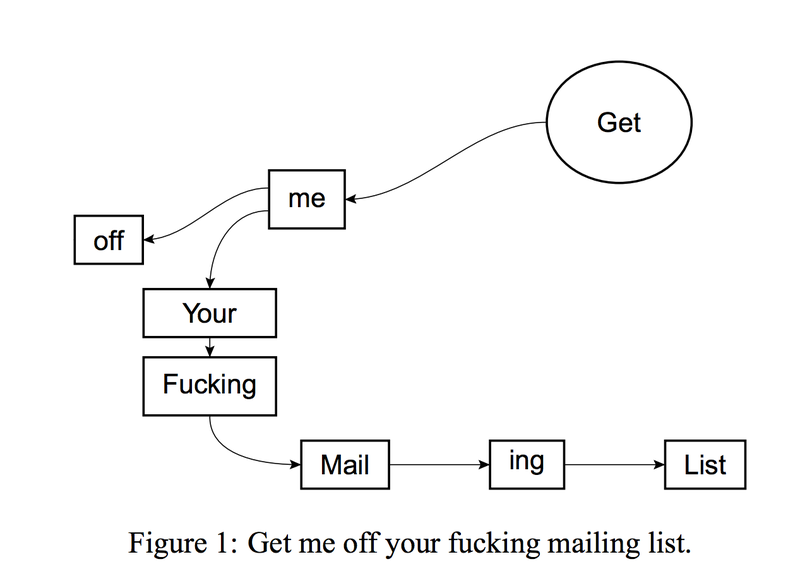
Get me off your email list

Figure 1 from the article “Get Me Off Your Fucking Mailing List”

Accepted for publication by the highly reputable International Journal of Advanced Computer Technology

But the other story is a lot better. It details how some journals now survive not by selling subscriptions or getting institutional support, but by charging a fee to publish your paper. They are apparently known as “predatory journals” because they spam the email universe looking for gullible (or, presumably, unscrupulous) people looking to break into publication. “Article mills” (after the analogous “diploma mills”) would seem a more appropriate name.

As you can see above, the “peer review” process becomes somewhat lax in these cases. One pair of scientists slapped the above-referenced article and began submitting it to peer review spammers. They were amused to discover that one journal accepted their article for publication. Another journal not only accepted but published an article (consisting of nonsense text) by Maggie Simpson and Edna Krabappel. It now sends the authors regular demands that they pay their $459 bill.

But it’s not just spam scammers – peer review controls are easy to get past even at some highly reputable publishers.


Episode VII, Special Edition

December 4, 2014

(Guest post by Greg Forster)

Ladies and gentlemen, humor is now concluded. We have a winner.

(You won’t get it if you haven’t seen this yet, but then, if so there’s no hope for you anyway.)


Welcome to Weimar!

November 14, 2014

minaj11f-2-web

(Guest post by Greg Forster)

It’s been a while since we had a post on union goons shutting down debate by force. It happened again yesterday at AEI.

In other news, the central bank has spent years flooding the economy with cheap money, and fascist imagery is now cool and transgressive.

Willkommen . . . bienvenue . . . welcome!


Peter DeComo for Al Copeland Humanitarian

October 30, 2014

DeComo

Jon David Sacker and Peter DeComo

(Guest post by Greg Forster)

In the storied tradition of Herbert Dow and the inventors of the heatball, I am proud to nominate Peter DeComo for this year’s Al Copeland Humanitarian of the Year.

DeComo is the chairman and CEO of ALung Technologies, which produces cutting-edge innovative medical technologies that save lives when lungs fail. Get this – ALung makes a gizmo called the Hemolung Respiratory Assist System, which can keep you alive without using your lungs long enough for doctors to perform a double lung transplant, including the time needed for your body to accept the new lungs and start using them.

Pretty awesome, huh? In a perfect world, that alone would be enough to qualify DeComo for public honors.

But we don’t live in a perfect world, and few people have seen that illustrated as starkly as Peter DeComo.

You see, the Hemolung is in active use, saving lives across Europe and Canada – but not in America, the land of its birth. This lifesaving device was invented here, but apparently “for export only,” as Mark Steyn put it. It’s not approved for use in the U.S.

But that didn’t stop Peter DeComo.

This February, Jon David Sacker was rushed to the University of Pittsburgh hospital after his body rejected the transplanted lungs he’d received two years earlier. The Hemolung was his only hope of survival. It was the Hemolung or the hearse for Sacker.

Pittsburgh happens to be the city where ALung manufactures the Hemolung. The University of Pittsburgh is the medical school where the Hemolung was invented. And there were no Hemolungs at the university hospital.

But that didn’t stop Peter DeComo.

The closest Hemolung fit for actual use was in a Canadian town on Lake Ontario. DeComo hopped in the car and personally drove north to the border crossing. He made the trip in the middle of the night, having gotten the first phone call at 11pm. He was met by Murray Beaton from the Canadian hospital, who had popped the device into his car and driven south to meet DeComo. They met and handed off the device in the dark on a tiny dirt road just north of the crossing, and DeComo headed back toward Pittsburgh and the desperately ill Sacker.

Whereupon the border guard informed DeComo that he was not allowed to bring the Hemolung into the U.S., because it was not approved for use there.

DeComo told him that a man’s life was at stake. No dice. Apparently the people who rule our country are perfectly willing to take “someone’s life is at stake” as a reason to actively help terrorists commit more murders and destroy our freedom, but not as a reason to let Jon David Sacker go on breathing.

But that didn’t stop Peter DeComo.

DeComo’s brilliant split-second thinking saved Sacker’s life. The Toronto Star relates the key moment:

Then he changed tactics. He said that he wasn’t really importing the device. Since it was an ALung product and he was ALung CEO, the Hemolung was his property and he was simply retrieving it.

“He closed his little cabin door,” DeComo said. “He made a call and he came out and said, ‘Okay you can go.’”

God bless Peter DeComo.

Are you ready for the kicker? Here it is:

Before they sped off, the border guard shouted out one last comment.

As DeComo recalls, he said: “Hey, let me tell you something. I would recommend that you keep some of that (expletive) on your shelves and next time, you won’t have to make that drive.”

I’m sure he’d love to. In the meantime, since I can’t give him a sane world, I will give him the next best thing: a nomination for Al Copeland Humanitarian of the Year.


School Choice and Religious Freedom

October 30, 2014

Marcher with flag

(Guest post by Greg Forster)

OCPA’s Perspective has published my article on how school choice promotes religious freedom, pluralism, and peace:

It’s folly to be afraid of letting religious institutions participate in public programs on the same terms as everyone else. That kind of oppressive Kemalism has only exacerbated religious hatred when it’s been tried in places like Turkey or France. Americans have historically been more enlightened.

Believe it or not, school choice often helps children learn to respect the rights of those who don’t share their faith, and has never been found to have the opposite effect. A large body of empirical research (reviewed by Patrick Wolf in an article titled “Civics Exam” in the journal Education Next) finds that private school students are more likely to support civil rights for those whose beliefs they find highly unfavorable. Five of these studies have specifically looked at school choice programs; of those, three found the choice students were more tolerant of the rights of others while two found no difference. No empirical study has ever found that school choice makes students less tolerant of the rights of others.

The occasion for the article is an unwise legal decision as an Oklahoma school choice program winds its way through the painfully slow processes of the legal system:

If the church is burning down, don’t call the fire department! That’s using government funds to benefit a church. If someone scrawls swastikas on the synagogue, don’t call the police! And heaven forbid we allow the mosque to use our municipal water and sewer lines. Alas, Judge Jones doesn’t see things that way, and the case will continue its four-year journey through the courts.


Over One Billion Saved

October 1, 2014

McDonalds billions

Watch out, Ronald. We’re catching up!

(Guest post by Greg Forster)

Matt seems to have been a little distracted by the Ramones yesterday, so for those who are still wondering, the new study from the Friedman Foundation is a comprehensive financial audit of modern school choice programs. It finds that choice has already saved $1.7 billion. As Matt notes, Friedman produces some pretty awesome slideshows that let you absorb tons of information in two minutes. Check it out below and let us know what you think!

The School Voucher Audit: Do Publicly Funded Private School Choice Programs Save Money? from The Friedman Foundation for Educational Choice

Stop Nick Cage Before He Kills Again!

September 25, 2014

Spurious Correlations

(Guest post by Greg Forster)

This graph of the correlation between the number of Nicholas Cage films and the number of swimming pool drownings in each year (correlation = 0.666004) and many more await you at Spurious Correlations.

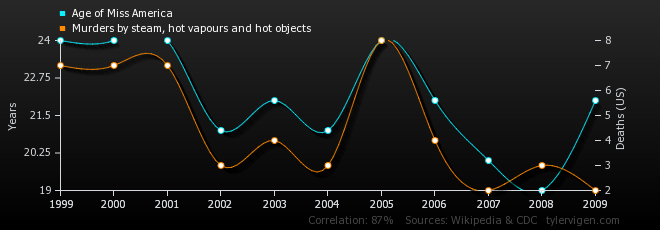
Here’s the graph of the age of Miss America and the number of murders by steam, hot vapors and hot objects (correlation = 0.870127):

Spurious Correlations 2

Perhaps you scoff at such weak correlations. It may interest you to know that the marriage rate in Kentucky and the number of people who drown after falling out of a fishing boat correlate at 0.952407! What on earth are newlyweds doing in Kentucky, and how do we put a stop to it?

HT Michael Strain