We took the contributions by Larry Cuban (from Stanford University), Matthew DiCarlo (the Shanker Institute), Anna Egalite (North Carolina State University), Rick Hess and Paige Wiley (the American Enterprise Institute), Ashley Jochim (the Center for Reinventing Public Education), Matthew Ladner (the Charles Koch Institute), Megan Tompkins-Stange (the University of Michigan), Martin West (Harvard University), and Daniel Willingham (the University of Virginia) and boiled it down to three trade-offs and three lessons.
EdChoice carries my post using the new NAEP results to bring us back to our earlier discussion of Ian Kingsbury’s finding about what our condescending friends at NACSA do to minority charter operators:
If you’re wondering why the education status quo wants heavy regulation, ask yourself why Facebook CEO Mark Zuckerberg asked Congress to regulate social media: Regulation cements the power of dominant providers, shutting out smaller and less powerful rivals. That’s why heavy regulation does so much damage to minority communities. They have less political power to influence the content of regulations — which more powerful providers can shape in their own favor — and less ability to afford the enormous cost of compliance.
Borrowing Matt’s graphic above to make the point about Louisiana, land of the overregulated NACSA dream.
The article is an updated and peer-reviewed version of the article we posted on SSRN last fall. In it we discuss the combined results of five experiments we conducted in which students were randomly assigned to go on a field trip to see live theater or be in the control group. In two of those experiments we added a second treatment condition in which students went on a field trip to see a movie version of the play. We found that students randomly assigned to see live theater experienced significantly higher tolerance and social perspective taking as well as stronger knowledge of the plot and vocabulary of the plays than the control group. Being randomly assigned to the movie treatment did not produce these same benefits.
So there seems to be something about experiencing live theater that cannot easily be produced by watching a movie instead. Given how often schools are inclined to watch movies and how rarely they are now willing to go see live theater, these results are quite relevant.
When I was a kid in the 1970s someone wrote a book about UFOs having visited earth in the past called Chariots of the Gods. The only thing I remember about this book was a photo of an ancient stone staircase and a caption that read “Staircase going down-to a spaceport?” Someone else wrote a book called “Crash Go the Chariots.” I never examined this book, but I imagine that it was a bit like shooting fish in a barrel.
I am in the midst of reading Jonathan Haidt’s The Righteous Mind: Why Good People are Divided by Politics and Religion and found the following passage quite striking. The book summarizes a great deal of psychological research to reach this point which I cannot do justice to, but roll with this in any case:
In the same way, each individual reasoner is really good at one thing: finding evidence to support the position that he or she already holds, usually for intuitive reasons. We should not expect individuals to produce good, open-minded, truth-seeking reasoning, particularly when self-interest or reputational concerns are in play.
Sounds dismal so far, but fortunately he goes on…
But if you put individuals together in the right way, such that some individuals can use their reasoning powers to disconfirm the claims of others, and all individuals feel some common bond or shared fate that allows them to interact civilly, you can create a group that ends up producing good reasoning as an emergent property of the social system. This is why it is so important to have intellectual and ideological diversity within any group or institution whose goal is to find truth (such as an intelligence agency or community of scientists) or to produce good public policy (such as a legislature or an advisory board).
Again, I can’t summarize the research that lead to this conclusion (read the book and see what you think) but basically Haidt lays out a case that says if you believe that you are some sort of scientist guided solely by sweet reason and evidence, you are the victim of self-delusion. Good reasoning happens through a social challenge process over time.
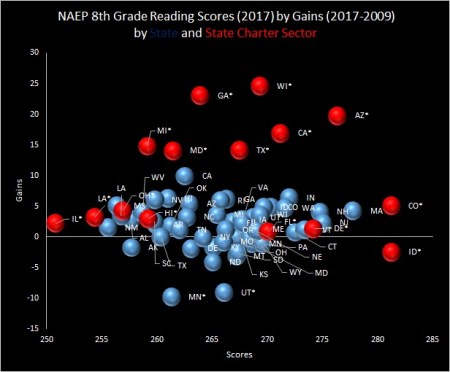
In that spirit of civil challenge, I’ll offer the following two charts. The first a scatterplot of the 8th grade reading 2017 scores by gains (2017 minus 2009 scores) for all 50 states and all 16 state charter sectors with scores in both 2017 and 2009.
There is a huge amount of success to celebrate in this chart for multiple state charter sectors, most of which have either unusually large gains, or unusually high scores, or else unusually high scores and gains.
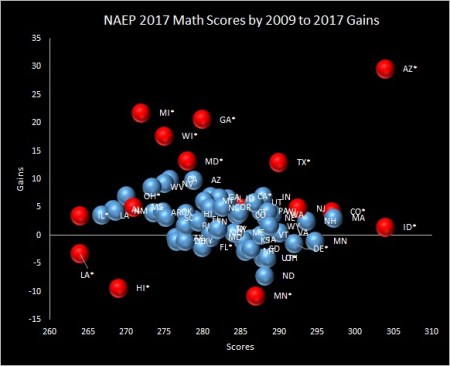
Do however take note of Louisiana’s charter sector position in the above chart. Now let’s look at the same chart for mathematics:
Again, there is a great deal to like here- multiple charter sectors with large gains (MI, WI, GA, MD, TX) or high scores (CO, ID) or both high scores and gains. Arizona, this one is for you:
Again however take a look at Louisiana’s charter sector-again low scores and low gains. A quick trip to the NAEP data explorer will demonstrate that this same trend is evident in 4th grade NAEP scores, and state scores have been trending in a negative fashion in recent years as well.
In recent years a school of thought arose in our space that a centralized authority or “harbor-master” could produce better outcomes by carefully controlling both the entrance and the exit of schools from charter sectors, primarily on the basis of standardized test scores. In the case of the Recovery School District in Louisiana, there was a period of strong gains in state test scores to buttress this belief. State test scores however have repeatedly shown themselves vulnerable to gaming and manipulation, especially when large consequences ride on them. Soviet steel makers reported non-stop prodigious growth in steel production for decades when facing such incentives as well. How much steel was actually made-who knows? Educators however have neither the incentive or ability to “teach to” or otherwise game the NAEP exams, which is why they have long stood as an external audit on state testing.
In this case, NAEP and state tests are both pointing in the same direction.
My preexisting belief, laid out previously on this blog, is that RSD was a very clever policy innovation for a district that at one point had little more than empty buildings to leverage. I’ve also however long suspected that the notion was over-hyped and ignored some very basic political realities. When for instance Denver announced that yeah, well, about that whole making facilities available thing, we’ve kind of discovered that we are a school district and that our dominant special interests don’t really like this idea after all. The reaction in my tribe was something along the lines of “duh- what did you think was going to happen?”
I’ll go further and say that RSD has a false allure for many of our technocratic friends: things can get better, but only if someone is in charge. Someone like me. True relinquishment means letting go: let operators develop new models, let parents respond to them, let the primordial soup bubble and bake. Don’t assume that you know what constitutes a “high quality education,” don’t aim a narrow vision of quality at a single type of community, allow the interplay of different choice programs to flourish.
Now, having fully confessed my preexisting beliefs, I have offered evidence that I believe confirms them. If someone has countervailing evidence to present, the comment section awaits your thoughtful challenge. If you buy into the harbor-master system, come and defend it.
My latest in OCPA’s Perspective is on ed schools as barriers to entry in the teaching profession:
Arne Duncan, the Obama administration education secretary, said in 2009 that “by almost any standard, many if not most of the nation’s 1,450 schools, colleges, and departments of education are doing a mediocre job of preparing teachers for the realities of the 21st-century classroom.” He said education schools are “cash cows,” and he’s right. Teachers who need credentials are hostages to the ed school system, so universities create ed schools in order to collect the ransom money.
In addition to economic rent-seeking, I also cover the ideological side of the problem:
Gregg Garn, the dean of the University of Oklahoma College of Education, lists “politics of education” as his first area of research interest. On his web page, a document full of left-wing political and policy posturing is listed more prominently than his curriculum vitae. I suppose since education schools seem to exist for political propaganda, it’s fair enough that he considers his political platform a more relevant credential to establish his qualifications than his academic track record.
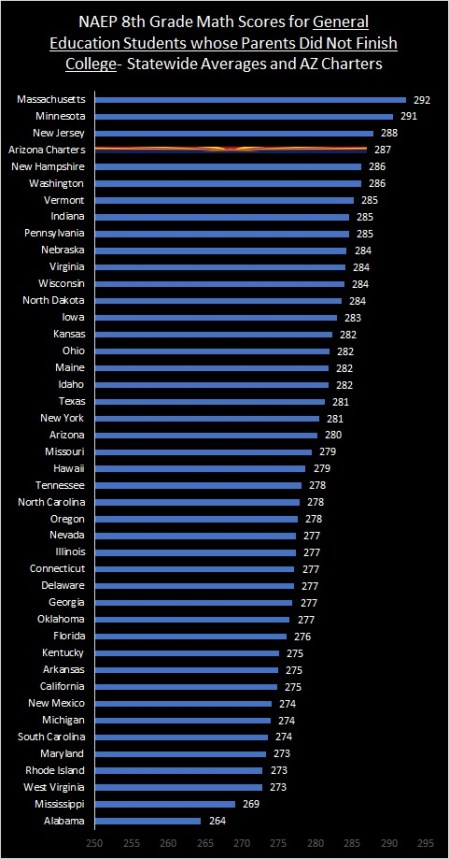
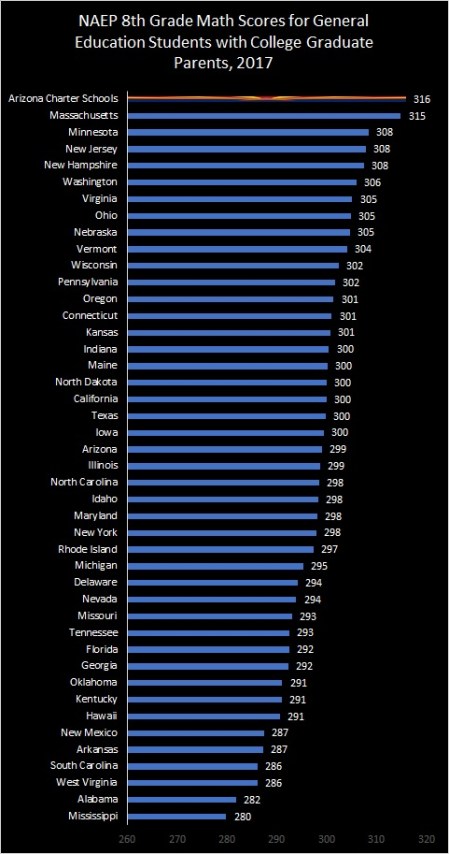
So Arizona charter schools rocked the 2017 NAEP again. In 8th grade math, Arizona charter students narrowly scored below the top scoring state (Massachusetts) in 2015 and above them in 2017. Arizona charter schools educate a majority minority student body, both overall and specifically in 2017’s 8th grade class. It’s really quite extraordinary to see them in the same academic neighborhood as MA, given their majority-Anglo, high income, spend twice as much per pupil combo status. If MA is a good sport, they would fight left handed- what chance does a majority-minority school system with half the spending per pupil have against the highest performing state education system in the nation many years running?
I decided to dig into the details.
The Free and Reduced Price lunch definition has become fairly sketchy, so in the below comparisons I will make use of parental education as a proxy for socio-economic status. Another source for variation between states and sectors involves special program students, so the below comparisons will focus on general education students (neither ELL nor SPED). The first set of scores are for students whose parents did not finish college and are in the general education program:
Massachusetts is still winning the duel, but not comfortably-switch to the right hand? Note for the record that 10 out of 10 of the top performing states have a majority Anglo student population. In fact you don’t spot a majority minority student population state until Texas pulls in at #19. Did I mention before that Arizona charter schools are majority minority? Oh, yes, well good that again then.
Now let’s run the same numbers for general education students with college graduate parents. This should be the MA right handed fighting btw- far more fancy degrees in Massachusetts than Arizona after all, more graduate degrees as well. Well, Arizona charter kids are not left-handed either:
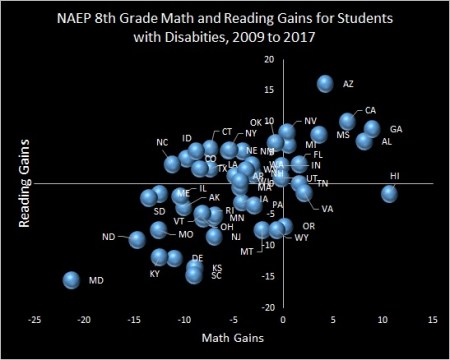
Last week I showed you the above chart on the math and reading trends for students with disabilities. As you can see, a plurality of states land in the quadrant showing declines in scores on both math and reading. Arizona landed as one of the few bright spots, and when I ran Arizona trends on all six NAEP exams since 2009 (when NAEP reconfigured the Science exams, the national economy collapsed and shortly into the then new Obama administration):
In both the AZ and the USA cases, these are the NAEP trends of students attending public schools. Just think of how much higher those Arizona gains might have been if these poor families had not been distracted by the opportunity to attend a private school or to customize the education of their child through the ESA program…
Today taxes are due, so it is time to announce the recipient of this year’s William Higinbotham Inhumanitarian Award. We had many (un)worthy nominees, so it was difficult selecting the winner (loser). My nominee, Derek Jeter, is certainly annoying in trying to make us eat our baseball vegetables by denying fans the fun distraction of mascot races while the team loses a lot of baseball games goes through its rebuilding phase. But the criteria for awarding The Higgy states that: “‘The Higgy’ will highlight individuals whose arrogant delusions of shaping the world to meet their own will outweigh the positive qualities they possess.” So, there should be some amount of coercion in whoever receives The Higgy and Jeter is not really forcing anyone to have no fun at baseball games. If anything, it is my own darn fault for being a Marlin fan. Jeter is just doing a poor job of running the team, but I am free to become a fan of another team or enjoy something else.
Jason’s nominee, Traci Wilke, was a principal who punished a student for secretly recording a teacher making threats against another student. There is clearly an element of coercion in the principal’s behavior, but if we started awarding Higgies to every school administrator who suppressed the revelation of unflattering information, we’d run out of space on the internet. It would be like handing out speeding tickets at the Indy 500.
This year’s Higgy really comes down to Greg’s nominee, Romanus Cessario, or Matt’s nominee, John Wiley Bryant. Greg’s nominee is certainly vile for defending the forced abduction of a Jewish child because he believes Catholic doctrine requires it. It almost feels like the sort of argument one might make as a freshman in college to see what ridiculous extremes you might reach if you followed a certain idea to its bitter end. But this is a serious grown-up writing in First Things, which was once a respectable outlet. As Greg notes, the really insidious part of the article is that it reveals how much social conservatives seem to be willing to abandon liberalism. The way I’d put it is that these days you don’t have to scratch much beneath the surface to discover how many Jew-hating authoritarians there really are out there.
But I think Cessario falls short because he has no ability to shape the world to his ends. Writing this kind of drivel has about as much influence on the world as the guy sitting on the park bench muttering to himself about how things will be different when he is in charge. Greg is right that abducting children is BSDD, but I think writing in defense of it falls short of being PLDD. The too-easy embrace of authoritarianism and Jew-hating by social conservatives is alarming, but Cessario is a very mediocre anti-Semite. He couldn’t even achieve excellence at that.
John Wiley Bryant is the most deserving of this year’s Higgy because he arrogantly and coercively sought to reshape the world in a way he imagined would be better, but ended up making it significantly worse. Like Matt and many other people of our generation, I gained significant cultural literacy (and had a ton of fun) watching Bugs Bunny cartoons. For trying to force us to watch “educational” television instead of freely choosing quality programming, John Wiley Bryant is awarded the William Higinbotham Inhumanitarian Award. He joins last year’s winner, Plato, the 2016 winner, Chris Christie, the 2015 winner, Jonathan Gruber, the 2014 winner, Paul G. Kirk, and the inaugural winner, Pascal Monnet.
Update — Thanks to Greg for being our official Higgy Historian and remembering earlier winners.
I have a post at OCPAThink on the lack of alignment between short-term test score changes and long-term life outcomes:
As an education researcher, I feel a little like an engineer hearing that the coefficient of gravitation has been cut in half as an energy-saving measure, or a mathematician getting the news that for the sake of simplicity, Pi will henceforth be rounded down to 3. We’ve spent a generation building our discipline—and education reform ideas—on the assumption that rising scores mean better education. If they don’t, we have to rethink everything.
We’ll have to look beyond tests for the next accountability – school choice and other forms of local control.
We won’t set high standards with the narrow tool of test scores alone. It takes a broad vision to know what education is, and qualitative human judgment to know when schools are providing it. The future of school accountability is the people at large—not a specialist expert class—empowered to use their full human judgment to evaluate schools that they know personally. In other words, school choice and other forms of local control.
The post contains tons of links to Jay’s writing on this, natch!
Education reform seems to be consumed by a string of fads. When things don’t work out, we tend to move on to the next fad without reflecting very much on what went wrong so that we might avoid that error in the future. Mike McShane and I recently edited a book on Failure, which explicitly attempted to correct this problem by acknowledging failures and trying to draw lessons from them.
To the extent that NAEP results are informative about school quality (and I’ve previously expressed my doubts about this), test scores for Louisiana charter schools have been falling off a cliff. In 8th grade math, for example, scores rose to as high as 280 in 2013, but have dropped to 264 in 2017. A change of 10 scale points is supposed to correspond roughly to a grade level, so this is a pretty precipitous drop over the last four years. In 8th grade reading scores rose to as high as 261 in 2013 before falling to 254 in 2017. 4th grade reading and math scores have similarly declined.
I’d like to hear what champions of the Louisiana portfolio model think is going on. I thought Portfolio Management was supposed to give us only high quality options — and it largely relies on test scores as an indicator of quality — so why are the scores dropping? Are Portfolio Managers actually not very good at predicting quality? Have there been other regulatory changes that came along with Portfolio Management that have harmed the educational environment? For example, the leaders of the Recovery School District were at the forefront of eliminating exclusionary discipline from schools. Could the change in school discipline have eroded behavioral control and harmed achievement? Of course, it is always possible that there have been changes in the composition of students in charter schools which have caused these declines, although virtually all schools in New Orleans are charters and the composition of the city has not changed that much in 4 years.
But it is important to remember that just eyeballing NAEP scores is a horrible way to assess causal effects of programs, so we should be very wary of attributing any change in scores to any policy or practice. Nonetheless, NAEP is useful for raising questions and generating hypotheses. I’d like to hear the hypotheses that supporters of Porfolio Management have to offer that might account for the precipitous drop in NAEP scores in Louisiana’s charter sector over the last several years.


 Posted by Jay P. Greene







 Jay P. Greene's Blog