Deep down in places they don’t talk about at parties, suburbanites want that wall, but broad choice can take walls down

June 12, 2017

(Guest Post by Matthew Ladner)

Important new study from the Fordham Institute on open enrollment in Ohio. The map above shows dark blue show districts not participating in open enrollment, and they just happen to be leafy suburban districts who are both higher income with student bodies that tend to be pale complected that also happen to be near large urban districts with many students who are neither of these things. Feel free to reference this map the next time someone claims that public schools “take everyone.”

Many moons ago I wrote a study for the Mackinac Center about the interaction between charter schools and open enrollment in Michigan. I found a very clear pattern among some of the suburban districts whereby charter schools provided the incentive for early open enrollment participants to opt-in. After one district began taking open enrollment transfers, and some additional charters opened, it created an incentive for additional nearby districts to opt in- they were now losing students to both charters and the opted in district. Through this mechanism, the highly economically and racially segregated walled-off district system began to:

Not every domino fell however. I interviewed a superintendent of a fancy inner ring suburb who related that they saw their competitors as elite private schools, not charter schools. When I asked him why his district chose not to participate in open enrollment, he told me something very close to “I think historically the feeling around here is that we have a good thing going, so they want to keep the unwashed masses out.”

Contrast this as well with Scottsdale Unified in Arizona, which is built for 38,000 students, educates 25,000 students, 4,000 of whom transferred into a Scottsdale Unified school through open enrollment. 4,000 transfer students would rank Scottsdale Unified as the 9th largest CMO in Arizona, and they are far from the only district participating in open enrollment in a big way. Why is Scottsdale willing to participate unlike those fancy Ohio districts? They have 9,000 kids living within their boundaries attending charter and private schools.

Why haven’t choice programs torn down the Berlin walls around suburban districts? Sadly because they have been overly focused on urban areas. The National Alliance for Public Charter Schools Dashboard shows that 72.6% of Ohio charter schools operated in urban areas. The voucher programs likewise started in Cleveland, and then expanded out to include failing schools (and children with disabilities statewide). More recently a broader voucher program has begun the process of phasing in slowly on a means-tested basis, but the combination of adding a single grade per year and means testing promises to unlock a very modest number of walled off suburban seats.

These programs have benefits, but they will not provide an incentive for fancy suburban districts to participate in open enrollment any time soon. Informal conversations I have had with Ohio folks related to me that Ohio suburban and rural dwellers- aka the people who elect the legislative majorities-tend to look at charter schools as a bit of a “Brand Ech” thing for inner city kids. Rest assured that the thousands of Scottsdale moms sitting on BASIS and Great Hearts charter school wait lists do not view charters as “Brand Ech.” Likewise these folks probably see themselves as paying most of the state of Ohio’s bills through their taxes and just might come to wonder why the state’s voucher programs seem so determined to do so little for their kids and communities.

A serious strategic error of the opening act of the parental choice movement was to look out to places like Lakewood Ohio or Scottsdale Arizona and say “those people already have choice.” This point of view is both seriously self-defeating in terms of developing sustaining coalitions, it also fails to appreciate the dynamic interactions between choice programs. Arizona’s choice policies include everyone and have created a virtuous cycle whereby fancy districts compete with charter and private school options for enrollment. This leads to a brutal crucible for new charter schools in Arizona whereby parents quickly shut many down because they have plenty of other options. Educators open lots of schools and parents close lots of schools-leading to world-class Arizona charter scores. Arizona’s charter NAEP score triumph was more or less mathematically inevitable once this process got rolling. Did I mention the part about Arizona leading the nation in statewide cohort NAEP gains since 2009? That too but Ohio not so much.

I’m open to challenge in the comment section from any of my Ohio friends or anyone else, but by contrast to these eyes Ohio’s choice programs look to be mired in an urban quagmire and they need the leafy suburbs to play in order to win. Current policies not only have not unlocked Ohio’s Scottsdale Unified equivalents, they likely never will. NACSA put Ohio’s revised charter school law in their top ten, but allow me to pull up a couch and heat up some popcorn for the next few years as charters lawyer up and parents resist arbitrary bureaucratic closures, and the rate of new schools opening goes glacial.

Competition is by far the best method of quality control and bringing the leafy suburban districts into the melee is crucial if you are in the urban fight to win. The districts currently largely untouched by charters and private choice overlap with those not participating in open enrollment. Regulating urban charters is not going to make your suburban districts into defacto CMOs. This.isn’t.hard.to.figure.out. While counter-intuitive to many if you want to secure improved education options for the poor, you need to include everyone.


Tech Billionaires and Schools-The Next Big Thing or Edufad 10,000.0?

June 7, 2017

(Guest Post by Matthew Ladner)

The NYT turns in an interesting article on Silicon Valley tech firms and public schools. I hope some of this stuff works out, but there seems to be little in the way of positive evidence as yet.


“Public Schooling” Is a Myth

June 5, 2017
jlo4xg

The answer is the same for the question: “Do ‘public schools’ serve all students?” Image credit: Snopes.

(Guest Post by Robert Enlow)

Some urban legends just won’t die no matter how many times they are disproven. My favorite is the one that sucked me in during college—the one where Phil Collins wrote the song “In the Air Tonight” after watching a friend refuse to help someone drowning. I admit that one had me going for a while.

In K-12 education, there is an even greater urban legend: that public schools accept all students. This legend is a huge porker that has been repeated so many times that almost everyone believes it is true.

But it isn’t, and it never has been.

First, people in power have always gamed the system. The powerful do it in our nation’s capital, according to a  report released recently by the U.S. Inspector General. The report found that the former D.C. Public School Superintendent, Kaya Henderson, regularly helped her wealthy constituents and friends game the public school lottery.

They do it in New York, where Deputy Mayor Richard Buery used every trick in the book to get his son into a prestigious public school.

And they are doing it like crazy in Chicago, where some public schools regularly over-inflated their enrollment numbers so they could get more money.

I can hear the wailing chorus now: There may be problems with some schools showing favoritism, but every public school really does accept every kid who comes to their doors. That’s the public school way.

But is it? What about the massive increase in selective admission public schools or magnet schools? In Chicago, selective schools enroll kids based on test scores, and they are now a huge chunk of the high school marketplace. Across the country, according to data at the National Center for Education Statistics, the number of selective enrollment magnet schools grew from 2,722 in 2010-11 to 3,254 in 2013-14. That is an increase of more than 500 schools in just three years.

And what about some of our most vulnerable special needs students? Surely, every single public school accepts every single student with disabilities. Think again. Public schools often contract with private schools or private companies to serve children who they can’t serve. According to the most recent data available from the National Center for Education Statistics almost 260,000 children in America, or 4 percent of all special needs students, fall into this category.

Moreover, any quick review of the headlines will show numerous stories showing that not every public school is adequately serving every child with special needs even though they have a legal obligation to do so. The simple fact is that not every public school is equipped—or required—to serve every type of disability. Public school districts can build public schools that specialize in children with specific disabilities such as autism. Or they can create alternative schools.

So, let’s not forget what most of us know but won’t admit: that it’s okay to choose private schools as long as the public schools do the choosing.

The legend says that public schools accept all comers. That is simply not true, and it never has been.

In fact, the entire system is set up to ensure that public schools don’t really accept all comers. That’s because attendance in public schools is based on geography—on where people live. What this means in practice is that public schools accept all kids who look like each other or who live in similar types of houses and whose family income is the same. K-12 public schools are more segregated by race and income than ever before.

And do you know what happens when a parent tries to cross the public school line or lies about where they live to go to a better school? The school districts use public dollars to hire private investigators to tail parents to check where they actually live. Then they send them to jail.

Not every student can actually attend every public school, and not every public school accepts and serves every child.

It’s time for a serious debate on how we can best serve all kids, regardless of where they live or where they go to school. And it’s past time for the urban legend that public schools serve all to die.

Robert C. Enlow is President and CEO of EdChoice.


Nevada Tries to Wish Away the Strain

June 5, 2017

(Guest Post by Matthew Ladner)

The Nevada legislative session appears headed to a disappointing end on the school choice front. Governor Sandoval backed away from his threat to veto the budget without funding for the ESA program, and a deal to increase the state’s modest tax credit program passed the Nevada Senate last night. Worse still, despite the wee-tiny Silver State charter sector a bill which appears replete with regulatory measures for charters are headed to Governor Sandoval’s desk. What do you do when you are the state with a catastrophic district overcrowding problem and the charter school tortoise of the region? More bureaucracy to the rescue!

Sigh.

In combination these actions signal an unwillingness to address Nevada’s K-12 challenges seriously. The overcrowding problem isn’t going away. The Review Journal reports that a majority of Clark County schools are over 100% capacity and they included this handy illustration:


Does this look like a state that should be only cautiously dabble with private parental choice? Should Nevada be rolling out the red carpet for charter school operators, or subjecting them to state-sponsored harassment? Can the new NFL football stadium being built for a billionaire be used for classroom space? From the Review Journal:

Of data for 344 schools, 230 are over capacity, according to the report. Among those schools, 68 are operating at 125 to 150 percent capacity and 35 are operating at 150 to 175 percent. Two are taking more than double their load, at over 200 percent.

Growing class sizes have been the result of both a budding population — particularly in the high-growth area of Henderson — and multimillion-dollar budget shortfalls.

Budget constraints in 2015-2016 increased class sizes in grades 4-12 by 0.5 students, saving $9.1 million, according to the district. Cuts in 2016-17 added one student in elementary classes and 1.5 students in secondary grades, saving $21.5 million.

That translates to a tight squeeze for teachers and students.

“I think (my son) has suffered, I’m sure he has,” said Rebecca Colbert, a Beatty Elementary parent who said her fifth-grade son is in a class of 39 students. “I know the teacher has. She’s been doing double work.”

8,000 students had filed applications to opt-in to the ESA program. This alone would not have solved Nevada’s overcrowding problems, but it certainly would have helped. The 2015 problems that prompted the NVESA program are larger in 2017 and will continue to worsen. The strain believes in Nevada, even if Nevada tries not to believe in the strain.

The NVESA program continues to exist in an unfunded state, awaiting the possibility of more enlightened leadership who are willing to take the steps necessary to get serious about Nevada’s K-12 problems.


“Not Just Taking Their Money”

June 1, 2017

(Guest Post by Matthew Ladner)

RedefinED profiles an interesting snippet from current Florida K-12 politics. There is quite the controversy over an omnibus ed bill that districts want vetoed. Districts don’t want charters, but they need them:

The same district leaders who complain about the Legislature and call for a veto also say they need charter schools to accommodate population growth, as funds are scarce to build new schools. This is especially true in the southernmost part of the county, where approved developments that were dormant during the recession are now springing to life.

Some also recognize that charter schools can give a second chance to students who fall through the cracks in the district system. Board member Susan Valdes, speaking at the May 16 board meeting, described two such students, one who lost a parent to military combat and the other who had been ill.

“If the governor signs the bill,” Valdes said, addressing administrators in the auditorium, “hey, life lesson that we should learn about really, truly taking care of our children — not just taking their money.”

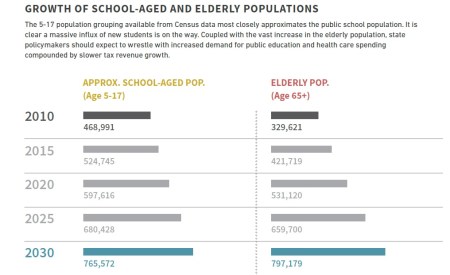
This is all going to get more challenging as Florida’s youth and elderly populations continue to expand. The current bill that stands at the center of the controversy includes a series of small but important steps in the needed direction. The yearned for veto will do nothing to address the reality that the Florida public school system must adapt to changing circumstances. Moreover “just taking their money” was an entirely reprehensible waste of human potential even during the easiest of times, which these are surely not. Just remember where you heard it first folks.