Parent Power Gives Teachers Freedom to Teach

September 20, 2016

classroom-435227_640

(Guest post by Greg Forster)

OCPA’s latest Perspective carries my article reviewing evidence suggesting that, where parents are in charge of education, teachers are free to teach. The data come from a study of federal teacher surveys that I did with Christian D’Andrea in 2009, but they are of fresh interest in light of the recent crisis over accountability in education reform.

Government power over schooling harms teachers in many ways. It takes away their control over what and how they teach:

On accountability, we found private school teachers were much more likely to say they have a great deal of influence on performance standards for students (40 percent versus 18 percent), curriculum (47 percent versus 22 percent), and discipline policy (25 percent versus 13 percent). They were also more likely to have a great deal of control over selection of textbooks and instructional materials (53 percent versus 32 percent) and content, topics, and skills to be taught (60 percent versus 36 percent).

It also saddles teachers with a legal and regulatory environment that prevents them from keeping order:

Shockingly, we found public school teachers were four times more likely than private school teachers to say student violence was a problem on at least a monthly basis (48 percent versus 12 percent). That means about half of public school teachers are being asked to work in an environment where violence is a regular problem. Nearly one in five public school teachers had been physically threatened by a student, compared to only one in 20 private school teachers (18 percent versus 5 percent). Nearly one in 10 public school teachers had been physically attacked by a student, three times the rate in private schools (9 percent versus 3 percent).

Where student violence is a problem on some days, student disorder is a problem every day. Sure enough, we found public school teachers were much more likely to report that student misbehavior (37 percent versus 21 percent) or tardiness and class cutting (33 percent versus 17 percent) disrupt their classes. One in eight public school teachers reported that physical conflicts among students occurred every day; only one in 50 private school teachers said the same (12 percent versus 2 percent). How are teachers supposed to teach?

The institutional environment is undermined by government control in other ways, too, undercutting teachers’ relationships with peers and school leaders:

Where parents are in charge, the school is free to be itself, and that cultivates a strong spirit. Private school teachers were much more likely to strongly agree that there is a great deal of cooperation between staff members (60 percent versus 41 percent), that their colleagues shared their values and understanding of the core mission of the school (63 percent versus 38 percent), and that their fellow teachers consistently enforced school rules (42 percent versus 29 percent).

These intangible factors affect how schools manage their more material affairs. Private schools almost always have smaller budgets than public schools. Yet somehow private school teachers were more likely to strongly agree they had all the textbooks and supplies they needed (67 percent versus 41 percent). They were also more likely to strongly agree they got all the support they needed to teach special needs students (72 percent versus 64 percent). And although their class sizes were only moderately smaller, private school teachers were much more likely to strongly agree that they were satisfied with their class sizes (61 percent versus 34 percent).

Sure enough, teachers who are accountable to parents are a lot happier than teachers who are accountable to government. Check it out and let me know what you think!


TXESA

September 20, 2016

(Guest Post by Matthew Ladner)

The Texas Public Policy Foundation, the Texas Business Leadership Council and Excel in Ed teamed up to publish a new white paper by yours truly called The Yellow Rose The Achilles Heel of Texas: Improving College Eligibility Rates through K-12 Savings AccountsBottom line: only a minority of Texas public school students get prepared for even a moderately selective college or university, and the percentage moves to catastrophically low levels when looking at the ethnic minority student groups which now constitute a large majority of Texas students. Meanwhile an annual 90k+ of new students per year has been driving resources out of the classroom and into debt, with no end in sight and an aging population that will slow revenue growth and create new costly problems in health care and pensions.

Judging from the number of applications received in the first year of NVESA, enrollment growth in Texas could be substantially slowed by a universal ESA program, which would give the public system a chance to focus resources away from the debt spiral of constantly building new facilities and then surrounding them with portable buildings. We could expect such a system to have the well-established positive effects for both participating and non-participating students, but also represents an opportunity for low-income students especially to save and build assets for future higher education expenses.


The 2016 AZ Merit: Improving but Meh versus Mehssachusetts

September 19, 2016

(Guest Post by Matthew Ladner)

The Arizona Department of Education released 2016 AZMerit data last week, and charter school students show an across the board advantage.

az-merit-2016

Breaking down the data by subgroups consistently show charter advantages as well. Let’s start with Anglos:

azmerit-anglo

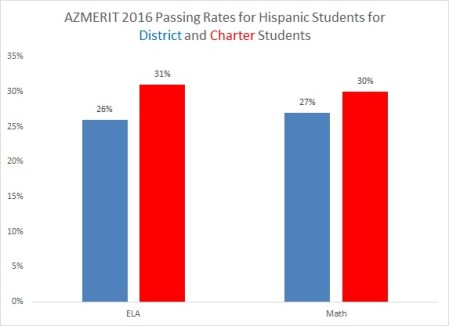
Move on to Hispanic students:

az-merit-hispanic

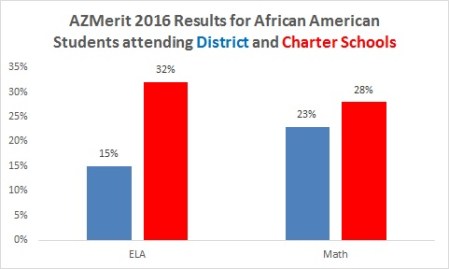
African-American students:

azmerit-black


Native American students:

azmerit-native-american

Asian students:

azmerit-asian

Special education students (btw the percentages of special education students among district and charter schools were roughly equivalent among tested students):

azmerit-sped

Economically disadvantaged students, but with an *.  A high percentage of Arizona charter schools do not participate in the federal free and reduced lunch program, and about 85% of alternative (dropout recovery) schools in Arizona are charter schools. Having said that, charter schools score higher again:

amerit-ecodis

This next chart required me to dust off my algebra skills and use the existing data to solve for X:

azmerit-non-disadvantaged

What we can take from this: while differences in student populations explains some of the differences between overall charter and district scores, when the charters lead in each and every subgroup it does not explain anything close to all of the difference. Every difference across every subgroup counts, and in the end the add up to:

az-ma

For those of you squinting at your Ipad, that is the statewide averages for Massachusetts (the highest scoring state) on the left, Arizona charters in the middle, and Arizona Districts.  MA of course is much wealthier and spends a great deal more than AZ, but when you break down the subgroups Arizona charter students outscore like students from Massachusetts, which makes me want to CeleNAEP good times here in the cactus patch:


Usual Suspect Mark Pocan spins a Keyser Soze story on GAO Parental Choice Report

September 16, 2016

(Guest Post by Matthew Ladner)

The American film classic the Usual Suspects (spoiler alert!) features a quick thinking unreliable narrator Verbal (played by Kevin Spacey) who concocts a vivid tale based on material on a bulletin board sitting behind the police officer who is interrogating him. Representative Marc Pocan has used equivalent powers of imagination and a recent GAO report on private choice programs as his bulletin board to spin his own imaginative and deceptive tale.

First the report:

gao

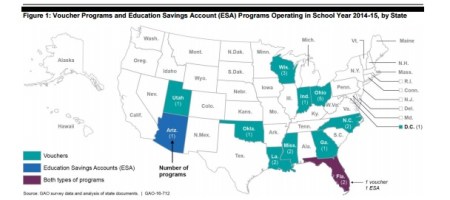
The report is a straightforward description of the nation’s voucher and ESA programs, and deals with primarily with a state of confusion among school districts as to whether they are obligated to provide “equitable services” to special needs students who participate in private choice programs. It’s a fairly dry 49 page read if you go through the report, although it does have the occasional interesting graphic like this one:

gao-1

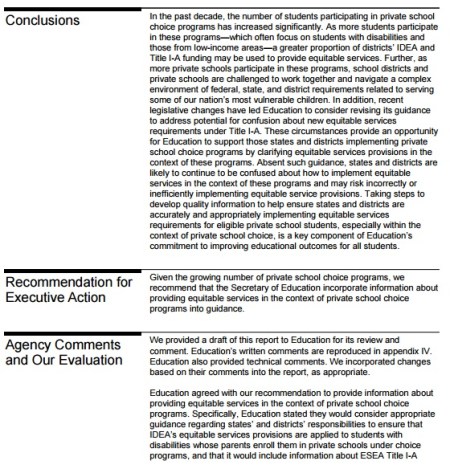
In any case after a number of pages of descriptive work the report concludes:

gao-4

You are welcome- I waded through this report so you wouldn’t have to!

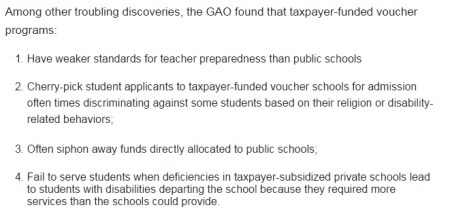
So from this bulletin board material Rep. Marc Pocanconcocts his tale of woe and destruction visiting down upon the states like Biblical plagues from private choice programs in a piece in HuffPo titled omniously Why You Should be Worried About the Rapid Rise of Private Voucher Schools:

gao-3

In other words, private choice programs are the most vicious gangster in the history of Pocan’s imagination:

These claims have even less to do with the GAO report than Officer Kujan’s bulletin board relationship with the tale of Keyser Soze.  The only “discovery” in the GAO report-districts are confused about whether they are obligated to provide special education services to students participating in private choice programs in the same fashion they do to other private school students, which is to say, not much to begin with. Thus the report recommends USDoE guidance to districts to dispel confusion because the districts retain discretion on whom to serve.

The real discovery here is that Rep. Pocan is willing to spin long-known facts about private choice programs into a breathless but ineffectual attempt at a hit piece. In order-

  1. Teacher prep has always been different between public and private schools and there is approximately zero evidence that traditional certification produces better learning, but hey if you want state certified teachers the public school system is still there as an option.
  2. Some private choice programs require schools to change their admission policies, but many do not. Let me know when you get the GI Bill to require random admission lotteries into the Ivy League and I’ll start to take you seriously on this. No? How about random lottery admissions for open enrollment transfers between district schools, who currently get to pick and choose at will? The total number of seats available may be greater for lighter touch programs and overly meddling with private schools can and has backfired in a lack of seats in high quality private schools.
  3. Money is following the child, lamest claim in the opponent playbook.
  4. Perceived deficiencies in taxpayer-subsidized public schools to students with disabilities is why parents choose to participate in the first place. Satisfaction surveys of special needs choice programs have been off the charts. Private choice programs expand the options for special needs parents.

Sadly, rather than engage in an intellectually honest debate, Rep. Pocan has constructed a boogey-man story and attempted to claim that the GAO told it to him before he started repeating it. They did nothing of the sort, and silly efforts like this is example number 89,623 of why choice opponents willingly surrender their credibility on a regular basis.


Texas Special Education Disgrace-“It Was All a Numbers Game”

September 13, 2016

(Guest Post by Matthew Ladner)

The Houston Chronicle has delivered an expose on a covert and “successful” effort by the Texas Education Agency to create a defacto cap of 8.5% on the number of Texas public school students who would receive special education services. Successful gets air quotes btw if you define success as avoiding delivering special education services to hundreds of thousands of kids by keeping them cooped up a Section 504 no man’s land.

The process of identifying children for special education services is conducted by human beings and thus involves all sorts of error- children who do not actually have disabilities are often identified for services, students who do have disabilities do not receive services, students who do have disabilities don’t always receive the correct services. It’s a difficult process. The Texas Education Agency created an arbitrary target for special education enrollment in 2004 of 8.5% of a school population, effectively incentivizing districts to deny services to students. In theory the restraining of services could have come in the category most prone to over-identification: specific learning disability. If that had been the case maybe, maybe there would be a silver lining to this story. Instead the Chronicle found across the board reductions in all disability types. From the Chronicle:

Over a decade ago, the officials arbitrarily decided what percentage of students should get special education services — 8.5 percent — and since then they have forced school districts to comply by strictly auditing those serving too many kids.

Their efforts, which started in 2004 but have never been publicly announced or explained, have saved the Texas Education Agency billions of dollars but denied vital supports to children with autism, attention deficit hyperactivity disorder, dyslexia, epilepsy, mental illnesses, speech impediments, traumatic brain injuries, even blindness and deafness, a Houston Chronicle investigation has found.

More than a dozen teachers and administrators from across the state told the Chronicle they have delayed or denied special education to disabled students in order to stay below the 8.5 percent benchmark. They revealed a variety of methods, from putting kids into a cheaper alternative program known as “Section 504” to persuading parents to pull their children out of public school altogether.

“We were basically told in a staff meeting that we needed to lower the number of kids in special ed at all costs,” said Jamie Womack Williams, who taught in the Tyler Independent School District until 2010. “It was all a numbers game.”

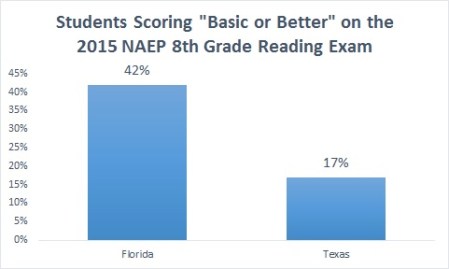
Perhaps someone could attempt to justify this practice by claiming that Texas schools did a fantastic job educating the 8.5% of students they provided services. Well, not so much:

texas-vs-fl-sped

Having the state effectively punish districts going over an arbitrary cap on the percentage of special education students at a minimum violates the spirit of federal special education law. As flawed as the Individuals with Disabilities Education Act and the associated practices remain, the unmistakable intent of the law has been to provide special education services to all students who need it. IDEA, warts and all, stands as landmark civil rights legislation for children with disabilities and the practices adopted by unelected officials at the Texas Education Agency must be viewed as an attempt to subvert this legislation at the expense of some of the most vulnerable students.

The reader should note that while the Chronicle article places blame for the 8.5% policy squarely upon the Texas Education Agency, this practice could not have endured for so long without the active acquiescence of Texas school districts. If they had objected to this policy, as was their moral duty, we would not have learned of this a decade after formulation as a part of an investigative report. Texas school districts have long complained however of the costs associated with special education, and that state and federal funds fail to cover the full cost of providing services. Kudos to the school officials who spoke to the Chronicle’s investigators, but the number who quietly went along with this greatly outnumbered those who made any attempt to set things right.

The Florida approach of setting special needs students free to attend public and private schools with their state funding represents a profoundly more humane approach to special education. If the districts resent having to divert dollars from general education to special education, let special needs family seek out a solution with their “inadequate” state dollars. The Chronicle article represents another chapter in the long book of what happens when people are forced to rely upon the goodwill and sound thinking of soulless bureaucrats.

No one enjoys bragging on Texas more than me, but this is nothing short of disgraceful and needs to be made right.


Math Gains by State Charter Sector

September 9, 2016

(Guest Post by Matthew Ladner)

So just for fun I decided to calculate the cohort math gains for states and state charter sectors in NAEP. Note that on the charter side there are considerable sampling issues in deriving an estimate for a relatively small group of students, making it a really great idea to check a secondary source of data rather than accepting an 8th grade NAEP score for charter students as written on a stone tablet by a higher power.  Various other caveats also apply- high gain scores are not the same as high scores, for instance. The number one gainer below (MN charters) does not have an especially high average 8th grade math score, and in fact lags about ten points below the statewide average for Minnesota. The opposite is true of the number two gainer (AZ charters) which have significantly higher overall scores than their statewide average and high scores overall. Charter sectors dominated by lots of new schools getting their sea legs full of students taking an academic hit getting used to a new school can create an optical illusion in a snapshot, such as those provided by NAEP. Many of these sectors may be on their way to improving in other words as ineffective/undesirable charters close, new ones open and survive, etc.

While NAEP has sampled the same cohort of students as both 4th and 8th graders, they are not of course testing the same students. Students move around, both between states and between district and charter schools. I don’t expect that many states are losing their high performing math students at high rates and having them replaced by low performing math students. In other words, at the state level kids moving around probably does not amount to much because things average out in the aggregate. I’m less confident of this being the case at the charter sector level. There are other caveats that could be dwelt upon, but that would start to violate the Prime Directive.

So okay you’ve been warned- each of these gain scores needs to be viewed in a broader context- far more context than I am going to be able provide here. Having said all of that:

math-gains-for-states-and-charter-sectors

Charter sectors cover both the top and the bottom of the chart- 7 out of the top 10, and the top four overall gains.

Down at the bottom of the chart alas we see the bottom five spots covered by charter sectors. So, Pennsylvania charters, we need to talk.  The NAEP listed your 2011 average 4th grade math score as 241, and your 2015 average 8th grade score as 249. I **ahem** double checked the numbers just to be sure I hadn’t made some mistake. The district numbers for Philadelphia in the TUDA- 225 for 2011 4th graders, 267 for 2015 8th graders.  Both of those scores are catastrophically terrible, but the second one is at least meaningfully higher than the first one. Something goofy with these NAEP numbers? PA charters dominated by dropout recovery programs? Who let the dogs out?

As stated above, no hard and fast conclusions should be drawn from this little insomnia driven exercise, but PA charters might want to turn up the water pressure:


Charters Are a Halfway House: Union Slip-Up Edition

September 8, 2016

slip-up-709045_640

(Guest post by Greg Forster)

America’s Last Education Labor Reporter proves once again why America needs to have at least one education labor reporter. He points out that a recent bureaucratic victory for the blob, in which the NLRB declared charter schools subject to unionization under federal labor law, also implies that if teacher unions attempt to organize charters they will be subject to financial disclosure and other restrictions under that same federal labor law:

If you think this would be a small price to pay, remember that when the Bush Administration’s Labor Department tried to reinterpret the LMRDA to include 32 NEA state affiliates, the union filed suit, calling the revision “unfair” and “motivated by an ill-will toward unions in general, and NEA and its affiliates in particular.”

A mixed victory for the unions, but it’s also a reminder of the problem built into the design of charter schools.

Charters are, in the final analysis, government schools, and thus can never be more than a halfway house to real (i.e. private as well as public) school choice.

As Reagan said in Berlin: “A bird on a tether, no matter how long the rope, can always be pulled back.”

It’s a thought that Common Core supporters would also do well to ponder.


The Education of High Performing Students

September 6, 2016

(Guest Post by Matthew Ladner)

Fordham released an interesting report last week making the case for including high performing students as a subgroup in state accountability systems. Like most of you who spend your time reading obscure blogs written by wonks on a continuing mission to entertain themselves, I am sympathetic to the needs of high achieving students. In fact, recently a person who served as an official in the administration of Janet Napolitano when she was Governor of Arizona told me that gifted education was THE issue when they took office in 2003. The parents of gifted students were up in arms that there was very little to nothing to meet the needs of their children, and elected officials were hearing about it non-stop.

Then, I was told, the parents discovered BASIS charter schools. Things quieted down.

Arizona had badly over-exposed testing items in those days, and the dreaded worksheets drilling to those over-exposed items were too much in evidence once students reached the 3rd grade (the first year of state standardized testing). I experienced this first hand as a parent, and have heard the tale repeated many times in conversations with other parents during the sad, dying days of the AIMS exam. We called it “the 3rd grade wall.”  One of the priorities for those concerned with the education of high achieving students should be to maintain the integrity of the state testing system (aggressively curtailing item exposure and excessive district test prep) imo.

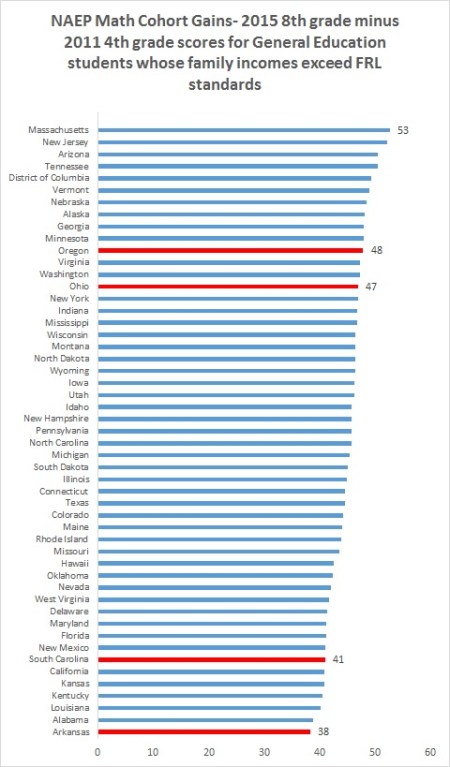
So anyway, I don’t have a problem with including high-achieving students as a subgroup, but I also don’t see it as strong tea.  The NAEP seems to suggest likewise. I ran cohort gains on 4th (2011) to 8th grade math (2015) for a relatively generic group of relatively high performing students- non-FRL eligible students in the general education program. Fordham identified four states as leaders in high-achieving subgroup accountability: Arkansas, Ohio, Oregon and South Carolina.

Math general ed non FRL

So putting on my social science cap, let me note that I have no idea what drives these numbers. One can certainly speculate with some confidence that socio-economics has something to do with it. Massachusetts and New Jersey top the list for instance, and just happen to be two of the four states with an average family income for a family of four in the six figures. DC also did well, but remember this is a very select slice of DC- the part that is knocking the ball out of the park. To the extent that policy has an impact on this (unknown) we should expect lags, etc. so try not to get too excited.

It’s hard to draw many conclusions from this, other than Arkansas’ dead last ranking seems to indicate that states need to do a great deal more than put high-achieving students in as a subgroup. My advice for Arkansas from the Cactus Patch (we are nipping at the heels of MA and NJ despite being much less wealthy and spending far less per pupil than either state btw) is, ah, see about passing some strong choice programs. Also, get BASIS on line one, stat.


CFB Rocks the Opening Weekend

September 5, 2016

Swoopes

(Guest Post by Matthew Ladner)

After botching last year’s playoff with an ill-advised NYE experiment, College Football came roaring back with a fantastic opening to the 2016 season. Houston puts an exclamation mark on its application to the Big 12 with a convincing win over Oklahoma, Aggy fans get set up for their usual soul-crushing disappointment with an early win, LSU athletic director friends Tom Herman on Facebook after stepping on a bear trap with a “neutral site game” against Wiscy @ Lambeau Field, Alabama looks like the 1985 Chicago Bears (again) while picking their fangs with USC, solid Clemson/Auburn, Georgia/NC matchups. Oh, and Texas defeats No. 10 Notre Dame in double overtime.

No that’s a true freshman throwing that ball, not Tom Brady.


I promise- it only looks like Tom Brady.

Did I miss anything? Oh yeah Arkansas had a dramatic one point victory over a directional school from Louisiana. Borderline necrotic….or something.  Oh wait, I know, Ole Miss and Florida State will be playing tonight. So the playoff has seemed to change the incentive structure for out of conference games. The playoff selection committee does not prize victories over tomato can opponents, so some of the big boys are lining them up and playing big match ups- which is great for the fans.

Opening weekend a’int over yet!


Ready Player One

September 2, 2016

(Guest Post by Matthew Ladner)

So I am 9 chapters into Ready Player One by Austin Texas uber-geek Ernest Cline and I can already tell you that this is basically the Forrest Gump for Gen-X, only waaaay better since it is about us instead of those tedious Baby Boomers.

If you were a teen in the 1980s, played tons of Atari 2600 video games, saw it as your purpose in life to put the high score on your favorite arcade game, played Dungeons and Dragons, were a film geek and listened to lots of Rush, then this book is a missing piece of your soul.  Cline wrote this book just for you, and Spielberg is currently filming the silver screen version.

If not, well you don’t know what you were missing.

Download now, read later, thank me after that. You are welcome in advance.