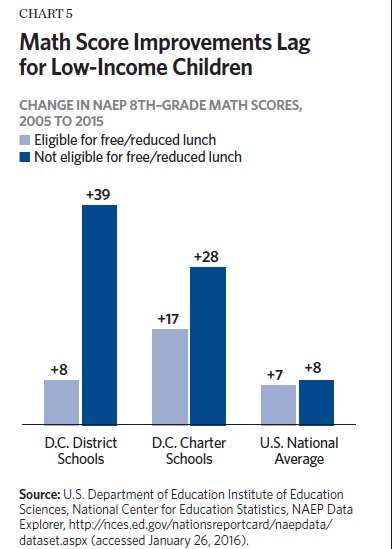
So when you have this go on for years (huge gains for the well to do, not so much for low-income kids):
You wind up with this:
It is only with some reluctance that I raise this topic. In one of the editions of the Report Card on American Education we spent an entire chapter on achievement gaps and just how tricky they can be. West Virginia for instance, down at the bottom of the chart, had a low achievement gap a few years ago because both White and Black scores were declining, but White scores were falling faster than Black scores…but the achievement gap was closing….Huzzah?
Um, no.
In the end though the situation in DC is much more straightforward: White scores are really, really high while Black scores are really low. In the end there really isn’t much lipstick to put on an almost sixty point achievement gap pig. DC has the highest scores for White kids in the country by a 12 point margin but scores for Black students towards the bottom of the barrel.
In 2015 DC’s White 4th graders had a substantially higher score on the 4th grade math exam (274) than Black students attending DCPS had on the 8th grade exam (248). I’m no social justice warrior, but that should sicken anyone’s soul.
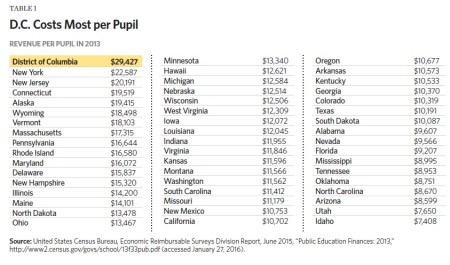
This is again a partially a reflection of the gentrification trend. The fact that more well to do families are staying in the District is very good for the financial health of the city. Most of DC’s school budget is locally generated and the rising affluence of the District has in fact generated an embarrassment of riches on the revenue per pupil statistics ($29k+ per year per kid).
Would that the District of Columbia Public Schools had made better use of it. The charter sector, with approximately half of the resources per pupil, Black students scored 18 points higher on the above exam. This cuts the achievement gap between Black students attending charter schools and White students in their enclaves of excellence in DCPS by approximately a third. Miles and miles to go to be sure, but at least the journey is underway.
Meanwhile back at DCPS…it can be very hard to focus.
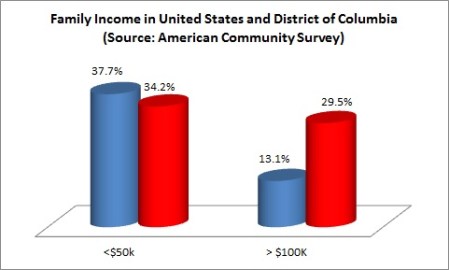
DC has a long-standing spot in our thoughts as a poor urban district. While there certainly low-income folks with kids attending DC public schools, this image is in need of an update. Here is some data from the United States Census Bureau American Community Survey from 2014, DC is red:
So the percentage of families with incomes over $100k is comfortably above twice the national average, while the percent below $50k is slightly below the national average. Mean family income:
Whatever statistic you want to examine- median income, mean income, workforce participation, etc. it all looks better in DC. Once upon a time you could say this doesn’t necessarily reflect upon public school scores because the affluent sent their children to private schools. Ah, but recall that private school attendance has been collapsing in the district despite the presence of a private scholarship program:
So between private school enrollment declining and overall public (district and charter combined) enrollment increasing and average family incomes well above the national average, the socio-economics of DC public education have likely never looked more favorable than now.
It is unclear how widespread this disproportionate spending is among U.S. high schools, but it raises the question of whether our spending in public education is consistent with our academic goals. And, from an equity perspective, the proposition of fielding a football team using scarce public resources implies the funds for a few student players comes at the expense of the many other students.
So, his evidence that sports are bad is that they cost more per pupil than math instruction and affect a smaller number of students. Normally, when economists perform a cost-benefit analysis they consider benefits as well as costs, but in this case Hansen only mentions the costs and fails to consider the benefits. Presumably he assumes the benefits to high school sports are small or zero, but rigorous evidence suggests the benefits can be substantial.
One analysis by Eric Eide and Nick Ronan uses an instrumental variable approach to estimate the effect of participating in high school sports on long-term outcomes, like educational attainment and earnings. They find:
…sports participation has a negative effect on the educational attainment of white male student athletes, a positive effect on the educational attainment and earnings of black male student athletes, and a positive effect on the educational attainment of white female student athletes. We find no effect of participation on the educational attainment or earnings of Hispanic males or black and Hispanic females.
From “an equity perspective,” as Hansen likes to frame the issue, sports seem like a real plus. Sports may give at-risk students a reason to stay in school so that they can actually receive math and other subject instruction. An amazing randomized experiment of a Chicago program called Becoming a Man — Sports Edition, demonstrates that participating in aggressive sports is particularly effective for disadvantaged youth in improving school engagement and reducing violent crime. Taking money from sports to increase resources for math instruction might do little good for students who have dropped out or gone to jail. In addition, we have all sorts of other expensive programs to help black boys, none of which seem to bother Hansen, and I doubt many have been shown to be as effective at improving outcomes as sports.
Sports may also convey leadership skills, which may account for the improved long-term outcomes among white girls who participate in sports. Again, much ink and and wealth has been devoted to building the self-esteem of girls, particularly in the sciences. High school sports seem like an effective way to accomplish that.
The per pupil cost figures on sports and math instruction are also misleading because almost all students are enrolled in math while fewer are on sports teams. Rather than posing a problem for equity, as Hansen suggests, this fact suggests that the total cost of sports is not that high. I’m sure we could bring the per pupil cost down if we mandated that all students play a sport, just as we mandate that all take math, but we would also raise the aggregate cost.
Of course, programs that serve only some students will be more expensive, but offering a variety of opportunities is precisely the mission of high schools. Every other elective activity in high school, including theater, band, newspaper, and art, also has higher costs per participating student than required courses, such as math and English. Does Hansen want to get rid of all of those programs as well? Does he think they also distract from the mission of schools?
Perhaps if Hansen had thought about what the mission of schools actually is, he might realize that it involves offering students a variety of experiences rather than the thin gruel of drilling math and reading all day. Thriving and successful adults aren’t produced by Hansen’s incredibly narrow conception of what it means to be educated.
In our next exciting episode of reviewing the DC education scene from the new study I wrote with Heritage we take a look at where the District remains despite a stunning level of investment and 25 years of improvement.
So let’s put DC into context in terms of revenue per pupil with data from the United States Census Bureau.
DC charter schools seem to be bringing in somewhere in the neighborhood of half of that figure on a per pupil basis. Now let’s see what the Trial Urban District Assessment NAEP has to say about how DC kids compare. The chart below compares kids on NAEP 8th grade math scores for students whose parents graduated from high-school but did not attend college. The hope here is to rank districts by kids not born on third base.
Note that if you do the same comparison by FRL status instead of parental education you still find DC ranked only ahead of Detroit and behind everyone else. The 17 point advantage for DC charter school kids in the above chart is considerable, but as the comparison makes painfully obvious, DC charters may be on their way, but they have not arrived. Still with less money and better scores the ROI is far, far higher than DCPS.
The heartbreaking part of the story however lies with the DCPS students. I’m not going to bother to look up the revenue per pupil statistics for Detroit but I am putting the over/under at half that of DC. Decades into DC reform efforts DCPS remains largely unchanged- far better at spending money than at teaching children, other than those who bought or worked their way into the high performing schools.
Next episode we’ll discuss what to do next. It shouldn’t involve continuing to bang our heads against the “better scores through improved management in an utterly broken system” wall. It also does not involve giving up.
The Capital is playing games with some limited success but low-income kids still hunger for academic gains.
(Guest Post by Matthew Ladner)
New study out today from the Heritage Foundation authored by yours truly on education in the District of Columbia. I will serialize the study a bit with a chart or two per post. The view I had of K-12 in the nation’s capital going into the project did not survive my investigation. My initial view going into the project is summarized in this chart:
Moving your 8th grade math scores from 230 in 1990 to 263 (combined district and charter) in 2015 is a lot of progress- by far the largest gains in the nation. While things are somewhat worse if we look at District of Columbia Public Schools (DCPS) scores alone (258) they still are far above the earliest measure. Better yet- when you examine charter scores in isolation from DCPS scores, the scores are higher still. Any actual education going on in DCPS back in 1990 looks to have been mostly accidental- I’m not sure what you would score on the NAEP math test if you just answered “B” every time, but with 3% of DC students scoring proficient and 83% scored “Below Basic” on the NAEP 8th grade math exam in 1990, it could not have been much lower. In 2015 19% of DC students scored proficient and only 49% scored Below Basic. The improvement is undeniable: time to CeleNAEP? Those gains dwarf anything seen out in the states, and the charter school sector getting close to half of the students is clearly a major driver of improvement. Twirl for me, girl on fire!
Alas while this story is true it is far from complete. What is going on in DC is both complex, partially encouraging and in the end very disturbing.
Overall enrollment in DC (district and charter) had been growing in recent years along with average incomes. A complex phenomenon is underway in which sophisticated young parents have figured out that they don’t need to move to Maryland or Virginia if they can find a spot in the right district or charter school in the District. In the end your kid doesn’t get educated by a district or a CMO but rather by a school. DC is the champion for NAEP gains, but it is also the champion for achievement gaps.
You can see the gentrification going on both in DC’s statistics and with the naked eye walking around town. Somebody keeps buying those million plus dollar brown stones and some of them are parents. This begs the question: how much of DC’s apparent academic gains owes to gentrification?
Sadly the answer is- affluent children have banked the vast majority of DC NAEP gains over the last decade.
There is a lot going on in this chart so pay close attention. These are again NAEP 8th grade math gains by family income (FRL status) over the last decade. First look at the light blue columns- gains for FRL eligible kids. DCPS district equals an 8 point gain, which is indistinguishable from the national average of 7 points. The 17 point gain for free and reduced lunch kids attending DC charter schools is the only real bright spot for disadvantaged kids in the public school system despite decades of reform.We used 8th grade math for purposes of illustration but you see a similar pattern across the NAEP exams.
Now observe the dark blue columns- DC kids whose incomes are too high for a Free or Reduced price lunch under federal guidelines. Here the gains are truly extraordinary- a 28 point gain for non-FRL kids attending charter schools and a 39 point gain for middle to high income district students. I’m placing my bet now that this isn’t solely due to schools in Georgetown doing an ever-better job educating kids with law-firm names, but also to the fact that people who once fled to Va and MD finding a spot that suited them in DC.
So in 1990 let’s estimate that the number of DCPS FRL kids scoring proficient on 8th grade math as effectively zero. Twenty five years later, that figure is up to 8 percent for district kids (charters excluded). DCPS in other words remains largely what it has always been- an organization far better at employing adults than meeting the needs of disadvantaged children. As we will see in a future post, the academic results of DCPS continue to disappoint even in comparisons against other urban districts despite 15 years of strong progress and gentrification.
I am Ozymandias-Queen of Queens! Look upon the ineffectiveness of my broom ye mighty and despair!
Overall the situation in DC K-12 is very complex- with both positive trends and heartbreaking stagnation. Regardless of where you are coming from on the political/philosophical side of things, if you are a DC taxpayer you should not stand for this state of affairs as it touches upon economically disadvantaged children. The above chart shows is that despite a truly shocking amount of tax effort and a decade and a half of reform, what DCPS has figured out how to do is to give the most academically to the kids born on third base. Mind you this is much better than giving approximately nothing to anyone a la DCPS circa 1990, but that is in the big picture a cold comfort. In the end it is very positive for the fiscal health of the District of Columbia that third base parents can in fact get a quality education for their children it in the right bits of DCPS. Moreover, those third base parents are paying a mind-numbing level of tax and they deserve a quality education for their children.
Image: Tim Keller of the Institute for Justice, right, wields his legal fiddle to defend school choice.
(Guest Post by Jason Bedrick)
Great news from the Peach State, where a superior court judge dismissed a constitutional challenge to Georgia’s scholarship tax credit (STC) law. The Institute for Justice intervened to defend the law on behalf of five tax-credit scholarship recipients. Currently, more than 13,000 Georgia students receive tax-credit scholarships to attend the schools of their choice.
School choice opponents alleged that the STC violated the state constitution’s historically anti-Catholic Blaine Amendment, which prohibits the state from publicly funding religious schools, among other provisions. However, citing precedent from the U.S. Supreme Court and several state supreme courts, Judge Kimberly M. Esmond Adams held that tax-credit eligible donations constitute private funds, not public expenditures:
Courts that have already considered whether a tax credit is an expenditure of public revenue have answered this question in the negative. Of particular importance is Arizona Christian Sch. Tuition Org. v. Winn, 131 S. Ct. 1436 (2011), where the United States Supreme Court found that taxpayers lacked standing to challenge a scholarship tax credit program under the Establishment Clause of the United States Constitution that was almost identical to the Program at issue here. Like Georgia’s Program, the Arizona program provided that taxpayers could receive a credit for donations made to independent scholarship organizations which then provided scholarships for students to attend private schools. […] Plaintiffs have not presented any arguments for why this Court should not follow this persuasive authority.
The fact that tax-credit eligible donations are private funds is the primary reason that STC laws have a perfect track record in the state courts thus far. It’s also why tax credits are the most liberty-friendly means of financing educational choice, as the late, greatAndrew J. Coulson never tired of reminding us (much to Greg’s chagrin). In response to the U.S. Supreme Court’s similar ruling five years ago, Andrew wrote:
The rationale underlying the Court’s ruling highlights a unique advantage that tax credits have over other ways of funding education: they expand both freedom of choice for parents and freedom of conscience for taxpayers.
Plaintiffs had argued that cutting a person’s taxes is equivalent to spending government money, and so taxpayers were being compelled to support religion when credits were used for donations to religious [scholarship organizations]. The Court said, “that is incorrect.”
Unlike the funding of public schools, which is compulsory for all taxpayers, participation in [a] tax credit program is voluntary. If an individual chooses not to donate to [a scholarship organization], his taxes are collected just as they have always been, and those dollars cannot be used for any sectarian purpose. Furthermore, if a taxpayer does choose to make a donation, he is free to select the STO most consistent with his own values. […]
There are other ways of funding universal choice in education, but only tax credits (either for parent’s own education expenses or for donations to [scholarship organizations]) respect the freedom of conscience of taxpayers as well as the freedom of choice of parents. If we truly wish our schools to help build strong, harmonious communities, there is no better way than to adopt such programs at the state level on a grand scale.
The opponents of educational choice are likely to appeal the judge’s decision. Let us hope their appeal meets the same fate as all of its predecessors.
I first remember meeting Andrew and his wife, Kay, at a conference in Toronto in 2000. I have to admit that he felt out of place. Here was this guy without any university, think tank, or other affiliation and without any formal training presenting on the history of markets in education. And people did not typically attend these meetings with spouses. Who was this guy?
As it turns out, this guy was a brilliant autodidact who “retired” after being an early programmer with Microsoft to devote his time to studying and advocating education reform. And he was really good at it.
The thing that struck me most about Andrew was his incredible optimism and quirky sense of humor. Liberty-oriented education activists tend to be on the losing side of policy battles. It can be downright discouraging. But Andrew never seemed discouraged or became bitter. It was a long game and he maintained a sunny optimism that freedom worked better and people would eventually gravitate towards what worked.
He didn’t mind standing apart from the crowd. Just because donors, policymakers, and other scholars were drawn to test-based accountability didn’t make Andrew feel like he had to join them. He even expressed serious reservations about certain methods of expanding school choice, including charters and vouchers, that he thought would invite excessive government regulation. I confess that I paid little attention to Andrew’s warnings back then but I wish I had. The experience and wisdom he obtained from studying history made him more sensitive to these dangers than my narrow practice of social science. The autodidact had quite a lot to teach highly trained people like me. As it turned out, choice reforms less prone to excessive regulation, like tax credit funded scholarships and ESAs, are now spreading rapidly — just as Andrew had expected and advised.
His humor often seemed to involve plays on words. For example I once posted to Facebook a photo of what I (incorrectly) captioned as a “Golden Lion Tamarind.” He made some sort of joke about how the dish was prepared. Some people of faith find small typos and errors in language interesting because they think they can be unintentionally prophetic. I don’t know if that was Andrew’s motivation but the thought of me secretly wishing to eat a small monkey is pretty funny.
I will miss that quirky humor, but more importantly I will miss his wise counsel and good cheer. It’s a long game that must go on but something will be missing without Andrew as part of it.
Choice Remarks carries my article on the government school monopoly and religious hatred:
For decades, we’ve heard opponents of school choice claim that the government school monopoly is our only protection against “jihad schools” that will teach children to hate and kill. In all that time, you know what we haven’t seen? Jihad schools, operating in any of the nation’s 59 private school choice programs across 28 states. In fact, the government school monopoly doesn’t protect us from religious division, and it can’t do so.
Partly we’re talking about good old fashioned bigotry that doesn’t want to believe highly religious minorities can support democracy and pluralism. But there’s more to the story.
We demand that highly secularized institutions should have a monopoly on education because we think such institutions are “neutral” with regard to religion. This fails for two reasons.
First, it incentivizes schools to marginalize and alienate religious minorities in order to legitimize the secular monopoly on education. Religious minorities must be seen as dangerous, or the interests of the monopoly will be threatened.
Second, highly secularized institutions are inherently less effective at inculcating the values and practices essential to democracy and pluralism:
This is because a secular institution can tell you to be good (be tolerant, respect diversity, etc.) but it can’t tell you why. It can’t connect the rules of right behavior to deep sources of meaning, purpose, and identity. It ends up just spewing a lot of sentimental gas, and then wagging its finger at you if that doesn’t work, and then punishing you. Or it offers utilitarian, mercenary reasons to be good. None of that helps students form either a deep attachment to moral rules or the self-discipline to carry them out.
Citing low enrollment and bogus “research” that excludes the mountain of random-assignment studies, one anti-choice group says Mississippi’s education savings account program for students with special needs is a “failure.”
Of the more than 50,000 children with special needs in Mississippi public schools, 251 were qualified and approved to receive vouchers. Of those, only 107 appear to have used them, .0018 of one percent of Mississippi’s children with special needs.
The research claim clearly doesn’t hold water (unsurprisingly, the only gold standard study they cite is the recent one from Louisiana) but what about the low enrollment? Is this a program that parents don’t really want? Or perhaps there just aren’t enough private school seats for parents?
First, it’s pretty rich that a group that opposes educational choice cites low enrollment as a reason it is “failing.” If enrollment was high, do you think they would see that as a sign of success?
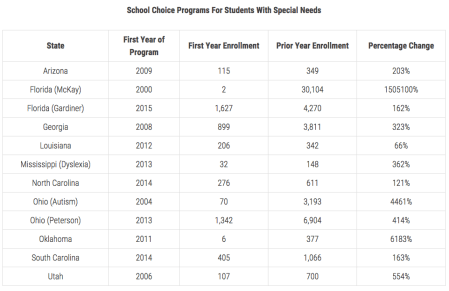
Second, the ESA program is still in its first year. As Empower Mississippi demonstrates in this helpful chart, programs that start small can grow significantly over time:
As Empower Mississippi notes, detractors were probably quick to declare Florida’s McKay scholarships a “failure” when only two students used them in the first year, but after experiencing 1,505,100% growth in the next decade and a half, I doubt anyone is making that case anymore.
That said, detractors might be right that there aren’t enough private school seats right now. However, one of the purposes of educational choice is to expand the market. Greater demand should spark greater supply, if the price is right. Unfortunately, that’s a big “if.” The Magnolia State’s ESAs are currently funded at only $6,500 per year. Funding is tied to the state’s base student cost rather than the cost for students with special needs, as Arizona does.
If Mississippi lawmakers want to see greater supply in private school seats for students with special needs — and empower parents to use the ESAs to tailor their child’s education using tutors, online courses, educational therapy, etc. — then they should make sure that the ESAs are adequately funded.
[UPDATE: Grant Callen of Empower Mississippi wrote to let me know that I got one very important detail wrong: the image I used originally was of a Japanese Magnolia, not the North American Magnolia that is Mississippi’s state flower. I stand corrected!]
And it is also important to identify states that have weakened public education—by seeking to privatize their schools or turn them into profit-making ventures, as well as states that have aggressively instituted a regime of high stakes testing that unfairly sorts, ranks and demoralizes students, educators and schools.
Unlike other organizations such as The American Legislative Exchange Council (ALEC) and Michelle Rhee’s StudentsFirst, whose report cards rank states in relation to their willingness to privatize public education and weaken the status of the teaching profession, we take another path. We give low marks to states that devalue public education, attack teachers and place high stakes outcomes on standardized tests.
But…..there seems to be no consideration of outcomes going on in Little Ramona‘s report card. She pulled together some University of Arizona College of Education folks and they gave states a grade on various policies like “No High Stakes Testing” and “Resistance to Privatization” and others. “Chance for Success” is my personal favorite: why gather someone’s opinions about the chance for success rather than measure er actual success? In the Report Card on American Education that I have coauthored/authored for the American Education Exchange Council, we rank states according to the overall NAEP scores and NAEP gains for low-income general education students. We think this is a reasonable approach given the large differences between average family incomes etc. between states. Some disagree (and we claim only that the comparison is reasonable rather than perfect) but at least we are looking at student outcomes, which don’t even constitute an afterthought in Ravitch’s Report Card.
Anyway, my home state of Arizona received an overall grade of “F.” Quelle horreur!
Strangely enough though, if we conjure up the NAEP data and examine academic progress by state for the period in which all 50 states participated (2003 to 2015) this is what you learn about Arizona: in 4th grade math Arizona had the 9th largest state gains, in 8th grade math the 3rd largest. In 4th grade reading Arizona students had the 17th largest gain and in 8th grade reading the 2nd largest state gain.
Ah well Arizona’s demographics became more favorable during this period. Nope-economy got drop kicked and the student population moved to majority minority status. Yeah but spending went way up. Er, no, it actually wentdown after the Great Recession. But maybe the scores would have gone up even more without all of these terrible policies! Mmm hmmm….and maybe there is a breeding population of aquatic dinosaurs in Loch Ness as well. What do you mean no credible evidence? Maybe they eat their dead so dino bodies don’t wash up on shore. I mean it could be something stranger still going on.
Seems legit…
A few years ago I successfully campaigned to receive the first (and as far as I know still only!) Lifetime Bunkum Award from Reactionaries-R-Us. In that same spirit, I can’t wait to see what happens with Arizona’s gains once we earn our way to the first Ravitch F-minus!
UPDATE: I recalled the the University of Arizona College of Education played a large role in the creation of a charter school in Tucson called the Wildcat School. The Arizona Daily Star reported “When it opened, it was lauded as the first charter school to have an affiliation with a state university. Its goal was to provide an academically rigorous math- and science-focused education for low-income students.”
The school closed in 2013 after receiving two “D” grades in a row and facing the prospect of a third, which would have qualified the school for state intervention. The Board President, a professor at the U of A College of Education Professor explained “We just know we weren’t making the achievement test scores that we needed to make. I’m not sure I have an explanation for that,” he said. “We just faced the reality that we needed to act in a way that was best for the families and students in our school.”
Kudos to the board for pulling the plug on something that wasn’t working for kids. If I were a cynic I might note that they made a rational decision after getting themselves in over their heads, facing the prospect of an increasingly embarrassing situation. Thus under this uncharitable view they made the right call to pull the band-aid off rather than have things get progressively worse. You might very well think that, but I of course could never be so cynical. Ever. Ravitch hires University of Arizona ed school profs to grade state K-12 policies, they give Arizona and F. Meanwhile Arizona comes near first in overall NAEP gains. Professors from the same department essentially create their own charter school and it folds. Meanwhile Arizona’s charter schools rock the 2015 NAEP like a New England state.
I’m pretty sure I do have an explanation for that and it’s fairly straightforward- no aquatic dinos eating dead aquatic dino explanations necessary.





 Posted by matthewladner
















 Jay P. Greene's Blog