Extremism in Defense of Mediocrity is Quite a Vice

January 31, 2013

(Guest Post by Matthew Ladner)

So Michelle Malkin recently wrote columns of an alarmed tone warning of the dangers of the Common Core. Here is a taste:

Under President Obama, these top-down mal-formers — empowered by Washington education bureaucrats and backed by misguided liberal philanthropists led by billionaire Bill Gates — are now presiding over a radical makeover of your children’s school curriculum. It’s being done in the name of federal “Common Core” standards that do anything but set the achievement bar high.

Substitute the word “conservative” for “liberal” and the paragraph reads like Diane Ravitch. Ms. Malkin proceeds to repeat various anti-Common Core assertions as facts-but are they facts? Having read that last bit about “standards that do anything but set the achievement bar high” I decided to put it to a straightforward empirical test.

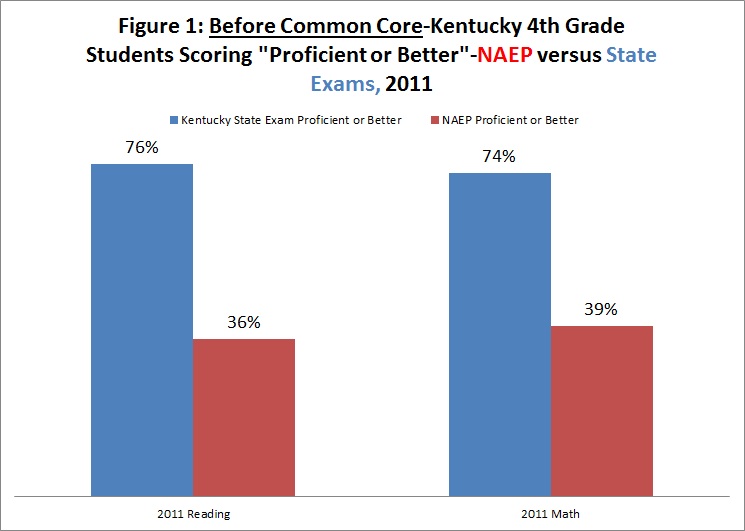
Kentucky was the earliest adopter of Common Core in 2012, and folks from the Department of Education sent some before and after statistics regarding 4th grade reading and math proficiency. I decided to compare them to NAEP, first 2011 KY state test and 2011 NAEP for 4th Grade Reading and Math. NAEP has four achievement levels: Below Basic, Basic, Proficient and Advanced. Kentucky also has four achievement levels: Novice, Apprentice, Proficient and Distinguished. The first figure compares “Proficient or Better” on both NAEP and the state test in 2011:

KY CC 1As you can see, Kentucky’s definition of “Proficient” was far more lax than that of NAEP. In the Spring of 2012 however they became the first state to give a Common Core exam. How did the 2012 state results compare to the 2011 NAEP?

KY CC 2Kentucky’s figures are strongly suggestive that the new test is a good deal more rigorous than the old one- it tracks much closer to NAEP than the previous test. While it is possible that Kentucky had item exposure that explains some of the difference, but let’s just say there is an awful lot of difference to explain. We would expect somewhat lower scores with a new test, but if the new test were some dummied down terror…

There will also still be honest differences of opinion over standards independent of the rigor of the tests. Moreover, just because it is an obnoxious pet-peeve of mine, it is worth noting that starting out more rigorous doesn’t guarantee that they will stay that way…

A formal study could definitively establish the rigor of the new Kentucky test definitely vis-a-vis NAEP, but it is well worth considering where KY’s old test ranked in such a study by NCES. Short answer: Kentucky’s old standards were high-middle when compared to those of other states. Ergo we can infer that the proficiency standard on the KYCC test is far closer to those of NAEP than a large majority of current state exams.

There is room for honest debate regarding Common Core as a sustainable reform strategy, but we should have that debate rather than the present one.

UPDATE: Reader Richard Innes detected an error in the NAEP proficiency rates in the first version of this post. I made the mistake of looking at the cumulative rather than the discrete achievement levels and then treating the cumulative as discrete-thus double counting the NAEP advanced. If you have any idea of what I am talking about give yourself a NAEP Nerd Gold Star. Getting instant expert feedback is one of the best things about blogging, and I have updated the charts to correct the error.

In terms of substance, both sets of KY tests were further apart from NAEP proficiency standards, but the new ones are still far closer than the old ones.


The 123s of the ABCs

January 28, 2013

ABCs of School Choice 2013 Milton & Rose

(Guest post by Greg Forster)

My colleagues at the Friedman Foundation have released this year’s ABCs of School Choice, which you can find here – but only if you want the very latest and best data on school choice.

Just inside the cover is this striking photograph of Milton and Rose, which I had never seen before. Coming up on seven years after his passing, I’m tremendously heartened by the progress school choice has made. Right up until his death Milton was boldly predicting that he would live to see one state enact a universal voucher. As I’ve said on numerous occasions, it was a gutsy thing to say for a man who had seen the far side of 90 and was cracking jokes about having outlived the actuarial tables.

Next to the photo appears this statement, which first ran in The School Choice Advocate in 2004:

Government is committed to assuring that all children receive a minimum education. It currently does so by setting up and running schools, assigning students within a designated catchment area to each school. Students are thereby deprived of choice. They go to the designated school or else they do not benefit from the government commitment and their parents must pay twice for their education—once in the form of taxes, again in tuition.

Equally important, government is deprived of the benefits of competition. It is as if the government decided that the automobiles it uses must be built in government factories. What do you think the quality and cost of government cars would be? Or, to take another example, it is as if recipients of food stamps were required to spend them in a specified government-run grocery store.

It is only the tyranny of the status quo that leads us to take it for granted that in schooling, government monopoly is the best way for the government to achieve its objective.

A far more effective and equitable way for government to finance education is to finance students, not schools. Assign a specified sum of money to each child and let him or her and his or her parents choose the school that they believe best, perhaps a government school, perhaps a private school, perhaps homeschooling. Let the schools in turn, whether government or private, set their own tuition rates, and control their own operating procedures. That would provide real competition for all schools, competition powered by the ultimate beneficiaries of the program, the nation’s children.

ABCs of School Choice 2013 Milton signature

Check it out.


Jeb Bush and Clint Bolick on Immigration in the WSJ

January 25, 2013

(Guest Post by Matthew Ladner)

Jeb Bush and Clint Bolick are teaming up for a book on immigration that will come out in March, and previewed their thinking today in the Wall Street Journal. Read the article here. Basic thesis:

In some conservative circles, the word “comprehensive” in the context of immigration reform is an epithet—a code word for amnesty. People who oppose such reform declare that securing the United States border must come before moving toward broader reform.

Such an approach is shortsighted and self-defeating. Border security is inextricably intertwined with other aspects of immigration policy. The best way to prevent illegal immigration is to make sure that we have a fair and workable system of legal immigration. The current immigration system is neither.

The immigration system is like a jigsaw puzzle. If one or more pieces are out of whack, the puzzle makes no sense. To fix the system, Congress must make sure all of the pieces fit together, logically and snugly.

Based on a True Story

January 22, 2013

Any movie that begins with the message, “based on a true story,” is in danger of engaging in bad story telling and insufficient character development.  Claiming that something is true appears to be license for lazy film-making.  My objection is not that many “based on a true story” films are barely connected to real events.  No, my concern is that because they claim to be real, film-makers think they can get away without doing the things necessary to make a great film.

Not all “based on a true story” movies are lousy; Argo, for example, tells a compelling story with well-developed characters.  But Argo’s effectiveness  is almost entirely derived from the ways the movie deviated from the “true story.”  [SPOILER ALERT] The tension-filled ending was great movie making even though — actually, because — it bore no resemblance to actual events.  And the most engaging  character played by Alan Arkin was the one almost completely invented for the movie.  In addition, we found the main character played by Ben Affleck so engaging in part because of the entirely fictitious back-story about his separation from his wife and son.  The greatness of Argo comes from its effective story telling, not from its “reality.”

Zero Dark Thirty, on the other hand, was a really disappointing film because it relied on its “reality” as a substitute for great film-making.  [SPOILER ALERT]  There was virtually no character development.  I didn’t know anything about what motivated the main character to join the CIA and hunt UBL.  Yes, I saw that she had a friend killed, but her obsession with UBL pre-dates that.  At one point in the movie, a supervisor specifically asks her why she was recruited by the CIA and she declines to answer.  So, I know almost nothing about her life other than that she is hunting UBL.  About 2/3 through the movie I realized I couldn’t even remember her character’s name because… well, because who cares about her?  The movie was also poorly paced, painfully slow at times, and lacking in comic relief or any other variation in tension.

The movie is gripping, but so is playing Call of Duty with my son.  Similarly, Call of Duty has no character development and maintains a numbing lack of variation in tension.  But it sure is fun while you are playing it!  It just isn’t a lasting story.  We won’t re-tell that Call of Duty match we had several years ago nor will anyone, in all likelihood, watch Zero Dark Thirty in ten years.  The appeal of it is entirely contained in the fact that it is topical.  The meaning and excitement of Zero Dark Thirty comes not from the story the movie tells but from the story that I know from the world that I impart to the movie.  When my knowledge of or interest in these current events fade, so will my (and everyone else’s) interest in the movie.  The movie requires my knowledge of current events to mask its inadequate story-telling and character development.  That’s not Best-Picture film-making.

Homeland is a much better version of Zero Dark Thirty.  It is better because it has well-developed characters about whom I care and because it is intentionally crafted to be properly paced.  It doesn’t have to worry about being true.  It can just be good.

It’s true that Zero Dark Thirty is popular, but then again so are reality TV shows and they suffer from many of the same defects.  If the Real Housewives of New Jersey were a scripted show, no one on Earth would watch it.  But the show is quite popular because it claims on some level to be “real.”  Everyone understands that it isn’t fully real.  But it is a little bit “based on a true story.”  And because of that, we accept its lousy story-telling and ridiculous characters.  We do that because we are actually imparting to it knowledge of other real people that we know who we think may resemble the characters in some ways.  We provide the context to make the stories work in reality TV.

Lastly, let me mention another recent film that claims to be “based on a true story,” The Way Back.  Despite claiming to be real, the movie works well with an engaging story and set of characters.  But as it turns out, the events on which the movie is loosely based are actually fiction.  According to IMDB:

The film is based on a memoir by Slavomir Rawicz depicting his escape from a Siberian gulag and subsequent 4000-mile walk to freedom in India. Incredibly popular, it sold over 500,000 copies and is credited with inspiring many explorers. However, in 2006 the BBC unearthed records (including some written by Rawicz himself) that showed he had been released by the USSR in 1942. In 2009 another former Polish soldier, Witold Glinski, claimed that the book was really an account of his own escape. However this claim too has been seriously challenged.

I don’t see this as an indictment against the film at all.  It was a compelling story that sold over 500,000 copies and led to a good movie because it was intentionally crafted to be a good story.  Life rarely gives us that in its reality.  That’s why we have imaginations to shape, combine, and alter our real experiences.  In some sense, every story is “based on a true story.”  The important thing is whether those stories are good, not whether they are true.

[Edited to add paragraph on Homeland]


Amid Talk of Gun Control, Don’t Forget School Reform

January 22, 2013

(Guest Post by William Mattox)

Amid all the talk about gun control and mental health reform, one important question begged by last month’s tragedy in Connecticut has gone unasked:  Is there anything we can do about the structure of education that might help lower the risk of another school massacre?  I believe there is – and a poignant story (and some very interesting research data) will help explain why.

Two of my children once attended a small private school in a town where we had just moved.  Early in the fall semester, another new kid at that school – a boy with Asperger’s Syndrome who would now be 19 or 20 years old – had several emotional “meltdowns” as he sought to adjust to his new routine.  This unsettling behavior caused some school officials, and a number of concerned parents, to wonder if our school was equipped to handle the challenges presented by this student (whom I’ll call “Bradley”).

Bradley’s teachers rallied to his cause.  They appreciated his keen intellect.  And they were reluctant to give up on him – partly because Bradley had had a rough childhood.  (His condition had been misdiagnosed for years, causing household stress that contributed to his parents’ divorce).  But there was an even greater reason for the teachers’ reluctance: Since this was a Christian school, the teachers felt they had a special responsibility to “go the extra mile” with social outcasts like Bradley.  Even if this was, at times, difficult.

So, Bradley remained a part of our school.  And the teachers who’d had experience working with Asperger’s students helped those who’d had none.  And they all sought to teach their students some important “life lessons” about dealing with people who are different from you.

Apparently, some of these lessons got through.  One day, I chaperoned a dance at the school.  When it came time for the first number, I saw one of the most popular teen girls in the school maneuver into a position where she could be the first girl Bradley asked to dance.  This girl didn’t have a romantic interest in Bradley.  But she did have a heart of compassion – and a maturity beyond her years.  And she recognized that no girl would be apt to dance with Bradley unless someone like her saw past his social awkwardness and validated his worth.  As a human being.  As a child made in the image of God.

After the dance, Bradley got into his mother’s van and made a peculiar announcement.  “Today, I placed my hand on the hip of four different girls,” he said.  These odd words brought tears to his mother’s eyes, for she understood them to mean that her socially-awkward son’s yearning for human connection, for some measure of normal acceptance, had been met in a most meaningful way that day.

Now, I don’t want to insinuate that an episode like this could have only occurred at a Christian school – or that it would have happened at every faith-based private school.  But when I consider how their Christian faith affected the way these teachers and students treated Bradley, I can’t help but affirm the Florida policymakers who created the McKay scholarship program that made it possible for Bradley to attend a private school of his family’s choosing.  Especially since a recent research study suggests that Bradley’s experience at that school was not that unusual.

According to a Manhattan Institute study, 47 percent of McKay scholarship recipients had been picked on often at their local public school – and 25 percent had been victimized physically. At their new schools, chosen for them by their parents, only 5 percent of these special needs students experienced frequent harassment and only 6 percent were physically mistreated.

In view of all this, I think every state ought to adopt programs like Florida’s McKay scholarships (or Arizona’s Educational Savings Accounts) which give families of special needs students the freedom to choose learning options for their children beyond those available at their local public school.  For many Asperger’s children (and other students with special needs) yearn for human connection and social acceptance – and delight when others affirm their worth in the eyes of God.

William Mattox is a resident fellow at the James Madison Institute and a Florida Voices columnist.  His four children have all attended public high schools.


Wolf and Witte Slam Ravitch on Milwaukee School Choice

January 18, 2013

Dwight Howard winning the 2008 Slam Dunk Contest.

As I’ve said before, I’m trying to avoid writing about Diane Ravitch because I think it’s now clear to all sensible people that she has gone completely nuts, lacks credibility, and was probablnever much of a scholar.  But I just can’t resist posting a link to the editorial my colleagues Pat Wolf and John Witte wrote today in the Milwaukee Journal Sentinel.  Wolf and Witte are responding to an earlier op-ed by Ravitch in which she declares:

Milwaukee needs one public school system that receives public dollars, public support, community engagement and parental involvement.

Vouchers and charters had their chance. They failed.

Wolf and Witte actually review the evidence on Milwaukee’s choice programs, including their own research.  They conclude:

Our research signals what likely would happen if Ravitch got her wish and the 25,000 students in the Milwaukee voucher program and nearly 8,000 children in independent charter schools were thrown out of their chosen schools. Student achievement would drop, as every student would be forced into MPS – the only game in town. Significantly fewer Milwaukee students would graduate high school and benefit from college. Parents would be denied educational choices for their children.

That’s not a future we would wish for the good people of Milwaukee.

There’s no point in trying to persuade Ravitch or her Army of Angry Teachers, since they abandoned rationality a long time ago.  But Wolf and Witte have done an excellent job of equipping sensible people with evidence that could help inform their views about school choice in Milwaukee.  Angry blather and bold (but false) declarations cannot compete with actual facts.

[Edited to correct typo in title.]


The Implications of a Blue Texas

January 17, 2013

(Guest Post by Matthew Ladner)

So I have been thinking about the talk of a “Blue Texas.” Texas has experienced a profound shift in partisan dominance within our lifetimes, and demographic changes in the state portend that it may happen again. Texas moved out of being part of the “Solid South” starting in the 1970s with the slow but steady rise of the Texas Republican party. Republicans had captured all of the statewide elected offices by the 1990s. Finally, the Republicans overcame Democratic gerrymandering to capture a majority in the Texas House and Senate in 2003.

A profound demographic shift has placed an expiration date upon the control of the Texas legislature by conservative Anglos. Conservatives may or may not remain ascendant in Texas but the days of the political dominance of conservative Anglos are certainly numbered.

One can see this trend coming in the ethnic distribution of the Texas school population. In 2011-12, Hispanics comprised 50.8% of children enrolled in the Texas public school system. Anglos comprised only 30.5 percent, and African-Americans only 12.8 percent. You can also get a sense of the scale and the growth in Texas by looking at public education statistics. With nearly five million students, Texas educates nearly as many public school students as the twenty smallest states combined. Texas may soon have twice as many public school students as Florida-despite the fact that Florida has the 4th largest public school population.  Texas has been adding a public school population roughly equal in size to the public school system of Wyoming every 14 months or so. Texas was the only state to gain 4 new Congressional seats after the 2010 Census- a small number of other states gained two, no one else gained either 3 or 4.

In 2012, Texas Hispanics comprised 25 percent of the electorate and favored Barack Obama over Mitt Romney by a margin of 62% to 37%. That’s a more balanced result than the national numbers, but hardly reassuring if you are a Texas Republican. Each passing year will see older Republicans passing on, and more young Hispanic voters entering the electorate. Some forecasters predict a “Blue Texas” by 2020- although it could happen either later or earlier or never depending upon a variety of factors.

Let’s start with the electoral college map. Republicans haven’t been very good at getting to 270 lately even with the now 38 Texas electoral votes in the bag. Without them states like Florida and Ohio could become mere style points for the Democratic nominee rather than crucial swing states. One could imagine other states trending Republican to counteract a Blue Texas, but it seems imaginary indeed.

For someone of modestly libertarian politics like myself, the most alarming scenario would be for a Blue Texas that becomes in effect a second California- a gigantic state in which organized public sector groups play an incredibly strong role in state policy making. I would expect that might blunt this momentum rather decisively:

Or perhaps not-predictions are hard, especially about the future. Some of you of course will be excited by the idea of a Blue Texas, others horrified by the prospect. Regardless the implications of a Blue Texas stretch far beyond Presidential politics. We can discuss some of those in future posts.

For now let’s keep an eye on this to see what happens next…


Starring Matt Ladner as the Difference Principle!

January 16, 2013

Hippies on stage

(Guest post by Greg Forster)

Are you ready for this? A Theory of Justice: The Musical!

No, really:

In order to draw inspiration for his magnum opus, John Rawls travels back through time to converse (in song) with a selection of political philosophers, including Plato, Locke, Rousseau and Mill. But the journey is not as smooth as he hoped: for as he pursues his love interest, the beautiful student Fairness, through history, he must escape the evil designs of his libertarian arch-nemesis, Robert Nozick, and his objectivist lover, Ayn Rand. Will he achieve his goal of defining Justice as Fairness?

Wait, I thought they already made that show. It was called Hair.

Here’s a publicity photo from the production – Matt Ladner in costume for his co-starring role as “The Difference Principle”:

ladnerhippie

HT David Koyzis


Shanker Institute Scholar Bounded in a Nutshell but Counts Himself a King of Infinite Space

January 15, 2013

(Guest Post by Matthew Ladner)

Matthew DiCarlo of the Shanker Institute has taken to reviewing the statistical evidence on the Florida K-12 reforms. DiCarlo reaches the conclusion that we ultimately can’t draw much in the way of conclusions regarding aggregate movement of scores.  He’s rather emphatic on the point:

In the meantime, regardless of one’s opinion on whether the “Florida formula” is a success and/or should be exported to other states, the assertion that the reforms are responsible for the state’s increases in NAEP scores and FCAT proficiency rates during the late 1990s and 2000s not only violates basic principles of policy analysis, but it is also, at best, implausible. The reforms’ estimated effects, if any, tend to be quite small, and most of them are, by design, targeted at subgroups (e.g., the “lowest-performing” students and schools). Thus, even large impacts are no guarantee to show up at the aggregate statewide level (see the papers and reviews in the first footnote for more discussion).

DiCarlo obviously has formal training in the statistical dark arts, and the vast majority of academics involved in policy analysis would probably agree with his point of view. What he lacks however is an appreciation of the limitations of social science.

Social scientists are quite rightly obsessed with issues of causality. Statistical training quickly reveals to the student that people are constantly making ad-hoc theories about some X resulting in some Y without much proof. Life abounds with half-baked models of reality and incomplete understandings of phenomena, which have a consistent and nasty habit of proving quite complex.

Social scientists have developed powerful statistical methods to attempt to establish causality techniques like random assignment and regression discontinuity can illuminate issues of causality. These types of studies can bring great value, but it is important to understand their limitations.

DiCarlo for instance reviews the literature on the impact of school choice in Florida. Random assignment school choice studies have consistently found modest but statistically significant test score gains for participating students. Some react to these studies with a bored “meh.” DiCarlo helps himself along in reaching this conclusion by citing some non-random assignment studies. More problematically, he fails to understand the limitations of even the best studies.

For example, even the very best random assignment school choice studies fall apart after a few short years. Students don’t live in social science laboratories but rather in the real world. Random lotteries can divide students into nearly identical groups with the main difference being that one group applied for but did not get to attend a charter or private school. They cannot however stop students in the control group from moving around.

Despite the best efforts of researchers, attrition immediately begins to degrade control groups in random assignment studies. Usually after three years, they are spent. Those seeking a definitive answer on the long-term impact of school choice on student test scores are in for disappointment. Social science has very real limits, and in this case, is only suggestive. Choice students tend to make small but cumulative gains year by year which tend to become statistically significant around year three, which is right around when the random assignment design falls apart. What’s the long-term impact? I’d like to know too, but it is beyond the power of social science to tell us, leading us to look for evidence from persistence rates.

So let’s get back to DiCarlo, who wrote “The reforms’ estimated effects, if any, tend to be quite small, and most of them are, by design, targeted at subgroups (e.g., the “lowest-performing” students and schools). Thus, even large impacts are no guarantee to show up at the aggregate statewide level.”  This is true but fails to recognize the poverty of the social science approach itself.

DiCarlo mentions that “even large impacts are no guarantee to show up at the aggregate statewide level.” This is a reference to the “ecological fallacy” which teaches us to employ extreme caution when travelling between the level of individual and aggregate level data. Read the above link if you want to know all the brutally geeky reasons why this is the case, take my word for it if you don’t.

DiCarlo is correct that connecting the individual level data (e.g. the studies he cites) to aggregate level gains is a dicey business. He however fails to appreciate the limitations of the studies he cites and the fact that the ecological fallacy problem cuts both ways. In other words, while generally positive, we simply don’t know the relationship between individual policies and aggregate gains.

We know for instance that we have a positive study on alternative certification and student learning gains. We do not and essentially cannot know however how many if any NAEP point gains resulted from this policy. The proper reaction for a practical person interested in larger student learning gains should be summarized as “who cares?” The evidence we have indicates that the students who had alternatively certified teacher made larger learning gains. Given the lack of any positive evidence associated with teacher certification, that’s going to be enough for most fair minded people.

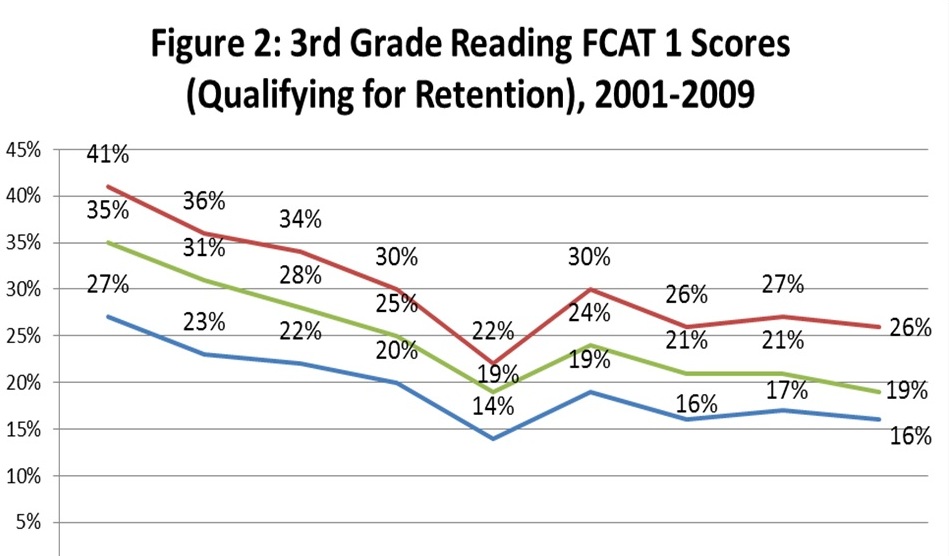
FCAT 1

The individual impact of particular policies on gains in Florida is not clear. What is crystal clear however is the fact that there were aggregate level gains in Florida. You don’t require a random assignment study or a regression equation, for instance when considering the percentage of FCAT 1 reading scores (aka illiterate) above. When you see the percentage of African American students scoring at the lowest of five achievement levels drop from 41% to 26% on a test with consistent standards, it is little wonder why policymakers around the country have emulated the policy, despite DiCarlo’s skepticism.

I could go on and bomb you with charts showing improving graduation rates, NAEP scores, Advance Placement passing rates, etc. but I’ll spare you. The point is that there are very clear signs of aggregate level improvement in Florida, and also a large number of studies at the individual level showing positive results from individual policies.

The individual level results do not “prove” that the reforms caused the aggregate level gains. DiCarlo’s problem is that they also certainly do not prove that they didn’t. It has therefore been necessary from the beginning to examine other possible explanations for the aggregate gains. The problem here for skeptics is that the evidence weighs very much against them: Florida’s K-12 population became both demographically and economically more challenging since the advent of reform, spending increases were the lowest in the country since the early 1990s (see Figure 4) and other policies favored by skeptics come into play long after the improvement in scores began.

The problem for Florida reform skeptics, in short, is that there simply isn’t any other plausible explanation for Florida’s gains outside of the reforms. They flailed around with an unsophisticated story about 3rd grade retention and NAEP, unable and unwilling to attempt to explain the 3rd grade improvement shown above among other problems. One of NEPC’s crew once theorized that Harry Potter books may have caused Florida’s academic gains at a public forum. DiCarlo has moved on to trying to split hairs with a literature review.

With large aggregate gains and plenty of positive research, the reasonable course is not to avoid doing any of the Florida reforms, but rather to do all of them. In the immortal words of Freud, sometimes a cigar really is just a cigar.


Head Start Revealed

January 14, 2013

Despite the obvious effort to delay and conceal the disappointing results from the official and high quality evaluation of Head Start, the Wall Street Journal shines the light on the issue in today’s editorial.  DC’s manipulating scumbags might want to take note that efforts to hide negative research might just draw more attention.  It’s comforting to see that the world may sometimes look more like Dostoevsky’s Crime and Punishment than Woody Allen’s Crimes and Misdemeanors.

The Journal reveals that Head Start supporters have not only ignored the latest study, but they are trying to sneak an extra $100 million for Head Start into the relief package for victims of Hurricane Sandy.  They also note that the most recent disappointing Head Start result is just the latest in a string of studies failing to find benefits from the program despite a cumulative expenditure of more than $180 billion.

And then the Journal finishes with this:

The Department of Health and Human Services released the results of the most recent Head Start evaluation on the Friday before Christmas. Once again, the research showed that cognitive gains didn’t last. By third grade, you can’t tell Head Start alumni from their non-Head Start peers.

President Obama has said that education policy should be driven not by ideology but by “what works,” though we have to wonder given his Administration’s history of slow-walking the release of information that doesn’t align with its agenda.

In 2009, the Administration sat on a positive performance review of the Washington, D.C., school voucher program, which it opposes. The Congressionally mandated Head Start evaluation put out last month was more than a year late, is dated October 2012 and was released only after Republican Senator Tom Coburn and Congressman John Kline sent a letter to HHS Secretary Kathleen Sebelius requesting its release along with an explanation for the delay. Now we know what was taking so long.

Like so many programs directed at the poor, Head Start is well-intentioned, and that’s enough for self-congratulatory progressives to keep throwing money at it despite the outcomes. But misleading low-income parents about the efficacy of a program is cruel and wastes taxpayer dollars at a time when the country is running trillion-dollar deficits.

A government that cared about results would change or end Head Start, but instead Congress will use the political cover of disaster relief to throw more good money after proven bad policy.

[UPDATE: And here is a good follow-up op-ed on the study by Lindsey Burke on the Fox News web site.]