Winner of the 2011 Al Copeland Humanitarian Award: Earle Haas

October 31, 2011

We had several especially worthy nominees for this year’s Al Copeland Humanitarian Award.  Greg nominated Charles Montesquieu, I nominated David Einhorn, and Matt nominated Steve Wynn.  But Anna Jacob nominated this year’s winner: Earle Haas, the inventor of the modern tampon.

Montesquieu’s nomination was especially important in light of the clear shift away from rule by law to rule by regulators.  No one knows what the health care bill actually required; most of the important parts were left to be decided later by regulators.  The new financial regulation is similarly just a template for regulation to be determined later.  This is a very corrosive and dangerous development in a representative democracy and Greg was right to warn us about this.

But it is not quite worthy of “The Al.”  As Greg notes, we are letting Montesquieu’s ideas about the rule of law slip away from us.  If someone were able to reverse that alarming trend, that person might be worthy of “The Al.” There is no shortage of good political philosophers and most have received plenty of recognition.  The tricky and courageous part is to properly implement those ideas.

My nomination of David Einhorn was, I thought, a useful antidote to the economic illiteracy of the Occupy Wall Street movement as well as the petty financial regulators who impede short-selling to appease mob anger and (they claim) promote stability.  But I’m not sure Einhorn’s contributions have lacked proper recognition.  Financial news regularly repeats whatever he says and gives him plenty of credit for correctly identifying past corporate frauds and excesses.

Steve Wynn probably most closely resembles Al Copeland in his personal biography.  They are both business people whose products are adored by some while denounced by others.  They both nearly drove their businesses into the ground.  They both have reputations for being personally difficult.  But despite all of these and other failings, they have both done much more for humanity than most people who win humanitarian awards.

But the “Al” is not given for personal similarity to Al Copeland.  Wynn has built some very nice hotels, turned around an increasingly seedy Las Vegas, and launched a fast-growing subsidiary in Macau.  But frankly my life (and most other people’s lives) would be just fine without these things.  I like the frivolous nature of Wynn’s gambling hotels, just like Copeland’s spicy chicken, but the “Al” is not mostly about being frivilous.

Earle Haas’ tampon, on the other hand, has made an enormous difference in improving women’s lives and making our society better.  Women often felt confined to their house a few days every month.  This limited their ability to work, travel, and engage in public life almost as much as restrictions on women in Saudi Arabia — at least for those few days.  Just look at the ad copied above.  The tampon allowed women to more regularly work during World War II to increase productivity.  The tampon helped defeat the Nazis!

But the tampon also helps illustrate where advancements for women really tend to come from.  Technological innovation, like the tampon, helped liberate women and that innovation comes from a capitalist system.  Earle Haas invented the tampon, at least in part, to make money.  Tampax Corporation brought the product to a mass market primarily to make money.  And women were successfully educated about the benefits of tampons through advertising.  Contrary to the loosely Marxist notion that advertising artificially creates desires for unnecessary products, just look at how essential advertising of tampons was in overcoming irrational opposition and ignorance of its benefits for women and society.

Activists, politicians, and other miscreants who regularly receive credit for advancing the interests of women have often done no such thing.  In fact, quite often they have undermined the cause.  Demanding that women be paid the same even if they are more likely to be absent from work just discourages people from hiring women.  But inventing new technologies that reduce the need for women to be more absent from work allows women to be paid the same without harming their employers.  If speeches and laws created reality we would be right to recognize the activists and politicians.  But Earle Haas was able to create a new reality that no speech or law could do on its own.

If the tampon was good enough to defeat the Nazis and undermine Saudi-like restrictions on women, its inventor is good enough for the “Al.”

(Updated for missing paragraph)


Liberal Goons Disrupt Common Core Presentation

October 29, 2011

(Guest Post by Matthew Ladner)

Jay, Rick Hess and others have been critical of the Common Core effort for running a “stealth campaign.” Here in the following youtube video however, you will see Common Core proponents come out to make a public presentation, only to be shouted down by a bunch of left wing yay-hoos.

Apparently the irony of inviting officials to a “real conversation about education” when they have just shouted one down doesn’t sink in to the tiny little brains of these people. Ditto for shouting “Shame! Shame!” as the panel takes the only sensible action and leaves.

Sadly a growing portion of the left seems to espouse free speech right up to the point when someone says something with which they disagree.


Steve Wynn for Al Copeland Humanitarian Award

October 28, 2011

"Stay Thirsty My Friends..."

(Guest Post by Matthew Ladner)

Last year, Jay nominated the Most Interesting Man in the World for the Al, arguing that he represented an appealing avatar for the manly good life.

Often on the blog, I have used the image of Leonardo di Caprio’s portrayal of Howard Hughes in the Aviator as a tribute to the restless innovator overcoming challenges.

Today it is my pleasure to nominate a real person who embodies qualities of both of these fictional characters: Steve Wynn.

WSJ reporter Christina Brinkley wrote a fascinating book about the battle to control the Las Vegas Strip called Winner Takes All: Steve Wynn, Kirk Kerkorian, Gary Loveman and the Race to Own Las Vegas. There were many interesting things about this book, but Steve Wynn without a doubt steals the show.

Steve Wynn essentially created the modern Las Vegas, transforming the city from a seedy, neon lit gambling hole to what it is today. I’ll let you decide for yourself what it is today, because the seedy neon lit gambling hold is certainly still there.

Ick...

I can remember watching the U2 video I Still Haven’t Found What I’m Looking For, filmed on Fremont Street back in the late 1980s and thinking to myself “Vegas is repulsive. I have absolutely no interest in ever going there.”

Some of you reading this will have exactly the same reaction to Vegas today, but mine has entirely changed, and it is because of Steve Wynn. Steve Wynn invented the Las Vegas that I enjoy visiting.

Steve Wynn invented the modern Las Vegas in the late 1980s when he built the Mirage, the first of the modern casinos, on the strip. Wynn’s vision for updating Vegas was straightforward: he was out to build destination resorts so interesting that people would want to visit even if they weren’t interested in gambling.

Today, the Mirage has fallen into meh status (a volcano? Snore….) but that is a tribute more to the fantastic cycle of one-up manship that the success of the Mirage inspired.  Wynn imagined a Las Vegas that would appeal to far more than gambling junkies, paving the way for a hyper-competitive market in every type of distraction, from fine dining to elaborate stage productions, fine art to high-end nightclubs.

In other words, the tacky Vegas is still available, but now, so is everything else.

Winner Takes All paints a fascinating portrait of Steve Wynn as the ruthless capitalist moving Vegas forward. Others had tried to top Wynn in developing new resorts, but for the most part, Wynn was in a competition against himself. In building the Bellagio, a resort which would make Louis XIV green with envy, someone asked Mr. Wynn what he had in mind for decoration behind the check in counter. When someone suggested a piece of fine art, Wynn liked the idea so much that at one point he had multiple auctioneers in New York and London buying everything in sight. When you read winner takes all, you can imagine the London and New York auctioneers wondering to themselves Egads, who is this person in Las Vegas buying all of our art?”

Today, you can visit Mr. Wynn’s gigantic Picasso collection in a restraunt in the Bellagio known, appropriately enough, as Picasso’s, which combines fine dining with a museum of art experience. I highly recommend it.

Winner Takes All details the rise and fall of Steve Wynn. In building the Bellagio, vacuuming up fine art, and other projects (including the Beau Rivage, a “baby Bellagio” in Biloxi Mississippi- a market faux pas) Binkley presents Wynn as the capitalist gone mad. Wall Street analysts began calling Wynn out on his extravagent spending. Wynn’s reaction as conveyed by Binkley is priceless, something along the lines of “These idiots and their quarterly profit statements! Don’t they get it? I’m an artist!”

Wynn went so far off the financial deep end that his rival Kerkorian, developer of the MGM, wrote a check and bought Wynn’s company straight out from under him. I’m trying to imagine anyone having the ability to write a check with enough zeros in it to purchase the Bellagio and various lesser properties, but it certainly says something about the depths to which Wynn had driven his stock price. The transformative mastermind of the modern Las Vegas was finished, a victim to his own obsession.

Well, that wouldn’t do for an ending, now would it?

Despite losing it all, Wynn found new investors willing to back his vision of excellence. Wynn secured $2.7 billion to build the Wynn hotel, buying an old property for a relative song, and topping himself yet again with a fantastic new resort. Today Vegas is down like everything, but don’t count Steve Wynn out. Personally I can’t wait to see what the mad artist/capitalist comes up with next.


Nomination for the Al Copeland Humanitarian Award: Earle Haas

October 27, 2011

Greg has nominated Charles Montesquieu and I have nominated David Einhorn for this year’s Al Copeland Humanitarian Award.  Here is Anna Jacob’s nomination of Earle Haas, the inventor of the modern tampon:

An overlooked everyday convenience, the mighty tampon is a transformative technology, offering comfort and convenience to consumers. Women had been improvising for thousands of years prior to this revolutionary invention- in Ancient Egypt, using softened papyrus; in Rome, using wool; in Japan, paper; in Indonesia, vegetable fibers, and in Equatorial Africa, rolls of grass. Made of compressed cotton, the tampon as we know it was patented in 1933 by Dr. Earle Cleveland Hass of Denver, Colorado whose “catamenial device” included such modern conveniences as a removal string and insertion applicator. Dr Hass sold the patent and trademark to Gertrude Tendrich who went on to found the Tampax company three years later. The Tampax sales team realized that advertising alone would not ensure the success of their product and established an education department to dispel myths and misconceptions. Mabel Matthews, Tampax’s first full-time educational consultant, travelled to women’s colleges throughout the U.S. discussing the safety and effectiveness of her product.

At the beginning of World War II, the tampon industry faced a setback that could’ve killed this invention before it ever reached mass production. Production of cotton bandages for the troops exploded and Tampax had to assert its product as an essential health product if it was to secure the raw materials of cotton and paper that were need for its production. Company executives travelled to Washington DC numerous times to plead their case, basing their strategy on the lesser size of their product in comparison to its alternative, the sanitary napkin or “maxi-pad.” Tampax succeeded in ensuring access to these materials by asserting that both production and transportation of Tampax actually opened up shipping space and raw materials for the war effort.

Dr Haas’ invention has been transformational for women both personally and professionally, allowing them to travel, work, and swim, unhindered by a predictable restriction three to five days out of every 28. Thank you Dr Haas!


Some Thoughts in Advance of NAEP ’11 Release

October 27, 2011

(Guest Post by Matthew Ladner)

NAEP is going to release the 2011 Reading and Mathematics results on November 1st. I thought it would be interesting to boldly make some predictions in advance. Here’s my first one: the 2011 results won’t be all that different from the 2009 results.

I know, I’m going waaaaay out on a limb here, but that’s my prediction and I am sticking to it.

While a number of states have engaged in far-reaching reforms, the vast majority of these efforts still lie in the implementation stage. Possible exceptions in my mind include Washington D.C., Louisiana and Florida.

For DC, the 2011 NAEP will constitute the first plausible check on the tenure of Michelle Rhee. DCPS began making substantial math and reading progress in the mid 1990s, with huge gains but with scores still low. Assuming normal lags between changes and impacts, I believe that the 2009 NAEP arrived a bit early. I’ll be very interested to see what happens with the 2011 scores. Washington DC is also experiencing gentrification, so I will look at the free and reduced lunch numbers.

Louisiana will be a very interesting case, as some important statewide reforms still remain in the implementation phase, but where New Orleans has been in serious reform mode since 2005. I’ll take a look at the trend in urban numbers.

Florida of course enjoyed a steady increase in NAEP scores since 1998. Florida lawmakers also instituted a fresh set of far-reaching reforms in 2011, but the verdict on those will come years down the road. Governor Crist failed to pursue far-reaching reforms of his own, and vetoed some of those that reached his desk. Florida’s scores may rise again, but I won’t be surprised if they hit a plateau.

The Great Recession may also make this NAEP a little less incremental that usual. It will be interesting to see what happens to scores in the “Sand States” with the greatest property crashes (Arizona, California, Florida and Nevada) in addition to other states with acute economic distress like Michigan.

I will look with some interest at Arizona’s scores. Not only is the state face down on the economic canvass, with house building and flipping having been signature industries before the pop, it is possible that the infamous SB 1070 may lead to the illusion of progress in Hispanic scores. To the extent that the already partially overturned SB 1070 convinced undocumented families to leave Arizona, it may create the appearance of academic improvement.

Outside of that, I’ll be looking for pleasant surprises. Tell me what you are interested in seeing from the 2011 NAEP in the comments.


Gates Responds

October 26, 2011

Steve Cantrell, a senior researcher at Gates, sent me an email last night in response to my post from yesterday asking for the MET results to be released.  He said that I was right in suggesting that large, complicated projects sometimes take longer than originally planned.  He said that final scores for coding the videos had just been delivered to the research team and that the full results for the 2009-10 year were now scheduled to be released January 5, 2012.  It’s unclear whether that report will also contain information for the 2010-11 year as well.  The MET web site will be changed to reflect this new schedule.  (Update: According to another email from Steve Cantrell, the January release will only have the full 09-10 results.  The final results including 10-11 and are scheduled for release in early summer of 2012 .)

Steve also clarified information on the cost of the project.  Last year I repeated the New York Times and LA Times description of the project costing $45 million.  More recently I’ve repeated the Wall Street Journal description of the project cost as $335 million.  Steve resolved the confusion by saying that the MET study costs about $50 million and the $335 million figure includes grants to the partner districts.

Let me be clear that I think Gates has a lot of good and smart people working on the MET project.  My concern is not that these are bad people.  My concern is that Gates has a flawed strategy based on centrally identifying what educators should do and then building a system of standards, curriculum, and assessments to impose those practices on the education system.  I don’t think this kind of centralized approach can work and I fear that it creates enormous pressure on good and smart researchers to toe the centralized line — even if it becomes obvious that it is not working.  Everyone at Gates can see what happened to the folks who pushed small schools when the Foundation decided that approach was not working.

And unlike Diane Ravitch, Valerie Strauss, and the Army of Angry Teachers, I am not criticizing the Gates Foundation because I think Bill Gates is in the “billionaire boys club” and therefore somehow disqualified from using his wealth to try to improve education.  I am critical of recent Gates Foundation efforts because I believe Gates can and should try to improve education by adopting a more fruitful strategy.

(corrected typos)


Gates Foundation — Release the MET Results

October 25, 2011

A sketch of the $500 million new Gates Foundation headquarters

Bill and Melinda Gates mentioned again in the Wall Street Journal the Measuring Effective Teachers (MET) project that their foundation is orchestrating.  Bill and Melinda may want to check on the status of the MET research they’ve been touting since full results were promised in the spring of 2011 and have yet to be released.

Just to review… In an earlier interview with the Journal, MET was described as follows:

the Gates Foundation’s five-year, $335-million project examines whether aspects of effective teaching, classroom management, clear objectives, diagnosing and correcting common student errors can be systematically measured. The effort involves collecting and studying videos of more than 13,000 lessons taught by 3,000 elementary school teachers in seven urban school districts.

The motivation, re-iterated in the new piece by Bill and Melinda Gates is to identify  what “works” in classroom teaching to develop systems that train and encourage other teachers to imitate those practices:

It may surprise you—it was certainly surprising to us—but the field of education doesn’t know very much at all about effective teaching. We have all known terrific teachers. You watch them at work for 10 minutes and you can tell how thoroughly they’ve mastered the craft. But nobody has been able to identify what, precisely, makes them so outstanding….

The intermediate goal of MET is to discover what we are able to measure that is predictive of student success. The end goal is to have a better sense of what makes teaching work so that school districts can start to hire, train and promote based on meaningful standards.

As I’ve argued before, using research to identify “best practices” in teaching only makes sense if the same teaching approaches would be desirable for the vast majority of teachers and students, regardless of the context.  And as I’ve also  suggested before, I don’t believe this effort is likely to yield much in education.  Effective teaching is like effective parenting — it is highly dependent on the circumstances.  Yes, there are some parenting (and teaching) techniques that are generally effective for almost everyone, but those are mostly known and already in use.

This doesn’t mean we are completely unable to measure effective teaching (or parenting).  It just means that we have to judge it by the results and cannot easily make universal statements about the right methods for producing those results.  To make a sports analogy, there is no single “best practice” for hitters in baseball.  There are a variety of stances and swings.  The best way to judge an effective hitter is by the results, not by the stance or swing.  And if we tried to make all hitters stand and swing in the same way, we’d make a lot of them worse hitters.

It is because of this heterogeneity in effective teaching practices that I think the MET project is doomed to disappoint.  And according to inside sources, I’ve heard that results are being delayed because they are failing to produce much of anything.

According to the MET web site, the full results for the 1st year should have been released in the spring:

 In spring 2011, the project will release full results from the first year of the study, including predictors of teaching effectiveness and correlation with value-added assessments.

It is almost November and we have not seen these results.  I understand that in very large and complicated projects, like MET, things can take much longer than originally planned.  If so, it would be nice to hear that explanation.  It would be even nicer if the Gates Foundation released results if they have them, even if those results were not what they had hoped they would find.

Some inquisitive reporters should start asking Gates officials and members of the research team about the status of the MET results.  Reporters should go beyond talking to the media flacks at Gates HQ and actually talk to individual members of the team confidentially.  If they do that, they may confirm what I have been hearing: MET results have been delayed because they aren’t panning out.

(UPDATE:  Gates responds.


What’s Going Right in Waconda?

October 24, 2011

According to the Global Report Card that Josh McGee and I developed, tiny Waconda, Kansas is one of the top-performing school districts in the United States.  Other than being the home to what residents claim is the world’s largest ball of twine (pictured above), one might not think that there was anything exceptional about this rural, farm community in north central Kansas.

But in 2007 the average student in Waconda performed better than 91% of students in our 25 country comparison group in math achievement.  If we relocated Waconda to Finland, the average student in Waconda would outperform 88% of the students in Finland in math.

A reporter for Yahoo News was curious about what they were doing right in Waconda.  Here is what she found:

So why are Waconda kids–65 percent of whom live in poverty–doing so well? And can other schools follow their lead?

The Waconda district comprises four small towns–Cawker City, Downs, Glen Elder and Tipton–and seven schools spread over 411 square miles. Most people in the area work in agriculture or in manufacturing.

The district’s superintendent of seven years, Jeff Travis, told Yahoo News that after years of high test scores, the community expects its students to excel. Most years, he added, no one drops out of high school. The district won 14 state Governor Achievement Awards and one national “Blue Ribbon Award School” over the past four years.

“It’s a tradition now, and they expect themselves to do well,” Travis said. “Like a ball team that continues to win because of a tradition, we have an academic tradition.”

Still, the community doesn’t quite seem to get how exceptional they are. “Everybody’s pretty happy [but] nobody understands how big a deal it is,” he said.

Travis says the students’ high level of achievement is even more extraordinary given that 65 percent of them qualify for free or reduced federal lunches, an indication that they live in poverty. High poverty schools are often dogged by low test scores and high dropout rates. Many educational observers indeed blame the nation’s sky-high child poverty level for the country’s comparatively low performance in math.

One theory Travis has is that Waconda school kids have no sense that they’re materially deprived. “North Central Kansas is rural, and urban poverty is kind of different [from] rural poverty,” he said. “A lot of our people don’t even understand that they’re living in poverty.” According to state data, most of the students are white, and no kids need English language learning classes.

About 10 percent of the students in the school district are foster kids, Travis says. “We just [have] a lot of adults that care about kids, so it’s been a popular thing for parents to take in foster children.”

But Josh adds a useful note of caution at the end of the reporter’s piece:

One of the Global Report Card’s authors, Josh McGee, says the small size of Waconda schools may have skewed the results slightly, since randomness has a greater impact on a smaller sample size. Most of the best-performing school districts in his ranking were small, and many of them were also made up of charter schools. You can read more about his methodology here.

We may not be able to generalize much from the success in Waconda, but it is a fun and impressive story.

Meanwhile, coverage of the Global Report Card continues to stream in.  For an updated list of media for the Global Report Card (with links), click here.


In Defense of “Achievement Gap Mania”

October 19, 2011

(Guest Post by Matthew Ladner)

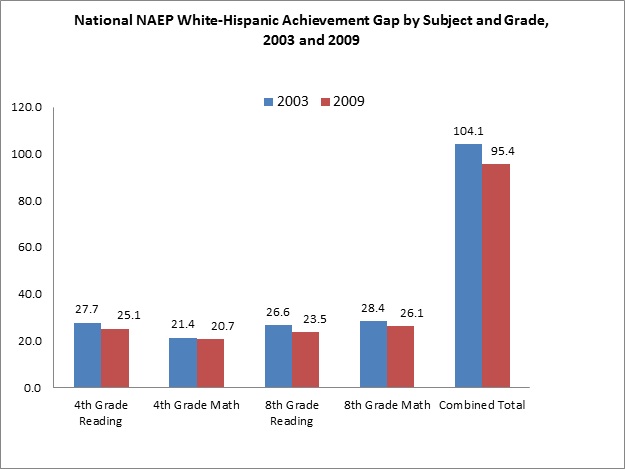
So the early appearance of the 2011 NAEP has given me reason to update a project, leaving me with some interesting charts to burn off. The above chart measures the national White-Black achievement gap for all four of the main NAEP exams for the 2003-2009 period. Mind you, that on these exams, 10 points is approximately equal to a year worth of average academic progress. These are White scores minus Black scores, with the 2003 gaps in Blue and the 2009 gaps in Red.

In Jay’s post below, you can watch a Fordham discussion that includes debate over whether we have fallen into the grip of “achievement gap mania.” If so, we have precious little to show for it. We did have some narrowing of the achievement gap between 2003 and 2009, but at two and a half plus grade level gaps in all four subjects. Start your low-calorie, carrot juice diet and mark your calendar for 2075 or so, assuming that we can maintain today’s glacial pace of closing.

The news is approximately as dismal on the White-Hispanic front:

While I do sympathize with the argument that we need to get everyone to understand their stake in education reform, I must say that there is a reason why people are passionate about achievement gaps. The term “disgraceful” does not begin to describe the catastrophic failure represented in the charts above. Black and Hispanic children score little better than what the average 1st to 2nd grade Anglo student would score on a 4th grade reading test. It’s only the developmentally critical literacy acquisition window after all.

The focus on the achievement gap is important because it cuts to the heart of American ideals. We believe in equality of opportunity. We believe in meritocracy. We believe in class mobility and self-determination. Call it the triumph of hope over experience if you wish, but we believe that public education can help achieve all of this and we refuse to give up on the notion.

The terrible truth of course is that our public education system is pervasively classist to an extent that goes far deeper than the naive equity funding attorneys ever seemed to grasp. If we auctioned the limited supply of high quality public school seats on Ebay rather than covertly through mortgages, perhaps all of this would more transparent. If we could tag our highly effective instructors, we could watch a time-lapse film of them fleeing dysfunctional school systems for the leafy suburbs and/or leaving the profession entirely. Increased resources could in theory ameliorate these problems, but strangely enough they didn’t.

Why? Paul Hill said it best:

Money is used so loosely in public education—in ways that few understand and that lack plausible connections to student learning—that no one can
say how much money, if used optimally, would be enough. Accounting systems make it impossible to track how much is spent on a particular
child or school, and hide the costs of programs and teacher contracts.  Districts can’t choose the most cost-effective programs because they
lack evidence on costs and results. 

The sad thing is, some are so desperate to maintain the above paragraph that they are willing to ignore the consequences, including the two charts above. They comfort themselves with excuses. Blah blah poverty yadda yadda video games. Whatever. I’m not saying that achievement gaps are the sole responsibility of schools, or that we will live to see them completely closed. I agree with Rick Hess that there are serious shortcomings to a reform strategy solely based on gaps.

We can however do a hell of alot better than this. We focus on achievement gaps not because it is expedient, but because it is necessary.


Josh McGee on the Global Report Card

October 18, 2011

Check out Josh discussing the Global Report Card at this Fordham Institution event on “The Other Achievement Gap” focusing on the disappointing performance of some of our “best” students and school districts.

Josh starts at around 12:30 in the video.

Also check out the updated list of coverage on the Global Report Card.