So I ran the NAEP learning gains for free and reduced lunch eligible children for the entire period in which all 50 states have data available on all 4 main NAEP exams.
West Virginia, you’ve got some ‘splaining to do!
What has Maryland been up to? Underrated?
North Carolina…you really let yourself go!
Florida wins despite the fact that starting the clock in 2003 ignores large gains between 1998 and 2002.
Discuss amongst yourselves…I’m feeling a little verklempt.
Jay Mathews and I are rebooting our somewhat troublesome bet. We’re starting over from scratch. This time, rather than counting legislative chambers, we’re going to count “enactments” of school choice. Any time a new school choice program or expansion of a school choice program (defined the same way as before) is enacted, that counts as one.
I have to get to seven enactments in 2011 to win.
We’re currently at four:
1. AZ new program
2. AZ program expansion
3. CO new program
4. UT program expansion
I’m getting out a little ahead of the Arizona governor, here, but those bills are both slam dunk at this point.
I warned Jay that Indiana is looking pretty good, so it’s really a fight over whether I can get two wins in places like Wisconsin, Oklahoma and D.C. He’s cool with that.
As we have seen in the past, teacher licensing requirements have little relation to student achievement. One reason for this may be that rather than driving up teacher quality, licensure requirements can be so full of bureaucratic red tape that they drive away smart and knowledgeable teaching candidates who have other options.
In support of that theory, I offer an anecdote, namely an email from a good friend of mine who has more knowledge and training than most prospective teachers — she went to Princeton for undergrad, Yale for a master’s degree, and Harvard for law school. But before she can even get in the door and start studying pedagogical techniques and the like, she is being told that she has to take nine (9) more undergraduate courses of background knowledge.
Here’s her email:
Hey, Stuart! I am planning on entering a teacher licensing program this summer, with the goal of eventually teaching 4th or 5th grade in a low-income school. . . .
My current hurdle is that the local university took a look at my Princeton, Yale, and Harvard transcripts and determined that I need to take 9 undergraduate courses to even enter the licensing program. I can understand (on some level) needing to take three more science courses, but they also claim that I need to take courses in early American history (for some reason, constitutional law and all of my early American government classes don’t count), world geography (my specialization at Yale in international politics isn’t enough), and world civilization. Plus none of my corporate finance courses or econ courses can count toward the math requirements.
Very frustrating. I’m trying hard not to let the bureaucratic hurdles get me down.
So a graduate of Princeton, Yale, and Harvard is being told that she is woefully undereducated for the task of teaching disadvantaged 4th graders. Res ipsa loquitur, as lawyers say.
“He is the standard-bearer,” said Michael J. Petrilli of the Thomas B. Fordham Institute, a conservative-leaning education think tank. “Those governors who are going to have religion on education reform are looking to him to be their mentor.”
and from Paul G. Pastorek, Louisiana’s superintendent of education:
“Arne and Jeb are really the most influential people at the national level right now pushing college and career readiness for our kids and improvement for our schools,” said Paul G. Pastorek, Louisiana’s superintendent of education and a Republican. “Jeb is working with statehouses and state leaders to directly impact the agenda. He is above all others on the issue among Republicans.”
Of course, journalistic ethics require “balance” and this is where it gets fun:
Many Democrats and labor leaders denounce the Bush agenda. They say that vouchers drain funding from public education and that grades of D and F stigmatize schools that need help. Critics also say other policies he espouses — including merit pay — are unfair to teachers and rely too much on standardized tests.
Florida’s academic gains, critics say, could have been much larger if Bush had sought more collaboration.
“He doesn’t believe in bringing people along with him,” said Andy Ford, president of the Florida Education Association, the state teachers union. “He just forces his will on everybody.”
Ford said many teachers were irate that Obama shared a platform in Miami with a former governor who fought the union almost nonstop for eight years. “The White House is on the wrong track by associating with Jeb Bush,” he said.
Don’t worry Andy, Governor Bush is bringing plenty of people along with him. Someday even you reactionary types may come around, but no one has time to wait for that. As for “the gains would have been much larger if Governor Bush had sought more collaboration” claim, strangely enough, Florida has had the largest NAEP score gains in the country. Try again. As for the President associating with Governor Bush, well, who wouldn’t want to associate with results like these:
The first is Bush’s own creation of the Florida Reading Research Center, a state technical assistance agency solely focused on providing reading assistance — complete with reading coaches — in elementary schools so that kids could read by the time they graduate third grade.
It would be hard to argue that this wasn’t a big reason for the rise in Florida’s fourth-grade reading scores on the National Assessment of Education Progress, the grade and area where the state saw the highest gains under Bush.
The former governor also never mentions any possible effects from a class-size reduction referendum in the state which he opposed but was approved anyway by voters early in his tenure.
Dorn, in a Q & A I did with him late last year, also noted that Bush was governor during a real-estate boom that allowed per-pupil expenditures in Florida to rise 19 percent. That allowed schools to hire hundreds of reading coaches. But, said Dorn: “That kind of money is not available in any state right now, and I suspect a number of states will be in for a rude shock when they try the symbolic step of assigning letter grades to schools without supporting instruction.”
Let’s take these one at a time:
1. Governor Bush happily acknowledges that the reading improvement effort strongly contributed to the overall effort to improve literacy. No one necessarily needs to create the State X Reading Research Center. If they want to hit the ground running they can use the Florida Reading Research Center’s research.
Bless their hearts, the edu-reactionaries come across as a bitdesperate to spin their way to a story that will justify what seems to be their goal: a yet more expensive version of today’s failed status-quo. No one should take this the least bit seriously, as we cannot afford it, and it wouldn’t work anyway. States around the country are drawing inspiration from the Florida reforms for a reason, and Governor Bush is the first one to emphasize that the Florida cocktail was state of the art, cutting edge reform in 1999. Today’s reformers can take Florida’s reforms as their floor, rather than their ceiling.
I made the bet thinking I had three. I turned out I had five. By the time the bet went live on the blog I had seven.
Then, in the comments, Matt brings to my attention that both Utah houses passed a major financial expansion of the Carson Smith voucher program on March 10. And Scott notes that Minnesota’s House passed a new voucher program on March 30.
Last week I challenged Jay Mathews of the Washington Post to a bet:
Tell you what, Jay. Let’s make a bet. You say there won’t be “a wave of pro-voucher votes across the country”…[W]e’ll set a mutually agreed on bar for the number of voucher bills passing chambers this year. If we hit the bar, you have to buy me dinner at a Milwaukee restaurant of my choice. But if we don’t hit the bar, I buy you dinner at a DC restaurant of your choice. That’s pretty lopsided in your favor, dollar-wise. How about it?
Today I’m proud to announce that Jay has accepted the bet!
The terms, exactly as I offered them to Jay over e-mail:
Here’s what I propose. I win the bet if at least ten legislative chambers pass bills in 2011 that either create or expand a private school choice program. Otherwise you win. Just based on my experience in the movement, I think if we got that many chamber passages, it would mark 2011 as a banner year for choice.
Definitions: A “private school choice program” is a program that funds attendance at private schools using public funds, either directly (by vouchers) or indirectly, through the tax code (as is the case with many school choice programs these days). That means charter schools don’t count. This is the definition we use here at the foundation. “Expanding” a program means increasing the eligible student pool, or increasing the amount of funds available to support the program (on either a per-student or global basis). That’s in your favor because I’m agreeing not to count, say, relaxation of burdensome restrictions on participating schools as an “expansion.”
Jay’s succinct response: “It’s a bet!”
Well, I didn’t plan it this way, but during the time I was working out the details and deciding how many programs to propose for the bet, and then communicating with Jay, there were a few votes on school choice programs!
When I proposed the bet to Jay earlier this week, I had missed the votes in Arizona a couple weeks ago. I thought we only had three of the ten passages needed for me to win the bet – the Virginia House, the Oklahoma Senate and Douglas County, Colorado.
When Matt clued me in on the Arizona votes, I realized that we were already at five out of the ten passages needed for me to win:
1. VA House new tax-credit scholarship program (February 8 )
2. AZ Senate tax-credit program expansion (March 8 )
3. AZ House tax-credit program expansion (March 10)
4. Douglas County, CO new voucher program (March 15)
5. OK Senate new tax-credit scholarship program (March 16)
Then what happens?
6. IN House new voucher program (March 30)
7. U.S. House voucher expansion (March 30)
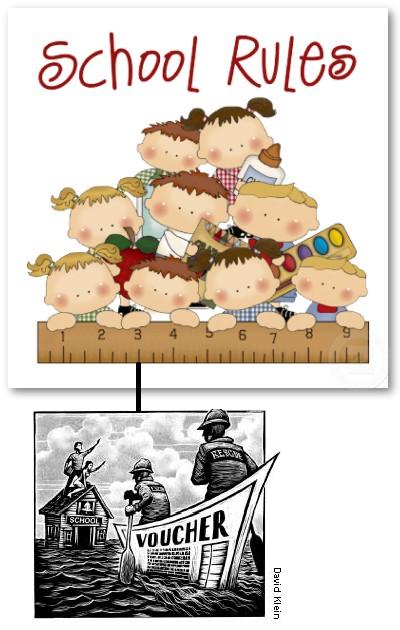
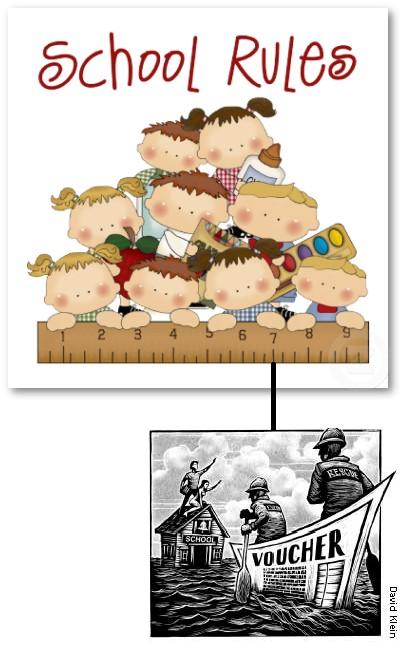
We got to seven votes before I even announced the bet! So much for my plans to make this a big, drawn out, suspenseful thing. The whole shooting match is going to be over before I even get three blog posts out of it. And here I made these cool ruler graphics and everything!
Here’s one other thing that’s bothering me. Was it unethical for me to make the bet with Jay without revealing to him that Indian is the official ethnic food of Jay P. Greene’s Blog?


 Posted by matthewladner








 Jay P. Greene's Blog