Oklahoma Governor Henry signs Special Needs Vouchers

June 8, 2010

(Guest Post by Matthew Ladner)

Oklahoma joined Maine, Vermont, Wisconsin, Ohio, Arizona, Minnesota, Illinois, Florida, Pennsylvania, Utah, Georgia, Iowa, Rhode Island, Louisiana and Indiana  in the states with private school choice programs when Governor Brad Henry signed the Lindsey Nicole Henry Scholarships for Students with Disabilities Act.

Governor Henry became either the second, third or maybe fourth Democratic Governor to create a new private school choice law with his signature. I lost count after Janet Napolitano became the first in 2006. In past the past couple of weeks, Democrats have passed a major teacher quality bill in Colorado, lifted the charter school cap in New York and now signed a voucher bill into law.  The alliance between sincere progressives and K-12 reactionaries continues to bend if not yet break.

It is a fascinating time to be working in K-12 reform.


National Standards Nonsense Redux

June 7, 2010

The revised set of proposed national standards were released last week.  I don’t know what else to write about this without sounding like a  broken record.  The bottom line is that this is a really dangerous movement that is receiving support from some people who should know better.

As we’ve already pointed out at JPGB, there is nothing voluntary about these national standards.  Neal McCluskey over at Cato has also made this same point numerous times.  The federal government requires that states commit to adopting the national standards as a condition of applying for Race to the Top Funds.  And the Obama administration is floating the idea of making state adoption of these national standards a requirement for Title I or other federal funds.  So, the national standards are “voluntary” in the sense that states can choose not to do it as long as they don’t mind letting the federal government hand out the tax dollars their residents pay to residents of other states but not to them.

We’ve also pointed out numerous times that many credible people have raised strong concerns about the rigor and soundness of the proposed national standards (here, here, here, and here).  The Fordham Foundation has given passing grades to the proposed standards, but frankly it is not particularly persuasive to gather a group of your like-minded friends experts and ask them to give grades to something you favor — especially if the grades given by the experts might be changed if they are at odds with Fordham’s predisposition.

But perhaps the strongest objection to national standards that we have repeated at JPGB (here, here, and here) is that even if the current set of proposed national standards is an improvement for some states (and less good than others), there is strong reason to fear that people opposed to sensible, rigorous standards will gain control over the newly created national standards infrastructure and be in a position to impose their nonsense on everyone.  Remember that teacher unions, ed schools, and other opponents of tough standards that might expose the shortcomings of schools and teachers are much better organized and politically powerful than anyone else in education politics.  Over time they will gain control of the machinery of national standards even if they do not control it now.

None of the reasons typically given for national standards is compelling.  As I’ve written before,  “We don’t need national standards to prevent states from dumbing down their own standards. We already have a national test, the National Assessment of Educational Progress (NAEP) administered by the U.S. Department of Education, to show how states are performing on a common yardstick and to shame those that set the bar too low. Illinois, for example, isn’t fooling anyone when it says that 82% of its 8th graders are proficient in reading because according to NAEP only 30% are proficient. The beauty of NAEP is that it provides information without forcing conformity to a single, national curriculum.”

And to repeat myself some more: “Nor is it the case that adopting national standards would close the achievement gap between the U.S. and our leading economic competitors. Yes, many of the countries that best us on international tests have national standards, but so do many of the countries that lag behind us. If there really were one true way to educate all children, why stop at national standards? Why not have global standards with a global curriculum?

We would oppose global standards for the same reasons we should oppose national standards. Making education uniform at too high of a level of aggregation ignores the diversity of needs of our children as well as the diversity of opinion about how best to serve those needs. And giving people at the national or global level the power to determine what everyone should learn is dangerous because they will someday use that power to promote unproductive or even harmful ideas.”

I’ve never seen any of the advocates of national standards adequately address any of these objections.  Until they do I guess I’ll just have to keep repeating myself.


Pass the Popcorn: Another Take on IM2

June 7, 2010

(Guest post by Greg Forster)

If you didn’t like my take on Iron Man 2, try this one on for size:

Part of the long-running series.


Manzi Joins the Party

June 7, 2010

(Guest post by Greg Forster)

In the Corner, Jim Manzi’s comment on Grover Whitehurst’s proposals for education reform is that it’s really no longer a matter of arguing over what would help; it’s just a question of figuring out how to make it happen in the face of entrenched union opposition. Manzi thinks that’s a good sign:

It is striking how far thoughtful, mainstream liberal wonk opinion has moved on the question of educational reform….When one side of the political divide loses its own ideological belief in a specific position and defends it based purely on interest-group power, this often creates an opportunity for real change.

Welcome to the party, Jim!

It seems to me that education reform is ripening as political issue for Republicans, if they are willing to seize it, as they did welfare reform 20 years ago. Like welfare reform, this would probably imply being willing to engage on the policy detail, and to work with Democrats in order to create a bipartisan solution with staying power. It looks to me like there is lots of common ground to be found.

I think that’s right, but it will all hinge on the willingness of enough Democrats to buck the teacher union mafia, just as welfare reform hinged on the willingness of enough Democrats to buck the social-services union mafia twenty years ago. Fortunately, there are reasons to think that could happen. And the best part is, today the people turning against the unions are not just any Dems, they’re the social justice Dems, who bring to the table their unique cultural power to annoint and legitimize things within the Left.


DMN: African Americans Choosing to Leave Dallas ISD

June 7, 2010

(Guest Post by Matthew Ladner)

Must read story from the Dallas Morning News. Important piece of context that the DMN failed to mention: DISD has been an academic train wreck for decades, especially for African-Americans. A quick look at Texas Education Agency reports reveals that only 5.1% of DISD African-Americans received a “criterion score” on the SAT or ACT, which if memory serves would qualify the student to attend a moderately selective university.

The story contains multiple hints of battles over patronage, and academically, it is hard for me to think of thousands of African-American children going to school somewhere other than DISD as anything less than a net positive. If the Texas legislature were to improve the state’s charter school law, and to pass measures to create private choice options, it would be the equivalent of sending a rescue flotilla to the Titanic.


NJ Governor Christie: NJEA = Hotel California

June 5, 2010

(Guest Post by Matthew Ladner)

He’s going to stab it with his steely knife, and he just might kill the beast…


“Voluntary” Standards

June 4, 2010

I am shocked – shocked! – to discover that political manipulation of education is going on in here!

Your NCLB and RTTT grants for supporting national standards, monsieur.

(Guest post by Greg Forster)

Over on NRO, Heritage’s Lindsey Burke and Jennifer Marshall warn that the Obama administration is finding even more ways to use federal influence to push “voluntary” national standards on the states.

So much for Checker’s apparently serious assertion that the standards “emerged not from the federal government but from a voluntary coming together of (most) states, and the states’ decision whether or not to adopt them will remain voluntary.” Bwa ha ha!


New Study Links Tax Credit to Florida Public School Gains

June 3, 2010

(Guest Post by Matthew Ladner)

A new study by David Figlio links higher gains among Florida public schools with higher levels of competition from the Step Up for Students tax credit program. You can read the St. Pete Times story by Ron Matus here.  Matus wrote:

Figlio emphasized the boost was significant, but modest.

“Anybody looking for a silver bullet has to keep looking,” he said. “What we find is certainly positive and statistically strong, but it’s not like public schools are revolutionizing overnight because of this, either.”

So it turns out that the public school gains associated with a state program with an initial statewide cap of $50m in a state with a multi-billion dollar public school budget were statistically significant but modest. Would it be reasonable to expect anything more from such a modest program? I suggest we scale this public school improvement program up to say a cool billion per year and then measure the impact.

My favorite line in the story comes from a hostile academic:

Another researcher remained skeptical. Stanford labor economist Martin Carnoy, who has studied the impact of vouchers and reviewed the latest study, said Figlio and Hart did “an honest job with the data.”

But here is the real story: even after several years the effect size is TINY,” he wrote in an e-mail. “They are so small that even small downside effects would nullify them, leaving vouchers as mainly an ideological exercise.”

This is one of the more unintentionally hilarious statements I have read in some time. The field of education reform battle is covered with the dead bodies of reforms that show nothing in the way of a statistically significant impact. Increasing per pupil funding, Head Start, teacher certification, almost everything studied by the “What Works” clearinghouse so far, etc. All of these failures cost a great deal of money and deliver nothing in the way of sustained academic gains.

So the state of Florida passes a small law that actually saves the state money and shows a statistically significant and small result of improving public schools, and we are supposed to wring our hands and despair because something bad could come along and nullify the gains? Ummmmm, no.

First of all, nothing bad did come along and nullify the gains- quite the opposite. This program was only a part of the strategy to increase parental choice in Florida. That strategy also includes charter schools, McKay vouchers and virtual schooling- all of which either already are or soon will be much larger programs than Step Up for Students.

Second, the parental choice strategy was itself a part of a larger effort to improve Florida public schools. Parental choice reinforced the central K-12 reform of grading schools A-F. Transparency, rewards for success, consequences for failure formed the core of the Florida strategy.

Did it work?

The Step Up for Students program played a contributing role in Florida’s symphony of success rather than “destroying public education.”  This is what Milton Friedman argued all along. Bravo- the obvious conclusion to draw is to push both parental choice and public school reform still further in Florida and elsewhere.


New Florida Study Makes It 18-0

June 3, 2010

(Guest post by Greg Forster)

David Figlio’s study (with Cassandra Hart) on how the Florida Tax-Credit Scholarship program impacts public schools is finally out. Guess what? His detailed statistical analysis finds that competition from school choice improves public schools. (Here’s some local news coverage.)

But that was no surprise to anyone who’s been following the research. Early last year I counted up the studies and here’s what I got:

Removing the double-count for studies that had findings in multiple locations, that made it 16 studies finding school choice improves public schools to zero finding they hurt public schools. (The one null finding was in DC, where the program pays enormous cash bribes to the public system – apparently on the princple that children are the chattel property of the government school system – in order to deliberately neutralize its effect on public schools.)

After that, Jay came out with yet another study finding that Milwaukee vouchers have improved public schools. That brought it up to 17-0.

Now Figlio and Hart in Florida, adding the first study that looks at tax-credit scholarships rather than vouchers, have made it 18-0.

Oh, and in case you’re wondering, the Florida tax-credit program also dramatically improves education for the students who are using it.

As always, critics are trying to make hay out of the fact that in the Figlio/Hart study, a tiny, population-limited, regulation-cramped choice program produces only moderate-sized benefits. Well, geniuses, if the benefits of a tiny, population-limited, regulation-cramped program are too small for you, can you think of any way you might make the program’s impact bigger?


Why Do Miami Kids Read a Grade Level Better than Oregon Kids?

June 2, 2010

(Guest Post by Matthew Ladner)

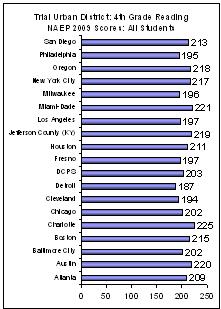
The NAEP released the 2009 Urban District NAEP results recently, which of course was an invitation to go exploring the data. I thought it would be interesting to look at the results for 4th grade reading.

So Charlotte, Miami and Austin come out looking pretty good among urban districts. Oh, and Oregon too. Silly me, I must have accidentally slipped the statewide average for all kids in Oregon into the comparison of urban school districts. When you throw in all the rich kids in Oregon into the mix, they look like a decent urban school district, although not, I will note, the best urban school district.

Perhaps a bit of control for demographic differences between these jurisdictions is in order. After all, some districts like Austin (and I suspect Charlotte) have quite a few affluent kids attending them. So in the next chart, I only look at free and reduced lunch eligible children in the districts for more of an apples to apples comparison.

So Miami wins overall with a score of 215 for FRL kids, followed closely by NYC at 214. Both of these scores exceed several statewide averages for all students- such as California’s. Miami not only was the low-income reading champion for 4th grade, but the both the low-income and the overall reading champion for 8th grade.

Oregon low-income kids perform **ahem** like a mid-tier urban district despite the inclusion of suburban kids, and approximately a grade level behind both Miami and NYC.  Some might also find it interesting that the Miami school district is 91% minority, while Oregon is 72% Anglo. 

I certainly do. Quite a bit actually.

When I read Bernard Lewis’ book What Went Wrong? about how the Islamic world went from being the premier civilization to an economic backwater, it seemed to me that Lewis had asked the wrong question. Most of the world, after all, is a backwater. The real question is What Went Right? with the West more than what went wrong in the Islamic world.

It behooves us to ask both questions in this case: what in the world is wrong with Oregon, and what is going right in Miami? I have a very good idea of what is going right in Miami. Good standards and testing, transparency, letter grade rankings for schools, parental choice, alternative certification, curtailment of social promotion. I don’t know what Oregon has been doing, but it looks to me like they should make some rather dramatic changes.