The Unions Doth Protest Too Much

April 19, 2010

(Guest post by Greg Forster)

Wow, the graphic above seems to have struck a sensitive spot with our Sith apprentice, Leo Casey. Here’s his surprisingly defensive overreaction.

Leo thinks he has my motives all figured out. He thinks my post last week was trying to sow division within the union by pitting their internal constituencies against one another.

Er, no. I don’t think many UFT members read Jay P. Greene’s Blog, except the ones who are paid to.

Leo’s evidence about my motives consists entirely of a passage from a book written 20 years ago by people who have no connection to me. Oh, and he lists my affiliation as being with “the Milton Friedman Foundational Educational Choice.” Two words right out of five ain’t bad – at least by his standards.

You would think that a person who has been caught participating in eggregious political fraud and promoting scandalous calumny would be more careful. Or maybe you wouldn’t.

Sherman Dorn likewise misconstrues my purpose (although without the foot-shooting intellectual slapstick we’ve come to expect from Leo). Dorn writes of my post: “This is corruption! is the implication.”

Er, no. I not only didn’t say anything about corruption, I didn’t imply anything about it. There’s nothing corrupt about UFT representing more non-teachers than actual teachers.

Dorn invokes my status as a political scientist with hoity-toity academic credentials in order to sadly lament that I failed to provide an extensive discussion of the academic literature on different types of voting systems in my blog post. Well, let’s try to satisfy him by adopting some unnecessarily opaque academic jargon as we look back at the actual, clearly and explicitly expressed purpose of the post.

My post is what political scientists call “positive theory.” That is, I’m offering an explanatory model of the unions’ behavior. Why do unions invest so much of their effort in racking up a trillion dollars in mostly-unfunded pension obligations, rather than taking a more evenhanded (and thus presumably less noticeable) approach to what kinds of swag they grab? Why do they support policies that make working conditions worse for teachers?

Down here in the dark bowls of the earth where we “trolls” live, the prevailing explanation is that the union leadership has incentives to do things that fatten themselves at the expense of the union membership. Well, I’m not saying that’s not true! But there’s at least one other plausible theory, and my post offered it. Or both could be right!

But . . . I’ll admit that I did have a hidden agenda! Namely, I wanted to create some transparency about whether the UFT represents “teachers.” It’s not wrong for UFT to represent more non-teachers than it does teachers, but it’s wrong for UFT to puff itself up as The Voice of The Teacher in order to promote policies that serve another agenda. Not that I think a union should puff itself up as The Voice of the Teacher even if it does primarily represent teachers, any more than I think the National Organization for Women should puff itself up as The Voice of Women. But how much more shameless would it be if most voting members of NOW were men?


Love Lost

April 17, 2010

It’s been a while since I last posted on Lost, so let’s review what we’ve learned since then.  Most importantly, we’ve learned that something is horribly wrong with the parallel world.  After the side-flashes for Jack and Locke it seemed like the parallel world was one where everyone had worked out their problems.  But it now seems clear that it was all too good to be true.  Starting with the Desmond side-flash episode and continuing this most recent week with Hurley’s side-flash, we are learning that the parallel world is almost certainly bad.  It’s somehow false and people are detecting that, notably Desmond, Charlie, Daniel, and now Hurley.

One big problem with the parallel world is that it is missing love.  Desmond was missing Penny.  Charlie was missing Claire.  Daniel was missing Charlotte.  Hurley was missing Libby.  Is the show telling us, as I earlier guessed, that suffering and loss are virtuous?  Better to have loved and lost than never to have loved at all.

But this doesn’t quite fit everyone’s experience in the parallel world.  Jack and John seem to have great lives in the parallel world, including love.  Nevertheless, I’m willing to bet that the parallel world is somehow false and bad and they need to get back to the Island world.

Desmond already seems to be working on getting the band back together.  He’s manipulating everyone so that they awaken to what they are missing in the parallel world and could get in the Island world.  I wouldn’t be surprised to see him getting everyone back on a plane with a dead Locke so that they can get back to the Island.  Maybe that’s why he ran Locke over. 

We learned a few other things that mostly confirmed things that we suspected.  The whispers are dead people who are stuck on the Island because they had done bad things.  And we have confirmation that Smokey really is bad.  Despite my efforts to build a theory where he might be good, it seems obvious that he is not.  We also know that people are supposed to work out their problems on the Island.  Jack and Hurley both made direct statements about how they used to be controlling (or passive for Hurley) but have now changed.  That was bad script-writing to be so direct about it.  Couldn’t they have just shown us without telling us?

There’s still a lot we don’t know.  In fact, we don’t know much about any of the important things.  What bad thing happens if Smokey gets off the Island?  Whose side is Widmore on?  What is the purpose of these people finding love or working out their issues other than the benefit to them?  Why should we care?


Arkansas Senate Ads

April 15, 2010

The TV airwaves in Arkansas are filled with third-party ads supporting Bill Halter against Blanche Lincoln.  Here’s one:

And here is a basic translation of what the ad says:

I’d like to be able to say that Senator Lincoln’s ads in response are any different, but they aren’t.  And the Republicans aren’t yet running many ads, but their rhetoric is basically the same.  Arkansas politicians seem determined to fulfill the worst stereotypes that people may have about the state.


Charlie Crist Vetoes Tenure Bill

April 15, 2010

(Guest Post by Matthew Ladner)

Florida Governor Crist vetoed a tenure reform bill despite the fact that he endorsed it publicly on multiple occasions.


Memories of the Way We Were

April 15, 2010

(Guest Post by Matthew Ladner)

Today is tax day, and if you are like me, it is your favorite day to throw a fit about paying them. It’s worth keeping in mind that about half of your state budget winds up going to K-12, and that those K-12 budgets are incredibly bloated by historic standards.

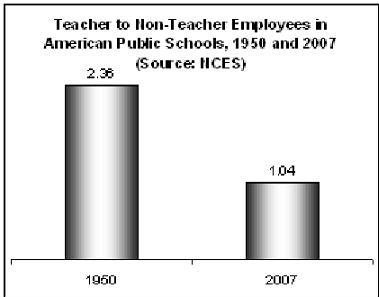
So we used to employ 2.36 teachers for every non-teacher in American public schools. Today, it is close to 1 to 1.

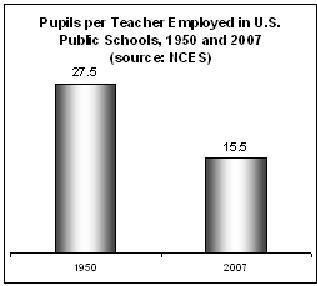
We must be packing students into classrooms like sardines in order to afford this vast legion of non-teachers! Except, um, not so much. That ratio fell despite hiring far more teachers per pupil. And thus we move from an inflation adjusted spending per pupil total of $2,377 in 1950 to over $12,000 per pupil today.

Jay and Greg noted in Education Myths that the notion of a lost golden age of public education is a myth. At least, that is, in terms of academic achievement (best we can tell, it has been flat). In terms of efficiency however, there was a golden age, and it has indeed been lost.


Only 40% of UFT Voters Are Actual Teachers

April 14, 2010

(Guest post by Greg Forster)

Over on NRO, Rick Hess points out that only 40% of the voters in last week’s UFT elections were actual teachers.

Do you think this sort of thing might have something to do with the problem of runaway, unfunded teacher pensions? Looks like at least one union is representing retirees at least as much as teachers.

This also sheds some light on why the unions favor policies that destroy the working environment for public school teachers. Only 40% of their voters are affected by the destruction of the teacher working environment.

And this is after the implementation of a new rule that counts each vote by a retiree as only 0.72 of a vote. If the retirees’ votes hadn’t been diluted, the teachers would only be 34% of the electorate and the retirees 46%.

In case you’re wondering, the other 22% of the UFT vote is composed of what the union calls “functional teachers,” i.e. almost entirely non-teachers (librarians, nurses, counsellors, etc.)


New Report on Teacher Pensions

April 14, 2010

[Guest post by Stuart Buck]

Yesterday, the Manhattan Institute and the Foundation for Educational Choice released a report written by me and Josh Barro. The title: “Unfunded Teacher Pension Plans: It’s Worse Than You Think.” The main finding:

According to the fifty-nine funds’ own financial statements, total unfunded liabilities to teachers—i.e., the gap between existing plan assets and the present value of benefits accrued by plan participants—are $332 billion. But according to our more conservative calculations, these plans’ unfunded liabilities total about $933 billion.

In addition, we have found that only $116 billion, or less than one quarter, of this $600 billion discrepancy is attributable to the stock market drop precipitated by the 2007 financial crisis. The Dow Jones Industrial Average would have to nearly double overnight to make up for the present underfunding of these plans.

The meat of what we did is this: Most state plans assume that their current investments will get about an 8% rate of return in perpetuity. So that means that they set aside less money now to cover the pensions that will be paid in 2015, 2020, 2025, etc. But the 8% assumption is wrong, we argue, for two reasons: First, recent history shows that it may be too optimistic. Second, investments that have an 8% expected rate of return necessarily carry some risk — risk that the plan will actually fall short in a given year or even decade. And when a plan falls short, the burden falls to the taxpayer to make up the difference.

So we reanalyzed the teacher pension plans using the same interest rate that private plans are allowed to use — about 6%, based on corporate bond rates. When we do that, it turns out that pension plans are way more underfunded than they are publicly admitting.

Over at The Quick and Ed, Chad Aldeman has a response to our study:

States, unlike private companies, do not fold under. Indiana, which according to the authors has a DB pension plan for teachers that is only 42% funded, is not likely to go out of business and take its workers down with it. The state of Indiana can assume a riskier investment return for its pension fund than an employer like those mentioned above or any other modern private firm (and, just for good measure, it’s worth pointing out that Indiana assumes only a 3 percent real rate of return).

All this is lost on the report’s authors, who would prefer states lower their assumptions on stock market returns from about 8 percent down to 6, the standard rate used by corporations in their calculations. This would mean telling a state like Pennsylvania, which has accumulated a 9.23 percent return in the stock market over the last 25 years (as of February 2010), that its 8 percent investment assumption is too high.

This is all irrelevant. We’re not saying that when states engage in risky investments, teachers then are at risk of not being paid their pensions. The problem is precisely the opposite: Teacher pensions are guaranteed by states that don’t go out of business. But that doesn’t make the risk magically go away. The risk just ends up being borne by the taxpayer. So if a state decides to blow all of its pension money gambling at a horse race, the teachers will still get their pensions, but taxpayers will suddenly find themselves paying higher taxes to make up the shortfall (or else seeing huge budget cuts to other important state services).

In the last sentence, Aldeman cites a document put out by the Pennsylvania pension system, but that document actually proves our point. The Pennsylvania pension system may have made an average of 9.23% per year for the past 25 years, but they still predict that looking forward, there will still have to be “significant and perhaps prohibitive tax increases at the State and/or Local levels.”

Moreover, to focus on the 25-year rate of return, as Aldeman does, ignores three things: 1) past performance is no guarantee of future success; 2) the PA pension system now has less assets on Dec. 31, 2009 than on June 30, 2004, which means it lost money over a 5.5 year period; and 3) this kind of variability (i.e., risk) requires taxpayers to pay extra when investments are disappointing for years on end.

The problem with Pennsylvania, as with many other states, is that when times were flush (the late 1990s or the mid-2000s), legislators did not have the foresight to let pension systems accumulate some savings for possible tough times ahead. Instead, they decided to lower contributions to pension systems and/or increase pension benefits, all on the assumption that high stock market returns would magically pay for it all. But when the stock market falls, the pension systems are left with extra liabilities that no one ever paid for, and the risk ultimately rests with the taxpayer.

It’s a heads-I-win, tails-you-lose system. That’s why taxpayers need state pension systems to use an accounting method that more properly and honestly accounts for all of the risk that they’re shifting onto us.


Reformer’s Disease

April 14, 2010

I think I’ve discovered a new medical disorder that I call Reformer’s Disease.  Good and smart people involved in education reform can easily be stricken with this disorder in which they visualize a desirable reform policy and then imagine that they can simply impose that policy on our education system and that it will come out as they want.

In particular, I’ve noticed instances of Reformer’s Disease in discussions with folks over national standards as well as in Mike Petrilli’s recent post on Flypaper about teacher tenure reform. Advocates for national standards tend to imagine that the national standards that will be adopted are the ones they prefer.  And they further imagine that people whose vision of national standards they oppose will never take control of the standards in the future.  National standards advocates don’t seem to have any theory about how political systems operate, what kinds of standards those systems are likely to adopt, or how those systems are likely to alter standards in the future.  Instead, these victims of Reformer’s Disease have grown tired of politics and simply imagine that they will be the puppeteers who will get the educational system to do the right things without having to think about how the incentives and structure of that system may well thwart or pervert their efforts.

Similarly, Mike Petrilli shows signs of Reformer’s Disease in his post on teacher tenure reform.  He asks, “Rather than use choice to set in motion a chain reaction that ends with the removal of bad teachers from the classroom, why not go right at the bad teachers themselves?”  Why focus on structures, incentives, and politics when we can just get schools to do the right thing — remove bad teachers, adopt the right standards and curricula, etc…?

Perhaps Mike’s question can best be answered by transplanting this discussion to a different industry.  Why should we bother with all of this choice and competition among restaurants when we can just get right at ensuring that bad chefs are removed?  Why have all of these different restaurants with their varying style and quality when we can just ensure quality through national restaurant standards?

Of course, when we transplant the discussion to restaurants the answer to Mike’s question seems obvious.  We need choice and competition because it helps impose the proper incentives on decision-makers within the educational system to make the right choices.  With stronger choice and competition bad teachers are more likely to be removed because keeping bad teachers would harm the interests of their bosses by causing schools to lose students and revenue.  The main barrier to removing bad teachers is not tenure, per se; it is the lack of incentives to remove bad teachers that allows the tenure system to be adopted and continue.  Just removing tenure would not rid the system of bad teachers because principals, superintendents, and others up the chain have little to no incentive to fire bad teachers.

Yes, schools need to get rid of bad teachers and the tenure that protects them.  Yes, schools need solid standards and curricula.  But people need to avoid Reformer’s Disease and remember that they can’t simply impose solutions on an unwilling system governed by perverse incentives.  Choice and competition are not at odds with tenure reform or standards reform.  Competition is a necessary part of how one actually accomplishes and sustains those other reforms.


Flypaper Fail

April 13, 2010

(Guest post by Greg Forster)

Mike Petrilli argues that tenure reform is better than choice.

Trouble is, he openly admits that the only reason DC got tenure reform is because of the proliferation of charter schools: “Score one for competitive effects!” says Mike.

He also cites tenure reform in Florida and Rhode Island. Both of which have – guess what? – school choice programs.

Mike asks, why bother with choice? Why not go directly for tenure reform?

Uh, maybe because the only possible way to create sufficient pressure for something as “radioactive” (Mike’s word) as tenure reform is the “competitive effects” created by choice? As your own examples show?

Sorry, Mike, your argument has failed.


The States Are Concealing Teacher Pension Costs of ONE TRILLION DOLLARS!

April 13, 2010

(Guest post by Greg Forster)

A new study by Josh Barro and Stuart Buck, co-sponsored by the Foundation for Educational Choice and the Manhattan Institute, finds that states have total teacher pension liabilities of ONE TRILLION DOLLARS!

These days that doesn’t sound like much, does it? We’re getting to the point where raising an alarm about ONE TRILLION DOLLARS is a little like holding the world to ransom for a measly million.

But check out some other points from the study:

  • These teacher pension liabilities are systematically concealed from the public. The states claim they’re on the hook for “only” $332 billion.
  • Not surprisingly, these concealed liabilities aren’t properly funded. Every pension fund is in shortfall – California alone by $100 billion.
  • The funding shortfalls aren’t trivial. The five worst states (by percentage) are less than 40 percent funded. Only five plans in the whole country are 75 percent funded.

The logic is simple: extravegant teacher pension promises cost nothing to make, and the people who make the promises will mostly have moved on to other things by the time the gigantic costs come due. The due date can be held off by dishonest accounting – you don’t need to put a trillion dollars into the pension fund if you just pretend you don’t owe a trillion dollars. When the chickens come home to roost, those in power can shrug their shoulders and blame the irresponsibility of previous administrations. And where will the guilty parties be by then?

It’s the perfect crime.