Sen. Lieberman has another great piece in the Washington Post on DC vouchers. The issue just won’t go away as much as the cool crowd wishes it would.
Lieberman in WashPo
June 22, 2009
 Leave a Comment » |
  vouchers | Tagged: D.C. vouchers, Joseph Liberman |
  Permalink
 Posted by Jay P. Greene
No News — NEA Lies
June 20, 2009You read it here on JPGB first. The NEA sent a letter to members of Congress containing bald-faced lies about the DC voucher program. Now the WSJ has picked up the story. The WSJ wrote:
Public school teachers are supposed to teach kids to read, so it would be nice if their unions could master the same skill. In a recent letter to Senators, the National Education Association claims Washington, D.C.’s Opportunity Scholarships aren’t working, ignoring a recent evaluation showing the opposite.
“The DC voucher pilot program, which is set to expire this year, has been a failure,” the NEA’s letter fibs. “Over its five year span, the pilot program has yielded no evidence of positive impact on student achievement.”
That must be news to the voucher students who are reading almost a half-grade level ahead of their peers. Or to the study’s earliest participants, who are 19 months ahead after three years. Parents were also more satisfied with their children’s schools and more confident about their safety. Those were among the findings of the Department of Education’s own Institute of Education Sciences, which used rigorous standards to measure statistically significant improvement.
It should be no news that the NEA lies. They do not have a commitment to the truth; their only commitment is to the interests of their members and leadership. If that requires lying, they show no restraint.
The only news is that people, including the news media, public intellectuals, and policymakers, continue to treat the teacher unions as if they were credible actors in education policy discussions. It is a mystery to me why they are ever contacted for comment by reporters or invited to serve on panels. People who feel obliged to lie should be shunned and their opinions should never be solicited because their opinion can never be trusted as serving the truth.
I understand that the teacher unions have a right to exist, to represent their members in negotiations, and to attempt to influence policy. But I don’t know why anyone should help them influence policy since they have shown such a callous disregard for truth and obsessive concern with self-interest.
Now I know that Leo Casey or one of his sock puppets might accuse me of being untrustworthy. Here’s the difference: While I might be mistaken, I am unlike the union folks in that my continued employment is not dependent on my holding particular opinions. If I woke up tomorrow and decided that vouchers made no sense, I would be perfectly free to do so without penalty. My position as a tenured professor does not depend at all on my believing that something is true.
The same cannot be said for Leo Casey or other unions flacks. If they woke up one morning and decided that vouchers were the key to improving the education system, they could not say so and expect to continue to be employed. If they cannot change their mind without severe penalty, why would we believe that they are telling us their honest opinion now? And if we can’t be sure that they are telling us their honest opinions, why would we ever ask them for their opinions?
I also know that some might accuse Matt or Greg of lacking the freedom to change their minds since they don’t have tenure like I do. Actually, there is a remarkable amount of latitude at think tanks for people to say what they really think. If you don’t believe that, think about Sol Stern or Diane Ravtich. Besides, if Matt or Greg suddenly changed their minds they could pretty easily find work at another think tank that held a different view. Where would all of the union people work if they changed their minds?
I say what I say because I believe it is the truth. The teacher unions say what they say because they want something.
2 Comments | teacher union, vouchers | Tagged: Leo Casey, NEA, vouchers | Permalink
Posted by Jay P. Greene
Teasing Out Freedom from Responsibility
June 19, 2009
(Guest Post by Matthew Ladner)
I have a new study coming out from the Goldwater Institute called Freedom from Responsibility: A Survey of Civic Knowledge Among Arizona High School Students. You dear reader get a special sneak-peak!
This study employs a straightforward methodology: we designed a telephone survey instrument to test civic knowledge based upon the United States Citizenship and Immigration Services (USCIS) exam items. The USCIS administers a test to all immigrants applying for citizenship and makes the questions public.
USCIS officials choose 10 questions out of the item bank of 100 questions and give them as a citizenship exam. In order to pass, the applicant for citizenship must answer six out of the 10 questions correctly. The questions are not multiple choice, instead requiring applicants to supply an answer. When they ask “Who wrote the Declaration of Independence” the applicant has to answer “Thomas Jefferson” in order to get the question correct.
Recently, the USCIS had 6,000 citizenship applicants pilot a newer version of this test. The agency reported a 92.4 percent passing rate for the test among citizenship applicants on the first try. I did not expect Arizona high school students to do that well of course, given that those seeking citizenship have had the opportunity to prepare for the test. On the other hand, Arizona high school students have some advantages of their own: multiple courses in American history and social studies, hopefully exposure to American history outside of school, etc.
I randomly selected 10 of the USCIS questions and included them in a survey, curious to see how many high school students would pass the test required of immigrants.
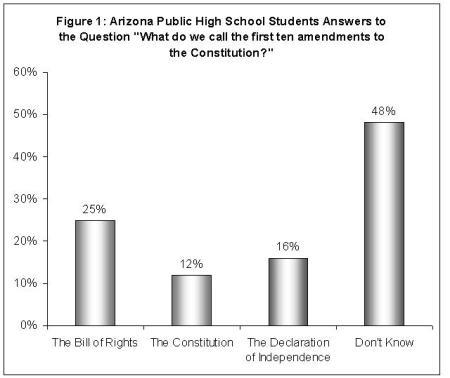 Here’s your free sample: One of the questions was “What do we call the first ten amendments to the Constitution?” How many high school students attending public schools answered correctly?
“I don’t know” beat “the Bill of Rights” by almost a two to one margin, and 75% of students got the question wrong.
Notice also that 12% of Arizona students thought that the first ten amendments to the Constitution were called “The Constitution.”
Phoenix, we have a problem…
21 Comments | civic values | Tagged: Goldwater Institute, High school civic knowledge, Matthew Ladner | Permalink
Posted by matthewladner
Can Meg Whitman Save California?
June 17, 2009 (Guest Post by Matthew Ladner)
Fortune posed the question back in March and matters have only grown more desperate since. California voters (quite rightly in my view) rejected the Governator’s tax increase initiatives, raising the spectre of default and rumors of a federal bailout.
Living in Arizona, within California’s cultural and economic sphere of influence, you meet California refugees all the time. My colleague at the Goldwater Institute, Clint Bolick, quips that Arizona desperately needs to build a border fence-on our Western border rather than our southern border.
Business Week wonders aloud whether the American economy can recover without California righting its’ economic ship. California had a pretty rotten 1990s overall, with poverty rates significantly higher in 2000 than in 1990. It seems on track to have another rotten decade in the Oughts. The beatings will continue until morale improves.
Forbes recently created a list of the top 10 cities for economic recovery, and the 10 worst cities for economic recovery. Four of the best cities were in Texas. Five of the worst were in California. The country could benefit greatly from a reformed California economy rediscovering the vibrancy of the past. As it is, California is an economic mess.
California is also dragging the nation down educationally. With 1 in 8 of America’s public school students attending California’s terribly underperforming public schools, we have little chance of climbing the international league tables with California performing so poorly.
The public sector unions speak with a loud voice in Democratic Party primaries, and the Democrats have huge majorities in the legislature. Perhaps California’s public sector unions are following the UAW model: suck the blood out of your host and then seek a federal bailout.
I am a confirmed Californiaphobe, but if the question is: can Meg Whitman save California, my only response can be: I certainly hope so.
1 Comment | politics | Tagged: California budget problems, California education, Meg Whitman | Permalink
Posted by matthewladner
New Blog Alert
June 17, 2009
Leave a Comment » | blogging | Tagged: John Stossel | Permalink
Posted by matthewladner
McGuire on Unions and Urban Students
June 16, 2009(Guest Post by Matthew Ladner)
MaryEllen McGuire of the New America Foundation takes on the unions for dealing out the least experienced teachers to the neediest children in U.S. News and World Report:
Teachers with the least experience are educating the most disadvantaged students in the highest poverty, most challenging schools. Low-income kids are being “triaged” not by experienced teachers, but by those with fewer than three years of teaching to go on.
Does it matter? Absolutely. According to the research, teacher experience is at least a partial predictor of success in the classroom and, at present, one of the only approximations for teacher quality widely available. Experienced teachers tend to have better classroom management skills and a stronger command of curricular materials. Novice teachers on the other hand struggle during their initial years in any classroom.
McGuire’s point is valid, but of course we should not be content to use experience as an approximation for teacher quality. There are both outstanding young teachers and truly awful experienced teachers, as you might recall from the Son of Super Chart:
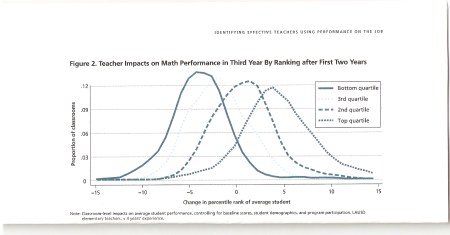
The Son of Super Chart broadly backs up McGuire-the curve for 1st year teachers is centered on -5, and the curve for 3rd year teachers on 5. All else being equal matching inexperienced teachers with high needs kids is an abominable practice.
Of course, all else need not be equal, which is why Teach for America works well.
McGuire proposes solutions:
Once we can wrap our heads around the true extent of the problem we can start taking down the second obstacle: figuring out a way to entice more experienced teachers to teach in high need schools. This will require a long-term commitment to systemic reform including investing in low-poverty schools to make them more attractive teaching placements and funding incentives to initially attract experienced and, we hope, higher quality teachers to low-income schools.
Will this require dollars beyond what we have? Not necessarily.
Federal law already provides schools with money to pay for this. It’s just that the funds typically go to reduce class sizes or provide professional development for teachers instead – strategies that have mixed results. Some of these funds should be redirected to pay for incentives drawing teachers into high-poverty schools. This is also a great use of stimulus money.
I’m glad to see to someone from the New America Foundation describe the results of class size reduction as “mixed.” Wow- you are half way there. The real word you are looking for however is “c*a*t*a*s*t*r*o*p*h*i*c” and the issue goes much deeper than the distribution of experienced teachers. On average, American colleges of education are recruiting from the bottom third of American college students based on admission scores.
Reading between the lines, the world is precisely as the unions want it to be: an emphasis on class size and seniority over teacher quality or equity. The system is also perfectly designed to deliver the most needy students low-quality teachers.
John Rawls is surely spinning in his grave.
UPDATE/CORRECTION
I loaded the wrong Brookings study Super Chart! The correct Super Chart! is from page 28 of the same study and shows a weaker relationship between experience and student learning gains, with year one teachers with a bell curve centered around -3 and second and third year teachers around zero.
10 Comments | teacher quality | Tagged: MaryEllen McGuire, New America Foundation | Permalink
Posted by matthewladner
TV News
June 15, 2009
How can anyone watch TV news? First we had the media fawning over Susan Boyle, the British Idol singing star. Sure she has a nice voice, but the not so subtle subtext of the coverage was: “How can anyone so homely have such a beautiful voice?!” Wow, we always thought that beauty was an essential ingredient to a good singing voice.
And now we have the sensational coverage of Amanda Knox’s murder trial in Italy. The not so subtle subtext of the coverage is: “How can anyone so pretty be a murderer?”
I know that all sentient beings understand the shallowness of TV news, but it is worth remarking on these egregious examples.

5 Comments | random pop culture | Permalink
Posted by Jay P. Greene
The Lie Seems to Be Spreading
June 15, 2009
(Guest post by Greg Forster)
Here on JPGB we’ve been tracking the progress of Dick Durbin’s lie that the DC voucher program didn’t show academic gains – which is all true except for the part where it says that the program didn’t show academic gains. (We’ve also had some fun passing along the AP’s reprot that Durbin tried to help Rod Blagojevich make a deal for Barack Obama’s vacant Senate seat.) Now it would appear that we’ve made our way back upstream to the source.
A little bird told me the NEA has mailed out the following letter to all U.S. Senators. Note the line I’ve highlighted.
June 11, 2009
Dear Senator:
On behalf of the National Education Association’s (NEA) 3.2 million members, we would like to express our strong opposition to proposals reportedly under consideration in the Armed Services Committee to provide private school vouchers for military families.
Vouchers are not real education reform. Pulling children out of the public school system doesn’t solve problems – it ignores them. Real reform will put a qualified teacher in every classroom, keep their skills up to date with continuing education, and raise pay to attract and retain the best teachers.
Proponents of a military family voucher program have cited the District of Columbia voucher program as a model. However, the DC voucher pilot program, which is set to expire this year, has been a failure. In fact, over its five year span, the pilot program has yielded no evidence of positive impact on student achievement.
Vouchers are clearly not the right solution to ensure every student the highest quality education. Voucher schools are permitted to maintain their admissions standards and can reject any public school student they choose. They can reject students based on prior academic achievement and on the basis of gender. Students with special needs often cannot find a private school that can serve them. In contrast, public schools serve all students who come through their doors.
Providing vouchers for 750,000 students in military families stationed in the United States would be a huge expense. These resources would be much better spent on to ensure ALL children the highest quality education. The U.S. Department of Education has created the What Works Clearinghouse (WWC) clearinghouse to help school districts, educators, parents, and other stakeholders choose programs that have been proven effective. A brief review of their database revealed dozens of programs that have been scientifically proven effective at improving student achievement in reading and math, at increasing the likelihood of students staying in school and completing their education, and at improving the language and achievement of English language learners. We have attached examples of these programs for your information.
Again, we urge your opposition to any proposals to create a private school voucher program for military families.
Sincerely,
Diane Shust
Director of Government RelationsRandall Moody
Manager of Federal Advocacy
Of course, the whole letter is shot through with dishonesty – but it’s the sort of dishonesty that’s routine in politics. (E.g. The empirical evidence consistently shows that vouchers do in fact “solve problems,” not only by helping the students who use them but by improving public schools.)
The highlighted sentence, on the other hand, represents the kind of thing you normally can’t get away with. No matter how many Senators you buy.
Hey, here’s a question (and not just for Leo): If vouchers are really so bad, why do their opponents have to lie about them all the time?
1 Comment | teacher union, vouchers | Tagged: Greg Forster, NEA | Permalink
Posted by Greg Forster
Pass the Popcorn: Where Are They Now?
June 12, 2009(Guest post by Greg Forster)
Don’t let anyone tell you Pass the Popcorn doesn’t take accountability seriously. Opinion about pop culture is so ephemeral, it’s easy to get away with writing crud because you know nobody will remember it in ten minutes anyway.
So to hold myself to a higher standard, here’s a retrospective of my 2008 movie posts, along with an updated opinion with the benefit of 20/20 hindsight (including home viewing where applicable).

Speed Racer
What I thought last year: Fantastic. Much more than a thrill ride – an exceptionally well constructed and executed melodrama. One of the best movies I’ve seen in years. But I probably won’t enjoy it as much on a small screen.
What I think this year: Boy was I wrong about that last part.

Iron Man
What I thought last year: A better-than-just-good movie that could have been great, except the marketing suits wouldn’t allow the movie to be either clearly pro-weapons-makers or clearly anti-weapons-makers, so the central character development around which the whole movie is built is left ambiguous. That and the climactic battle is lame.
What I think this year: The ambiguity isn’t as bad as I had thought – there are some subtleties that I missed. What’s driving Stark’s crisis of conscience is not that making weapons was bad per se, but that his weapons are being abused. So I’ll upgrade the movie from better-than-just-good to really good. But the battle is still lame.

The Hulk
What I thought last year: The last Hulk movie really stank in spite of having been made by one of the few really great moviemakers of the 1990s, and this one doesn’t look any better. The Hulk character is probably unfilmable; the emotional intimacy you get in comics and (to a lesser degree) on TV isn’t available in the movie format, so the character’s dependence on anger probably just can’t be well exploited on film. I’m going to skip it.
What I think this year: No regrets.

The Happening
What I thought last year: Shyamalan got lazy and his work has gone precipitously downhill. Early reports indicate this doesn’t look like the movie that will turn him around. Skip.
What I think this year: No regrets.

Wall-E
What I thought last year: It’s an “A” movie about a lonely robot who discovers companionship, wrapped in a “C” movie about the evils of consumerism.
What I think this year: The more I watch it, the easier it gets to ignore the “C” movie.

Hancock
What I thought last year: Boy, it’s fun to remember Will Smith’s early-90s novelty act. And this was a fun movie. But not one I’d feel the need to see again.
What I think this year: Yup.

The Dark Knight
What I thought last year: Well, I wrote about it six times (here, here, here, here, here and here) so that gives you an idea of what I thought.
What I think this year: Was six posts really enough?

Quantum of Solace
What I thought last year: Fantastic potential. Squandered.
What I think this year: Can’t wait for the next movie. Can wait to buy this one.
4 Comments | Pass the Popcorn | Tagged: City of the Dark Knight, Greg Forster, Hancock, Iron Man, James Bond, M. Night Shyamalan, Quantum of Solace, Speed Racer, The Dark Knight, The Happening, The Hulk, Wall-E, Will Smith | Permalink
Posted by Greg Forster
WSJ Dances Kabuki
June 12, 2009
(Guest post by Greg Forster)
First it was Mike Petrilli, now the Wall Street Journal joins the Obama/Duncan dance on charter schools.
Kids, simply having a charter law does not mean you actually have charter schools worthy of the name.
It can’t be! The Journal!
Jim, we knew this was a possibility when we first confirmed the presence of the kabuki phenomenon.
But . . . the Journal!
The Wall Street Journal is a newspaper, subject to the same political imperatives as any other. To expect it to be immune to kabuki would be illogical.
Oh, come of it! This is the Journal we’re talking about, you green-blooded hobgoblin! Can’t you think about anything but logic at a time like this!
Shouting will not remedy the situation, doctor. I recommend we ask Mr. Checkov to arm the photon torpedoes.
1 Comment | charter schools | Tagged: Greg Forster, Mike Petrilli, Wall Street Journal | Permalink
Posted by Greg Forster

 Jay P. Greene's Blog