
(Guest Post by Matthew Ladner)
Steven Brill brings the pain in a fantastic new article on NYC rubber rooms. Money quote:
“Randi Weingarten would protect a dead body in the classroom. That is her job.”
(Guest Post by Matthew Ladner)
Steven Brill brings the pain in a fantastic new article on NYC rubber rooms. Money quote:
 Leave a Comment » |
  teacher union | Tagged: AFT, Randi Weingarten, rubber rooms, Steven Brill |
  Permalink
 Posted by matthewladner

All images from GothamSchools, whose Elizabeth Green broke the story
(Guest post by Greg Forster)
Last week, the UFT got caught handing out cue cards to New York City Council members before a public hearing of the council’s education committee. The council members dutifully asked the questions they had been given, which pointedly invited anti-charter diatribes from the teacher-union and DOE witnesses.
The members then unanimously voted to make Grigori Potemkin their new committee chairman.
Internet wags are calling the scandal “cue card check.” ALELR has consulted his deep moles within UFT and offered an intriguing report on the union’s strategy for the Council’s next hearing.
The cue cards have to be seen to be believed:



That’s “questions for Leo” as in our dear friend and Sith apprentice Leo Casey, who testified at the hearing. My pledge to you, the reader: from now on, every time Leo posts calumnies about Jay, I will post a link to this story.
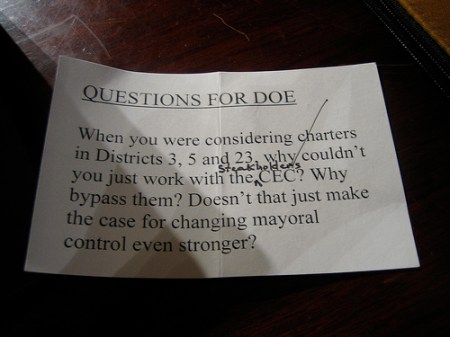
And that’s “questions for DOE” as in officials from the Department of Education. The cue cards were handed out by the UFT, but is it plausible that the department officials had no idea they were being asked scripted questions?
HILARIOUS UPDATE! When I first posted this, I didn’t look closely at the handwritten edit made to this cue card. Check it out – note the spelling. And this is from an organization of teachers!
This story doesn’t seem to have broken out of the local circuit yet, but it’s getting a whole lot of attention in the city media. The Daily News is leading the way, documenting the extent of UFT political contributions to the council members who got cue cards and covering Randi Weingarten’s attempts to deflect blame by claiming that a charter school organizer once did the same thing. (Not true, says the organizer – and who has more credibility here?)
But ALELR notes that props are not being given to Elizabeth Green of the blog GothamSchools, who broke the story and snapped all the pictures you see above (and more, which you can enjoy in all their glory by following the link).
Green wryly notes that the cue cards with accusatory anti-charter questions were handed out by “a representative of the city teachers union, which describes itself as in favor of charter schools.”
8 Comments | charter schools, journalism, teacher union | Tagged: Best of Greg, cue card check, Elizabeth Green, Greg Forster, Leo Casey, Mike Antonucci, Randi Weingarten, UFT | Permalink
Posted by Greg Forster
(Guest post by Greg Forster)
Randi Weingarten explained this week that, contrary to the outrageous slander that the unions are against education reform, she’s actually in favor of having the federal government create rigorous national academic standards for public schools, and will remain in favor of it as long as the Democrats are in power. (I’m paraphrasing.)
She writes: “Should fate, as determined by a student’s Zip code, dictate how much algebra he or she is taught?”
So the AFT now endorses the principle that a child’s education should not be determined by Zip code? When did that happen?
And if a child’s Zip code shouldn’t determine how much algebra he or she is taught, why should that determination be made in Washington instead? Apparently the amount of algebra you learn should be determined not by your Zip code, but by your international dialing code.
At least with Zip codes, some families can exercise school choice by moving to a different neighborhood. Yes, it’s an unfair system, since not all families are equally mobile; apparently Weingarten thinks the fair thing to do is to take away the freedom now enjoyed by some parents, so that there will be an equality of unfreedom.
Here we see the real modus operandi of the Left – achieve equality by leveling downward.
1 Comment | politics, residential school choice, school accountability, teacher union, vouchers | Tagged: Greg Forster, national standards, Randi Weingarten | Permalink
Posted by Greg Forster


(Guest post by Greg Forster)
Lots of people are picking up on the temper tantrum about alleged “demonizing of teachers” begun by a Randi Weingarten speech and continued in Bob Herbert’s column on the speech.
Even that notorious right-winger Eduwonk points out that Weingarten and Herbert are hitting a straw man. I think the real problem is not that school reformers demonize teachers but that defenders of the government school monopoly angelize them. When we reformers insist that teachers should be treated as, you know, human beings, who respond to incentives and all that, rather than as some sort of perfect angelic beings who would never ever allow things like absolute job protection to affect their performance, it drives people like Weingarten and Herbert nuts.

A typical teacher, as seen by Randi Weingarten
But what I’d like to pick up on is the question of whether the troubles of the government school system are comparable to the troubles of the auto industry.
Of the alleged demonizing of teachers, Herbert had written:
It reminded me of the way autoworkers have been vilified and blamed by so many for the problems plaguing the Big Three automakers.
Eduwonk points out Herbert’s hypocrisy (though he delicately avoids using that word) on this point, because elsewhere in the column, Herbert praises Weingarten for expressing a willingness to make concessions on issues like tenure and pay scales. Union recalcitrance on these types of reform, Eduwonk points out, is precisely why the auto industry is in so much trouble, and Weingarten has been driven to make noises in favor of reform because a similar dynamic has been at work in the government school system.
On the other hand, Joanne Jacobs thinks the comparison between the AFT and the UAW is inapt:
I don’t think skilled teachers and unskilled auto workers have much in common. Auto unions pushed up costs, especially for retirees, making U.S. cars uncompetitive. In education, the problem isn’t excessive pay, it’s the fact that salaries aren’t linked to teacher effectiveness, the difficulty of their jobs or the market demand for their skills.
But teachers’ unions have pushed up costs – dramatically. In the past 40 years, the cost of the government school system per student has much more than doubled (even after inflation) while outcomes are flat across the board. And this has mainly been caused by a dramatic increase in the number of teachers hired per student – a policy that benefits only the unions.
It’s true that high salaries aren’t the main issue in schools, although teacher salaries are in fact surprisingly high. The disconnect between teacher pay and teacher performance is much more important. But the UAW has the same problem! Their pay scales don’t reward performance, either.
The source of Jacobs’ confusion is her mistaken view that auto workers are “unskilled.” Farm workers are unskilled, but not auto workers. The distinction she’s reaching for is the one between white-collar or “professional” work and blue-collar work. But some blue-collar work is skilled and some is unskilled, and auto workers are in the former category. This matters because with skilled blue-collar workers, as with white-collar workers, there’s a dramatic increase in the importance of incentives as compared with unskilled labor.
In fact, a lot of smart people have been arguing (scroll down to the Dec. 26 post) that exorbitant salaries and benefits aren’t nearly as much of a problem in the auto industry as union work rules – including poor performance due to absolute job protection, pay scales that don’t reward performance, and rigid job descriptions that make process modernization impossible.
Sound familiar?
(Edited)
4 Comments | economics, teacher pay, teacher quality, teacher union | Tagged: AFT, Andy Rotherham, Best of Greg, Bob Herbert, Eduwonk, Greg Forster, Joanne Jacobs, Randi Weingarten, UAW | Permalink
Posted by Greg Forster
Earlier this week I made my Modest Proposal for B.B. (Broader, Bolder or is it Buying Bananas?). I noted that Randi Weingarten denounced vouchers as a waste of time despite considerable evidence supporting it, while she embraced the B.B. idea of community schools despite there being absolutely no evidence to support the claim that public schools could improve achievement by expanding their mission to include a host of social services.
Given the lack of evidence for B.B. I generously : ) offered to support a series of large pilot studies of the community schools approach, if Weingarten, Leo Casey, and the B.B. crowd would agree to a similar series of large pilot voucher programs as a way of learning more about both reform strategies. No word yet but perhaps their internet is broken (just try unplugging it and plugging it back in).
Shital Shah from the Coalition for Community Schools, however, sent me a nice note with a link to a report claiming to contain the evidence supporting their approach. After reviewing the report I still see virtually no evidence to give us confidence that public schools can increase student achievement by offering everything from legal assistance to health care.
In Appendix B the report lists 21 studies of the community school approach. Seven of them have no student achievement outcomes. Seven examine student test scores but only make pre/post comparisons without any control group. And another seven have comparison groups but none employ random assignment, regression discontinuity, or another rigorous research design. Four of those seven just compare achievement at schools using the B.B. approach to city or statewide averages. And of the seven studies with some kind of control group, two find null effects, another finds null effects in math but not reading and even then only among schools with “high implementation” of the approach. The quality (and quantity) of the evidence supporting community schools is no greater than what we could find to support the healing power of crystals.
I understand why Randi Weingarten or Leo Casey would be pushing the educational equivalent of crystal healing. Their job is to advocate for the interests of their union, not to make fair and reasonable assessments of research claims. If schools expand their mission to include providing health care and other social services just think of all of the dues-paying nurses and social workers they could add to their rolls.
The greater mystery is why normally tough-minded and rigorous researchers, like Jim Heckman and Diane Ravitch, would sign on to this approach entirely lacking empirical support. Heckman won the Nobel Prize for Economics for crying out loud. But then again Linus Pauling won the Nobel Prize for Chemistry and later became a public advocate for mega doses of vitamin C to cure cancer, another intervention completely unsupported by rigorous evidence.
I’ll repeat that I am not against trying the B.B. community school approach with large pilot programs that are carefully studied. I just can’t see why normally smart people would fully endorse untested approaches while ignoring other interventions, like expanding choice and competition in education, which have considerably more supporting evidence.
(edited for typos)
Leave a Comment » | myth of helplessness, vouchers | Tagged: Broader Bolder, Diane Ravitch, James Heckman, Jay Greene, Jay P. Greene, Leo Casey, Randi Weingarten, vouchers | Permalink
Posted by Jay P. Greene
The advocates of B.B. (Broader, Bolder; or is it Bigger Budgets? or is it Bloated Behemoth?) have yet to muster the evidence to support widespread implementation of their vision to expand the mission of schools to include health care, legal assistance, and other social services. They do present background papers showing that children who suffer from social problems fare worse academically, but they have not shown that public schools are capable of addressing those social problems and increasing student learning.
And if you dare to question whether there is evidence about the effectiveness of public schools providing social services in order to raise achievement, you are accused of being opposed to “better social and economic environments for children.” Right. And if you question the effectiveness of central economic planning are you also then opposed to a better economy? And if you question the effectiveness of an untested drug therapy are you then opposed to quality health-care?
To help the B.B. crowd generate the evidence one would need before pursuing a reform agenda on a large-scale, I have a modest proposal. How about if we have a dozen large-scale, well-funded pilot programs of the “community school” concept advocated by B.B.? And, at the same time let’s have a dozen large-scale, well-funded pilot voucher programs. We’ll carefully evaluate the effects of both to learn about whether one, the other, or both are things that we should try on an even larger scale.
I’m all for trying out new ideas and carefully evaluating the results. I can’t imagine why the backers of B.B. wouldn’t want to do the same. So as soon as Larry Mishel at the union-funded Economic Policy Institute, Randi Weingarten of the AFT, and Leo Casey of the AFT’s blog, Edwize, endorse my modest proposal, we’ll all get behind the idea of trying new approaches and studying their effects — “community schools” and vouchers.
Wait, my psychic powers are picking something up. I expect that some might say we’ve already tried vouchers and they haven’t worked. In fact, Randi Weingarten just wrote something very much like that when she declared in the NY Daily News that vouchers “have not been shown by any credible research to improve student achievement.” Let’s leave aside that there have been 10 random assignment evaluations (the gold-standard in research) of voucher programs and 9 show significant positive effects, at least for certain sub-groups of students. And let’s leave aside that 3 of those analyses are independent replications of earlier studies that confirm the basic positive findings of the original analyses (and 1 replication does not). And let’s leave aside that 6 of those 10 studies have been published in peer-reviewed journals (including the QJE, the Journal of the American Statistical Association, and the Journal of Policy Studies), three in a Brookings book, and one in a federal government report (even if Chris Lubienski somehow denies that any of this constitutes real peer-review). And let’s leave aside that there have been more than 200 analyses of the effects of expanding choice and competition, which Clive Belfield and Henry Levin reviewed and concluded: “A sizable majority of these studies report beneficial effects of competition across all outcomes… The above evidence shows reasonably consistent evidence of a link between competition (choice) and education quality. Increased competition and higher educational quality are positively correlated.”
Let’s leave all of that aside and ask Randi Weingarten how many random-assignment studies of the community school concept she has. Uhm, none. How many evaluations of community schools, period? Uhm, still none. But that doesn’t stop her from drawing the definitive conclusion: “Through partnerships with universities, nonprofit groups and other organizations, community schools provide the learning conditions and resources that support effective instruction and bring crucial services to an entire community.” How does she know?
But I’m eager to help her and all of us learn about community schools if she is willing to do the same to learn about vouchers. Better designed and better funded voucher programs could give us a much better look at vouchers’ full effects. Existing programs have vouchers that are worth significantly less than per pupil spending in public schools, have caps on enrollments, and at least partially immunize public schools from the financial effects of competition. If we see positive results from such limited voucher programs, what might happen if we could try broader, bolder ones and carefully studied the results?
And if community schools really deliver all that is being promised, great, let’s do that too. But if our goal is to do what works, why not give both ideas a real try?
(Link added)
10 Comments | vouchers | Tagged: AFT, Broader Bolder, Chris Lubienski, Edwize, Jay Greene, Jay P. Greene, Randi Weingarten, school choice, vouchers | Permalink
Posted by Jay P. Greene

 Jay P. Greene's Blog