
(Guest post by Greg Forster)
Last weekend I finally got to see Quantum of Solace. I had heard it wasn’t as good as Casino Royale, so going in, I tried to manage my expectations.
“It doesn’t matter whether it’s as good as Casino Royale,” I told myself. “It’ll be fun, and it’ll probably be better than just fun, and that’s better than most movies. I’ll just enjoy what’s on the screen without worrying about what’s not.” That’s how I try to approach most movies.
It wasn’t enough.
Don’t get me wrong. Quantum of Solace is not a bad movie. I enjoyed most of the two hours I spent watching it. However, not only was there a tremendous amount of lost potential – an approach to the Bond story that could have taken the francise to a whole new level – but there were actually some pretty significant stretches that I couldn’t enjoy even on the level of fun or coolness.

These data over here illustrate the precipitious decline of cool gadgets in James Bond films, as measured by both quality and quantity. I’ll move this electronic display across the tabletop just by moving my hand, so the audience will momentarily forget that this table-computer thingy is not an adequate substitute for a buzzsaw wristwatch.
The lost potential here is pretty darn serious. Casino Royale not only gave us a really cool Bond movie, but the setup for what could have been a two-part (or longer) serious epic story arc- the first real epic storyline in the franchise.
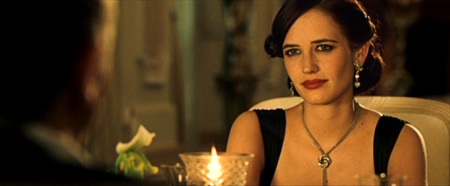
I can’t find it now, but in the runup to the new movie, some fan put together a desktop wallpaper image of Vesper Lynd with the tagline “Payback’s a Bitch.” That got me more excited to see the movie than anything in the official advertising – Bond both loves and hates Vesper (“the bitch is dead”) and thirsts for revenge on her killers even as he hardens his heart against all natural human affection.
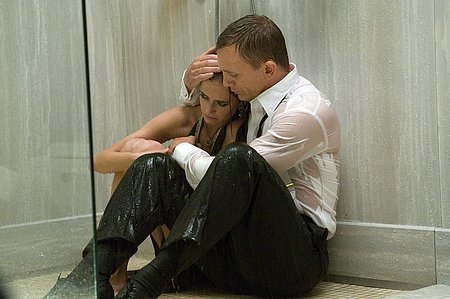
Quantum of Solace does try to redeem that promise, and there are some really good moments. The very last thing Bond does before the end credits roll is a really shocking twist – not so much a plot twist as a “character twist” – that works perfectly. It violates our expectations pretty radically, yet resolves the story perfectly, though not in the way we had thought.
And about two-thirds of the way through the movie, there is a scene that pays tribute to a famous moment in an earlier Bond movie that could have been incredibly cheap and derivative, but is pulled off with note-perfect direction and ends up being extremely effective.
There are also a number of great dialogues in the movie. Bond’s intereactions with M at the beginning are great – Judy Dench is finally permitted to do more than scowl at Bond, and her talents unexpectedly provide real depth to the M character here. And there’s a short but really powerful scene between Bond and Felix Leiter, about which more later.
But while there is some good action, some coolness, and several good moments that show us the epic this movie could have been, the movie not only doesn’t fulfill its potential, it frequently doesn’t even work on the level of standard Bond movie.
It wasn’t just the absence of a decent villain – although that flaw alone is more than enough to shame any director who makes a Bond movie.
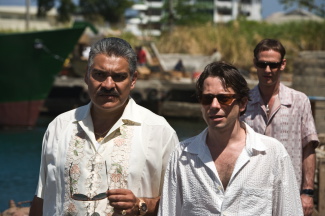
That guy on the left? Literally the instant he came on the screen I was scared of him. He’s in the movie for about five minutes. The loser on the right is the “villain.”
One does wonder just what has to happen to a man to cause him to make a James Bond movie with a lame villain. All action/adventure movies, but especially Bond movies, depend on the personality of the villain; his cunning is needed to test the hero’s wits, his ruthlessness to test the hero’s courage, his power to test the hero’s strength, his evil to test the hero’s good. The lame villain would have prevented the film from reaching anything like its full potential even if there were no other flaws.
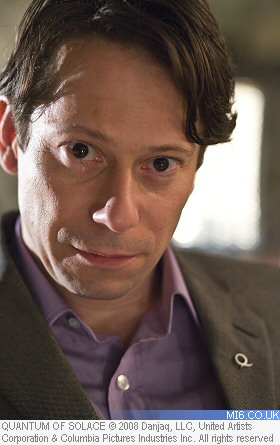
He’s supposed to be scary. I’m told that if you stare long enough you’ll start to see it, like those “magic 3D” posters from the 90s. Anyway, I think they were going for “creepy guy who makes your skin crawl,” but they got “bug-eyed pervy loser.”
It wasn’t just the gaping holes in the plot. In case you’re curious, those holes arise primarily because the filmmakers decided to give the movie an environmental theme. I say “theme” because the movie is not at all didactic about the environment. They were smart enough to avoid that trap. But they wanted the evil scheme to somehow involve the environment, and what they came up with (I won’t spoil it, though really there’s not much to spoil) doesn’t pass the laugh test.
As for the lengthy scene in the middle of the movie that takes place at a radically avant-guarde European opera performance, while many (including my wife) found it annoying, I actually didn’t mind it.
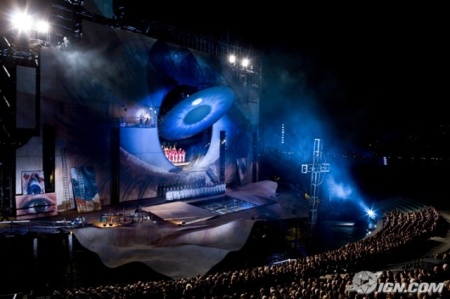
I can see why they put it in – just like they put in that scene at the “dead bodies” museum exhibit in Casino Royale. They’re trying to reintroduce the tone of the older Bond movies that was simultenously highbrow and exotic. Flying off to Brazil (or wherever) used to be something only the rich could do, and for those who couldn’t do it, it was a little like flying to Mars. Today, when the Bond audience is comfortably upper-middle class and airfares to just about everywhere in the world are within their reach, it’s hard to take Bond to esoteric places. While the scene probably doesn’t work as well as the director hoped it would, I think it’s serviceable.
But now back to the flaws.
It wasn’t just the movie’s anti-Americanism. Here the movie is didactic, alas. One winces to hear the mass-murdering psychopath Haitian dictator Aristide discussed (though he is identified by a generic description and not by name) as a saint. And the filmmakers don’t seem to be aware that the Aristide whom they so admire was returned to office by U.S. power after being deposed in a coup.
But the damage here is pretty radically mitigated by several factors. First, it’s obvious that they felt they had to have something left-wing in there to counterbalance the fact that the movie’s villain is a phony environmental philanthropist, which might be taken as a critique of certain real-life phony environmental philanthropists. (“I did learn something about the environment from this movie,” my wife said to me afterward. “I learned not to trust people who claim to be acting on behalf of the environment.”) There’s a sense, or at least I had the sense, that when they denounce American imperialism, they do so out of a sense of obligation. Second, on some occasions America really has been guilty of the kind of evil attributed to it here – although one wonders whether either the filmmakers or the audience are aware of who the real perpetrators of those evils were (and are), and which of the two political parties they tend to be clustered in.
But most importantly, Felix Leiter is given an opportunity to point out that if America has sometimes done nasty things, it is, on balance, not the world’s worst offender. In a Bolivian bar, Bond snorts, “you guys have carved up this place pretty well,” and Leiter spits back, “I’ll take that as a compliment – coming from a Brit.” Even by the standards of civilized nations, America stands up pretty well.
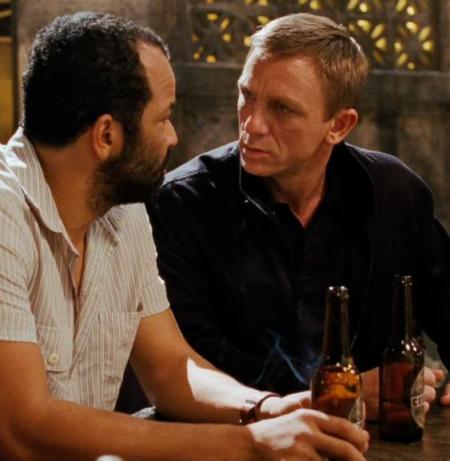
In the Bond films, Felix Leiter has always stood for America. He lacks Bond’s air of elegant sophitication and savior-faire, but also Bond’s arrogance and hard-heartedness. Bond is the advanced-but-decadent Old World, Leiter is the plain-but-decent New.
Watch, for example, the first few minutes of Goldfinger, and see how differently Bond and Leiter treat the girl in the bikini by the poolside. If you’ve studied your Tocqueville, you know how to pick out the American in any crowd of men – he’s the one who talks to women like they’re human beings, not property.
On the subject of Felix Leiter as representative of America, it’s almost amazingly appropriate that the Felix Leiter character has switched races – and not for the first time, if you’re prepared to accept the quasi-official Bond film Never Say Never Again, where Bernie Casey took the role. Race is the most distinctive aspect of the American experience, so it’s fitting that the representative American should be alternately black and white. America is as much the slick East Coast sharpness of Jack Lord in Dr. No as it is the wry “aw shucks” Midwestern charm of Cec Linder in Goldfinger; America is also the simultaneous smoothness and bluntness of Jeffrey Wright.

“Felix Leiter – a brother from Langley.”


I’ll go out on a limb and say that if Quantum of Solace had to be the first ever anti-American Bond film, it’s appropriate that the task of sticking up for America’s good name should fall to a black Felix Leiter. Those who hold themselves out as representatives of black America often don’t have much good to say about America, but that was not always the case, and if I may trust my personal experience, I find black Americans to be among the most intensely patriotic. Indeed, they’re almost the last sizeable population group among the core politically left groups who obviously mean it with all their hearts when they protest that they, too, love their country. And that’s not at all surprising – around the world, we are discovering that those who have been deprived of their liberties are the ones who cherish them most, while those who have long enjoyed liberty come to take it for granted. Why should we surprised to discover this at home? True, it was against American oppression that American blacks had to fight to gain their liberties, but now that they have liberty, they cherish it, and will not allow it to be lost. And they know that America, even with all it has done wrong, stands for liberty as no other nation does, or ever has.
But now, again, back to the flaws.
I think the main flaw in Quantum of Solace is the mandate that a sequel must be bigger and flashier than the original. Where Casino Royale centered around a card game and gave us intrigue, cunning, dialouge, and character development, Quantum of Solace is nonstop car chases, explosions, etc. Everything has to be bigger and blow up more spectacularly. That just doesn’t leave any time for the revenge plotline to develop properly.
This flaw is badly exacerbated by the poor editing and bad pacing of the action sequences. Each individual camera shot is too short, while each action sequence as a whole is too long. Because of the rapid-fire editing that spoils so much of the action, someone has called this “Bond for the ADD generation.” But I disagree; no one with ADD would have had the patience to sit through these interminably long action sequences. I barely had the patience to sit through them myself.
I wish I could say that this movie is good but not great. As I said, it’s not a bad movie. I enjoyed watching it, for the most part. But I just can’t bring myself to type that it’s a good movie. Looking at my grand unified field theorem of Bond movies, I’d have to say that where Casino Royale was “Reboot Awesomeness,” Quantum of Solace has skipped right past the “Still Good” phase and landed squarely in “Passable,” alongside The Spy Who Loved Me and The World Is Not Enough. That doesn’t bode well for the next one.
But remember the tagline to the end credits of every Bond movie: “James Bond will return.” And so he shall.


 Posted by Greg Forster



 Jay P. Greene's Blog