Rock Star Pay for Rock Star Teachers Part Trois

May 7, 2009

(Guest Post by Matthew Ladner)

A few months ago I got an angry email from an Arizona teacher claiming that her school had been terribly underfunded, and that she had 32 students in her classroom. I wrote to her:

If you have 32 children in your classroom, my first question is what is your school district doing with all of that revenue?

The JLBC put the statewide spending per pupil in Arizona at $9,399. A classroom of 32 at the statewide average would mean $300,768 in revenue from the students in your class.

Her response:

1-teacher, 1ELL teacher, 1 Special ED teacher, reading specialist, principal, janitor, secretaries, music, art, PE, computer teacher, Cafeteria workers, Para-educators, paper, textbooks, hands on science materials, Computers (this is the 21st century learning) building up keep, electricity, water, tables, chairs , etc…..

She forgot to mention administrative salaries from central command. There is one tiny little problem with all of this. According to the 2007 NAEP, 44 percent of Arizona 4th Graders scored BELOW BASIC in reading.

In other words, as Dr. Phil likes to say, how’s that hiring your average teacher from the bottom third of university students and supplementing them with crowds of others working out for you?

Shape up people!

The sad reality of American public education is that our schools have become revenue and employment maximizers that all too often are profoundly unfocused on the bottom line: student learning.  Public schools ought not to be jobs programs, but focused on their mission of equipping students with the academic skills necessary for success in life.

So, if you’ve got $300,000 in revenue from a classroom (many states have more) call me crazy, but I think you’ve got $100,000 for what research shows to be going away the most important factor for student learning gains: a high quality teacher. When I say a high quality teacher, I mean a verified high quality teacher whose student learning gains are being tracked over time by both administrators and parents on a continuous basis.

The best platforms for ongoing value added assessment are web-based data products that allow teachers to develop common assessment items based on state standards. If there are state standards for a subject, you can do value added analysis on it. When schools really get going on this, they give monthly assessments. This gives ongoing assessment data that greatly drops the amount of error (using only state tests, some of the pioneering value added models require 3 years worth of data).

Overall, it isn’t very hard to imagine a system that would improve upon the status-quo in these practices. We can no longer in good conscience socially organize our efforts to teach children to read along the lines of: let’s hire an army of people who want job security and summers off , do absolutely nothing to reward merit, and hope for the best.

This must change, and it will change.


“Forward” our Motto?

April 29, 2009

(Guest Post by Matthew Ladner)

The MacIver Institute, Wisconsin’s new think-tank, released a report today by yours truly comparing the NAEP scores of Wisconsin and Florida. Let’s just say that UW-Madison would have probably fared better against the national champion Florida Gators in football last year.

wisconsin

Florida spends considerably less per student than Wisconsin and has a student profile considerably more challenging. Despite that fact, Florida surpassed Wisconsin overall on 4th grade reading (although within the margin of error) on 4th Grade Reading scores in 2007.

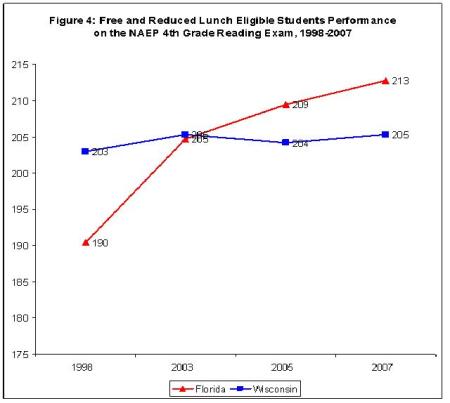
Most impressively, this gain was driven by much larger gains among traditionally underperforming student groups. The figure above shows the progress among Free and Reduced lunch kids in Florida and Wisconsin. In 1998, Florida’s low-income students were an average of 13 points behind their peers in Wisconsin. In 2007 however they had raced 8 points ahead.

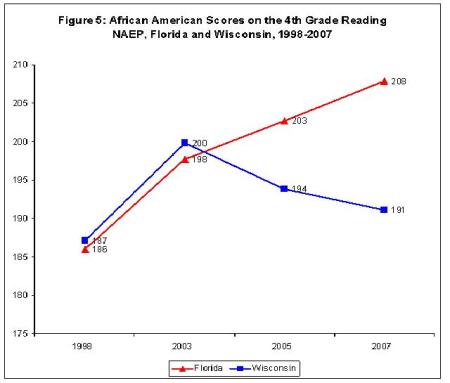
Among African American students, Florida and Wisconsin once shared space near the bottom in reading achievement. Wisconsin is still there. Florida’s African Americans students now outscore their peers in Wisconsin by 17 points.


wisconsin-african-americanOne finds the same pattern among children with disabilities. In 1998, Wisconsin students with disabilities scored 18 points higher than those in Florida. In 2007, it was 4 points lower.
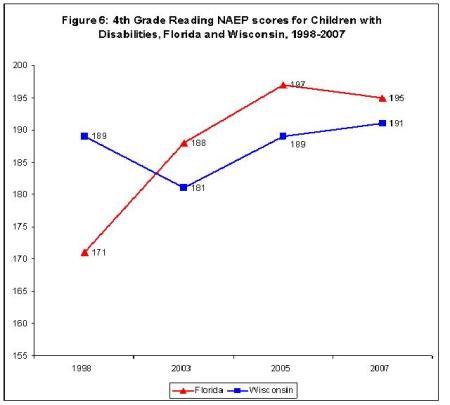
wisconsin-disabilities

The problem isn’t that Wisconsin’s scores are low, it is that they are flat.   When the Fordham Foundation found that Wisconsin had the lowest NCLB standards in the country it hinted that the state had not been vigorous in pursuit of broad K-12 reform.

Wisconsin of course was a trailblazer in parental choice with the Milwaukee Parental Choice Program. The learner has surpassed the master however with two statewide parental choice programs- one for low-income children, and one for children with disabilities. If anyone can explain why a low-income child in Milwaukee deserves an opportunity to attend a private school, but a similar child in Racine does not, I’d love to hear why. Florida also has a stronger charter school law.

Rather than sporting the lowest NCLB standards in the country, Florida doggedly pursued top-down accountability with the FCAT and grading schools A to F, and creating real consequences for school failure.

Florida embraced genuine alternative teacher certification, Wisconsin has not.

I am open to correction by my Cheesehead friends, but my distant view from the far-away desert leads me to wonder if Wisconsin may have become complacent when it comes to education reform. Coasting on their demographics, avoiding the tough calls and controversy necessary to improve public schools.

If so, perhaps inspiration can be drawn from the state song:

On, Wisconsin! On, Wisconsin!
Grand old Badger State!
We, thy loyal sons and daughters,
Hail thee, good and great.
On, Wisconsin! On, Wisconsin!
Champion of the right,
“Forward”, our motto,
God will give thee might!

Time will tell whether progressive Wisconsin will take this lying down. Will “Forward” or “comfortably stalled” be a better fitting motto for Wisconin in the next decade?


Rock Star Pay for Rock Star Teachers Part Deux

April 29, 2009

(Guest Post by Matthew Ladner)

Last year I was reading the comments section of a newstory online, and came across a comment from a public elementary school teacher. She was complaining that she had 34 students in her classroom.

So let’s do the math. The statewide average spending per pupil in the state: $11,000. Total revenue generated by this classroom = $374,000. Let’s assume the teacher gets a total compensation package of $60,000 including benefits. The question becomes- what did they do with the other $314,000?

Ah, that was what the teacher was really angry about. Her elementary school had 8 teachers in “non-classroom assignments.”

I don’t have a problem with 30 some odd kids in a classroom. It’s been done, and is being done. Remember?


Many insist that the period depicted by this photo constituted the “good ole days” of education. Jay and Greg have felt compelled to dispel the myth of the lost golden age of public education, back in the good ole days, when public schools were far more effective than they are today. The truth, of course, is that NAEP scores for 17 year olds are flat as far back as you can take them.

What has not been flat- public school spending- adjusted for inflation per pupil has steadily increased even while test scores have stagnated, even while Americans have become wealthier and poverty has declined.

Of course, there is no single explanation for this trend, but certainly the national obsession with lowering average class sizes must be viewed to have been an enormously expensive academic failure. Consider the international evidence:


class-size-11

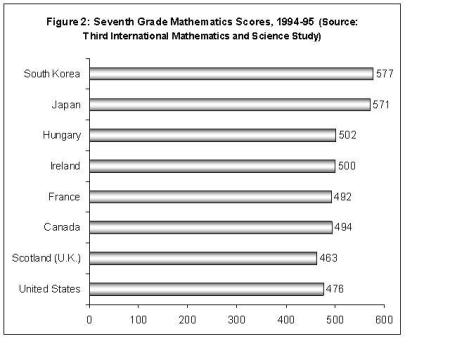
Really big classes in Asia, really small in the United States. However, when it comes to achievement:

class-size-2

The average South Korean seventh-grader scores 21 percent higher than the average American on seventh-grade mathematics, despite having much larger average class sizes. While a variety of factors contribute to the relative deficiency of American public schools, many scholars are beginning to suspect the main factor is the relatively inferior average quality of American teachers.

In How the World’s Best Performing Schools Come Out on Top, the international management consulting firm McKinsey & Company point squarely at teacher quality as a key variable in explaining variation in international academic achievement. In its findings, McKinsey quoted a South Korean policymaker who noted, “The quality of an education system cannot exceed the quality of its teachers.”


McKinsey found that the top-performing school systems around the world recruit their teachers from the top third of each graduating cohort. Moreover, South Korean schools draw from the top 5 percent of college graduates. Larger class sizes create the resources to pay South Korean instructors much higher salaries.


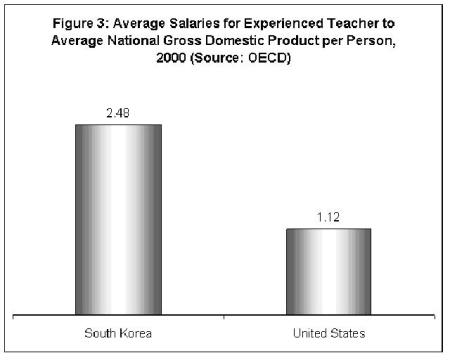
The Organisation of Economic Co-operation and Development measures relative teacher pay by comparing the average salaries of teachers with 15 years of experience with a nation’s gross domestic product (GDP) per capita. A high salary compared with per capita GDP suggests that a country invests more of its financial resources in teachers and suggests a relative prestige of the profession. By definition, the average person in each of these countries will earn a ratio of 1. Figure 3 compares teacher-salary-to-per-capita GDP for the United States and South Korea.

teacher-pay-korea

An experienced South Korean schoolteacher makes a relatively impressive wage compared with teachers in the rest of the world. In South Korea, teaching is an honored profession—not just rhetorically but in compensation as well. In the United States, meanwhile, a teacher with a college degree and 15 years of experience makes a salary relatively close to the average GDP per person. Not surprisingly, there are many qualified applicants for each open teaching position in South Korea.


McKinsey quotes the New Commission on the Skills of the American Workforce to contrast the United States with those countries having more successful education systems: “We are now recruiting our teachers from the bottom third of high-school students going to college…. [I]t is simply not possible for students to graduate [with the skills they will need] unless their teachers have the knowledge and skills we want our children to have.”


Rock Star Pay for Rock Star Teachers!

April 28, 2009

(Guest Post by Matthew Ladner)

The Goldwater Institute released a new study today titled New Millennium Schools: Delivering Six-Figure Teacher Salaries in Return for Outstanding Student Learning Gains. In this report, my coauthors Mark Francis, Greg Stone and I argue that the United States has made a tragic error in emphasizing teacher quantity (through efforts to limit average class size) rather than teacher quality. The growing literature on student learning gains clearly demonstrate that teacher quality trumps the impact of class size variation by a wide margin.

The value added literature has revealed stunning equity issues. We don’t attract enough high ability teachers into the profession, we quickly lose many of those we do to frustration or administration, and we distribute most of the remainder to the leafy suburbs. I don’t have a problem with incentive “combat pay” but let’s face it: it is not enough to simply redistribute the limited number of high quality teachers. We need to attract many more of them.

After exploring foreign and domestic examples of systems that make the opposite choice, we propose a solution: a school model which not only employs value added assessment to identify high achieving teachers, but also splits the additional revenue for students after the 20th with the teacher. We propose a 2/3 teacher, 1/3 school split for the 21st student and beyond. This works out to a $5,200 bonus per child.

With this split, our school delivers a six figure teacher salary at 32 students based upon Arizona’s relatively modest funding for charter schools. A class size of 32 students is hardly outside of the historical practice for American public schools, or even the current practice entirely.

There are many practical issues to consider, and variations on the basic model, so please read the study. I’ll write more about the study in the coming days, but the most important point is this: there is plenty of money in the public school system to treat teachers like true professionals and reward them for excellence.

UPDATE: Education Week’s Stephen Sawchuck points out that principals already covertly increase class sizes for additional pay.


How much do Arizona Public Schools Actually Spend?

April 24, 2009

(Guest Post by Matthew Ladner)

Watch your favorite bearded libertarian edu-nerd (okay maybe third favorite) debate how much Arizona really spends in public schools:


Dubya’s Failure vs. Jeb’s Success

January 8, 2009

(Guest Post by Matthew Ladner)

The Heritage Foundation released a study by Dan Lips and yours truly today making the case that real education reform needs to come up from the states, rather than down from the federal government.  We focus on the success of Florida’s reforms, the disappointment of NCLB, and note that in fact NCLB threatens Florida’s continued success. Now the Bushies are exiting the Washington scene, can we at long last admit that the 2014 requirement is encouraging states to lower their standards?

Dan explains this better than I can, so I’ll just sit back an marvel at the cool graphics that the Heritage folks came up with, like the one above.


Safe Harbor Won’t Stop the Race to the Bottom

November 5, 2008

head-in-the-sand

(Guest Post by Matthew Ladner)

Charlie Barone did an excellent job unpacking NCLB’s safe harbor provision in reaction to a report by the Center on Education Policy warning of the looming 2014 train-wreck (where 100% of students must be proficient).

I co-authored a study for the Heritage Foundation also critical of the 2014 requirement. My concern is that what states will obviously do is to simply dummy down their tests in order to comply. I believe this process has already started, and will accelerate as the passing requirements escalate.

Barone however unpacked the arcane “Safe Harbor” provision on NCLB. Safe Harbor basically gives you a pass on AYP so long as you can reduce the number of children scoring below proficient by 10%. If this represents an obtainable standard, then presumably states would not feel overly pressured to drop their cut scores.

So, I decided to put safe harbor to a test- a very forgiving one. I looked at data from Florida’s 67 school districts over the past six years on 4th grade Reading and Math. The NAEP shows that Florida has been making solid progress on both subjects.

So what happens if you assume that we are at the 2014 100% requirement, an apply safe harbor to the overall performance of Florida districts? Judging them solely on 4th grade math and reading, and without judging any of the required student subgroups– like the various ethnic groups, free and reduced lunch kids, special education children, etc- Florida’s districts failed to make safe harbor 71% of the time based on the overall results alone.

I’ll leave the debate over whether public schools should be able to routinely reduce their passing rates by 10% year after year to others. The point I am making is: they don’t. I am confident that if required to break down results by various subgroups, that not a single Florida district would have made AYP during these six years under safe harbor. The number of individual schools making safe harbor is also likely to be negligible.

This, during a period of strong statewide improvement in both reading and math.

The sad reality is that, unless changed, NCLB will create a tremendous and perverse pressure on the state of Florida and others to dummy down their state accountability exams. In the greatest of ironies, a bill which aspired first and foremost to create transparency in public education contains the seeds of its own destruction in encouraging states to lower passing standards.

Gene Hickok and I endorsed Senator Cornyn and De Mint’s A-Plus concept as a way out of this looming train wreck. Under it, states could negotiate a single set of testing with the feds: preferably one better designed than a one-size-fits-all system with the mother of all perverse incentives built in. The Department would have discretion as whether to accept a state model rather than AYP, so no one is proposing to burn down the Department of Education.

The administration was not enthused. Nor, to my knowledge, have they ever acknowledged that 2014 is a problem. Nor to my knowledge have they ever embraced anything that could be considered a solution. Refusing to recognize a problem and thus failing to take action against it while it is still relatively manageable- ring any bells?

The Democrats will run the department and Congress, and powerful constituencies in their coalition want to vastly increase federal funding and replace testing with “portfolio assessments.” Now would be an outstanding time for all who believe in public school transparency-Democrats and Republicans- to pull their heads out of the sand on this issue. Safe harbor is not a solution. If you don’t like A-Plus- fine, propose another solution. Pretending like there isn’t a problem is a recipe for disaster.


Fortune Favors the Bold

July 2, 2008

(Guest Post by Matthew Ladner)

The Goldwater Institute released a new study today co-authored by yours truly titled Fortune Favors the Bold: Reforms for Results in K-12 Education.

The study makes the case for robust education reforms rather than incremental tinkering with a fundamentally broken system. Here in Arizona, for example, inflation adjusted spending per capita in the K-12 schools has tripled since 1960, and 44% of our 4th graders in public schools score “below basic” on the NAEP 2007 4th grade reading exam.

The kids are running around with their hair on fire, while we adults wonder whether to use a cup or a bucket of water to put out the flames. It’s time to use the fire hose.

The four reforms proposed:

  • A universal system of choice, either through vouchers or a universal tax credit. Despite having among the nation’s most robust system of private and public school choice, choice programs have simply absorbed about of the third of the increase in the public school population since the charter law passed in 1994. Arizona could enjoy substantial academic and financial benefits from passing a far bolder choice program than anything currently on the books, and we would still be building new public schools.
  • Reforming Public School Governance. Charter schools make up nine out of the top 10 high schools in the greater Phoenix area, and the 10th is a magnet school. Not a single district school cracks the top 10, with charters enormously overrepresented. The lesson is clear: good schools need a district bureaucracy like a fish needs a bicycle. Schools can and should govern themselves, freeing resources for instructional use.
  • Reform of Testing. Standardized testing has jumped the shark in Arizona and elsewhere. We put forward a proposal on how to preserve the transparency and diagnostic value of testing even when states respond to pressure to dummy down their tests.
  • Measure Teacher Effectiveness on a Value Added Basis. William Sanders’ path-breaking work on value added assessment shows that students learn 50% more over a three year period with highly effective teachers compared to those stuck in classes with the bottom 20%. Dr. Sanders finds that variation attributable to teacher performance is 10 to 20 times greater than that associated with class size. Further, high-quality teachers are too rare and clustered in the leafy suburbs. Value-added measurement serves as a pre-requisite for rational and just treatment of teachers as professionals and improving learning for children.
  • Jeb Bush put in what seemed like a radical set of reforms in Florida in 1999, and they have paid huge dividends. The time has come not only for other states to emulate Florida, but to reach further, and do more. Fortune favors the bold and American education reform dithers between being misguided, pointless, and too timid.


Marion Barry endorses D.C. Opportunity Scholarships

May 13, 2008

(Guest Post by Matthew Ladner)

Former mayor and current D.C. Councilman Marion Barry endorsed the school voucher program today in the Washington Post:

I was fortunate that I could afford the right school for my son. As I have been in years past, I am focused today on those who most need help. We need to give the same opportunity to the District’s low-income parents, and this package would help ensure that all parents in our city have choices about where their children attend school.


Charles Murray vs. Michael Oher

May 10, 2008

(Guest Post by Matthew Ladner)

Michael Lewis’ book The Blind Side tells a fascinating story about poverty and education through the lens of football. Lewis focuses on two main stories. First, on the legendary coach Bill Walsh’s struggles in the 1980s to overcome the most fearsome defensive force of the era. Second, on an incredibly disadvantaged young man who beat the odds.

As head coach of the San Francisco 49ers Bill Walsh had one big problem: New York Giants linebacker Lawrence Taylor (LT). Attacking from the left–the blind side of a right-handed quarterback–LT humiliated linemen and punished quarterbacks with bone-crushing sacks.

Lewis’ tale becomes truly fascinating when he goes inside the world of the NFL’s talent search for born left tackles–a rare combination of size, speed and agility. These rare men would rise to become the second highest paid positions in professional football for their ability to protect the quarterback from men like LT. This is where the story intersects with education.

Michael Oher grew up in inner-city Memphis. In and out of foster care, Michael’s lucky break came when his dying grandmother extracted a promise from a family friend to get Michael into a private school.

Michael was enrolled in a private Christian school called Briarcrest. On a cold day, a parent of another Briarcrest student found Michael breaking into the school to stay warm. The parent, Leah Anne Tuohy, a successful interior designer and wife of a Memphis businessman, took Michael in. Despite the fact that Michael scarcely spoke, a bond developed between the Tuohys and Michael and they eventually adopted him.

Although he had never played sports Michael was a natural athlete and was identified immediately by college scouts as a potential NFL left tackle. If Michael could get to college and play football, he was very likely to win a multimillion dollar contract to protect a quarterback’s blind side.

The Tuohys and the faculty at Briarcrest engaged in a Herculean effort to make Michael eligible for college. When Michael came to Briarcrest he had only erratically attended school, could scarcely read and knew little about anything.

Lewis skillfully explains the role of poverty in education, writing, “Michael wasn’t stupid. He was ignorant, but a lot of people mistook ignorance for stupidity, and knowingness for intelligence. He’d been denied the life experience that led to knowingness, which every other kid at Briarcrest took for granted.”

Michael was not unintelligent, but he was profoundly uneducated. Leah Anne would, for example, take Michael to an Italian restaurant and order multiple meals in order teach him the difference between different types of pasta dishes.

The implications of Michael’s story for public policy are profound as well. Lewis writes, “Michael Oher was in possession of what had to be among the more conspicuous athletic gifts…and yet, without outside intervention even his talent would likely have been thrown away…If Michael Oher’s talent could be missed, whose couldn’t? Those poor black kids [in the inner-city] were like left tackles: people whose values were hidden in plain sight.”

With a committed family, school, and private tutors, Michael was accepted to college.

Today he is approaching his senior year at the University of Mississippi, made all-conference as a sophomore and junior, and carries a 3.7 grade point average.

Michael made it. But he is very much the exception. For every six inner-city Memphis public school kids with the athletic ability to play college sports, only one qualifies academically to attend college. This says something about the state of inner-city public education.

“Pity the kid inside Hurt Village [in Memphis] who was born to play the piano, or manage people, or trade bonds,” Lewis wrote. The success of Briarcrest in helping Michael exemplifies the hope that school choice can give to troubled youngsters.

The hole Michael dug himself out of might not have been so deep if not for the dysfunctional Memphis public school system. One cannot help but wonder if Memphis public schools would be so completely indifferent if every student had the opportunity to attend private schools.

Our current education system limits school choice to parents who can afford to buy homes in good neighborhoods or pay private school tuition. Our best teachers often flee the classroom in frustration, or cluster in suburbs far from the students who need them most.

Kids should not require Michael Oher’s incredible luck to make it. Neither should they be stuck in inner-city schools run for the benefit of the adults rather than the kids in the system.

So how does Charles Murray fit into this?

Murray knows far more about IQ testing than I do. I know next to nothing. From what I’ve read of Murray’s works, it does seem obvious that everyone has an upper threshold for academic achievement, a ceiling if you will, and that those ceiling vary from person to person.

It also seems obvious to me, however, that these ceilings are of little practical importance for many inner city children who have never attended a decent school, and who often have parents and grandparents who have never attended a decent school.

In other words, children like Michael Oher have been operating so far below their ceilings that we have every reason to radically improve our education system, especially in the inner cities. I’d even be willing to bet, despite Murray’s characterization of the academic literature on the subject, that if we had before and after adoption IQ tests on Oher, that there would have been substantial growth. I could be wrong about this, and I’d welcome correction, but Michael Oher’s experience begs the question in my mind exactly what it is that IQ tests are actually measuring.

Regardless of such concerns, however, it seems clear to me that efforts to make much more effective use of the huge and tragically mismanaged resources put into inner city schooling should be accelerated.