Questions for Leo: Do you smell what the Blob is cooking?

April 21, 2009

therock

(Guest post by Greg Forster)

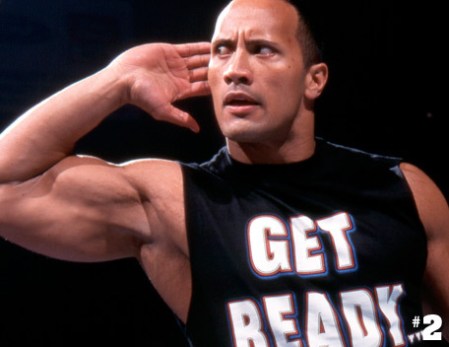
In today’s installment of our ongoing series Questions for Leo, we feature this 1997 photo of Leo Casey subtly indicating to the members of the New York City Council education committee that it’s time for them to pick up their cue cards and start asking the prearranged questions.

Since his appearance before the committee was more phony than a pro wrestling match, today’s question for Leo is: Do you smell what the Blob is cooking?

Below, the latest embarrassing expose on the UFT – yet another hilariously misspelled cue card.

barack-is-cooking

Edited to correct a misspelling – I put an “e” in “subtly.” Yes, I have submitted my job application to the UFT and expect to hear back shortly.


Questions for Leo: S’alright?

April 20, 2009

Our ongoing series “Questions for Leo” features this video of Leo and a NY City Council Member discussing whether “s’alright.”  Si.  S’alright.


Questions for Leo: Is It Easy Giving Green?

April 17, 2009

Henson and Kermit.jpg

(Guest Post by Greg Forster)

Today’s installment of the ongoing series Questions for Leo features this 1974 photo of Leo Casey on vacation in the Everglades with the then-chairman of the New York City Council education committee.

The Daily News coverage of union financial contributions to the puppets on the education committee reminds us how much green the unions have to give. So our question for Leo today is, “Is it easy giving green?”

I mailed him the question (on a cue card, of course) and he replied:

It’s not that easy giving green
Having to wish each day my conscience would leave
When I think it could be nicer
Being a thief, or a con artist, or a pro wrestler
Or something much more honest like that

It’s not easy giving green
It seems you blend in with so many other ordinary lobbyists
And people tend to pass you over
‘Cause you’re not standing out like GSEs that destroy the economy
Or stars in Hollywood

But green is the color of nastiness
And green makes politicians cool and friendly-like
And green can make you big, like a tyrant
Or important, like a monopolist
Or walk tall like you had dignity

When green rolls in from union fees
It could make you wonder why you hate children
But why wonder? Why wonder?
I have green, and it’ll do fine
It’s beautiful!
And I think it’s what you want from me

Photo courtesy The Jim Henson Company via the Baton Rouge Advocate.


Famous Steakholders, Volume 2

April 17, 2009

Could this be what Leo was talking about?

steakholder

(HT: Brian)

(Image source:  http://kaaser.at)


Famous Steakholders, Volume One

April 16, 2009

(Guest Post by Matthew Ladner)

Could this be what Leo was talking about?


Questions for Leo: Can you do that while drinking a glass of water?

April 16, 2009

Our ongoing series “Questions for Leo” features this undated photo of Leo Casey with a New York City Council member.  Our question for today is: Can you do that while drinking a glass of water? 

We chose that question over: How high up does the hand go?


Questions for Leo: Why are you so cool?

April 15, 2009

(Guest Post by Matthew Ladner)

Poor Leo, first he can’t get his leveraged buyout for public schools LLC off the ground due to the credit crunch. Then he bounced around in the rubber room.

Now he gets caught red-handed using NYC politicians as his Polly Prissypants.


The UFT’s “Cue Card Check”

April 15, 2009

guy-holding-cue-card

All images from GothamSchools, whose Elizabeth Green broke the story

(Guest post by Greg Forster)

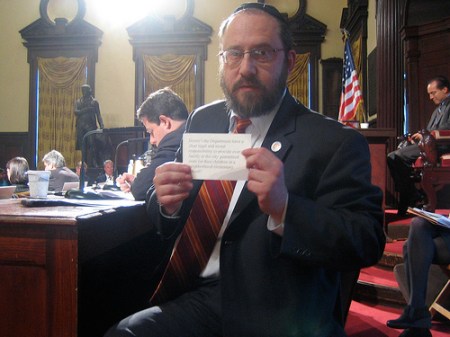
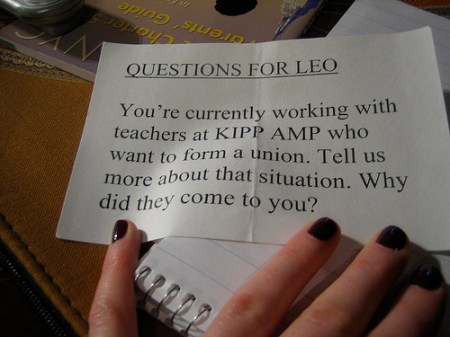
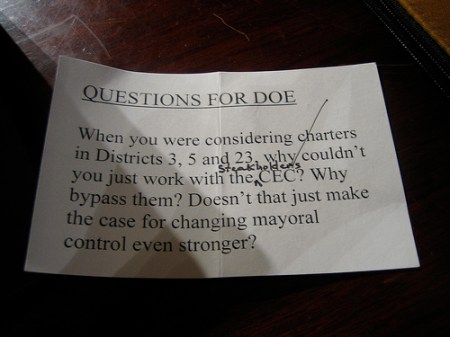
Last week, the UFT got caught handing out cue cards to New York City Council members before a public hearing of the council’s education committee. The council members dutifully asked the questions they had been given, which pointedly invited anti-charter diatribes from the teacher-union and DOE witnesses.

The members then unanimously voted to make Grigori Potemkin their new committee chairman.

Internet wags are calling the scandal “cue card check.” ALELR has consulted his deep moles within UFT and offered an intriguing report on the union’s strategy for the Council’s next hearing.

The cue cards have to be seen to be believed:

cue-card-2

cue-card

cue-card-leo

That’s “questions for Leo” as in our dear friend and Sith apprentice Leo Casey, who testified at the hearing. My pledge to you, the reader: from now on, every time Leo posts calumnies about Jay, I will post a link to this story.

cue-card-doe

And that’s “questions for DOE” as in officials from the Department of Education. The cue cards were handed out by the UFT, but is it plausible that the department officials had no idea they were being asked scripted questions?

HILARIOUS UPDATE! When I first posted this, I didn’t look closely at the handwritten edit made to this cue card. Check it out – note the spelling. And this is from an organization of teachers!

This story doesn’t seem to have broken out of the local circuit yet, but it’s getting a whole lot of attention in the city media. The Daily News is leading the way, documenting the extent of UFT political contributions to the council members who got cue cards and covering Randi Weingarten’s attempts to deflect blame by claiming that a charter school organizer once did the same thing. (Not true, says the organizer – and who has more credibility here?)

But ALELR notes that props are not being given to Elizabeth Green of the blog GothamSchools, who broke the story and snapped all the pictures you see above (and more, which you can enjoy in all their glory by following the link).

Green wryly notes that the cue cards with accusatory anti-charter questions were handed out by “a representative of the city teachers union, which describes itself as in favor of charter schools.”


AFT suggests LBO for Public Schools

December 11, 2008

end-wall-st-bull-collapsed-slide

(Guest Post by Matthew Ladner)

Leo over at EdWize (the AFT blog) has posed the question: “When you have spent that last decade telling everyone who would listen that public schools should be for sale, on what grounds do you complain about someone who would sell a Senate seat to the highest bidder?”

Leo has a different recollection of my past decade than I do, as I don’t remember ever telling anyone that public schools ought to be for sale, much less doing it constantly. Never mind that however, I think that Leo is on to something here. The prime targets for leveraged buyouts are companies whose stock valuation falls below the value of their assets. This of course only occurs through gross mismanagement, where companies become worth less than the stuff they have lying around. The management of such companies should be seen at best as incompetent, and at worst as rent-seeking leeches drawing paychecks while destroying value.

Many American school districts likely fall squarely into just such a state of mismanagement- taking $10,000 per year per student, but failing to teach 36% of 4th graders how to read, and failing to get half of African American and Hispanic student to graduate from high school. These are simply averages, and obviously many districts contribute far more than others.

Leo, you are a genius. We can put together a LLC to do the LBOs once the credit crunch ends. Who could be better at defeating the poison pill strategies of the leeches than a former AFT guy?

Leo, you do not yet realize your importance: with our combined power, we can destroy the leeches- they have foreseen this. Join me, and we can put an end to this destructive conflict, and bring learning, order and profit to the nation’s schools.

It is your destiny.


Voucher Effects on Participants

August 21, 2008

(This is an update of a post I originally wrote on August 21.  I’ve included the new DC voucher findings.)

Here is what I believe is a complete (no cherry-picking) list of analyses taking advantage of random-assignment experiments of the effect of vouchers on participants.  As I’ve previously written, 9 of the 10 analyses show significant, positive effects for at least some subgroups of students.

All of them have been published in peer reviewed journals or were subject to outside peer review by the federal government.

Four of the 10 studies are independent replications of earlier analyses.  Cowen replicates Greene, 2001.  Rouse replicates Greene, Peterson, and Du.  Barnard, et al replicate Peterson and Howell.  And Krueger and Zhu also replicate Peterson and Howell.  All of these independent replications (except for Krueger and Zhu) confirm the basic findings of the original analyses by also finding positive effects.

Anyone interested in a more complete discussion of these 10 analyses and why it is important to focus on the random-assignment studies, should read Patrick Wolf’s article in the BYU Law Review that has been reproduced here.

I’m eager to hear how Leo Casey and Eduwonkette, who’ve accused me of cherry-picking the evidence, respond.

  • These 6 studies conclude that all groups of student participants experienced reading or math achievement gains and/or increased likelihood of graduating from high school as a result of vouchers:

Cowen, Joshua M.  2008. “School Choice as a Latent Variable: Estimating the ‘Complier Average Causal Effect’ of Vouchers in Charlotte.” Policy Studies Journal 36 (2).

Greene, Jay P. 2001. “Vouchers in Charlotte,” Education Matters 1 (2):55-60.

Greene, Jay P., Paul E. Peterson, and Jiangtao Du. 1999. “Effectiveness of School Choice: The Milwaukee Experiment.” Education and Urban Society, 31, January, pp. 190-213.

Howell, William G., Patrick J. Wolf, David E. Campbell, and Paul E. Peterson. 2002. “School Vouchers and Academic Performance:  Results from Three Randomized Field Trials.” Journal of Policy Analysis and Management, 21, April, pp. 191-217. (Washington, DC: Gains for all participants, almost all were African Americans)

Rouse, Cecilia E. 1998. “Private School Vouchers and Student Achievement: An Evaluation of the Milwaukee Parental Choice Program,” The Quarterly Journal of Economics, 113(2): 553-602.

Wolf, Patrick, Babette Gutmann, Michael Puma, Brian Kisida, Lou Rizzo, Nada Eissa, and Marsha Silverberg. March 2009.  Evaluation of the DC Opportunity Scholarship Program: Impacts After Three Years. U.S. Department of Education, Institute of Education Sciences. Washington, DC: U.S. Government Printing Office. (In the fourth year report the sample size shrunk so that the positive achievement effect barely missed meeting a strict threshold for statistical significance — p < .06 just missing the bar of p < .05.  But this new report was able for the first time to measure the effect of vouchers on the likelihood that students would graduate high school.  As it turns out, vouchers significantly boosted high school graduation rates.  As Paul Peterson points out, this suggests that vouchers boosted both achievement and graduation rates in the 4th year.  Read the 4th year evaluation here.)

  • These 3 studies conclude that at least one important sub-group of student participants experienced achievement gains from the voucher and no subgroup of students was harmed:

Barnard, John, Constantine E. Frangakis, Jennifer L. Hill, and Donald B. Rubin. 2003. “Principal Stratification Approach to Broken Randomized Experiments: A Case Study of School Choice Vouchers in New York City,” Journal of the American Statistical Association 98 (462):299–323. (Gains for African Americans)

Howell, William G., Patrick J. Wolf, David E. Campbell, and Paul E. Peterson. 2002. “School Vouchers and Academic Performance:  Results from Three Randomized Field Trials.” Journal of Policy Analysis and Management, 21, April, pp. 191-217. (Dayton, Ohio: Gains for African Americans)

Peterson, Paul E., and William G. Howell. 2004. “Efficiency, Bias, and Classification Schemes: A Response to Alan B. Krueger and Pei Zhu.” American Behavioral Scientist, 47(5): 699-717.  (New York City: Gains for African Americans)

This 1 study concludes that no sub-group of student participants experienced achievement gains from the voucher:

Krueger, Alan B., and Pei Zhu. 2004. “Another Look at the New York City School Voucher Experiment,” The American Behavioral Scientist 47 (5):658–698.

(Update: For a review of systemic effect research — how expanded competition affects achievement in traditional public schools — see here.)