No Instant Replay

October 26, 2009

It’s a bad call.  No doubt about it.   Of course, I mean introducing instant replay into baseball as well as the call in the Angels-Yankees game. 

Yes, the ump should have called both Yankee players out rather than just one because neither had a foot on the bag when tagged.  But to introduce instant replay to fix this or other errors in baseball officiating would make things worse than the problem it is meant to correct.

Officials are human and will make mistakes.  In the absence of corruption or bias (and there is no reason to assume that the men in blue are generally corrupt or biased), errors will be distributed randomly.  In the long run, they should even themselves out and no team should have a particular advantage.

It’s true that a particular call made at a particular moment will seem to alter the outcome of a game, series, or championship.  But the truth is that every call in every game has some minute effect on the outcome of that game and potentially a series or championship.  If any call went a different way, players and coaches could make different decisions about pitches to throw, ways to swing, players to substitute, etc…  Life is a string of choices; changing any one — no matter how small — might change all subsequent ones — including big ones.  In general, the best we can hope for is that errors in officiating are rare and unbiased.

Introducing instant replay might correct some errors, but it certainly wouldn’t be practical to try to use it to review all potential errors in officiating.  And since any call — even the one not at what seems like the pivotal moment — can alter the outcome of the game, the outcome can still be altered by errors unless all calls are reviewed.  And even if they are reviewed, there can be errors in the review.  In short, there is no way to remove errors from officiating.

Even if we tried to reduce error by reviewing certain calls, we couldn’t always know which calls really would influence the outcome of the game.  What’s more, instant replay reviews significantly slow down a sporting event and interfere with the play and enjoyment of that sport. 

People need some perspective.  It’s a game.  It’s meant as entertainment.  We should no sooner have instant replay reviews of baseball calls than judges’ votes in So You Think You Can Dance.  Let’s just assume that officials are acting in good faith and errors are a matter of chance, just as chance can influence whether the ball hits a seam and bounces in a strange direction.

But I suspect that discomfort with chance in life is part of the demand for instant replay.  To many people randomness feels like injustice — especially when that randomness goes against their interests.  There are no accidents in this view of the world, someone is responsible for everything that happens, and all wrongs must be righted.  An unwillingness to accept the reality of chance can lead to a headlong pursuit of justice that causes much more injustice.


Getting Less for Less

October 20, 2009

Hawaii decided to fix their budget shortfall by eliminating 17 days from this school year in exchange for an 8 percent reduction in teacher salaries.  That means Hawaii public school kids will spend 163 days in school compared to about 180 for most kids nationwide.

Eighty-one percent of all teachers approved the deal, which leaves “teacher vacation, nine paid holidays and six teacher planning days … untouched.”  Teacher benefits, including pension and health benefits also remain unchanged. In addition, “[t]he new agreement also guarantees no layoffs for two years and postpones the implementation of random drug testing for teachers.”  

So, teachers work 9.4% fewer days for 8% less pay, full benefits and two more years of guaranteed employment.  It’s not a bad deal… as long as you are a teacher.  Kids will be shortchanged, parents have to scramble for daycare, and the state gives away more than it gets in savings.

The only risk for the teacher union in doing this is that we might discover that student achievement is unaffected by 17 fewer days of school.  If that’s the case why not cut 34 days of school for 16% less pay?  Or maybe get rid of it altogether.


Nominee for the Al Copeland Humanitarian of the Year Award — Fasi Zaka

October 14, 2009

After triumphing over Nazism and Communism in the 20th century, liberty faces a new threat in this century — radical Islam.  This threat is being counteracted (we hope) by diplomacy with potential allies, force against enemies, and high-minded speeches to remind all that the cause of liberty is right and the cause of tyranny is wrong.

In addition to all that, there is another essential element in the arsenal of liberty — ridicule.  Tyrants of all stripes, in addition to being monstrously cruel and evil, are also almost always laughably, pathetically, and outrageously ridiculous.

Charlie Chaplin realized this when he mocked Hitler in  The Great Dictator.  In Dr. Strangelove, Stanley Kubrick portrayed the communist leader as a weepy drunk and the war-mongering general as a paranoid suffering from ED.  South Park has portrayed Osama Bin Laden as the slapstick LooneyTunes villain, Wile E. Coyote.  The Daily Show and Colbert Report make their living off of puncturing the pomposity of politicians.  Humor may not be the best weapon against tyrants, crooks, fools, and all other kinds of politicians, but it is a very important one.

But Chaplin, Kubrick, Parker, Stone, Stewart, and Colbert have mocked tyrants from the safety of the free world.  Fasi Zaka does it from the front lines.  Zaka is a Pakistani radio DJ — a shock-jock — and host of a TV news parody show, News, Views, and Confused.  Given long stretches of military rule, government censorship, and death threats from extremists, Zaka can’t and doesn’t address oppression in Pakistan head-on.  Instead, he flirts with the issues, poking fun at the Taliban and corrupt and incompetent Pakistani leaders with social satire more than political criticism.

For example, Zaka mocks the Taliban for smelling bad rather than for beheading opponents and suicide bombings.  As an LA Times profile described his approach:

So when a guest host, a character named Mr. Enlightened Moderations, poked fun at fundos , slang for Islamic fundamentalists, it was not for any extreme religious views but for poor dress sense, aversion to after-shave and limited use of deodorant. “You sound like a  fundo,” he’d say accusingly to callers. “You doesn’t even wears a deo, smelly boy.”

By mocking tyrants and their followers Zaka makes them seem uncool.  Making them uncool may limit their power more than a speech on their logical errors.  Remember that young men were drawn to Nazism in part because they wore shiny boots and neat brown shorts.  It was a struggle whether people would perceive fascism as the trend of the future or a group of buffoons singing Springtime for Hitler.  Buffoons who smell bad don’t attract girls, so young men are much less interested in movements that are uncool.

Not everyone agrees with Zaka’s humorous approach:

Some critics say Zaka is squandering a golden opportunity to be constructive and foster moderation in a confused younger generation.  “It bothers me when people do silly entertainment shows when we really need people to make a difference,” says Mani, another radio host.

Radio hosts don’t have to be boring and didactic to get their message across, counters Zaka, pointing to frequent discussions on extremism, women’s equality and the violence sweeping Pakistan. “They presume preaching is the way for change,” he says. “It isn’t.”

Zaka can be serious.  He is, after all, a Rhodes Scholar who was educated at Oxford.  And he regularly writes op-eds with more standard political criticism.  But it is his humor and ridicule that are really advancing the cause of liberty.

I make no claim that  Fasi Zaka is as funny as Charlie Chaplin, Steven Colbert, and the others.  The parts not in English seem even less funny, but you can check out a clip of his TV show here:

And like Chaplin, not all of Fasi Zaka’s political views are necessarily desirable.  Again, Zaka is worthwhile because he mocks bad guys, not because he’s a sound political analyst.

While Zaka may not be the funniest of these satirists for freedom, he is clearly one of the most courageous.  Making crap of the Taliban and military dictators is a real contribution to improving the human condition and makes Fasi Zaka worthy of a nomination for the Al Copeland Humanitarian of the Year Award.

(edited for clarity)


One Stop Special Ed Voucher Info

October 13, 2009

I know, I know.  I’ve been writing a lot recently about special ed vouchers.  But if you’ve missed it or are just looking for a convenient one-stop place to get the latest info, arguments, and evidence on special ed vouchers, check out the piece Stuart Buck and I wrote for the current issue of Education Next.  It’s filled with links, so it should be a useful resource for anyone interested in special ed vouchers.


Happy T-1 Peoples Day

October 11, 2009

Controversies surrounding the celebration of Columbus Day raise a number of interesting questions.  Unfortunately, many of the new answers offered are at least as simplistic and historically false as the established answers they are meant to replace. 

It is true that Europeans confiscated land on which other people lived, sometimes intentionally killed those people through war or disease, and more often unintentionally killed those people with disease (this was, afterall, before the development of the germ theory of disease or any practical means to control its spread).

While there is no doubt that Europeans confiscated land in the Americas from other people, we almost always fail to ask how those people came to possess that land.  We regularly refer to the people from whom Europeans confiscated lands as Indigenous Peoples or First Nations, but those terms are clearly inaccurate. 

Indigenous means “having originated in and being produced, growing, living, or occurring naturally in a particular region or environment” and first is defined as “preceding all others in time, order, or importance.”  Neither term correctly describes the connection between the people whom the Europeans displaced and the land from which they were displaced.  Those peoples neither “originated” from nor preceded “all others in time” on that land.  Instead, those peoples confiscated that land from other groups of people who preceded them, often through war and disease.  And those displaced people confiscated the land from people before them, and so on.

It would be more accurate to describe the people from whom the Europeans confiscated land as the “T-1” Peoples because they were the people in possession of the land in the prior time period.  And those T-1 Peoples confiscated the land from T-2 Peoples, who in turn took it from T-3 Peoples, etc….

This all raises some very messy and complicated questions about how a People can have a legitimate claim to a land.  You can’t just declare that history starts whenever it suits you.  Being a T-1 People does not make them the “first” or “indigenous.”  There was a history before that with its own prior claims of ownership.

Just to illustrate this messiness — much of the land around the Dakotas was in the possession of a group of Sioux known as the Lakota when large number of European descendants arrived in the area.  The struggle between these European-Americans and Lakota culminated in the massacre of Lakota at Wounded Knee and their confinement to reservations.  This chain of events was filled with suffering and cruelty inflicted on the Lakota and has been cited by activists to justify claims of expanded control over land in that area by the Lakota descendants. 

But how did the Lakota come into possession of that land before large numbers of Europeans arrived?  The Lakota can be traced to the Great Lakes area (and almost certainly came from somewhere else before that).  They were pushed west by the Ojibwe as the Ojibwe were pressured by the westward expansion of the fur trade.  The Mandan and Hidatsa blocked the Lakota from crossing the Missouri river, but eventually their resistance was weakened by disease and the Lakota were able to conquer the grassland in the Dakotas.  In doing so they also pushed west the Shoshone, who were struggling for that same valuable grassland.

So, who has the rightful claim to that land?  Is it the Lakota, because they were in possession of it before large-scale arrival of Europeans?  What if descendants of the Shoshone, Mandan, or Hidatsa showed up, could they legitimately claim the land as their own?  What about the descendants of the various peoples who preceded all of these groups?

Only simple-minded college students and slogan-shouting activists could say that Europeans stole that land from the indigenous people, massacred its people, and ought to give it back.  The problem is that all land has been stolen countless times, with round after round of massacres, and an endless string of confusing claims to rightful ownership.  Being the T-1 People is hardly a sufficient justification for the legitimate possession of land. 

If college students want to think seriously about these issues, they should discuss multiple, practical criteria for legitimate ownership of land, which might make them appreciate some of the messy compromises that explain status quo arrangements.


More Humanitarian of the Year Awards

October 9, 2009

 
At first I thought it was a joke, but no… the Nobel Peace Prize was awarded to Barack Obama.  He can now join unrepentant terrorist, Yassir Arafat, and fictional autobiography writer, Rigoberta Menchu,  in having received that honor.
 
Regardless of what one thinks about President Obama’s strategy for producing greater world peace, I think all can agree that it is a strategy that has yet to produce meaningful results.  It seems quite strange that the Nobel Peace Prize has gone to someone who hopes to produce peace without having achieved much of anything in the way of actual peace. 
 
There’s been no change in the situation with regard to Israel and the Palestinians.  There’s been no (positive) change with respect to Iran’s nuclear ambitions (and there have been some considerable negative developments). The situations in Iraq and Afghanistan have deteriorated significantly over the last year.  Other than a bunch of speeches, what good has actually been accomplished?
 
I just have to repeat that Al Copeland, the founder of Popeye’s Chicken, is more worthy of this kind of prize.  At least he actually did something to improve the human condition — like give us spicy chicken.

The Obama Administration to Date

October 4, 2009

This just about sums it up — that is zero-sums it up.


Jay & Marcus in NR

October 2, 2009

NR cover (Jay & Marcus article)

(Guest post by Greg Forster)

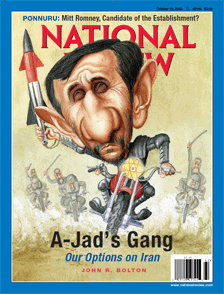
In the new National Review, Jay and Marcus review the research on special education funding incentives, including the findings of their recent study on the impact of vouchers in Florida.

Financial incentives are particularly important in low-level disability categories like SLD, where a diagnosis is easily fudged. While you need pretty solid evidence to diagnose a child with a traumatic brain injury or other severe disabilities, schools have plenty of leeway on SLD. Some research suggests that public schools use low achievement alone to serve as an indicator of SLD. Studies dating back to the 1980s found that SLD students are indistinguishable from low-achieving regular-enrollment students, with one study estimating that over half the students identified as SLD in Colorado did not fit either federal or state definitions for SLD.

Digital subscribers go here; paper-only subscribers go here; non-subscribers go here.


Just About Everything is Endogenous

September 30, 2009

A common technique in analyses of education policies (and popularized in the book, Freakonomics) has suffered a setback recently.  The technique attempts to correct for endogeneity, which occurs when your dependent variable is causing one of your independent variables rather than simply the other way around.

It’s probably best to explain this with an example.  Let’s say you want to know how the number of police officers in a city affects the crime rate.  In this example the dependent variable is the crime rate and the independent variable is the number of police officers.  That is, you are trying to explain how the size of the police force causes crime rates to be high or low.

The trouble is that the causal arrow also goes in the other direction.  The crime rate affects the size of the police force because cities with a lot of crime may decide to hire a lot of police officers.  So, the number of police officers is endogenous to the crime rate.  

That endogeneity could produce some odd results if we didn’t do anything to correct it.  We might find that the number of police officers causes crime rates to be higher when it might really be the case that the size of the police force reduces crime but high crime rates cause larger police forces.

This kind of problem comes up quite often in econometric analyses in general and in particular in evaluations of education policies.  So, it was a great a thing that University of Chicago economist James Heckman developed a technique for unravelling these circular relationships and correcting for endogeneity bias.  Basically, the technique uses some exogenous variable to predict the independent variable without bias.

Again, it’s probably easiest to explain with an example.  If we can find something that predicts the number of police officers that has nothing to do with the crime rate, then we can come up with an unbiased estimated of the number of police officers.  We can then use that unbiased estimate of how many police officers there would be (independent of the crime rate) to predict the crime rate.  In theory the technique works great.  Heckman won the Nobel Prize in economics for developing it.

The tricky part is coming up with a truly exogenous instrument (something that predicts the independent variable but has no relationship with the dependent variable).  The only obviously exogenous instrument is chance itself.  An example of that kind of instrument can be found in analyses of the effect of using a voucher on the student achievement of students who actually attend a private school when the vouchers are awarded by lottery.  Those analyses use whether a student won the lottery or not to predict whether a student attended a private school and then used that unbiased estimate of whether a student attended a private school to predict the effect of private schooling on student achievement. 

Whether a student won the lottery is purely a matter of chance and so is completely unrelated to student achievement, but it is predictive of whether a student attends a private school.  It is a perfectly exogenous instrument.

The problem is that other than lotteries, it isn’t always clear that the instruments used are truly exogenous.  Even if we can’t think of how things may be related, they may well be.

A perfect example of this — and it is one that raises questions about how exogenous all instruments other than lotteries truly are — was recently described in the Wall Street Journal having to do with date of birth.  The date during the year when babies are born has long been thought to be essentially random and has been used as an exogenous instrument in a variety of important analyses, including a seminal paper in 1991 by Josh Angrsit and Alan Krueger on the effects of educational attainment on later life outcomes. 

Since states have compulsory education laws require that students stay in school until a certain age, babies born earlier in the year reach that age at a lower grade and can drop out having attained less education.  By comparing those born earlier in the year to those born later, which they believed should have nothing to do with later life outcomes, they were able to make claims about how staying in school longer affected income, etc…

But new work by Kasey Buckles and Daniel Hungerman at the University of Notre Dame suggests that the month and day of birth is not really exogenous to life outcomes.  As it turns out, babies born in January are more likely to be born to unwed, less educated, and low income mothers than babies born later in the year.  The difference is not huge, but it is significant.  And since this variable is not exogenous, perhaps some or all of the effect of attainment Angrist and Krueger observed is related to this relationship between date of birth and SES, not truly attributable to attainment.

And if birth order is not random when we all assumed it was, what other instruments in these analyses are also not truly exogenous but we just don’t know how yet?  It’s a potentially serious problem for these analyses.


Pass the Clicker — Filled with Glee

September 25, 2009

With the possible exception of Flashforward, which I haven’t had a chance to see yet but looks promising, Glee is the best new TV show of the season.  It’s a dark high school comedy about the struggles and triumphs of the glee club coach and its members. 

The best part about it is its unhindered departure from realism.  No glee club really sounds that good.  All of the characters are outrageous stereotypes.  No high school is filled with as much viciousness.  I especially love the coach of the “Cheerios” cheerleading team enforcing the Darwinian social hierarchy and Principal Figgins with his hand always on the calculator looking to save money by feeding the students prison food.

But in fully departing from realism the show probably better captures the reality of high school life than any of the sappy, gritty, “realistic” high school dramas, like Boston Public, Dangerous Minds, or Dead Poets Society.  Those are adult fantasies of what they would like high school to be — filled with heroic teachers battling the odds to save eager students . 

That’s not high school.  High school is often banal, outrageous, awkward, and pathetic.  Surrealism captures the experience so much better than realism.  The only other depiction of high school that I can think of that similarly captures the high school experience is the movie, Election.

Given that much of the attraction of the show is its outrageousness and novelty, I expect that the quality of the show will rapidly fade.  By season 2 we will have exhausted the one-dimensional characters and become jaded to the show’s novelty.  But enjoy the ride for now.

And yes, a show about a glee club is pretty “gay.”  The show tackles this issue head-on by featuring the tension between youthful anxiety about masculinity and youthful desire to express one’s creative self.  Just watch how the football team uses a dance to Beyonce’s All the Single Ladies to win the game:

And if you need more dancing to that song (and who doesn’t?), check out this video of All the Single Babies:

(edited to correct typo)